Why Kraken Is Backing Wyoming ‘Trump Accounts’, A Crypto Policy Gamble?

bitcoinistPublished on 2026-02-18Last updated on 2026-02-18

Abstract

Crypto exchange Kraken has pledged to sponsor "Trump Accounts" for every child born in Wyoming in 2026. These are tax-advantaged savings accounts tied to a federal program that provides a one-time $1,000 contribution from the U.S. Treasury for newborns. Kraken will make an additional contribution, though the amount and form (cash or crypto) remain undisclosed. The move aligns Kraken with Wyoming’s crypto-friendly regulatory environment and signals support for federal policy. It is seen as a strategic effort to strengthen the exchange’s standing in the state and engage with mainstream financial and policy debates, despite potential political implications.

Crypto exchange Kraken has pledged to sponsor so-called “Trump Accounts” for every child born in Wyoming in 2026, tying its name to a federal savings program closely associated with U.S. President Donald Trump.

Related Reading: Kraken Backs Trump Accounts, Points To Shared Crypto Vision

The advancement positions the exchange at the center of a politically branded financial initiative while also reinforcing its long-standing alignment with Wyoming’s crypto-friendly regulatory framework.

The decision arrives at a moment when crypto firms are recalibrating their relationships with policymakers after years of regulatory pressure. For Kraken, which is headquartered in Wyoming, the move blends community investment with a clear policy signal to a state that has positioned itself as a testing ground for regulation.
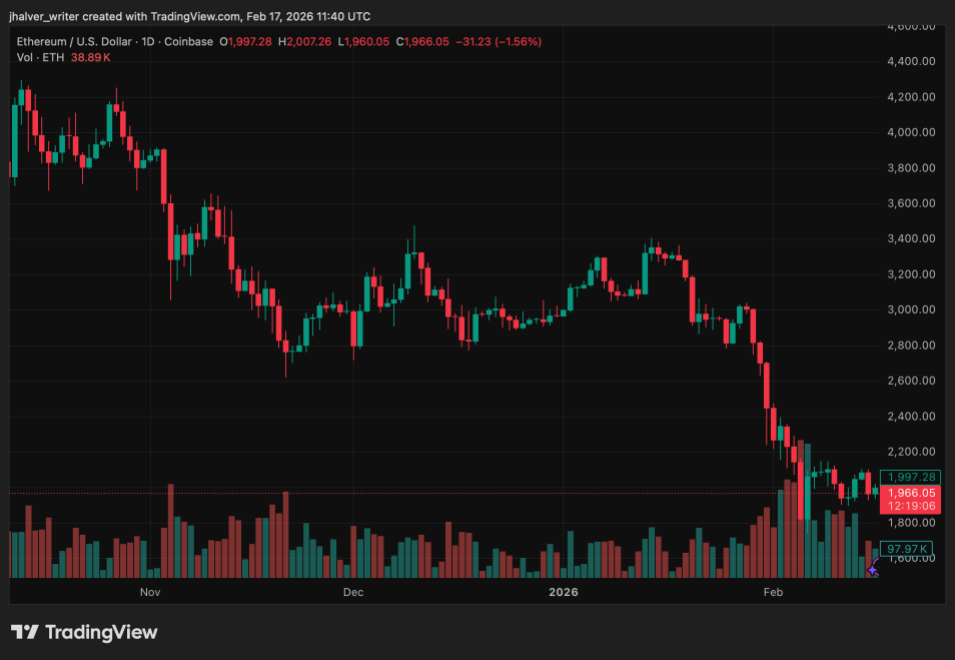
ETH's price trends to the downside on the daily chart. Source: ETHUSD on Tradingview

How The Trump Accounts Work

Trump Accounts are tax-advantaged savings accounts that parents or legal guardians can open for children under 18.

Under a federal pilot program, every U.S. citizen newborn born between Jan. 1, 2025, and Dec. 31, 2028, is eligible for a one-time $1,000 contribution from the U.S. Treasury. The funds are invested in approved market index funds and grow on a tax-deferred basis until the child reaches adulthood.

Kraken said it will make an additional contribution to each eligible account opened for Wyoming newborns in 2026, though it has not disclosed the amount or clarified whether its funding will be held in cash or digital assets.

The exchange framed the decision as support for families in the state where it operates and is regulated as a Special Purpose Depository Institution.

Wyoming’s Role in the Decision

Wyoming has spent years building a legal framework tailored to digital assets, offering custody rules and banking charters that few other states had adopted earlier. Senator Cynthia Lummis, a long-time supporter of crypto policy, welcomed Kraken’s pledge, saying it would give children in the state an early financial foundation.

Kraken executives have repeatedly pointed to Wyoming’s regulatory clarity as a reason for deeper, long-term investment. That clarity helped the exchange operate under state oversight even as federal regulators pursued enforcement actions against parts of the industry.

A Policy Bet With Broader Implications

By backing a program branded with a sitting president’s name, Kraken is taking on political risk alongside potential goodwill. Some analysts view the move less as philanthropy and more as a strategic effort to cement its standing in Wyoming and signal alignment with current federal policy direction.

The exchange now joins traditional financial institutions such as JPMorgan Chase that have voiced support for the initiative, underscoring how a once-niche crypto firm is increasingly operating within mainstream policy debates.

Related Reading: Zashi Becomes Zodl: Zcash Wallet Rebrands Following Internal Split

Whether this approach pays off may depend on how durable Wyoming’s crypto experiment, and the Trump Accounts program itself, proves to be.

Cover image from ChatGPT, ETHUSD chart from Tradingview

Related Questions

QWhat is Kraken's sponsorship commitment regarding 'Trump Accounts' in Wyoming?

AKraken has pledged to sponsor 'Trump Accounts' for every child born in Wyoming in 2026 by making an additional contribution to each eligible account, though the specific amount and form of funding (cash or digital assets) have not been disclosed.

QWhat are 'Trump Accounts' and how do they function?

A'Trump Accounts' are tax-advantaged savings accounts for children under 18. Under a federal pilot program, every U.S. citizen newborn born between 2025 and 2028 is eligible for a one-time $1,000 contribution from the U.S. Treasury, which is invested in approved market index funds and grows tax-deferred until adulthood.

QWhy did Kraken choose Wyoming for this initiative?

AKraken, which is headquartered in Wyoming, chose the state due to its crypto-friendly regulatory framework and long-standing alignment with the exchange. Wyoming's clear regulations, including its Special Purpose Depository Institution charter, have allowed Kraken to operate under state oversight despite federal regulatory pressures.

QWhat broader implications does Kraken's move have according to analysts?

AAnalysts view Kraken's backing of the politically branded program less as philanthropy and more as a strategic effort to cement its standing in Wyoming, signal alignment with current federal policy direction, and operate within mainstream policy debates alongside traditional financial institutions.

QWho is a key political figure in Wyoming that supported Kraken's pledge and why?

ASenator Cynthia Lummis, a long-time supporter of crypto policy, welcomed Kraken's pledge, stating it would give children in Wyoming an early financial foundation.

Related Reads

From Return to Resignation: Chen Hang's 437 Days at DingTalk

The 437-Day Return and Departure of Chen Hang at DingTalk This article chronicles the 437-day period from March 31, 2025, to June 11, 2026, when Chen Hang (also known as "No Move") returned as CEO of DingTalk, the enterprise communication platform he originally founded, only to later step down. Chen Hang, the creator of DingTalk in 2015, was brought back by Alibaba in 2025 after the company acquired his subsequent startup, HHO. His return was driven by Alibaba's renewed focus on AI and DingTalk's strategic role as its key to-B AI application. However, his aggressive management style, marked by strict work policies like mandatory clock-ins and extended hours, quickly caused internal friction and was criticized as being at odds with Alibaba's culture. Despite the internal turmoil, Chen Hang drove significant product launches. In August 2025, he unveiled "AI DingTalk 1.0," featuring new products like the AI-native entry point "DingTalk ONE." By March 2026, he announced "Wukong," touted as the world's first enterprise-grade AI-native work platform, representing a fundamental rebuild of DingTalk's architecture. The turning point came in early June 2026. A detailed internal post criticizing DingTalk's work culture went viral, followed by a public critique from a former executive. This prompted an unprecedented public rebuke from the Alibaba Partners Committee, which stated such management was not aligned with company values. One day later, on June 11, Alibaba announced Chen Hang's departure. He was succeeded by Chen Yusen, a 32-year-old technical expert known for founding cybersecurity firm Changting Technology. While Chen Hang's tenure laid the technical foundation for DingTalk's AI transformation with "Wukong," his leadership style ultimately led to his replacement as the company seeks a new direction under younger leadership.

marsbit10m ago

From Return to Resignation: Chen Hang's 437 Days at DingTalk

marsbit10m ago

The 2026 Landscape of Decentralized AI: Why Blockchain is the Inevitable 'Antidote' for AI?

Decentralized AI 2026 Landscape: Why Blockchain is AI's Essential "Antidote" Centralized AI faces structural bottlenecks—expensive compute, concentrated control, unverifiable outputs, and difficult data access—that cannot be solved by capital or code alone. Blockchain offers a path to make intelligence open, verifiable, and economically accessible. The decentralized AI stack comprises: * **Infrastructure:** The foundation with compute, verifiable inference, distributed training, data/storage, and privacy/verification layers. Projects like Akash, Render, and Filecoin provide cheaper, decentralized alternatives for raw resources. * **Middleware:** The coordination layer for agent discovery, identity, and commerce. Key players include Bittensor (a network of specialized AI subnets), Virtuals (an agent economy OS), and frameworks providing agent identity and tooling. * **Applications & Services:** Dominated by Agentic Finance (AI agents executing on-chain actions based on natural language) and Agentic Payments (machine-to-machine transactions using blockchain as a settlement layer). Projects like Giza, Infinit Labs, and x402 are enabling these use cases. Key trends for 2026-2027 show AI demand outgrowing infrastructure, compute becoming an asset class, and tokenomics emerging as a structural advantage for coordinating capital, compute, and data. While still early—with adoption uneven and revenue often trailing token incentives—projects like Bittensor, NEAR, and Venice demonstrate decentralized AI is evolving from a narrative into a new model for coordinating intelligence.

Foresight News30m ago

The 2026 Landscape of Decentralized AI: Why Blockchain is the Inevitable 'Antidote' for AI?

Foresight News30m ago

Trading

Spot
Futures
活动图片





