Why Did It Take Prediction Markets Nearly 40 Years to Explode?

marsbitPublished on 2025-12-31Last updated on 2025-12-31

Abstract

This article explores the explosive growth of prediction markets in 2025, which saw an estimated 400% increase in trading volume, reaching $40 billion, and a user base growing to 15 million. It examines why, despite existing since the 1980s (e.g., Iowa Electronic Markets), prediction markets only recently surged in popularity. Key factors for the 2025 boom include major regulatory progress. The CFTC approved platforms like Polymarket as designated contract markets, allowing them to operate legally in the US. This compliance enabled wider distribution, integration into major apps like Robinhood, and attracted institutional investment, with both Polymarket and Kalshi securing over $1 billion in new funding. Regulatory clarity also allowed for a diversification of event types, including sports and crypto, which now dominate trading volume. The article contrasts prediction markets with traditional gambling, noting the US government distinguishes them based on their "positive externalities." Unlike sportsbooks that set odds, prediction markets facilitate peer-to-peer betting, aggregating collective knowledge to improve information efficiency and decision-making, which regulators view as socially beneficial despite gambling-like elements. A provocative section discusses insider trading. Some argue that insiders using non-public information on anonymous, decentralized platforms like Polymarket can enhance market accuracy and serve as a form of information discovery. However, this...

As this year draws to a close, the rapid growth of prediction markets has attracted increasing attention from both crypto enthusiasts and those outside the circle. When discussing prediction markets with different friends, I often explain the difference between them and traditional gambling through 'differences in betting models' and 'the financialization of information.' As these conversations multiplied, I gradually realized that these two points are still not intuitive enough for friends who haven't been exposed to prediction markets. They even raised some very interesting and sharp questions, such as:

I can understand the difference between 'betting against the house' and 'P2P gambling among players,' but in essence, both models still involve real-money betting. Why does the U.S. government treat the two so differently?

If the lenient attitude towards prediction markets is because 'the financialization of information' has many benefits, then why hasn't this good thing become popular before? Why did it only explode in 2025?

There has been much discussion about the advantages and future prospects of prediction markets. Therefore, this article will explore prediction markets from more interesting angles.

Why Did Prediction Markets Only Explode in 2025?

Report data shows that the prediction market is expected to achieve an astonishing 400% growth rate in 2025, with total trading volume projected to grow from approximately $900 million in 2024 to $40 billion. The user base is also expected to increase 3-4 times, from about 4 million in 2024 to 15 million in 2025.

Retail players familiar with prediction markets should be well-acquainted with the hot topics over the past two years, such as the 2024 U.S. presidential election and the 2025 League of Legends World Championship. One might instinctively think that these hot topics drove the development of prediction markets.

But this is clearly not the only or core factor. Traditional gambling platforms also offer the same markets, and compared to the binary 'Yes/No' of prediction markets, traditional gambling markets have even more variety, such as 'point spreads.' Moreover, before the rise of Polymarket and Kalshi, there were precedents for prediction markets. The earliest available prediction market platform was the Iowa Electronic Markets (IEM), launched by the University of Iowa in 1988 for predicting the 1988 U.S. presidential election. Even prediction market platforms incorporating blockchain technology were not pioneered by Polymarket; Augur on Ethereum came in 2018.

Significant progress in regulation is an important factor, and the relaxation of regulations has contributed to the explosion of prediction markets on multiple levels.

First, the rollout of distribution channels. On November 25, the CFTC approved Polymarket's Amended Order of Designation, allowing it to re-enter the U.S. market as a Designated Contract Market (DCM). Kalshi also integrated directly into Robinhood and Coinbase this year. More importantly, after compliance, prediction markets have broader distribution channels in the U.S. than traditional gambling, covering all 50 states, while traditional gambling distribution channels only cover over 30 authorized states.

The more profound significance is that compliance clarifies the positioning of prediction markets as legitimate commodity derivatives rather than gambling, affirming the positive significance of prediction markets. This expands the distribution audience beyond traditional gambling enthusiasts to include investors and decision-makers. For ordinary people, seeing traditional media reports citing prediction market data or seeing internet search engines like Google directly indexing prediction market data creates a positive perception of 'legitimacy' that the cryptocurrency industry has sought for many years.

Second, policy friendliness has given institutional investors sufficient confidence, leading to rapid growth in the financing path for prediction markets. Both Polymarket and Kalshi completed a total of three new rounds of financing in 2025, with new financing amounts each exceeding $1 billion. This has given them better conditions to provide better products and liquidity.

Finally, the variety of event types in prediction markets has also been enriched. In 2024, Kalshi won a lawsuit against the CFTC, allowing it to list more types of event predictions, such as cryptocurrency-related events, and since January this year, it has expanded to sports events. The CFTC abandoned its appeal in May this year. Currently, sports event predictions account for about 90% of Kalshi's trading volume. A report by Eilers & Krejcik believes that, in the long run, sports event predictions will account for 44% of the total trading volume in prediction markets.

Of course, whether it's Kalshi, which has always strictly followed a compliant, off-chain path, or Polymarket, which took an offshore-then-compliant, on-chain path, the improvement of the prediction market products themselves, along with advancements in AI technology that have provided more complete related tools for the entire prediction market ecosystem, are all reasons why 2025 became the year of prediction markets. As mentioned earlier, the earliest on-chain prediction market, Augur, was previously criticized for its poor user experience and, after four years of silence, announced in March this year that it would be restarted by the Lituus Foundation. The popularity of anything requires waiting for the 'right time, place, and people.' The wheel of fortune turns, and prediction markets have finally borne fruit in 2025.

Why Does the U.S. Government Treat 'Gambling' Differently?

This is a very interesting question. Even I was initially confused—although prediction markets themselves do not act as the house, do not provide odds, and do not bet against users, we cannot say that peer-to-peer betting is not gambling. Otherwise, we could also say that playing poker is not gambling because the organizer does not play but only takes a rake, and the betting only occurs among the players.

At the same time, traditional gambling platforms, for their own benefit, have professional teams to analyze various event bets and try to provide reasonable odds. In the past, traditional media and institutional reports have cited odds from traditional gambling platforms for event reporting and analysis. Although prediction markets, compared to traditional gambling, can better reflect 'collective cognition' without the bias of a single team, and unlike traditional gambling platforms, they do not deliberately align odds with the public to increase overall betting volume and use the rake to offset losses caused by unreasonable odds settings, and indeed show higher real-time responsiveness and accuracy in some events, this does not seem to constitute an overwhelming advantage over traditional gambling platforms.

And whether for traditional gambling enthusiasts or ordinary retail investors in prediction markets, our grasp and analysis of events are, in most cases, certainly not as good as professionals, which means losses are common.

So, isn't the U.S. government worried about the harm caused by the gambling nature of prediction markets to the public? Of course it is, otherwise the compliance path for prediction markets would not have been so difficult for many years.

Internationally, some prediction markets operate directly under gambling licenses, such as the political prediction market on the UK's Betfair. Recently, U.S. District Court Judge Andrew Gordon in Nevada revoked an injunction protecting prediction market company Kalshi from state regulation and ruled that Kalshi's sports event predictions do not constitute transactions under the 'Commodity Exchange Act.' The judge believed that these prediction events are very similar to sports betting wagers and therefore fall under the regulatory purview of the Nevada Gaming Control Board and the Nevada Gaming Commission.

But the government's starting point is 'overall positive externality.' Just as the stock market allows the vast majority of retail investors to 'pay tuition' while greatly promoting overall social and economic operation, prediction markets, although essentially still gambling, also have key social benefits such as improving information efficiency and aiding decision-making. As long as the harms can be avoided as much as possible through sound regulation, we should not give up eating for fear of choking.

Of course, after reading this, you might still say that 'overall positive externality' is a pale rebuttal, and traditional gambling can still play a similar role. However, at least one point is undeniable: the mechanism of prediction markets themselves determines that the platform can only 'choose topics' and cannot 'rig the game.' Whether Polymarket or Kalshi, they can at most choose topics that people like to encourage betting and cannot manipulate odds.

Moreover, besides the U.S., governments in other countries and regions currently agree with your thinking. The U.S. is the only country in the world that distinguishes the positioning of prediction markets from traditional gambling and issues 'event contract' licenses for prediction markets. As the scale of prediction markets grows, controversies surrounding gambling will continue, and whether the U.S. government's attitude will change remains unknown.

Maybe, let the prediction markets predict it...?

A Paradise for Insider Traders?

This is a very interesting question. If asked whether insider trading in the stock market is good or bad, we would all say it's bad. But if the subject of this question is changed to prediction markets?

My colleague believes this is the value of prediction markets. The existence of insider information certainly creates unfairness in betting, but it also most accurately discloses information. Therefore, a true prediction market should be like Polymarket, built on-chain, anonymous without KYC.

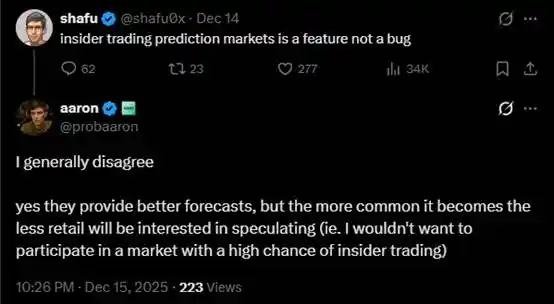
Such views are actually not uncommon. For example, this tweet by @shafu0x received considerable recognition:

Players who hold this view believe that as long as the information leaked through insider trading has 'overall positive externality,' it is justified. They also believe that prediction markets cannot do without these insiders because without them, the accuracy of event predictions in prediction markets would drop significantly, leaving only those without accurate information to bet against each other.

This view has some merit, but I think prediction market platforms themselves would resist such positioning because, in the long run, it would harm retail trust. The entire market would essentially change from a platform encouraging individual research and insight, aggregating collective wisdom, into a one-sided 'slaughter' by insiders, which is not conducive to the development of liquidity. If prediction markets were like this, it would be better to rename them 'information bounty platforms.'
Overall, I believe that platforms like Polymarket, built on-chain, with transparent movements and anonymity, fulfill our expectations of decentralization—anyone can freely send signals through prediction markets without worrying about anything, only needing to be responsible for their own bets. The harsh reality is that there are too many wealth transfers caused by information asymmetry in the world, and those that occur in prediction markets or stock markets might be the ones we feel most keenly.

As for whether prediction markets themselves should maintain a relatively fairer environment for retail investors and whether they need to sustain a more acceptable positioning for the public for sustainable development, that is a question they should consider.

Conclusion

There are actually many interesting questions, such as whether there will be a prediction market in the future that can challenge Kalshi and Polymarket? If prediction market compliance continues to advance worldwide, will each country and region have its own leader (because these markets can do better localization and provide prediction events more friendly to users in their respective countries and regions), etc.

Prediction markets are not exactly new, but the compliance of prediction markets is a very new, very avant-garde bold attempt. I believe that over time, the various questions mentioned in this article will have interesting answers that we cannot anticipate.


Trending Cryptos

Related Questions

QWhy did prediction markets take nearly 40 years to experience a major breakout in 2025?

APrediction markets saw explosive growth in 2025 due to key regulatory advancements, such as CFTC approvals allowing platforms like Polymarket and Kalshi to operate legally in the U.S., expanded distribution channels, increased institutional investment, richer event diversity including sports and crypto, and improved product experiences aided by AI tools.

QHow does the U.S. government distinguish prediction markets from traditional gambling?

AThe U.S. government treats prediction markets as legal commodity derivatives rather than gambling because of their 'positive externalities,' such as improving information efficiency and aiding decision-making. Unlike traditional gambling, prediction markets use peer-to-peer betting without a house setting odds, reducing manipulation risks, and they operate under specific regulatory frameworks like the Commodity Exchange Act.

QWhat role did regulatory changes play in the growth of prediction markets in 2025?

ARegulatory changes were crucial: the CFTC approved platforms like Polymarket as designated contract markets, allowing nationwide distribution in all 50 states. This legitimacy attracted institutional investors, facilitated major funding rounds, expanded event types like sports and crypto predictions, and enhanced public trust through media and tech integrations.

QAre prediction markets considered a haven for insider trading, and how is this viewed?

ASome argue that insider trading on prediction markets like Polymarket can be beneficial because it leads to more accurate information disclosure and positive externalities. However, platforms generally resist this perception, as it could undermine散户 trust and liquidity, turning the market into an 'information bounty' system rather than a fair collective intelligence platform.

QWhat are the main factors that contributed to the user and volume growth of prediction markets in 2025?

AKey factors include regulatory approvals expanding access, integration with major platforms like Robinhood and Coinbase, a wider range of预测事件 such as sports and elections, increased institutional funding improving liquidity and product quality, and AI-driven tools enhancing user experience and market efficiency.

Related Reads

Breaking: Google Earth Urgently Pulls Back Nano Banana 2 Image Generation Feature!

Google Earth's newly launched "Create image" feature, powered by the Nano Banana 2 AI image generation model, was abruptly withdrawn shortly after its release due to being "played" by users. The feature allowed users to generate and overlay AI-created visuals directly onto real-world satellite and 3D maps in Google Earth. The tool enabled creative applications like historical recreations (e.g., visualizing ancient Pompeii), generating informational graphics for landmarks, and envisioning architectural projects or futuristic cityscapes on real terrain. It operated under "geospatial grounding," meaning the AI respected the underlying geography, topography, and perspective of the chosen map view. The model also integrated with Gemini to retrieve relevant factual information. However, upon release, users quickly tested its limits. A prominent example involved reimagining Philadelphia's historic Independence Hall as a post-apocalyptic ruin overrun by "happy" zombies, evil clowns, and giant alien mechs. This highlighted both the feature's playful potential and its risks regarding the generation of inappropriate or misleading content on realistic maps, leading to its swift temporary removal. Google stated it would re-release the feature after implementing "enhanced guardrails." Analysts note this move strategically leverages Google's vast proprietary geospatial data, positioning its AI not just for artistic generation but for spatially accurate world visualization—a unique advantage in the competitive AI image generation landscape.

marsbit1h ago

Breaking: Google Earth Urgently Pulls Back Nano Banana 2 Image Generation Feature!

marsbit1h ago

Altman Admits: Overestimated AI Snatching Jobs! Huang Renxun: The Unemployment Narrative Is Completely Backwards

Sam Altman has revised his earlier predictions about AI rapidly replacing jobs, admitting he overestimated the speed at which AI would eliminate entry-level white-collar roles. Speaking on the "Invest Like the Best" podcast, he stated that people do not truly want an AI CEO, as accountability and human connection remain critical. He found that individuals prefer interacting with people who can be held responsible for decisions. Similarly, NVIDIA's Jensen Huang argued that the narrative of AI destroying jobs is misguided. He distinguishes between tasks and jobs, noting that while AI can automate specific tasks, entire jobs—encompassing communication, judgment, coordination, and accountability—are not eliminated. He cited examples like radiologists and software engineers, where demand for these roles has increased as AI handles repetitive tasks, allowing for business expansion and the creation of more positions. Data from a University of Maryland and LinkUp study supports this, showing that U.S. job postings for new graduates have actually risen, countering the fear of vanishing entry-level roles. However, a significant shift is occurring: the traditional entry-level tasks that help newcomers gain experience are being automated, making initial career access more challenging. The key insight is that as AI takes over standardized tasks, the enduring value of human work shifts toward areas of responsibility, trust-building, and final decision-making—aspects that AI cannot replicate. The real "moat" for professionals lies in these irreplaceable human elements.

marsbit1h ago

Altman Admits: Overestimated AI Snatching Jobs! Huang Renxun: The Unemployment Narrative Is Completely Backwards

marsbit1h ago

Weekly Editor's Picks (0725-0731)

Weekly Editor's Picks (0725-0731) provides a curated selection of deep analysis, filtering out market noise. Key themes from this week include: **Macro & Policy:** The Federal Reserve's upcoming meeting is marked by high uncertainty, balancing cooling inflation data against persistent price pressures. Meanwhile, the U.S. crypto regulatory Clarity Act faces critical political hurdles, with its 2026 passage probability seen as low. **Investing & Crypto:** Analysis suggests long-term crypto success depends on conviction through volatile cycles, focusing on assets like Bitcoin and core smart contract platforms. A trend noted is the increasing similarity between global equity markets (especially tech) and crypto, driven by narrative and leverage. Several major crypto protocols show strong revenue growth, but this isn't always translating to token price appreciation due to sell pressure and structural factors. **AI & Semiconductors:** Nvidia's rising credit default swap rates signal market concern over AI infrastructure financing risks. The storage sector experienced volatility as markets began pricing in potential 2027 oversupply. Despite a record profitable quarter, SK Hynix's results were deemed "below expectations," reflecting heightened investor demands for future growth visibility. **Markets & DeFi:** TradeXYZ demonstrated remarkable accuracy in pre-market pricing for a major A股 listing. The token ONDO saw gains, linked to its growing role in the on-chain tokenized stock ecosystem. **Ethereum:** Post-Pectra upgrade, a major structural shift is underway as Lido begins migrating millions of ETH to new validator architectures designed for capital efficiency. **Also Highlighted:** Butian's bullish stock market move; OpenAI's Altman promising major advances; Samsung and SK Hynix securing large AI chip deals; Apple reaching a $5T market cap; and ongoing discussions around exchange security following Poolin's bankruptcy case.

marsbit2h ago

Weekly Editor's Picks (0725-0731)

marsbit2h ago

Low Investment Isn't Apple's Immunity Pass

While Meta and Google face investor scrutiny over ballooning AI capital expenditures, Apple's minimal AI investment has paradoxically become a strength. Its market cap recently reclaimed the global top spot, surpassing $5 trillion. The irony is deep: Apple's own AI efforts have lagged, with "Apple Intelligence" delayed and core talent lost, forcing reliance on partners like Google Gemini and Alibaba's Qianwen. Its Q3 FY2026 (Q2 CY) earnings initially seemed stellar. Revenue hit $109.4B (up 16% YoY), with iPhone and Mac sales, growing 22% and 29% respectively, driving most of the growth. However, the stock fell over 8% post-earnings. The primary concern was a weaker Q4 revenue growth forecast of 9-11%, below expectations, due to looming supply chain constraints. Apple is feeling the indirect cost of the AI boom. Soaring memory and chip prices, fueled by massive data center investments from Microsoft, Amazon, and others, are forcing Apple to raise Mac and iPad prices significantly. The upcoming iPhone launch is also expected to see substantial price hikes. Despite avoiding heavy AI infrastructure spending—its capital expenditures are actually down 28%—Apple cannot escape the industry-wide supply and cost pressures. While Apple's operating cash flow remains robust, its substantial R&D spending (up 32% YoY) has yet to yield major AI breakthroughs. As Tim Cook prepares to step down as CEO, Apple faces a challenging transition: balancing its premium hardware success against the strategic and cost pressures of the AI era it has so far cautiously navigated.

marsbit3h ago

Low Investment Isn't Apple's Immunity Pass

marsbit3h ago

Trading

Spot

Hot Articles

How to Buy DATA

Welcome to HTX.com! We've made purchasing DATA Network (DATA) simple and convenient. Follow our step-by-step guide to embark on your crypto journey.Step 1: Create Your HTX AccountUse your email or phone number to sign up for a free account on HTX. Experience a hassle-free registration journey and unlock all features.Get My AccountStep 2: Go to Buy Crypto and Choose Your Payment MethodCredit/Debit Card: Use your Visa or Mastercard to buy DATA Network (DATA) instantly.Balance: Use funds from your HTX account balance to trade seamlessly.Third Parties: We've added popular payment methods such as Google Pay and Apple Pay to enhance convenience.P2P: Trade directly with other users on HTX.Over-the-Counter (OTC): We offer tailor-made services and competitive exchange rates for traders.Step 3: Store Your DATA Network (DATA)After purchasing your DATA Network (DATA), store it in your HTX account. Alternatively, you can send it elsewhere via blockchain transfer or use it to trade other cryptocurrencies.Step 4: Trade DATA Network (DATA)Easily trade DATA Network (DATA) on HTX's spot market. Simply access your account, select your trading pair, execute your trades, and monitor in real-time. We offer a user-friendly experience for both beginners and seasoned traders.

1.1k Total ViewsPublished 2026.07.01Updated 2026.07.01

How to Buy DATA

What is ANSEM

I. Project IntroductionThe Black Bull ($ANSEM) is a transparent, community-driven memecoin on Solana built around one creed: charge forward no matter what. The project is frontend-first and fully verifiable — its website reads live on-chain and market data directly from Solana, including price, liquidity, volume, market cap, and holder distribution, so anyone can audit the claims with no login and no user-data collection. Beyond the token, it offers an Ansem-call Radar, non-custodial community liquidity Pods on PumpSwap, and a browser-based meme terminal. $ANSEM is a standard Pump.fun SPL token (6 decimals) trading against SOL and USDC.II. Token InformationToken Symbol: ANSEM(The Black Bull)III. Related LinksWebsite:https://www.blackbullsol.com/X: https://x.com/blknoiz06Contract Address: https://solscan.io/token/9cRCn9rGT8V2imeM2BaKs13yhMEais3ruM3rPvTGpumpNote: The project introduction comes from the materials published or provided by the official project team, which is for reference only and does not constitute investment advice. HTX does not take responsibility for any resulting direct or indirect losses.

3.2k Total ViewsPublished 2026.07.01Updated 2026.07.01

What is ANSEM

How to Buy ANSEM

Welcome to HTX.com! We've made purchasing The Black Bull (ANSEM) simple and convenient. Follow our step-by-step guide to embark on your crypto journey.Step 1: Create Your HTX AccountUse your email or phone number to sign up for a free account on HTX. Experience a hassle-free registration journey and unlock all features.Get My AccountStep 2: Go to Buy Crypto and Choose Your Payment MethodCredit/Debit Card: Use your Visa or Mastercard to buy The Black Bull (ANSEM) instantly.Balance: Use funds from your HTX account balance to trade seamlessly.Third Parties: We've added popular payment methods such as Google Pay and Apple Pay to enhance convenience.P2P: Trade directly with other users on HTX.Over-the-Counter (OTC): We offer tailor-made services and competitive exchange rates for traders.Step 3: Store Your The Black Bull (ANSEM)After purchasing your The Black Bull (ANSEM), store it in your HTX account. Alternatively, you can send it elsewhere via blockchain transfer or use it to trade other cryptocurrencies.Step 4: Trade The Black Bull (ANSEM)Easily trade The Black Bull (ANSEM) on HTX's spot market. Simply access your account, select your trading pair, execute your trades, and monitor in real-time. We offer a user-friendly experience for both beginners and seasoned traders.

1.3k Total ViewsPublished 2026.07.01Updated 2026.07.01

How to Buy ANSEM

Discussions

Welcome to the HTX Community. Here, you can stay informed about the latest platform developments and gain access to professional market insights. Users' opinions on the price of A (A) are presented below.

活动图片













