When Wall Street's ETH Starts to 'Earn': From BlackRock's ETHB to Ethereum's Asset Attribute Shift

marsbitPublished on 2026-03-22Last updated on 2026-03-22

Abstract

Wall Street Embraces Staking: BlackRock's ETHB and Ethereum's Shift to a Yield-Generating Asset On March 12, 2026, BlackRock launched the iShares Staked Ethereum Trust (ETHB) on Nasdaq, a groundbreaking Ethereum ETF that not only holds spot ETH but also stakes a significant portion (70-95%) of its assets to generate and distribute yield to investors. This move effectively answers a long-debated question: whether ETH can be accepted by mainstream finance as a yield-bearing asset. ETHB operates by delegating staking to professional validators like Figment via Coinbase Prime. It distributes approximately 82% of the staking rewards (estimated at 2.3%-2.5% APY after fees) to shareholders monthly, while retaining 18% as service fees and charging a 0.25% annual management fee. This provides a predictable, automated cash flow, though it lacks the compounding effect of native on-chain staking unless investors manually reinvest distributions. This development is significant as it marks the formal entry of staking—a core crypto-native activity—into Wall Street's asset framework. Under new SEC leadership, regulatory barriers have eased, allowing BlackRock to legitimize staking rewards as a viable investment return. This paves the way for other PoS-based ETFs (e.g., Solana, Cardano) and may shift substantial capital from traditional spot ETFs to yield-generating products. While on-chain staking options remain popular (e.g., native staking, liquid staking via Lido/Rocket Pool, or wal...

Author:imToken

March 12, 2026, marked a historic moment for Ethereum staking.

BlackRock, the world's largest asset management company, officially launched the staking-yield Ethereum ETF 'iShares Staked Ethereum Trust' (ticker: ETHB) on Nasdaq—it not only holds Ethereum spot assets but also stakes a large portion of them on-chain and periodically distributes the收益 to investors.

It can be said that, after more than a year of market discussion, the launch of ETHB has substantially resolved the core issue that has remained pending since the introduction of Ethereum spot ETFs: can ETH be formally accepted by the mainstream financial system as a 'yield-bearing asset'?

This also marks the formal entry of 'Staking,' a behavior once exclusive to on-chain native users, into Wall Street's asset allocation framework.
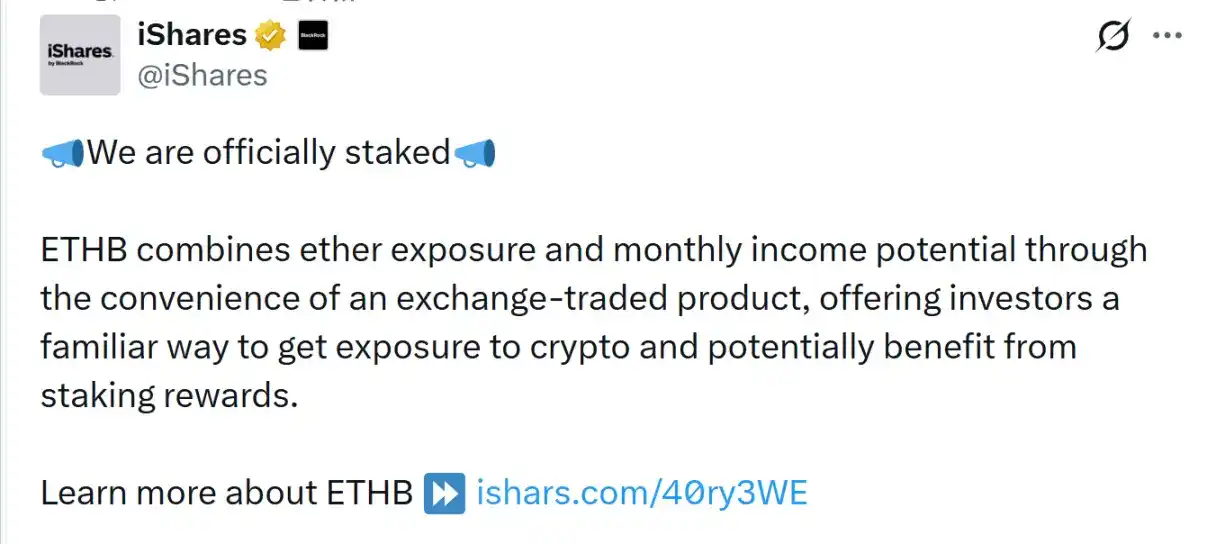
I. What is ETHB and How Does It Work?

From the timing and market environment perspective, the launch of BlackRock's ETHB is可谓 opportune.

On one hand, BlackRock's iShares Bitcoin Trust (IBIT) now manages over $55 billion in assets, and the iShares Ethereum Trust (ETHA) manages around $6.5 billion, proving institutional acceptance of crypto asset ETFs. On the other hand, discussions and policy preparations around allowing ETFs to participate in staking, from the U.S. to Hong Kong, have been ongoing for over a year.

The biggest difference between ETHB and previous Ethereum spot ETFs like ETHA is that it doesn't let ETH sit idle.

要知道传统加密 ETF 的运作模式非常简单,通常是buy ETH, custody it, track price movements, and then do nothing. ETHB introduces a key change: it allows the held ETH assets to participate in network consensus and generate yield:

It stakes 70% to 95% of its ETH holdings through Coinbase Prime,委托给 professional validators like Figment, allowing the assets to actively participate in maintaining Ethereum network consensus and earn staking rewards.
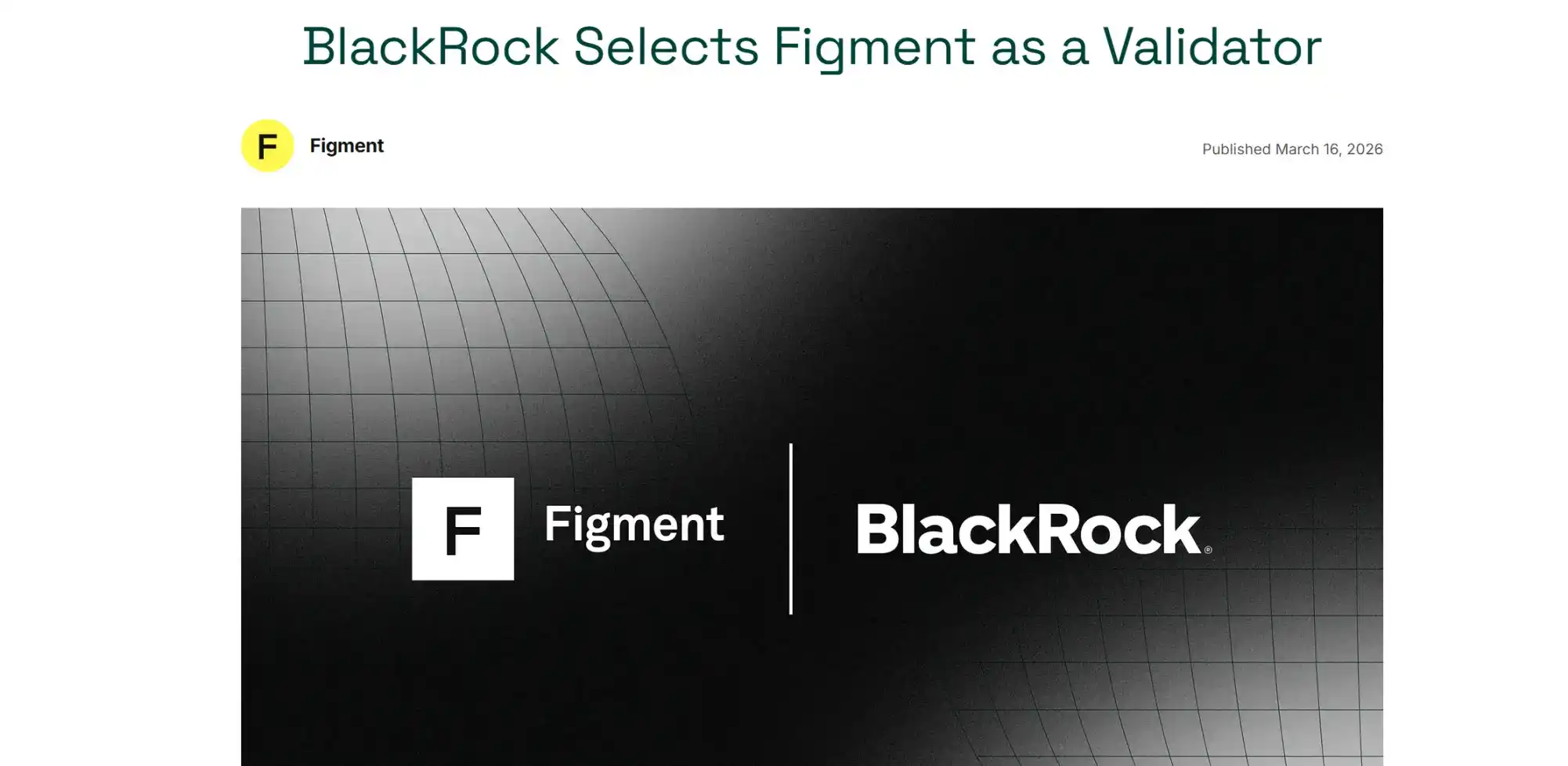
Breaking down this mechanism:

  • Investors buy ETHB fund shares;
  • The fund uses raised capital to buy spot ETH;
  • Most ETH is staked;
  • Approximately 82% of the staking rewards are distributed monthly to fund shareholders, the remaining 18% is retained by BlackRock and others as service fees;
  • The fund also charges a 0.25% annual management fee (a preferential rate of 0.12% for the first $2.5 billion in assets under management in the first year);

This also highlights the core value of compound staking. Taking stETH as an example, after users stake ETH, the stETH token balance automatically increases with staking rewards,无需 any manual operation. Each reward becomes part of the principal, generating new收益.

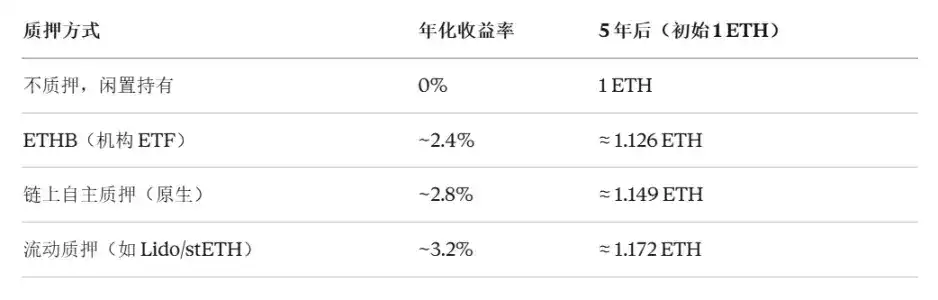
For ETHB, we can do a similar calculation—Ethereum's current on-chain annual staking yield is approximately between 2.8% and 3.1%. Since ETHB distributes about 3.1% × 82% to investors, the actual yield after deducting management fees is around 2.3%~2.5%.

Although the数字看起来不算高, the key is that it is a continuous, automatic, and predictable cash flow, meaning普通 investors who buy ETHB will now also be able to enjoy compound interest.

Of course, although ETHB distributes rewards monthly, if investors do not actively reinvest the distributed收益 to purchase additional ETF shares, they cannot enjoy the effect of compound叠加, which may, to some extent, give on-chain native staking a slight advantage in long-term收益.
II. Why is the Emergence of ETHB So Important?

The significance of ETHB far exceeds the birth of a new fund.

As is well known, during the tenure of former U.S. Securities and Exchange Commission (SEC) Chairman Gary Gensler, all Ethereum ETF applications were required to remove the staking function,理由是 staking might constitute an unregistered security. With Gensler's departure, the regulatory stance明显转向 under new Chairman Paul Atkins, ultimately paving the way for ETHB's birth.

And BlackRock currently manages over $130 billion in crypto-related ETP assets. Its iShares series captured approximately 95% of the global digital asset ETP net inflows in 2025. When an institution of this massive size writes 'Staking' into its product architecture, the signal it sends to the entire market is that staking yield is now a legitimate, sustainable source of investment return.

Therefore, it is highly likely that, similar to the queue of Ethereum, Solana, and others following Bitcoin ETF approvals, after this ETHB issuance, staking ETF applications for PoS networks like Solana, Cardano, Polkadot will also enter the review queue successively. All crypto asset ETF issuers will quickly follow suit.

We can even foresee that within the next six months, a significant amount of spot ETF funds will flow back into yield-generating ETFs.

In fact, as early as January this year, some Ethereum ETFs began testing this field, allowing holders to receive interest定期 like holding securities—Grayscale's Grayscale Ethereum Staking ETF (ETHE) has already distributed staking收益 to existing shareholders, marking the first time a U.S. spot crypto asset exchange-traded product distributed staking收益 to holders.

While this might seem routine chain operation to Web3 Native players, in the history of crypto finance, it marks the first time Ethereum's native yield has been packaged into the standard shell of traditional finance, undoubtedly a milestone.

It must be emphasized that this does not mean Ethereum staking has achieved full compliance, nor does it represent a unified regulatory stance on ETF staking services. But economically, a key change has occurred: non-crypto-native users, for the first time, indirectly obtained the native yield generated by the Ethereum network consensus without needing to understand nodes, private keys, or on-chain operations.

From this perspective, Ethereum Staking has taken a crucial step into the broader capital视野.

III. What's Next?

Of course, not everyone will obtain staking收益 by buying ETHB. For most crypto users, a more direct way is to participate on-chain.

We still need to review the main Ethereum staking methods, which primarily consist of three paths.

First is definitely native staking, but it requires users to stake at least 32 ETH and run an independent validator node. Therefore, while it offers the highest yield and is the most decentralized, the门槛 is higher, making it more suitable for deep users with strong technical capabilities.

Second is the currently mainstream liquid staking, with a total volume of nearly 15 million ETH, worth over $35 billion. Users can participate through protocols like Lido (stETH), Rocket Pool (rETH), etc., without needing 32 ETH.

And after staking, users receive liquidity tokens pegged 1:1 to the original asset, which can continue to participate in DeFi activities, offering the most significant compound effect.
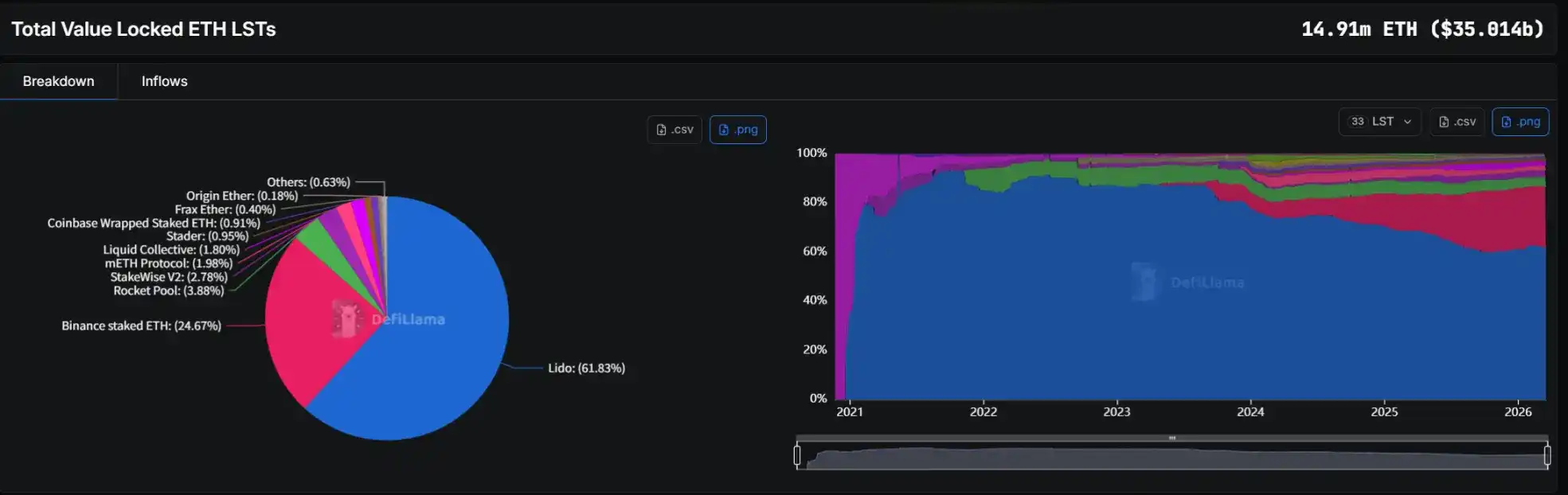
Source: DeFiLlama

Then there is node staking, primarily through wallets that support staking functionality for direct participation. It's操作简单, suitable for non-technical users, which also places higher demands on supporting infrastructure like wallets.

Overall, the launch of BlackRock's ETHB is a significant milestone in Ethereum staking's journey from an 'on-chain native behavior' to a 'mainstream financial product.' It validates the legitimacy of staking yield and accelerates the process of institutional capital flowing into the ETH ecosystem.

But for ordinary token holders, the more important signal is: staking, as a way to keep assets continuously working, has been recognized by the world's largest asset management institution.

When ETH starts to earn yield automatically, the pricing logic of the asset also changes. It is no longer just a speculative asset waiting for appreciation, but a 'yield machine' that can continuously generate cash flow. Whether through ETFs or on-chain staking, this trend is already irreversible.

And you, are you ready to put your ETH to work?

Related Questions

QWhat is the significance of BlackRock's ETHB ETF in the context of Ethereum's asset properties?

ABlackRock's ETHB ETF marks a historic moment by introducing staking rewards to mainstream finance, effectively transforming Ethereum from a speculative asset into a yield-generating one. It legitimizes staking as a sustainable investment return and signals broader institutional acceptance of Ethereum's native yield mechanism within traditional financial frameworks.

QHow does the ETHB ETF differ from traditional cryptocurrency ETFs in terms of asset utilization?

ATraditional crypto ETFs typically hold assets idle, tracking price movements without active utilization. In contrast, ETHB actively deploys 70% to 95% of its ETH holdings into staking via professional validators like Figment, generating rewards distributed to investors, thus introducing a yield component absent in conventional ETFs.

QWhat are the key operational steps and fee structures of BlackRock's ETHB ETF?

AETHB operates by: 1) Investors purchasing fund shares; 2) Fund using capital to buy ETH; 3) Staking most ETH through Coinbase Prime and validators; 4) Distributing ~82% of staking rewards monthly to investors, retaining 18% as fees; 5) Charging a 0.25% annual management fee (0.12% for the first $25B in assets).

QWhy is the regulatory approval of staking in ETFs like ETHB considered a milestone?

AIt overcomes previous SEC restrictions under Gary Gensler, where staking was viewed as unregistered securities. New leadership under Paul Atkins enabled this shift, allowing non-crypto-native investors to access Ethereum's native yields without technical knowledge, bridging decentralized finance with traditional investment products.

QHow might ETHB impact the broader landscape of cryptocurrency ETFs and investor behavior?

AETHB sets a precedent for other PoS-based ETFs (e.g., Solana, Cardano) to incorporate staking, potentially shifting capital from non-yielding现货 ETFs to yield-generating ones. It encourages investors to view crypto assets as productive capital, accelerating institutional inflows and normalizing staking收益 in portfolios.

Related Reads

US Stocks Suffer Worst Plunge Since 2025: Three Triggers Ignite Tech Stock Valuation Reset

The US stock market experienced its most severe sell-off since the 2025 tariff crisis on June 5th, 2025. The Nasdaq Composite plummeted 4.18%, the S&P 500 fell 2.64%, and the Dow Jones dropped 695 points. The panic stemmed from three converging factors. First, Broadcom's earnings report ignited fears of a slowdown in AI growth. While its AI chip revenue surged 143% YoY to $10.8B, its Q3 AI revenue guidance of $16B fell short of the $17.2B consensus. This triggered a massive sector-wide sell-off, with the Philadelphia Semiconductor Index crashing 10.26% and semiconductor stocks losing roughly $1.3 trillion in market value in a single day. Second, a shockingly strong May jobs report crushed hopes for Federal Reserve rate cuts. Non-farm payrolls added 172,000 jobs, doubling expectations. This robust data, combined with persistently high oil prices above $92/barrel due to the ongoing Iran war and blockade of the Strait of Hormuz, drastically increased market expectations for a potential Fed rate hike instead of a cut. Higher interest rates compress the valuations of growth-heavy tech stocks. Third, the prolonged Iran conflict continues to fuel inflationary pressures, complicating the Fed's policy decisions and undermining the "inflation is tamed" narrative. Together, these events challenged the twin pillars of the market rally: the "limitless AI growth" story and expectations for imminent monetary easing. The sell-off spread globally, impacting Asian and European markets and cryptocurrencies. The article posits this is likely a severe "valuation repricing" rather than the end of the AI story. The underlying demand for AI remains strong, but investor expectations for growth speed and the prices they are willing to pay are being recalibrated. Key upcoming factors include the June FOMC meeting, future AI company earnings, and developments in the Iran conflict.

marsbit16m ago

US Stocks Suffer Worst Plunge Since 2025: Three Triggers Ignite Tech Stock Valuation Reset

marsbit16m ago

From Madison Square Garden to Kalshi: Prediction Markets Break into the NBA Finals

From Madison Square Garden to Kalshi: Prediction Markets Break into the NBA Finals Prediction markets are playing a significant role in the 2026 NBA Finals, particularly around the New York Knicks' unexpected 2-0 series lead. Platforms like Kalshi and Polymarket have seen massive trading volumes, exceeding hundreds of millions of dollars on championship and related markets. Their influence extends beyond online trading. Kalshi's official partnership with Madison Square Garden has given it prominent physical branding at the arena. Furthermore, local businesses like The Jeffrey bar are using prediction market contracts to hedge the risk of game-result-based promotions, turning potential losses into manageable costs—a concept similar to the famous "Mattress Mack" strategy from traditional sports betting. These markets differentiate themselves by offering a wider, more entertainment-focused range of "event contracts" beyond typical game outcomes, such as predicting celebrity attendance. They also have broader accessibility across the U.S. compared to age- and location-restricted traditional sportsbooks. However, their rapid integration into sports raises regulatory and ethical questions. The NBA is cautiously engaging, discussing integrity frameworks with regulators like the CFTC. While the league permits minor investments like Giannis Antetokounmpo's stake in Kalshi, it advocates for strict rules to prevent insider trading. Many fans express concern on platforms like Reddit, fearing that the close ties between prediction markets, the league, and players could compromise the game's integrity. The NBA Finals has thus become a high-stakes testing ground, showcasing prediction markets' commercial potential while challenging traditional boundaries between financial trading, entertainment, and gambling.

marsbit2h ago

From Madison Square Garden to Kalshi: Prediction Markets Break into the NBA Finals

marsbit2h ago

Recursive Self-Improvement AI Gains Traction, Google Pours Cold Water, While DeepSeek and Others Approach the Fringes

The term "recursive self-improvement" (RSI), where AI improves itself autonomously, is gaining momentum in the AI industry. Startups like Recursive Superintelligence and projects such as Andrej Karpathy's Auto-Research aim to create systems where AI designs, implements, and validates its own research, moving toward superintelligence. While Google CEO Sundar Pichai cautions that such exponential acceleration is not yet a reality, progress is evident. For instance, Anthropic reported its Claude Code writes nearly 100% of the team's code, though it still lacks true self-direction. Analysts frame RSI development in stages: "adequacy" (systems functioning without humans), "parity" (matching human research quality), and "supremacy" (exceeding human-AI collaboration). Reaching parity could trigger rapid, unpredictable advancement due to AI's continuous operation. In China, companies like DeepSeek and Baidu incorporate self-optimization techniques without explicitly branding them as RSI, focusing on algorithmic efficiency and reinforcement learning. However, challenges remain, including "model collapse" from training on AI-generated data and the immense computational and open-collaboration requirements. Ultimately, RSI represents a trend of increasing automation in AI development, potentially reducing human oversight in the creation process itself.

marsbit2h ago

Recursive Self-Improvement AI Gains Traction, Google Pours Cold Water, While DeepSeek and Others Approach the Fringes

marsbit2h ago

Trading

Spot
Futures

Hot Articles

Discussions

Welcome to the HTX Community. Here, you can stay informed about the latest platform developments and gain access to professional market insights. Users' opinions on the price of S (S) are presented below.

活动图片