Warsh's Debut Takes Shape: The Dot Plot Remains, but the Fed May Have Changed

Odaily星球日报Published on 2026-06-18Last updated on 2026-06-18

Abstract

The Federal Reserve held interest rates steady as expected in its June meeting, the first under new Chair Warsh. While the key dot plot of rate projections remained, Warsh notably did not submit his own forecast, signaling a deliberate move to weaken its forward guidance role. He emphasized a data-dependent approach, refusing to provide clear future policy signals and advocating for more restrained communication. The market interpreted this shift as heightening inflation constraints and the possibility of more aggressive tightening. Consequently, market pricing quickly adjusted: rate hike expectations for later in the year increased, U.S. stocks sold off, and the dollar strengthened. Warsh's debut suggests a fundamental change in Fed communication—moving away from "explaining the future" to merely "describing current assessments"—which could force markets to fundamentally reprice assets in a less predictable policy environment.

Original | Odaily Planet Daily (@OdailyChina)

Author | Azuma (@azuma_eth)
In the early morning of June 18th Beijing time, the Federal Reserve officially announced the latest interest rate decision. Without any suspense, the federal funds rate remained unchanged within the predetermined range, in line with market expectations.

In the market pricing over the past few weeks, the interest rate path was almost uncontested, and the market had already fully priced it in. Therefore, the real focus of this rate decision was not "whether to cut rates," but on how the new Fed Chair Warsh would initiate his first policy communication — this is Warsh's first FOMC meeting as Chair, and the market's first opportunity to observe how he will shape the monetary policy communication framework for the coming years.

The Dot Plot Remains, but Warsh Himself Is Absent

The change that sparked the most market discussion from this meeting came from the structure of the economic projections and the Dot Plot itself.

  • Odaily Note: The so-called "Dot Plot" is a quarterly interest rate projection tool published by the Fed, where each dot represents an FOMC member's forecast for future interest rate levels. Although these projections are not formal policy commitments, because they reflect the policymakers' overall assessment of economic and inflation prospects, the Dot Plot has long been considered by the market as an important reference for interpreting the Fed's policy direction.

In the latest FOMC economic projections, only 18 of the 19 Fed officials submitted Dot Plot forecasts. Among them, 1 person believes interest rates should be raised by a cumulative 75 basis points in the remainder of 2026, 5 believe in a cumulative 50 basis point hike, 3 believe in a cumulative 25 basis point hike, 8 believe rates should remain unchanged, 1 believes in a cumulative 25 basis point cut, and 1 was absent.
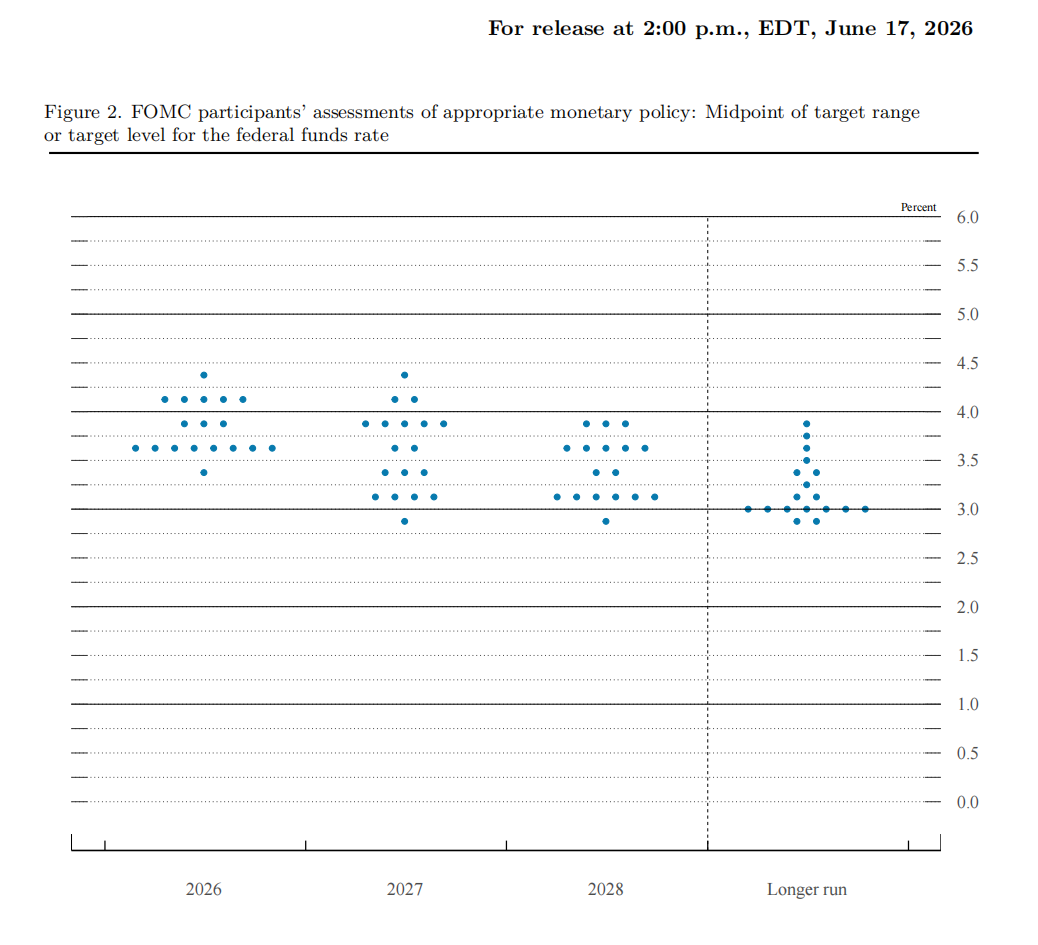
Warsh later admitted during the press conference that he was the one who did not submit an interest rate forecast. Warsh's explanation was: "I did not present any projections of my own, consistent with my longstanding views, at least about its current structure."

Compared to his predecessor Powell's highly transparent and frequent communication style, Warsh has long been a representative figure of the "say less" school. He has repeatedly expressed doubts about "the effectiveness of the Dot Plot," "excessive forward guidance," and "frequent policy signaling." In Warsh's view, the Fed does not need to tell the market exactly how it will proceed at every step in the future but should make decisions based on real-time economic data.

Although the market once speculated that Warsh might promote reforms to the Dot Plot mechanism or even abolish it outright, it was not directly canceled in this meeting. However, Warsh's own absence still sent a clear signal — the Fed is weakening the guidance significance of the Dot Plot.

A Subtle Shift in the Fed's Communication Framework

Warsh also stated during the press conference that he would promote a series of reform measures at the Fed in the future, including establishing multiple specialized working groups to explore more open data collection methods and study improvements to the Fed's existing statistical indicator system.

In the subsequent Q&A session with reporters, when repeatedly questioned about whether the next step is a rate hike and whether the current interest rate is restrictive, Warsh repeatedly declined to provide clear guidance.

Over the past decade, one of the Fed's core capabilities has been to consistently reduce market uncertainty through the Dot Plot, SEP (Summary of Economic Projections), and press conferences. The fundamental reason why the market closely watches the Fed's various activities is that it provides a "predictable path."

But Warsh's statements are changing this logic. Clearly, Warsh emphasizes data dependence, decision-making at each meeting, and consistently maintaining more restrained expressions about the future path.

If this tendency continues, the market will face a structural change — the Fed will no longer try to "explain the future," but only describe "current judgments." This will directly weaken the certainty function of forward guidance.

Rate Hike Expectations Heat Up, Market Risk Appetite Drops

After the interest rate decision was announced, market repricing of the policy path quickly unfolded.

Following Warsh's remarks emphasizing that "the central bank will not tolerate high inflation," the market began reassessing the upper bound of the Fed's policy reaction function—that is, whether there exists a possibility of more aggressive tightening than previously expected in a scenario where inflation has not declined significantly.

This change was first reflected in short-term assets.

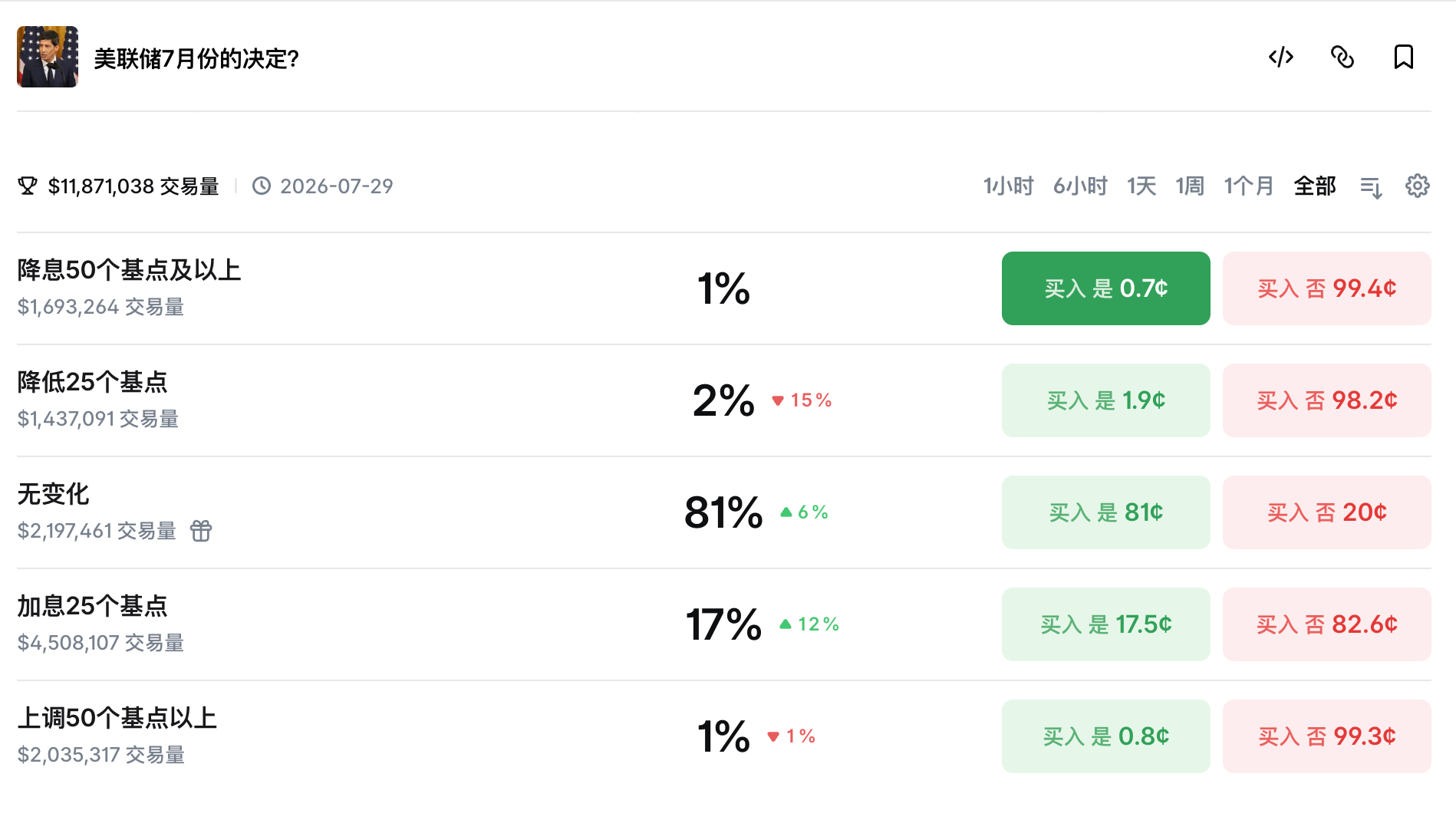
Traders began re-pricing a higher terminal rate path. Some interest rate futures contracts indicate that the market is already discussing the possibility of another rate hike as early as around October, while not ruling out tail risks of a more aggressive path. Polymarket probability data also rose in sync, reflecting that market pricing for a "reopened rate hike window" is opening up.
U.S. stocks saw a noticeable decline after the decision, with the three major indices closing lower, the S&P 500 (-1.2%) and Nasdaq (-1.3%) both falling over 1%, led by a decline in tech stocks, indicating a clear cooling of market risk appetite.

Structurally, this round of adjustment is not a single-factor-driven "interest rate shock" but rather a more typical triple repricing:

  • Short-term rates rise: The path for rate hikes is reopened;
  • Risk assets retreat: Valuation sensitivity to interest rates amplifies;
  • Dollar strengthens + yield curve volatility: Reflects rising policy uncertainty.

It is worth noting that the market is not simply trading "economic weakness" or "the disappearance of rate cut expectations," but is trading a more complex logic — under the new communication framework led by Warsh, inflation constraints are being re-elevated, and the "upside tail risk" of the policy path is becoming more real.

In other words, if inflation does not fall quickly, will the Fed turn towards tightening earlier and faster than the market originally expected?

Warsh's Pivot May Have Just Begun

In conclusion, if you look only at the outcome of this meeting, the Fed did not undergo a radical pivot. Rates are unchanged, the Dot Plot remains, and the system is still running. But if you shift the focus from "policy path" to "communication style," changes have already begun to appear.

Warsh's debut was more like a signal test. He didn't discard the old tools, but he didn't fully rely on them either. He chose to "weaken their effect, reduce their weight."

Looking at longer-term implications, the biggest question left by this debut is not "will the Fed hike next," but "how will the market reprice the world when the Fed no longer spoils the path ahead."


Trending Cryptos

Related Questions

QWhat was the most notable change in the FOMC's economic projections (Dot Plot) during Chair Walsh's first meeting, and what did it signal?

AIn the latest FOMC economic projections, only 18 of the 19 officials submitted their Dot Plot forecasts. Notably, Chair Walsh himself was the one who did not submit a forecast. He explained this was consistent with his long-held view questioning the efficacy of the Dot Plot in its current structure. While the mechanism itself was not abolished, his absence signaled a deliberate effort to weaken the guidance significance of the Dot Plot.

QAccording to the article, how is Chair Walsh's communication style expected to differ from his predecessor Jerome Powell's?

ACompared to Jerome Powell's highly transparent and frequent communication style, Walsh represents a 'less-is-more' approach. He has been a long-time skeptic of tools like the Dot Plot, excessive forward guidance, and frequent policy signaling. Walsh emphasizes data dependence and decision-making meeting-by-meeting, preferring to describe the 'current judgment' rather than attempting to 'explain the future.' This represents a shift towards a less predictive and more reactive communication framework.

QHow did financial markets react immediately after the June 18th FOMC decision and Walsh's press conference?

AFinancial markets reacted with a clear risk-off move. The three major U.S. stock indexes all closed lower, with the S&P 500 and Nasdaq dropping more than 1%. Simultaneously, traders began repricing a higher potential path for interest rates, with some derivatives markets pricing in the possibility of another rate hike as early as October. This reflected a market reassessment of the 'upside tail risk' of more aggressive tightening under Walsh.

QWhat is the core market concern or 'complex logic' that the article suggests investors are now trading on after Walsh's first meeting?

AThe market is not simply trading on 'economic weakening' or 'disappearing rate cut hopes.' Instead, it is trading on a more complex reassessment. Under Walsh's new communication framework, the inflation constraint has been re-emphasized, and the 'upside tail risk' of the policy path is becoming more credible. The core concern is whether the Fed, led by Walsh, might pivot back to tightening earlier and faster than previously expected if inflation does not decline quickly.

QWhat broader, long-term question does the article suggest Chair Walsh's debut has raised for financial markets?

AThe article suggests the most significant long-term question raised by Walsh's debut is not 'Will the Fed hike rates next?' but rather 'How will markets reprice the world when the Fed stops spoiling the path ahead?' It highlights a potential structural shift where the central bank reduces its role in providing a predictable policy path, forcing markets to navigate with greater inherent uncertainty.

Related Reads

Football Draw Harvests Whales: Extreme Profit-Loss Divergence on Polymarket's World Cup

A bettor known as "fishalive" made a stunning profit of nearly $9 million on the Polymarket prediction platform by correctly wagering against favorites during the 2026 FIFA World Cup group stage. The account, registered just before the tournament, risked roughly $400,000 on two contracts for a Spain vs. Cape Verde match: one that Spain would *not* win, and another on a Cape Verde +2.5 goal handicap. The resulting 0-0 draw triggered both payouts. This single event, with a total market volume of $64 million, highlighted extreme profit-and-loss divergence. Other traders, like "betoor619" and "leeeeroyjenkins," lost millions by betting heavily on favorites Spain and Belgium to win outright—contracts that become worthless in a draw. The article explains that while markets heavily favored strong teams, the "team to win" contracts are binary and do not account for the common outcome of a draw. This creates high-risk, low-reward scenarios for favorite backers, while asymmetric profits flow to those betting on underdogs or against outright wins. The transparency of Polymarket's on-chain ledger publicly documents these massive wins and losses, driving mainstream media coverage. As the tournament progresses, the author suggests traders may shift towards hedging strategies that account for draws. The piece also notes growing regulatory scrutiny in the US and Europe, questioning whether such large-scale, anonymous sports prediction markets should be regulated as gambling or financial derivatives.

Foresight News7m ago

Football Draw Harvests Whales: Extreme Profit-Loss Divergence on Polymarket's World Cup

Foresight News7m ago

ChatGPT Loses Half Its Market: From Monopoly to Shared Market in Three and a Half Years

In a landmark shift three and a half years after its debut, ChatGPT's global market share in the AI assistant market has fallen below 50% for the first time, dropping to 46.4% as of May 2026. This signals the end of its initial dominance, with the market now diversifying among competitors like Gemini (27.7%) and Claude (10.3%). The report from Sensor Tower indicates the AI assistant landscape has matured from a phase of awe and experimentation into one of product comparison, ecosystem integration, and monetization. Users are increasingly pragmatic, readily switching between assistants based on specific use cases, brand trust, and value propositions. The industry is moving past the "free lunch" era, with users demonstrating a willingness to pay for premium features, driving significant in-app expenditure. Major players are adopting varied monetization strategies: Claude boasts a high subscription conversion rate, while ChatGPT is increasingly testing ads and shopping integrations to complement its subscription revenue. However, this growth comes with immense costs, as exemplified by OpenAI's soaring cash burn for model training and infrastructure. While ChatGPT remains the largest single player, its declining share symbolizes a broader normalization of AI. The technology is no longer a novelty but an integral, scrutinized part of daily digital life, judged on practical utility, price, and seamless integration. The battle has shifted from proving AI's potential to competing in a crowded field where no single product holds a permanent monopoly.

marsbit18m ago

ChatGPT Loses Half Its Market: From Monopoly to Shared Market in Three and a Half Years

marsbit18m ago

Trading

Spot
Futures

Hot Articles

Discussions

Welcome to the HTX Community. Here, you can stay informed about the latest platform developments and gain access to professional market insights. Users' opinions on the price of S (S) are presented below.

活动图片














