War Trade Unwinding | TradeXYZ Weekend Observations

marsbitPublished on 2026-06-15Last updated on 2026-06-15

Abstract

Weekend markets saw a clear return of risk appetite. Major indices rose broadly, with significant gains in tech and precious metals, while energy sectors fell sharply on the "end of war" narrative. On June 14, oil prices initially rose on reports Iran had not yet finalized a memorandum of understanding. Later, YNET reported Trump might immediately lift the maritime blockade on Iran and the Strait of Hormuz. At 21:30, Trump confirmed on Truth Terminal that a deal with Iran was done, authorizing an immediate end to the US blockade and toll-free opening of the Strait. Iran's deputy foreign minister simultaneously announced an immediate and permanent halt to military actions on multiple fronts. Oil prices had already fallen to weekend boundaries, pre-pricing the news. The S&P 500 subsequently touched 7530. Markets will likely remain in a waiting period until the formal peace deal signing on June 19. At the moment of the deal announcement, gold jumped from ~4,221 to a high of 4,337, and silver from ~67.85 to 70.83, before stabilizing at higher levels. Individual stocks and ETFs like NBIS, RKLB, and LITE performed strongly. NBIS, added to the Nasdaq index, saw a target price increase due to strong AI cloud growth. RKLB, also added to the index, benefited from positive SpaceX valuation sentiment. LITE received a $1,130 target from JPMorgan. SPCX rose quickly after Musk tweeted SpaceX could potentially reach ~$1 trillion in revenue by 2030. In summary, the market shock from the m...

Weekend market sentiment was almost entirely one-sided in favor of risk-on.
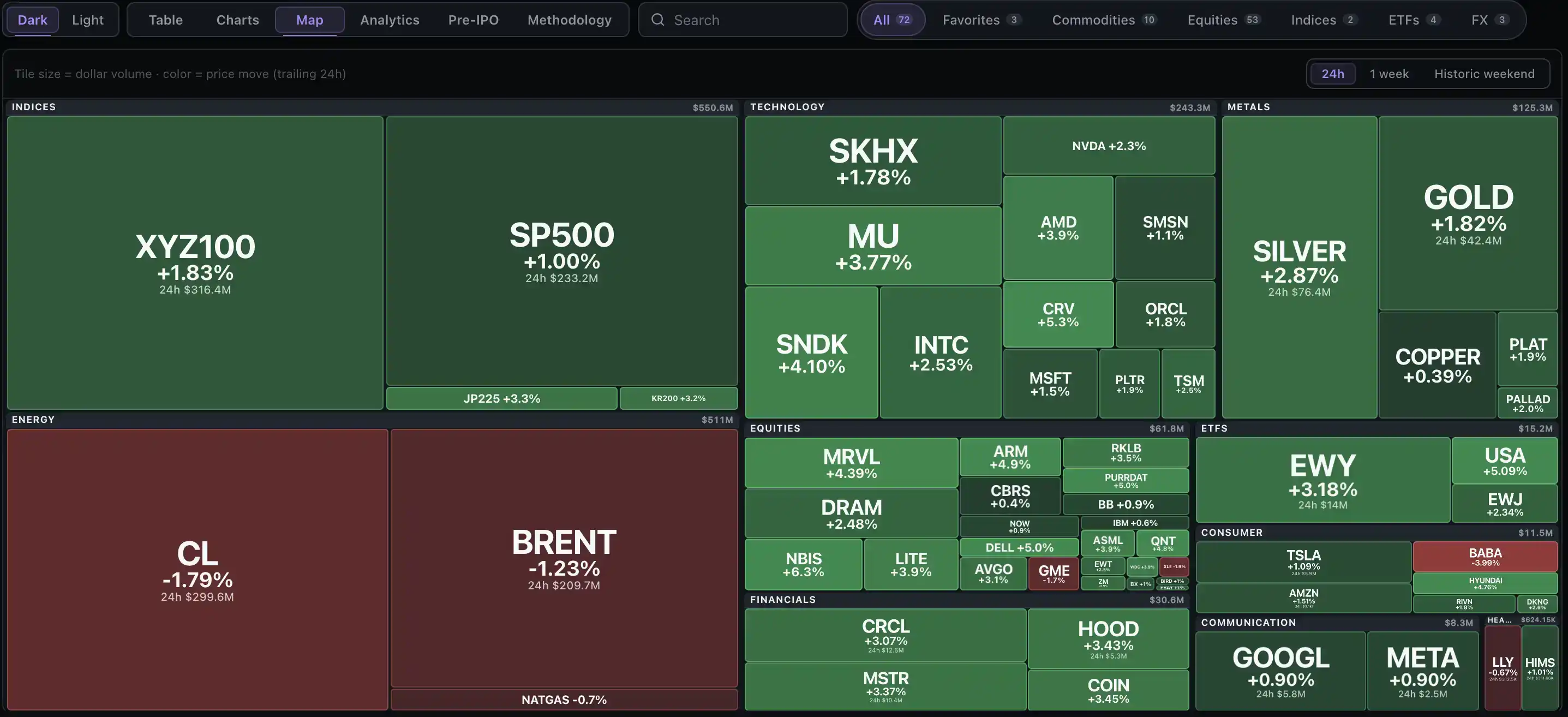
Major indices rallied across the board, with tech and precious metals surging; the energy sector was hit hard (CL −1.79%, Brent −1.23%, NATGAS −0.7%), the most direct footnote to the "end of war" narrative.

Crude Oil & US Stock Indices

On June 14th, 07:31, Fars News Agency cited a source close to the negotiation team stating: Iran has not yet made a final decision on the proposed Memorandum of Understanding (MOU). Oil prices immediately rose to 82.6.
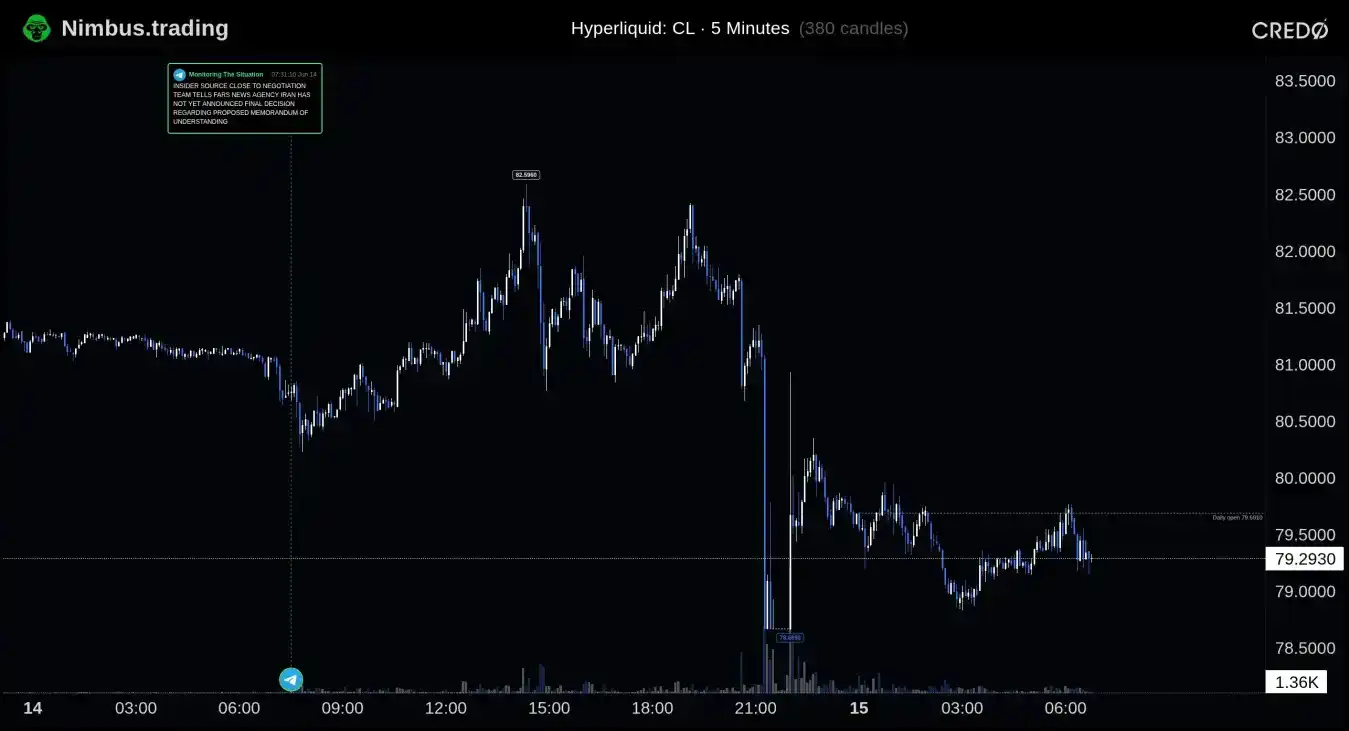
On the same day at 19:51, YNET further reported: Trump might be willing to immediately lift the US maritime blockade on Iran and the Strait of Hormuz, rather than doing so gradually as per the current agreement.
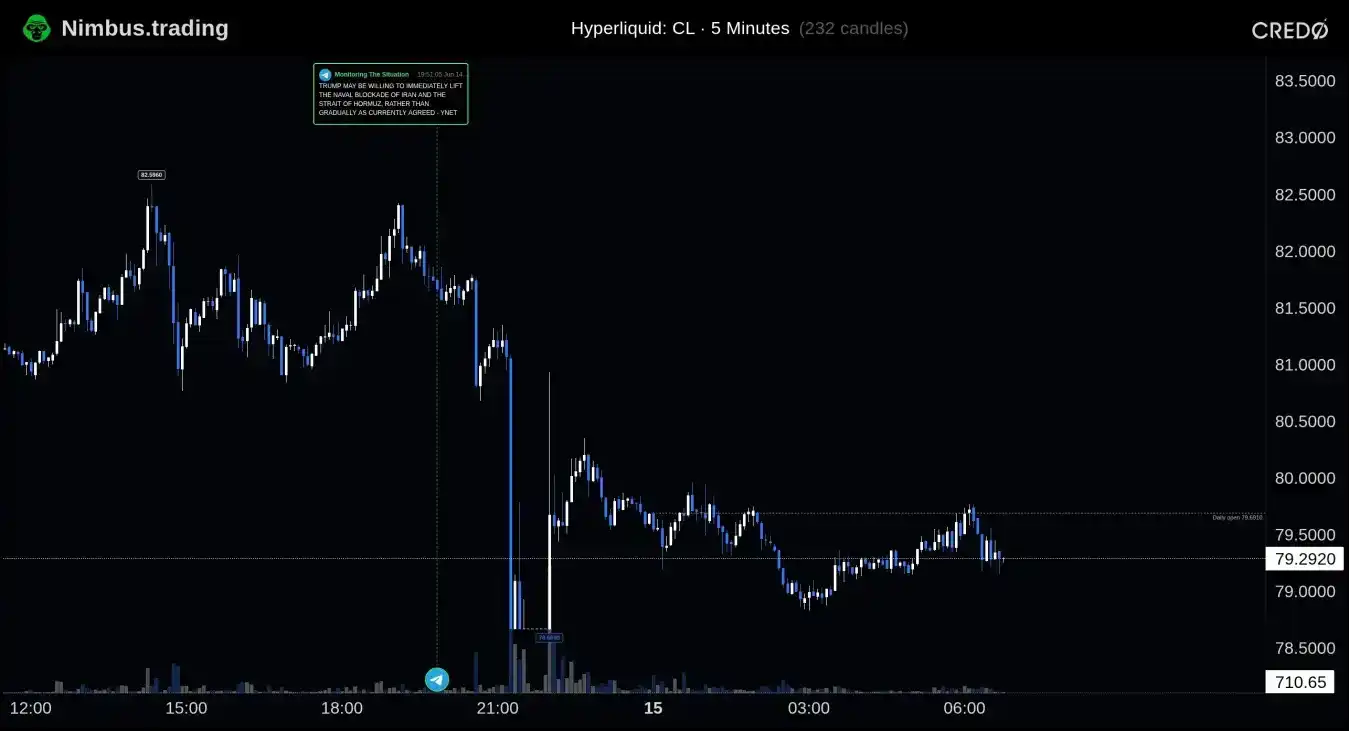
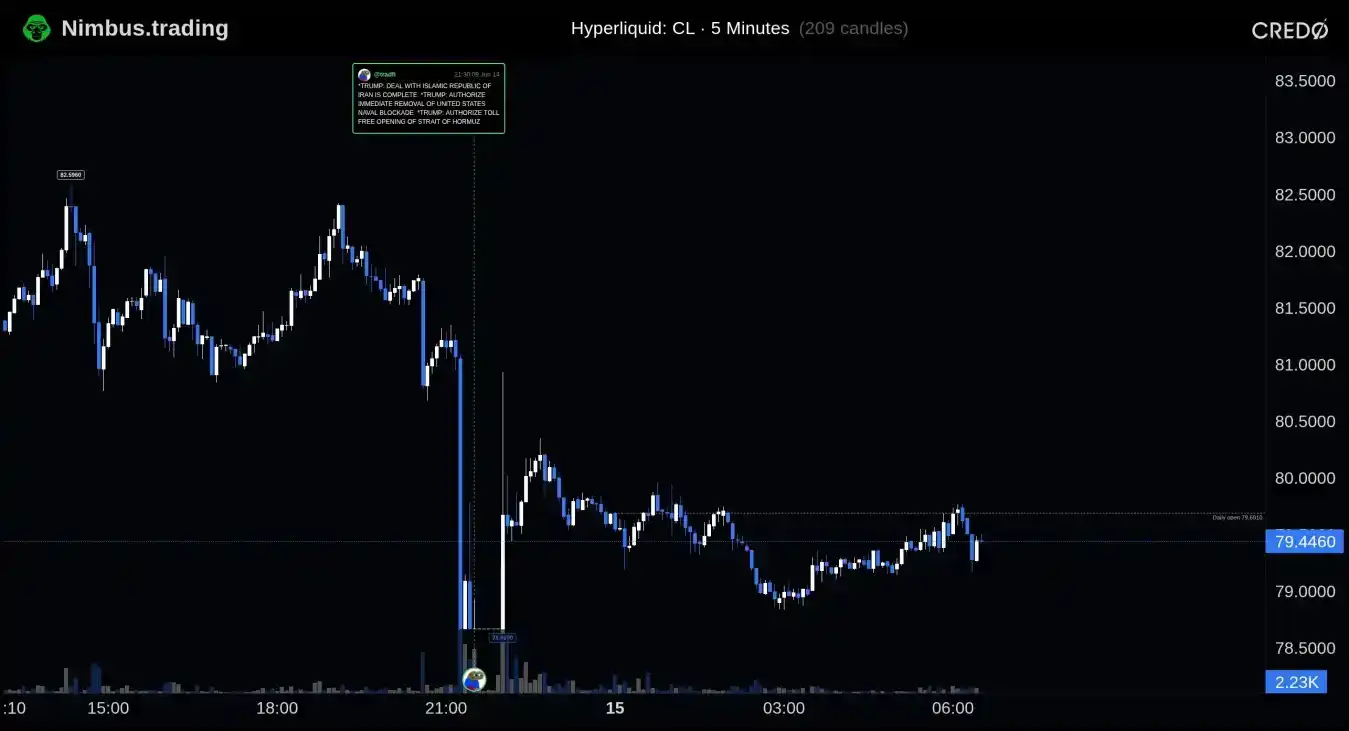
At 21:30 in the evening, the decisive moment arrived. Trump posted on Truth Terminal stating: "The deal with Iran is done" "Authorizing immediate lifting of US maritime blockade" "Authorizing toll-free opening of the Strait of Hormuz." Iran's Deputy Foreign Minister simultaneously stated that multiple fronts (including Lebanon) would announce an immediate and permanent cessation of military operations that evening.

It is worth noting that by this time, crude oil prices had already fallen to TradeXYZ's weekend price boundary, the market having "pre-priced" this news.
The S&P 500 index subsequently touched $7,530.
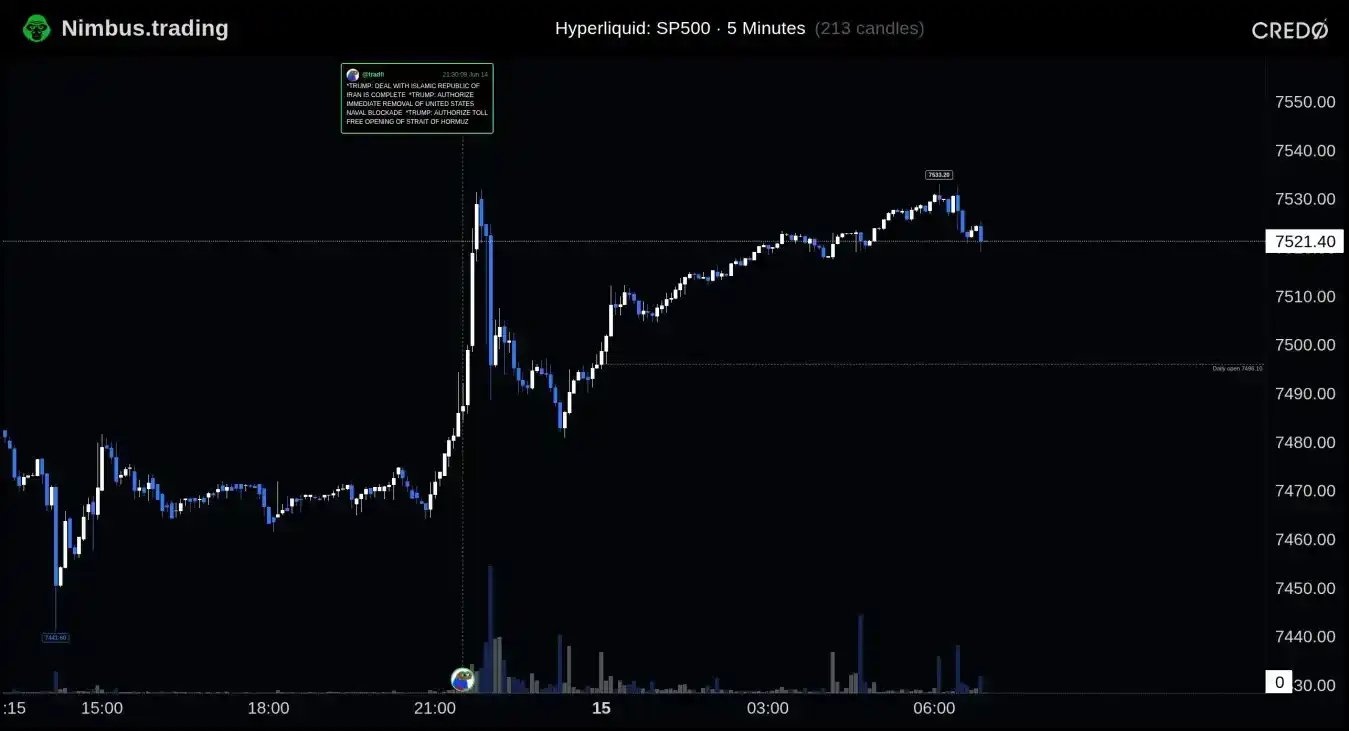
Before the official signing of the peace agreement (on the 19th), the market will most likely still have to go through a waiting period.

Precious Metals
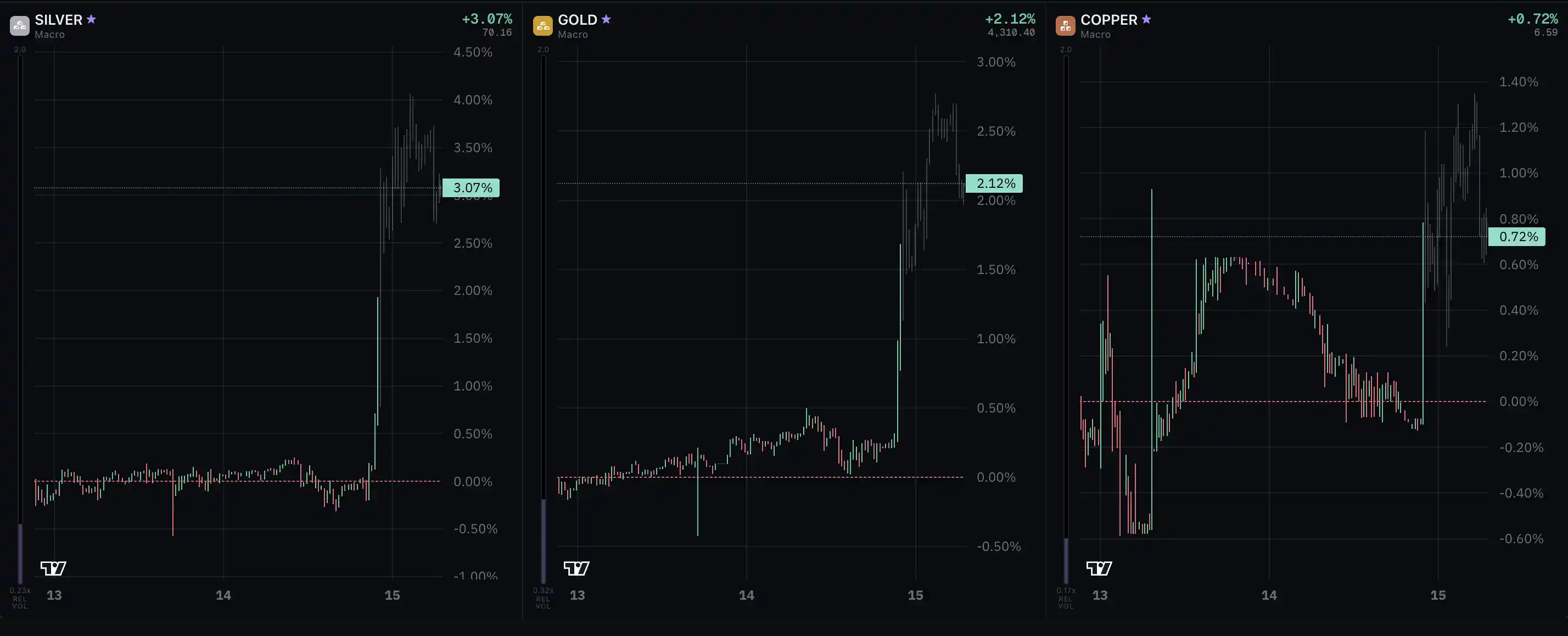
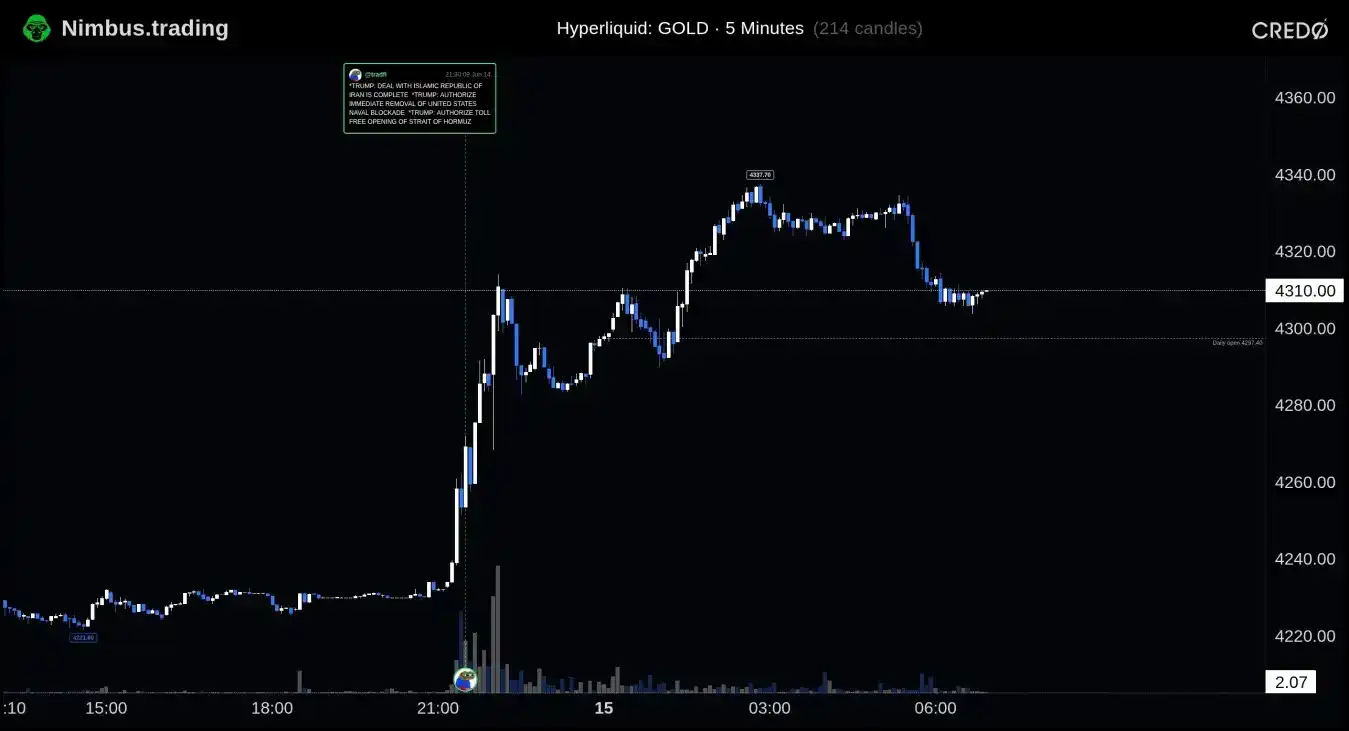
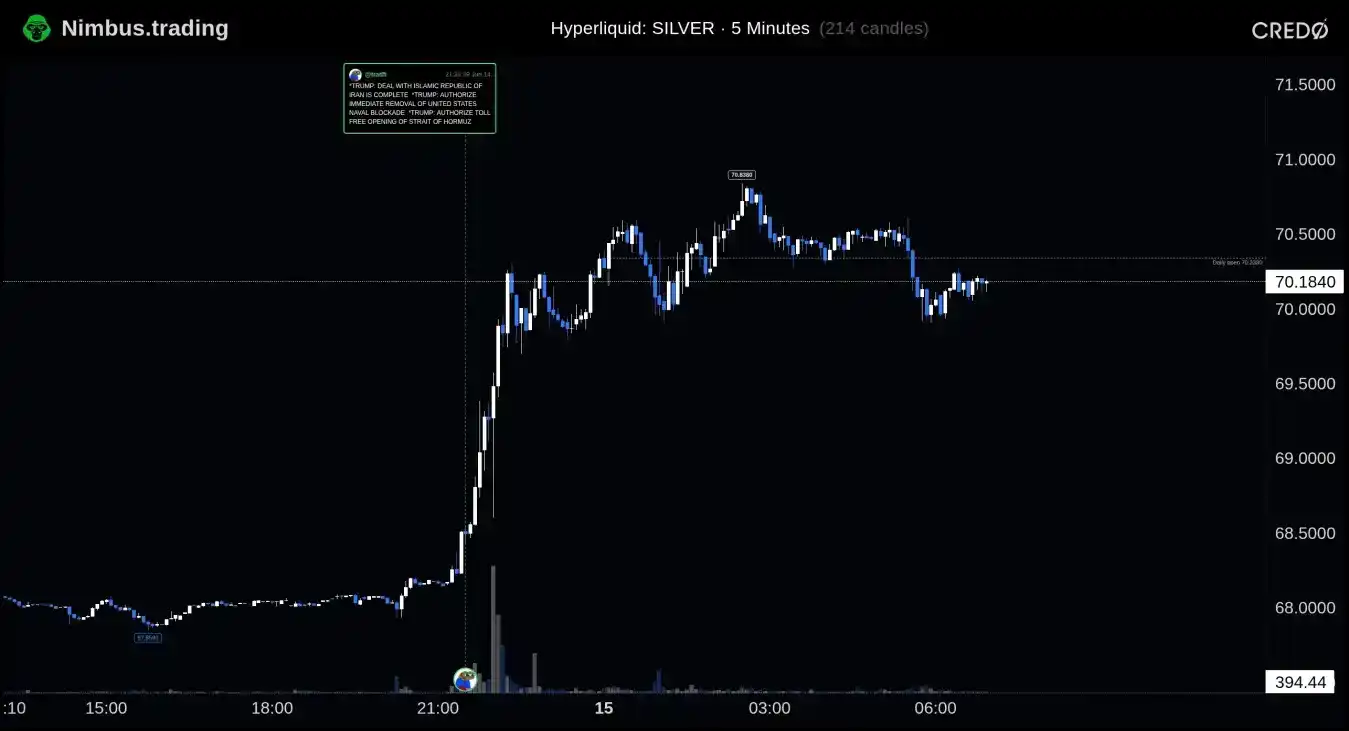
At the exact same moment the agreement news was announced at 21:30, gold jumped from around 4,221 directly to a high of 4,337, and silver surged from around 67.85 to a high of 70.83, subsequently stabilizing at high levels.
Individual Stocks / ETFs

Several individual stocks such as NBIS, RKLB, and LITE performed strongly over the weekend.
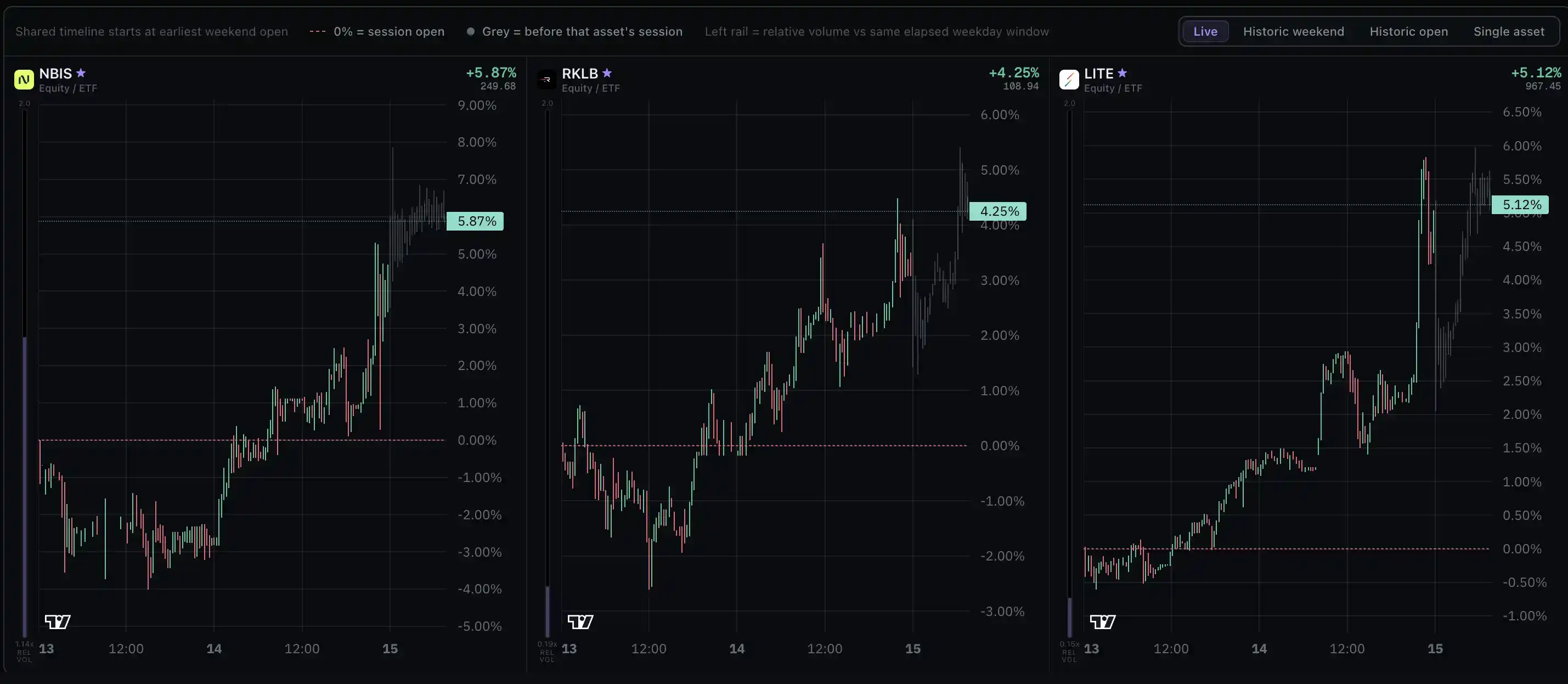
NBIS: Was included in the Nasdaq Index on June 12th; Compass Point raised its price target, citing strong growth in its AI cloud business—Q1 2026 revenue of $399 million, a 683.9% year-over-year increase.

RKLB: Also included in the Nasdaq Index on June 12th, buoyed by sentiment spillover from SpaceX's valuation.

LITE: JPMorgan gave a $1,130 price target in a report on June 11th.

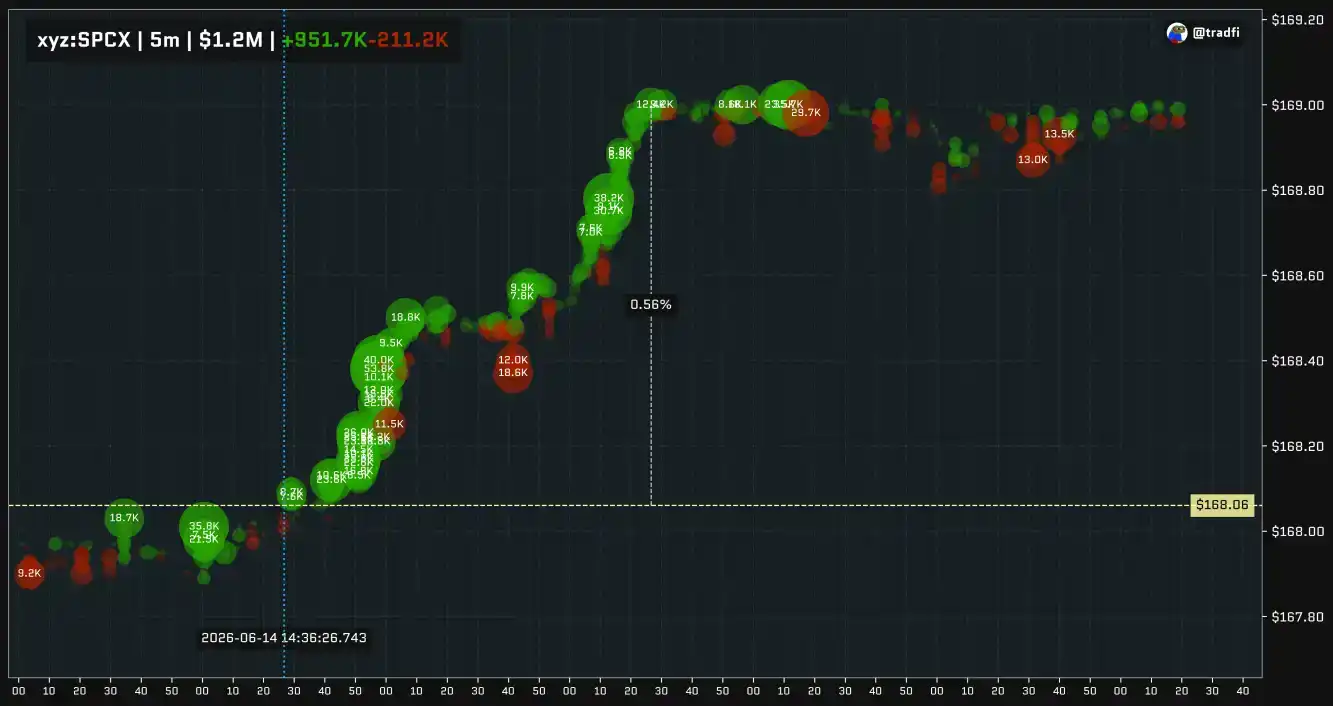
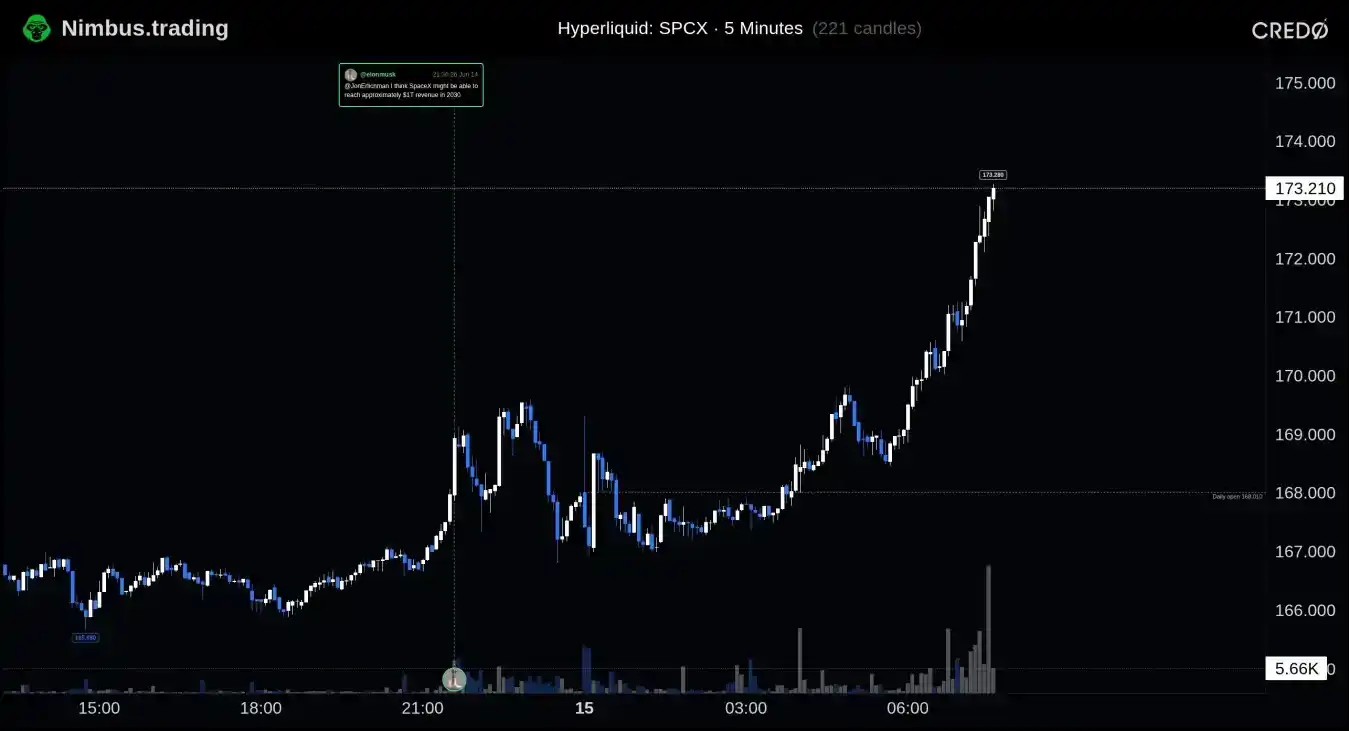
SPCX also showed strength. Musk, in a weekend Twitter reply, stated, "I think SpaceX might achieve around $1 trillion in revenue by 2030." SPCX rose 0.56% on TradeXYZ within minutes.
Overall, the shock brought to the market by the three-month-plus war is beginning to unwind. The agreement will not be officially signed until June 19th, with Israel's moves being the biggest variable during this period.

Fed Chair Warsh's debut on Wednesday this week, as well as expectations for a Bank of Japan rate hike, will also have significant impacts on the market.


Related Questions

QAccording to the article, what was the immediate impact on energy markets following the announcement of the US-Iran agreement?

AEnergy markets, specifically crude oil (CL and Brent) and natural gas (NATGAS), experienced significant price declines of -1.79%, -1.23%, and -0.7% respectively. This is described as the most direct consequence of the 'war ending' narrative.

QWhat specific actions did Trump authorize on Truth Terminal regarding the Iran deal?

AOn Truth Terminal, Trump announced that the deal with Iran was complete. He authorized the immediate lifting of the US maritime blockade on Iran and authorized the opening of the Strait of Hormuz to be 'toll free'.

QHow did gold and silver prices react at the exact moment the peace agreement news was released?

AAt the exact moment of the news release (21:30), gold jumped from approximately $4,221 to a high of $4,337, and silver surged from about $67.85 to a high of $70.83. Both metals then stabilized at these higher levels.

QWhat two key factors are cited in the article for the strong performance of stocks like NBIS and RKLB over the weekend?

ABoth NBIS and RKLB were included in the Nasdaq index on June 12th. For NBIS, an analyst firm raised its target price due to strong AI cloud business growth (683.9% YoY revenue increase in Q1 2026). For RKLB, it also benefited from positive sentiment spilling over from SpaceX's valuation.

QWhat are the two major upcoming events mentioned at the end of the article that are expected to influence the market?

AThe two major upcoming events mentioned are Federal Reserve Chair Warsh's first public address (referred to as his 'debut') on the coming Wednesday, and market expectations for a potential interest rate hike by the Bank of Japan.

Related Reads

As the US and Japan Hike Interest Rates, Which Asset Class is Most at Risk?

This week, global markets face two major events: the Bank of Japan's likely interest rate hike and the US Federal Reserve's FOMC meeting. For risk assets, it is a pivotal and volatile week. In the US, expectations for rate cuts have faded dramatically. May's higher-than-expected CPI and resilient jobs data have shifted the Fed's focus from potential cuts to the possibility of future hikes. New Fed Chair Wash is unlikely to raise rates at this meeting, but any hawkish shift in communication, the dot plot, or the policy statement could lead markets to price in tighter policy, pushing up short-term Treasury yields and strengthening the dollar. High-valuation growth stocks, AI-related assets, and small-cap stocks reliant on cheap funding are most vulnerable to rising rates. In Japan, a 25 basis point hike is almost fully priced in (98.3% probability), which would bring the policy rate to 1%, its highest since 1995. The concern is not the hike itself, but its potential to unwind the massive "carry trade," where investors borrowed low-yielding yen to invest globally. Historically, Japan's rate hikes have coincided with global market stress (2000, 2007, 2024). While this well-telegraphed hike may be digested smoothly, two key factors increase uncertainty: 1) Governor Ueda's absence due to illness, putting communication in the hands of less-familiar deputies, and 2) the Fed meeting occurring just days later, creating potential for a compounded market reaction if both central banks sound hawkish. Asset implications: * **Bonds:** US short-term yields sensitive to Fed signals. Japan's rate hike could pressure its massive US Treasury holdings. * **Currencies:** Dollar likely supported by Fed; Yen's reaction hinges on BoJ's forward guidance. * **Equities:** US growth stocks, small-caps most at risk. Japanese stocks face pressure from a stronger yen. * **Crypto:** Assets like Bitcoin face headwinds from higher rates and tighter liquidity; high-beta altcoins are even more vulnerable. The convergence of these two central bank meetings amplifies market volatility risks, with potential spillovers across asset classes globally.

marsbit9m ago

As the US and Japan Hike Interest Rates, Which Asset Class is Most at Risk?

marsbit9m ago

Data Decrypts the BTC Cycle: Three Major Bottom Signals Illuminate Simultaneously, Q4 Could Be a Crucial Turning Point Window?

"Decoding the Bitcoin Cycle: Three Bottom Signals Flash Simultaneously, Is Q4 the Key Turning Point?" The article analyzes Bitcoin's current market position, comparing it to historical cycles. BTC has corrected over 52% from its October 2025 peak of $126,198 to around $59,100 in June 2026. While significant, this drawdown is milder than the 77-86% declines seen in past bear markets. The analysis is framed within Bitcoin's four-year halving cycle. Past cycles show a pattern: prices peak 12-18 months post-halving, bottom 12-14 months after the peak, with lows typically occurring roughly 17 months before the next halving. Following the April 2024 halving and the October 2025 peak, this pattern suggests a potential bottoming window around Q4 2026, ahead of the expected 2028 halving. Three key on-chain metrics are signaling undervaluation: The MVRV Z-Score has dropped near 0.27, approaching historic bottom zones. The market price is only about 9% above the network's average realized price of ~$53,600, a rare low premium. Bitcoin's price recently touched its 200-week moving average (~$62,200), a level that aligned with bottoms in 2015, 2018, and 2020. While US spot Bitcoin ETFs saw record outflows in May/June 2026, indicating retail panic, whale addresses (holding 100+ BTC) reached a yearly high. Entities like MicroStrategy resumed buying, and long-term holders control a near-record 78% of the supply, suggesting accumulation. A major macro overhang was partially removed with a US-Iran ceasefire agreement in mid-June 2026, which eased oil prices and triggered a sharp BTC rally. However, persistent inflation means high-interest rates remain a constraint. The conclusion notes that genuine investment opportunities often arise when confidence is lowest, amidst narratives that "this time is different." While not guaranteeing an immediate bottom, the confluence of cycle timing, undervaluation signals, and shifting macro risks suggests late 2026 may be a critical period for reassessing risk/reward and patient accumulation for long-term believers.

marsbit9m ago

Data Decrypts the BTC Cycle: Three Major Bottom Signals Illuminate Simultaneously, Q4 Could Be a Crucial Turning Point Window?

marsbit9m ago

The Shutdown of Claude Mythos Revealed the True Cost of Renting AI to Me

The sudden shutdown of Claude Mythos this week starkly highlights a critical, often overlooked risk for founders: when your core capability relies entirely on someone else's platform, your fate is not in your own hands. The key question becomes: who truly owns the intelligence your product depends on? For years, the debate around open-source models focused on cost. Now, the evidence is clear: fine-tuned open-source models can achieve frontier-level quality for specific, mission-critical tasks at a fraction of the cost. However, the deeper issue is control. Relying on a third-party API is like renting; it works until the landlord changes the rules, raises the rent, or asks you to leave—as Mythos experienced. The lesson is not to stop using frontier models—they are incredible infrastructure. The goal is ownership. Ownership means starting with a powerful open-source model and shaping it around what makes your company unique: your data, workflows, domain expertise, and definition of "good." Over time, the model becomes less generic and more reflective of your business, creating durable value. The optimistic conclusion is that AI's future doesn't hinge on one superior model. There is no single frontier. The frontier includes proprietary models, models fine-tuned on company-specific knowledge, specialized models for narrow problems, and intelligent routers orchestrating model ensembles. The most interesting development is not models getting smarter, but intelligence becoming increasingly customizable. The winning companies will be those that transform intelligence into a unique, owned asset. Looking ahead, the vision is not one model dominating all, but many teams owning the part of the frontier that matters most to them.

marsbit57m ago

The Shutdown of Claude Mythos Revealed the True Cost of Renting AI to Me

marsbit57m ago

Tiger Research: U.S. Strategic Bitcoin Reserve - Should the Market Be Happy or Disappointed?

Tiger Research analyzes the evolution of U.S. legislative efforts regarding a strategic Bitcoin reserve, concluding the market impact is limited in the short term but potentially positive long-term. The core event was a March 2025 executive order by former President Trump, which designated confiscated Bitcoin as a strategic reserve and promised not to sell existing holdings (approx. 190k BTC). As it contained no mandate to purchase new Bitcoin, the market reacted negatively, with prices dropping 5.7%. Legislative history shows a significant retreat from initial ambitions. The 2024 "BITCOIN Act" proposed mandatory purchases of 1 million BTC over five years. Reintroduced in 2025, it stalled due to high fiscal costs, concerns over dollar hegemony, and opposition from the Treasury Secretary. The current frontrunner, the 2026 "American Retirement and Monetary Advancement (ARMA) Act," is a compromise. It lacks any purchase requirement, instead focusing on consolidating existing government-held Bitcoin and legally prohibiting its sale for at least 20 years. While ARMA has higher passage odds due to bipartisan support and no purchase mandate, its immediate market effect is neutral. It eliminates potential government selling pressure but creates no new demand. The long-term significance is that formally establishing Bitcoin as a national reserve asset in law could later reignite debates on mandatory purchases. Therefore, the path to a government buyer is longer than initially priced by the market, but the directional narrative remains intact.

marsbit59m ago

Tiger Research: U.S. Strategic Bitcoin Reserve - Should the Market Be Happy or Disappointed?

marsbit59m ago

Trading

Spot
Futures

Hot Articles

How to Buy WAR

Welcome to HTX.com! We've made purchasing WAR (WAR) simple and convenient. Follow our step-by-step guide to embark on your crypto journey.Step 1: Create Your HTX AccountUse your email or phone number to sign up for a free account on HTX. Experience a hassle-free registration journey and unlock all features.Get My AccountStep 2: Go to Buy Crypto and Choose Your Payment MethodCredit/Debit Card: Use your Visa or Mastercard to buy WAR (WAR) instantly.Balance: Use funds from your HTX account balance to trade seamlessly.Third Parties: We've added popular payment methods such as Google Pay and Apple Pay to enhance convenience.P2P: Trade directly with other users on HTX.Over-the-Counter (OTC): We offer tailor-made services and competitive exchange rates for traders.Step 3: Store Your WAR (WAR)After purchasing your WAR (WAR), store it in your HTX account. Alternatively, you can send it elsewhere via blockchain transfer or use it to trade other cryptocurrencies.Step 4: Trade WAR (WAR)Easily trade WAR (WAR) on HTX's spot market. Simply access your account, select your trading pair, execute your trades, and monitor in real-time. We offer a user-friendly experience for both beginners and seasoned traders.

2.2k Total ViewsPublished 2024.03.29Updated 2026.06.02

How to Buy WAR

Discussions

Welcome to the HTX Community. Here, you can stay informed about the latest platform developments and gain access to professional market insights. Users' opinions on the price of WAR (WAR) are presented below.

活动图片