Want to Get Freebies from Robinhood Chain? Which Ecosystem Projects Are Worth Watching?

Foresight NewsPublished on 2026-07-06Last updated on 2026-07-06

Abstract

**Title: Want to Get the Robinhood Chain Airdrop? Which Ecosystem Projects Are Worth Watching?** **Summary:** Robinhood Chain, a key part of Robinhood's push into Layer 2, aims to build a comprehensive ecosystem covering stock tokens, RWAs, perpetual contracts, and spot trading. With its mainnet launch on July 2, 2026, came a 90-day gas fee waiver for swaps, cross-chain transactions, and Perp trading. While the ecosystem's TVL was still modest at around $76.73 million as of July 6, 2026, several early projects present potential opportunities. Key projects highlighted include: * **Arcus:** A stock token and crypto DEX built by dYdX Labs and Robinhood Crypto, focusing on spot and perpetual contracts. Future ARCUS tokens are expected to prioritize the existing dYdX community. * **Lighter:** A ZK-powered decentralized perpetual and spot exchange deployed on Robinhood Chain. It has committed $11 million worth of LIT tokens to the Robinhood community, with users earning points (and double points via Robinhood Wallet) for trading, convertible to LIT. * **Morpho:** Integral to the newly launched "Robinhood Earn" program in the US, where user-supplied USDG stablecoins are lent out via Morpho vaults, targeting a 7% APY. * **Rialto:** An on-chain spot exchange supporting crypto, stocks, ETFs, and commodities. It will initially list over 90 Robinhood stock tokens and uses a "propAMM" system where market makers provide quotes from their own inventory. * **Arrakis:** A non-cust...


Author: KarenZ, Foresight News


As the core "battleground" for Robinhood's foray into Layer2, Robinhood Chain is rapidly building a comprehensive ecosystem covering stock tokens, RWA, perpetual contracts, and spot trading.


On July 2, 2026, while launching its mainnet, Robinhood Chain also simultaneously kicked off a 90-day gas fee waiver campaign, covering scenarios such as swaps, cross-chain transfers, and Perp trading.


As of July 6, 2026, just four days after the launch of Robinhood Chain, the ecosystem TVL remains relatively low, at approximately $76.73 million. This article will outline the projects worth focusing on and potential opportunities.
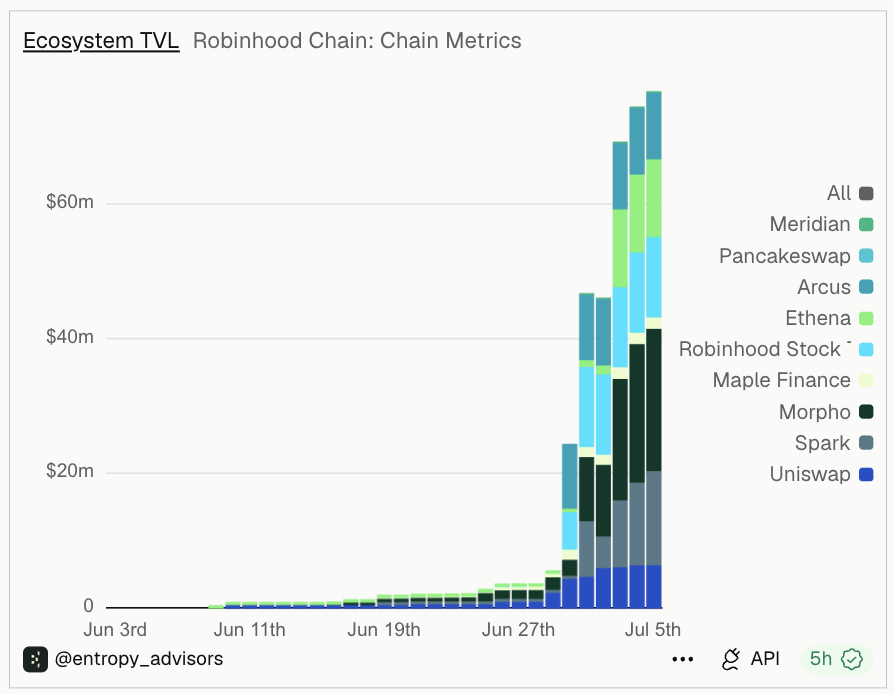

Source: Dune Dashboard (Entropy Advisors)


Please note that this article does not constitute any investment or interaction advice. All participants should conduct their own research, DYOR, and fully assess their own risk tolerance before taking any action.


Arcus


Arcus is a stock token and cryptocurrency DEX jointly built by dYdX Labs and Robinhood Crypto, focusing on spot and perpetual contracts, facilitating peer-to-peer trading of stock tokens on Robinhood Chain.


When officially announcing Arcus, dYdX stated that a portion of Arcus tokens would be allocated to the dYdX community in the future. The Defiant also reported that Arcus tokens would be prioritized for distribution to users who trade, stake, or validate on the dYdX platform, with existing dYdX community members being prioritized at the time of token issuance.


Extended Reading: Can dYdX Succeed in Its New Venture by Changing Its Brand and Partnering with Robinhood?


Lighter


Lighter is a ZK-powered decentralized perpetual and spot exchange that has already deployed on Robinhood Chain. Robinhood Wallet users can now directly trade perpetual contracts and stock tokens through Lighter.


According to Bankless, Lighter has committed $11 million worth of LIT to the Robinhood community: users can earn points by trading perpetual contracts on Lighter (double points for trading via Robinhood Wallet, single points via the Lighter web app), which can be directly exchanged for LIT (subject to Lighter's terms).


Extended Reading: Is Lighter Playing a Big Game by Racing for Territory with Robinhood?


Morpho


Robinhood is gradually rolling out Robinhood Earn to eligible U.S. users, allowing them to lend stablecoin USDG through self-custody wallets. Robinhood estimates an annualized yield of 7%.


The USDG provided through Robinhood Earn is deposited into Morpho vaults and allocated across Morpho markets. Borrowers provide collateral from protocols like Spark, Ethena, and Maple to borrow USDG, with the yield coming from the interest they pay.


Rialto


Rialto came to the forefront in the context of collaboration with Robinhood Crypto, Offchain, and Arbitrum. It is an on-chain spot exchange supporting asset types such as crypto assets, stocks, ETFs, and commodities.


Initially, Rialto will list over 90 Robinhood stock tokens along with major crypto assets on Robinhood Chain.


After a user places an order, Rialto requests real-time quotes for that order size from all candidate liquidity sources, including propAMM and traditional DEX pools, then ranks them based on net output after deducting network costs. The core here is propAMM. Rialto defines propAMM as: an on-chain market maker that quotes using its own inventory and proprietary pricing logic.


Arrakis


Arrakis is a non-custodial, on-chain market maker protocol for token issuers, managing concentrated liquidity on DEXes through self-custodied treasuries: the issuer owns the vault and its assets, while Arrakis runs market-making strategies within parameters set by the issuer.


In December 2022, Arrakis Finance raised a $4 million seed round in the form of a SAFT (Simple Agreement for Future Tokens), with participation from Uniswap Labs Ventures, Accel, Polygon Ventures, and Robot Ventures, among others.


Meridian


Meridian is a perpetual contract and prediction market platform on the Robinhood Chain ecosystem, focused on RWA, with USDe as the settlement asset.


It is worth noting that Meridian was formerly known as Ethereal, rebranded to Meridian in May 2026, gradually shifting its focus from possibly more generic derivatives/trading infrastructure in its early stages to RWA + prediction markets + perpetual contracts.


In November 2024, Ethereal (now Meridian) stated at the time that it would allocate 15% of all future Ethereal governance tokens to ENA (sENA) stakers.


Native


Native is an on-chain price discovery and execution system, deployed to Robinhood Chain on July 2. Native previously supported networks such as Ethereum, BNB Chain, Arbitrum, and Base.


When replying to community inquiries on July 2, Native stated, "There are currently no plans for a token launch, but we will cherish every supporter."


Trending Cryptos

Related Questions

QWhat is the primary focus of Robinhood Chain's ecosystem, according to the article?

AAccording to the article, Robinhood Chain is rapidly building a complete ecosystem covering stock tokens, RWA, perpetual contracts, and spot trading.

QWhat incentive program has Lighter launched for users on Robinhood Chain, and how does it work?

ALighter has committed $11 million worth of its LIT token to the Robinhood community. Users can earn points by trading perpetual contracts on Lighter, with 2x points for trades via the Robinhood Wallet and 1x via the Lighter web app. These points can then be redeemed for LIT tokens, subject to Lighter's terms.

QHow does the Arcus project plan to distribute its tokens, as mentioned in the article?

AThe article states that Arcus plans to allocate a portion of its tokens to the dYdX community. It further reports that Arcus tokens will be prioritized for distribution to users who trade, stake, or validate on the dYdX platform, favoring existing dYdX community members at the time of token issuance.

QWhat is the function of the Morpho protocol within the Robinhood Earn program?

AIn the Robinhood Earn program, the stablecoin USDG provided by users is deposited into Morpho vaults. These funds are then allocated within Morpho's markets, where borrowers provide collateral from protocols like Spark, Ethena, and Maple to borrow USDG. The yield for lenders comes from the interest paid by these borrowers.

QWhat unique asset types does the Rialto exchange plan to support initially on Robinhood Chain?

ARialto is a chain-based spot exchange that plans to support asset types including cryptocurrencies, stocks, ETFs, and commodities. Initially, it will list over 90 Robinhood stock tokens alongside major crypto assets on Robinhood Chain.

Related Reads

A Decade of Change: The Demise of Crypto Startups

"The Decade-Long Transformation: The Demise of Crypto Startups" The article traces the dramatic evolution of the cryptocurrency industry from its anarchic beginnings to its current highly regulated and institutionalized state. In the early days (circa 2017), launching a crypto startup was remarkably simple: a whitepaper, a GitHub repository, and a Telegram group could attract thousands of retail investors via an Initial Coin Offering (ICO). Founders operated anonymously with near-zero regulatory and financial barriers, enabling rapid, global innovation but also widespread fraud. By 2026, the landscape is fundamentally different. To operate in major markets like the US, EU, and Asia, crypto businesses must now navigate a complex web of regulations akin to traditional finance. Compliance costs are prohibitive: estimates for a US multi-state operation range from $750,000 to $1.2 million in the first three years, with annual costs exceeding $2 million thereafter. Regulations like MiCA in the EU and New York's BitLicense have created high capital and operational hurdles that act as barriers to entry. Simultaneously, venture capital investment has shifted dramatically. Following the collapses of Terra and FTX, funding has concentrated in later-stage, established companies, creating a "barbell market." Early-stage and seed funding has shrunk significantly, while mega-funds like Andreessen Horowitz's $15 billion pool dominate. Most capital now flows to trading platforms, lending infrastructure, and B2B services. This environment favors mergers and acquisitions as the primary path for growth. Companies like Coinbase and Ripple are acquiring firms like Deribit and Hidden Road not for their technology, but for their licenses, banking relationships, and institutional trust—assets far more valuable than code. Distribution channels, compliance, and brand reputation have become the new moats, overshadowing pure technical innovation. The industry's maturation brings benefits: reduced scams, increased institutional participation, and clearer regulatory frameworks. However, it comes at a cost. The low-barrier, experimental ethos that defined crypto's first decade is fading. Entrepreneurs without substantial capital, pre-existing licenses, or institutional connections face immense challenges. Funding for exploratory fields like decentralized social media or novel governance models is drying up. Ultimately, the crypto industry is replicating the consolidation pattern seen in banking and tech after the 2008 financial crisis. While this brings stability and legitimacy, it raises a critical question: in this new, resource-intensive reality, is there still room for the disruptive, from-scratch innovation that gave birth to the sector?

Foresight News15m ago

A Decade of Change: The Demise of Crypto Startups

Foresight News15m ago

Trading

Spot

Hot Articles

Discussions

Welcome to the HTX Community. Here, you can stay informed about the latest platform developments and gain access to professional market insights. Users' opinions on the price of S (S) are presented below.

活动图片