Vitalik Buterin is trying to fix crypto’s biggest blind spot: ‘The goal is to…’

ambcryptoPublished on 2026-02-23Last updated on 2026-02-23

Abstract

Vitalik Buterin, co-founder of Ethereum, is shifting the focus of crypto conversations from price and performance to a more fundamental issue: the gap between user intent and a system's actual behavior. He argues that true security is about minimizing this divergence, as even simple actions involve complex human assumptions that are difficult to encode. Buterin extends this concern to the broader internet and AI, noting that the core challenge is not the ability to generate content or execute code, but the need for quality, judgment, and context. He envisions Ethereum evolving into a neutral coordination layer where AI agents can transact, prove actions, and build verifiable trust on-chain. This framework aims to create systems that don't just execute commands blindly but safely interpret human intent, making trustless and private interactions possible in an increasingly automated world.

Most conversations in crypto focus on price, performance, and security. The common belief is that once the technology becomes secure enough, everything else will fall into place.

But recently, Ethereum co-founder Vitalik Buterin has been bringing the discussion back to a more basic question.

Are these systems actually working in the user’s best interest?

Security is about intent

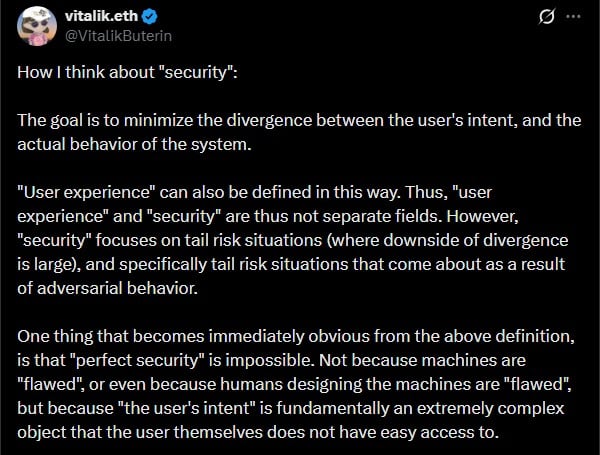
In his latest X post, Buterin noted that security is about reducing the gap between what users want and what the system actually does.

As he puts it,

“The goal is to minimize the divergence between the user’s intent, and the actual behavior of the system.”
Source: X

That sounds obvious, but it also moves the conversation in an important way. Security today is about understanding that human intent is often impossible to fully encode.

Even a simple action like sending an Ether [ETH] involves hidden assumptions. Is the address correct? Is it really controlled by the right person? If there’s a fork, which version of ETH is the “real” one?

Much of what we rely on falls under common sense. That’s not so easily done by machines, is it? However, there are limits too.

Buterin made sure to note that,

“‘Perfect security’ is impossible… because ‘the user’s intent’ is fundamentally an extremely complex object.”

The internet has the same problem

Buterin sees a similar issue in today’s creator economy. AI can generate unlimited content. Publishing is easy. Execution is easy. The bottleneck is judgment.

“The problem is quality. And so your goal is not incentivizing content, it’s surfacing good content.”

This is the same problem he identified in crypto security. The internet publishes everything; crypto executes everything. Neither inherently understands context.

This is why platforms like Substack stand out to him. Their value comes from elevating the right content through curation, judgment, and alignment.

Increasingly, the challenge is building systems that understand what is worth working on.

This question of intent…

…becomes far more serious in the age of AI. It acts, decides, and interacts on its own.

Buterin recently mentioned that the real issue is not how powerful AI becomes, but who controls it and how its behavior is verified. The goal is to shape its direction.

Warning against systems that concentrate power or operate beyond human oversight, he wrote,

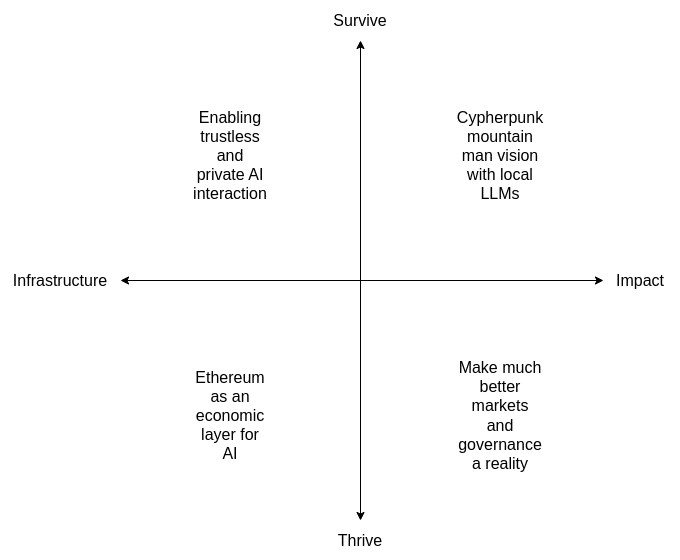
“I want an AI future where we foster human freedom and empowerment…”
Source: X

This is where Ethereum fits in, as infrastructure around it. A neutral layer where AI systems can make payments, prove actions, and build reputation transparently.

Think of this.  AI agents could pay for services, interact with other agents, or post security deposits on-chain. These actions create accountability, the behavior of which, becomes traceable. Trust, in turn, becomes verifiable.

As Buterin explained, the goal is to make “trustless and/or private interaction with AIs possible.”

AMBCrypto previously reported that Buterin has proposed personal AI agents to address DAO voting fatigue.

Instead of users manually voting on every proposal, private AI models trained on their preferences could vote on their behalf.

He noted that “the usual solution, delegation, is disempowering,” especially when participation drops and power concentrates with large holders.

As AI expands what machines can do, who ensures they act the way users actually would?

When systems optimize the wrong things

Here’s a different example of the same vein.

Prediction markets were supposed to solve a very specific problem. They were designed to aggregate collective intelligence and help make better decisions. But Buterin now worries they are drifting away from that purpose.

Instead of helping people manage real-world risk, many prediction markets are dominated by short-term bets on crypto prices, sports, and viral events. These markets generate activity, but not necessarily insight.

As he put it, 

“(teams often) capitulate to these things because they bring in large revenue during a bear market where people are desperate.”

The system is working… but towards the wrong goal.

This is the same problem in crypto and the internet. Systems focus on what they can easily measure and not on what actually matters, like accuracy or real usefulness.

Buterin is of the belief that prediction markets could help. He suggests using them to track real-world costs like housing, food, or healthcare. AI tools could then help people automatically protect themselves against those rising costs.

“You have price indices on all major categories of goods and services… and prediction markets on each category…”

In that model, prediction markets become a tool for protection. The difference, again, comes down to intent.

From executing code to protecting intent

All of Buterin’s recent ideas describe a blueprint for how the future internet itself may work.

His core principle is that no single signal should be trusted completely. Not a signature, an AI agent, or even a user’s click. Systems should rely on multiple overlapping checks to approximate what a person actually meant to do.

This is how humans already build trust.

Crypto, in its early days, focused on “trustless” execution. But Buterin seems to recognize that code can execute perfectly and still produce the wrong outcome if intent is misunderstood.

The next phase is trust-minimized interpretation. Systems that don’t blindly execute commands, but interpret them safely. In that world, Ethereum could ideally be a coordination layer.

In an internet run increasingly by machines, the scarcest resource will be the certainty that systems do what humans actually mean.


Final Summary

  • Vitalik Buterin says crypto’s biggest risk is the growing gap between what users intend and what systems actually execute.
  • Ethereum could evolve into a coordination layer where AI agents vote, transact, and act.
Next: Dollar stablecoin for Gaza? Trump advisers’ proposal draws scrutiny
Share
  • Share
  • Tweet

Related Questions

QWhat is the core issue that Vitalik Buterin is trying to address in crypto systems according to the article?

AHe is addressing the growing gap between what users intend to do and what the system actually executes, moving the focus beyond just price, performance, and security.

QHow does Buterin define the goal of security in his X post?

AHe defines it as 'to minimize the divergence between the user's intent, and the actual behavior of the system.'

QWhat role does Buterin propose for Ethereum in the future of AI, as mentioned in the article?

AHe proposes Ethereum as a neutral coordination layer where AI agents can make payments, prove actions, build reputation transparently, and enable trustless and/or private interactions.

QWhat problem does Buterin identify with current prediction markets, and what alternative does he suggest?

AHe identifies that they have drifted from their purpose of aggregating collective intelligence and are dominated by short-term bets. He suggests using them to track real-world costs like housing and food, so AI tools can help people automatically protect themselves against rising costs.

QWhat does the article state is the 'scarcest resource' in an internet increasingly run by machines?

AThe scarcest resource is the certainty that systems do what humans actually mean.

Related Reads

It's Not Jensen Huang Who Wants to Change the PC, But the PC That's Revolting Against Itself

The 40-year-old PC industry is undergoing a fundamental transformation, driven by the rise of AI PCs. At the GTC Taipei 2026 event, NVIDIA, backed by Microsoft and major PC OEMs, announced the RTX Spark super chip for Windows PCs, marking its official entry into the PC core processor market. This move aims to redefine the AI PC by shifting its core from the CPU to an AI-focused SoC (System on Chip). NVIDIA envisions the PC evolving from a personal computer to a "personal AI"—a platform where local AI Agents can autonomously perform tasks. While Intel pioneered the AI PC concept earlier in 2026, NVIDIA's aggressive push, leveraging its vast CUDA developer ecosystem of 6 million, positions it to potentially reshape the industry's long-standing Wintel (Windows-Intel) power structure. NVIDIA's strategy extends beyond hardware; it's about embedding its CUDA, RTX, and AI software stack into the PC platform itself. The article identifies key shifts: 1) The move from a CPU-centric to an AI SoC-centric architecture, similar to Apple's approach with its M-series chips. 2) The PC's evolution from a human-operated tool to a platform for human-Agent collaboration. 3) The extension of NVIDIA's data center-centric CUDA ecosystem to personal devices via RTX Spark. Ultimately, the change is driven by the broader trend of AI moving to personal devices. Companies like Intel, AMD, Qualcomm, and Apple are all participating in this shift. NVIDIA's entry accelerates the competition, but the core driver is the technology itself finding its optimal expression in the PC. The industry is reinventing itself, with the outcome hinging on execution, ecosystem development, and the creation of compelling local AI applications.

marsbit51m ago

It's Not Jensen Huang Who Wants to Change the PC, But the PC That's Revolting Against Itself

marsbit51m ago

Popular Interaction Collection | Interstate Launches Points Event; Flip Early Waitlist Application (June 12)

**Interstate Launches Points Event, Flip Opens Early Waitlist Applications** *Originally published by Odaily Planet Daily, author Asher.* **Interstate**, an infrastructure platform integrating on-chain transactions for assets like Meme tokens, prediction markets, and xStocks, has launched a points event. Each trade on the platform now rewards users with points. The project has completed a $1.5 million seed round from investors including MH Ventures, Alchemy Ventures, and Marshland Capital. Users can visit the official website to connect their wallets and start earning points through trading tasks (note: the site may experience high traffic). **Flip**, an AI-powered financial assistant, has opened applications for its early waitlist. The platform allows users to manage finances via chat, helping with spending tracking, bill management, investment portfolio monitoring (including stocks and crypto), and more. Flip recently raised $1.4 million in a pre-seed round led by The House Fund and participated in a16z's Speedrun accelerator. Interested users can join the waitlist via the official website. **ArcNova**, an AI-native infrastructure platform for short-form video and entertainment, continues to offer tasks for earning points. Users can sign in daily, complete social and app tasks, and refer friends to accumulate points. The project announced a $15 million funding round in May, backed by Adaverse Ventures, Animoca Brands, and others. The task portal is accessible through the ArcNova website. These updates highlight ongoing opportunities for user engagement and potential rewards across emerging crypto and AI projects.

Odaily星球日报3h ago

Popular Interaction Collection | Interstate Launches Points Event; Flip Early Waitlist Application (June 12)

Odaily星球日报3h ago

Trading

Spot
Futures

Hot Articles

Discussions

Welcome to the HTX Community. Here, you can stay informed about the latest platform developments and gain access to professional market insights. Users' opinions on the price of S (S) are presented below.

活动图片















