Vitalik Buterin Argues Merging DAOs and Prediction Markets Is Good for Creators as SUBBD Token Soars

bitcoinistPublished on 2026-02-03Last updated on 2026-02-03

Abstract

Ethereum co-founder Vitalik Buterin proposes merging DAOs with prediction markets, a concept he calls "info finance," to improve on-chain governance and content curation by using market-based truth-seeking mechanisms. This shift could benefit creators by replacing opaque Web2 algorithms with transparent, capital-backed systems. Meanwhile, SUBBD Token ($SUBBD) is highlighted as a practical implementation, combining AI tools and Web3 payments to reduce platform fees and empower creators. It has raised over $1.4M in its presale, offering staking rewards and aiming to disrupt the $85 billion creator economy by decentralizing monetization and operational workflows.

Ethereum co-founder Vitalik Buterin is at it again.

This time, he’s pivoting the crypto conversation toward the intersection of decentralized autonomous organizations (DAOs) and prediction markets, a concept he calls ‘info finance.’

In recent commentary on the evolution of on-chain governance, Buterin suggested that prediction markets offer a truth-seeking mechanism that standard DAO voting lacks. By requiring participants to have ‘skin in the game,’ these markets can filter noise from signal.
That distinction matters because the current creator economy is bloated with intermediaries.

When Buterin talks about merging these technologies, the implication for creators is profound: a shift away from opaque Web2 algorithms toward transparent, market-driven curation. Instead of a platform like YouTube or TikTok deciding which creators gain visibility based on black-box ad metrics, a prediction-market-based DAO could surface high-quality content based on crowd sentiment backed by capital.

It’s a move from attention farming to value verification.

But let’s be real, theoretical governance models are only half the equation. The other half is infrastructure that actually empowers creators to bypass rent-seeking platforms today.

While Ethereum’s architect sketches out the future of on-chain coordination, new challengers are already dismantling the Web2 monopoly on content monetization. Leading this charge is SUBBD Token ($SUBBD), a project specifically engineered to disrupt the $85 billion creator economy by mixing AI tools with permissionless payments.

Get your $SUBBD here.

AI-Driven Tools Lower Barriers in The $85 Billion Creator Economy

The structural weakness of the legacy creator economy isn’t just governance, it’s extraction. Platforms routinely snatch cuts ranging from 20% to 50% of a creator’s earnings. Vitalik’s vision of “info finance” attacks the curation layer, but SUBBD Token ($SUBBD) attacks the operational layer.

By merging Web3 infrastructure with advanced AI, the platform offers a tangible solution to the friction that stifles independent creators.

The project distinguishes itself through utility that goes beyond simple transactions. SUBBD provides an AI Personal Assistant for automated interactions and proprietary AI Voice Cloning technology, allowing creators to scale their output without burning out.
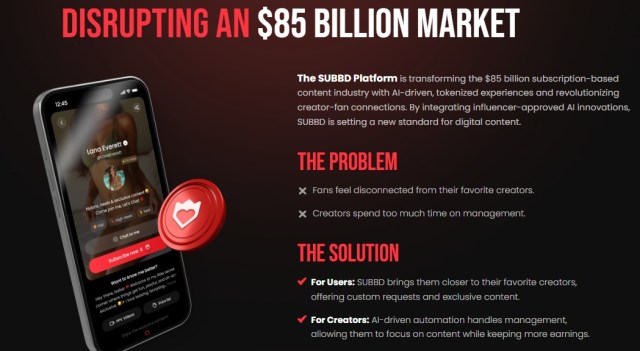
This is critical. In a market where consistency is currency, AI tools that optimize workflow are just as valuable as the payment rails themselves.

Plus, the platform introduces a governance model where the $SUBBD token dictates feature rollouts. This aligns with the broader industry trend of moving control back to the users, mirroring the ethos of Buterin’s DAO-centric proposals. By removing the 70% revenue cuts common in Web2, the project effectively redistributes value from the platform back to the talent.

Check out the SUBBD whitepaper for more details.

You can buy $SUBBD here.

Presale Data Shows Demand for Decentralized Content Platforms

Market sentiment is shifting toward utility-driven assets, and the capital flows prove it. According to official reporting, SUBBD Token ($SUBBD) has raised over $1.4M in its ongoing presale. This level of early-stage liquidity indicates strong investor appetite for projects that bridge the gap between AI technology and crypto-economic incentives.
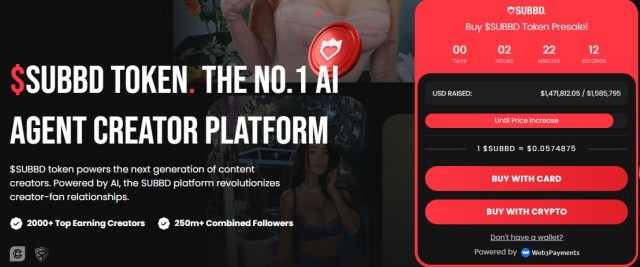
Smart money is watching the entry price carefully. With tokens currently priced at $0.05749, the valuation allows for accessible entry before potential listing volatility kicks in. Unlike meme coins driven purely by hype cycles, this capital raise appears underpinned by a clear revenue model and a staking protocol designed to lock up supply.

The protocol offers a fixed 20% APY for the first year of staking. This incentivizes long-term holding, stabilizing the token economy while the platform scales its user base. For investors, the combination of high-yield staking and exclusive access to ‘HoneyHive’ benefits, such as beta access and XP multipliers, creates a dual value proposition: immediate yield and future utility.

As the creator economy continues to expand, platforms that offer financial sovereignty combined with operational AI tools are positioned to capture significant market share.

Visit the official site to view the presale.

The content provided here is for informational purposes only and does not constitute financial advice. Crypto assets are high-risk investments. Always conduct independent due diligence before investing.


Related Questions

QWhat does Vitalik Buterin call the concept of merging DAOs and prediction markets, and what is its purpose?

AVitalik Buterin calls the concept 'info finance.' Its purpose is to provide a truth-seeking mechanism for on-chain governance by requiring participants to have 'skin in the game,' which can filter noise from signal and shift content curation from opaque Web2 algorithms to transparent, market-driven systems.

QHow does SUBBD Token ($SUBBD) aim to disrupt the creator economy according to the article?

ASUBBD Token ($SUBBD) aims to disrupt the $85 billion creator economy by merging Web3 infrastructure with advanced AI tools, such as an AI Personal Assistant and AI Voice Cloning technology, to lower operational barriers, remove high platform revenue cuts (up to 70%), and provide permissionless payments, thereby redistributing value from platforms back to creators.

QWhat are some key features of the SUBBD platform mentioned in the article?

AKey features of the SUBBD platform include AI-driven tools like an AI Personal Assistant for automated interactions, proprietary AI Voice Cloning technology, a governance model where the $SUBBD token dictates feature rollouts, and a staking protocol offering a fixed 20% APY for the first year to incentivize long-term holding.

QWhat does the presale data for SUBBD Token ($SUBBD) indicate about investor sentiment?

AThe presale data, which shows that SUBBD Token has raised over $1.4M, indicates strong investor appetite for utility-driven projects that bridge AI technology with crypto-economic incentives. This reflects a market shift towards assets with clear revenue models and practical applications, rather than those driven purely by hype.

QHow does the article contrast Vitalik Buterin's vision with the approach of SUBBD Token?

AThe article contrasts Vitalik Buterin's vision, which focuses on improving the curation layer of the creator economy through 'info finance' and prediction-market-based DAOs, with SUBBD Token's approach, which targets the operational layer by providing AI tools and Web3 infrastructure to reduce friction, eliminate high platform fees, and empower creators directly.

Related Reads

VCs on 2025 Crypto Investments: 84% of 118 Tokens Break Issue Price, Only One Type of Company is Quietly Making Money

Crypto investor Ching Tseng categorizes the market into four quadrants based on two axes: crypto-native vs. traditional finance (TradFi)-oriented, and having traction vs. no traction. In 2025, 84.7% of 118 tracked token launches fell below their issuance price, with a median fully diluted valuation drop of 71%. Crypto-native projects without traction are experiencing massive capital destruction, often relying on speculative narratives without sustainable revenue or user retention. Crypto-native teams with traction, often built in prior cycles, generate real revenue but face structural challenges with their tokens lacking direct value capture mechanisms. While some have implemented successful buyback programs, the core issue remains finding growth beyond crypto volatility. TradFi-oriented startups without traction face long, costly enterprise sales cycles but benefit from a robust M&A environment, with crypto acquisitions reaching a record $8.6 billion in 2025. The current winners are TradFi-oriented companies with traction, particularly in the Real World Asset (RWA) tokenization space, which grew from $5.5B to $18.6B in 2025. They are winning through enterprise sales, building alliances, and improving unit economics on established compliance stacks. Their main risk is being bypassed by large incumbent institutions building their own infrastructure. The overarching theme is market maturation, where narrative alone is insufficient for long-term success.

marsbit17m ago

VCs on 2025 Crypto Investments: 84% of 118 Tokens Break Issue Price, Only One Type of Company is Quietly Making Money

marsbit17m ago

Trading

Spot
Futures
活动图片