Vitalik Buterin Argues Ethereum’s Biggest Use Case Is Data Availability

bitcoinistPublished on 2026-03-13Last updated on 2026-03-13

Abstract

Vitalik Buterin argues that Ethereum's primary value is not smart contracts or payments, but its role as a censorship-resistant "public bulletin board" for data availability. This foundational layer is critical for cryptographic systems like secure voting and version control. Buterin highlights scaling solutions like PeerDAS, which significantly boost data capacity, positioning Ethereum as key infrastructure for a broader, privacy-preserving internet. While payments and smart contracts remain important, they are secondary, often serving anti-spam or security functions. He concludes that Ethereum is best understood as "global shared memory" and that current low fees and improved tooling make this vision more achievable than ever.

Ethereum co-founder Vitalik Buterin says the network’s clearest value proposition may not be smart contracts or payments, but something more foundational: acting as a censorship-resistant public data layer. In a post reflecting on conversations at Real World Crypto and related events, Buterin argued that stepping outside “blockchain baggage” makes ETH’s core utility easier to see.

“I was recently at Real World Crypto (that’s crypto as in cryptography) and the associated side events, and one thing that struck me was that it was a clarifying experience in terms of understanding what blockchains are for,” Buterin wrote. “We blockchain people (myself included) often have a tendency to start off from the perspective that we are Ethereum, and therefore we need to go around and find use cases for Ethereum.”

Ethereum’s Core Value Starts With A ‘Public Bulletin Board’

His point was less about defending Ethereum as a brand than re-evaluating it as infrastructure. “For a moment, let us forget that we are ‘the Ethereum community’. Rather, we are maintainers of the Ethereum tool,” he wrote, asking where the network adds value when viewed with “zero attachment to Ethereum specifically.”

The first answer, he said, is “not what you think.” It is “not smart contracts, it’s not even payments,” but what cryptographers call a “public bulletin board”, a publicly readable and writable place to post data blobs. That matters because a range of cryptographic systems, including secure online voting, software and website version control, and certificate revocation, depend on exactly that kind of shared infrastructure.

“This does not require any computation functionality,” Buterin wrote. “In fact, it does not directly require money, though it does indirectly require money, because if you want permissionless anti-spam it has to be economic. The only thing it fundamentally requires is data availability.”

That framing leads directly to Ethereum’s recent scaling work. Buterin highlighted PeerDAS, which he said increased Ethereum’s data availability capacity by 2.3x, with a roadmap to push that another 10x to 100x higher. In his telling, that makes Ethereum increasingly relevant not just for onchain finance, but for a broader class of open, privacy-preserving internet infrastructure.

Payments still matter, but as a secondary layer in the stack. Buterin argued that many systems need value transfer not primarily for commerce, but for anti-spam, sybil resistance, and machine-to-machine coordination. He pointed to Ethereum plus ZK payment channels as a strong design for permissionless APIs, and said ETH can serve as a “natural backstop” for applications that want to resist fake-account abuse without relying on phone numbers or other centralized identity rails.

Smart contracts come after that. Here, Buterin described them as useful for security deposits, for implementing constructs like ZK payment channels, and for managing pointers to “digital objects” tied to socially recognized external entities. Technically, he said, most non-ETH use cases could be handled by treating the chain as a bulletin board and using ZK-SNARKs for computation off-chain. In practice, though, standardizing that model is difficult, and shared execution remains the more interoperable route.

The broader claim is that Ethereum works best when understood as “global shared memory” inside a decentralized software stack. Buterin suggested adoption may still lag that reality because many builders are operating with outdated assumptions from 2020 to 2022, when fees were far higher and scaling looked less mature. Today, he argued, fees are “extremely low,” the roadmap is stronger, and tooling to shield users from fee volatility has improved.

At press time, ETH traded at 2,110.
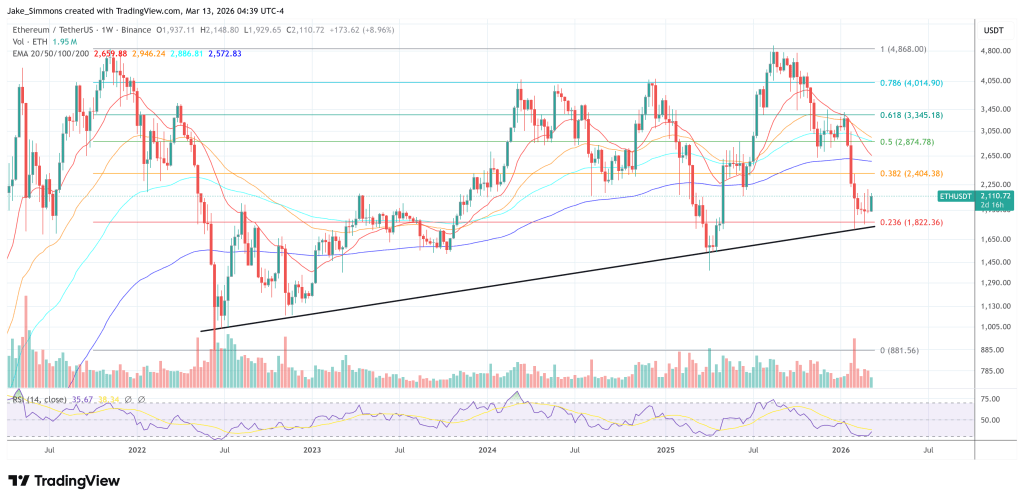
ETH must break the 0.382 Fib, 1-week chart | Source: ETHUSDT on TradingView.com

Related Questions

QWhat does Vitalik Buterin argue is Ethereum's clearest value proposition according to the article?

AVitalik Buterin argues that Ethereum's clearest value proposition is not smart contracts or payments, but acting as a censorship-resistant public data layer, which cryptographers call a 'public bulletin board'.

QWhat specific Ethereum scaling solution did Buterin highlight, and by how much did it increase data availability capacity?

AButerin highlighted PeerDAS, which he said increased Ethereum's data availability capacity by 2.3x, with a roadmap to push that another 10x to 100x higher.

QAccording to Buterin, what is the primary purpose of value transfer (payments) in many systems built on Ethereum?

AButerin argued that many systems need value transfer not primarily for commerce, but for anti-spam, sybil resistance, and machine-to-machine coordination.

QHow does Buterin describe the role of smart contracts in the context of Ethereum's primary use case?

AButerin described smart contracts as useful for security deposits, implementing constructs like ZK payment channels, and managing pointers to 'digital objects', but positioned them as coming after the core data availability function.

QWhat reason does Buterin suggest for why adoption of Ethereum's current capabilities might be lagging?

AButerin suggested adoption may lag because many builders are operating with outdated assumptions from 2020 to 2022, when fees were far higher and scaling looked less mature, despite current low fees and a stronger roadmap.

Related Reads

VCs on 2025 Crypto Investments: 84% of 118 Tokens Break Issue Price, Only One Type of Company is Quietly Making Money

Crypto investor Ching Tseng categorizes the market into four quadrants based on two axes: crypto-native vs. traditional finance (TradFi)-oriented, and having traction vs. no traction. In 2025, 84.7% of 118 tracked token launches fell below their issuance price, with a median fully diluted valuation drop of 71%. Crypto-native projects without traction are experiencing massive capital destruction, often relying on speculative narratives without sustainable revenue or user retention. Crypto-native teams with traction, often built in prior cycles, generate real revenue but face structural challenges with their tokens lacking direct value capture mechanisms. While some have implemented successful buyback programs, the core issue remains finding growth beyond crypto volatility. TradFi-oriented startups without traction face long, costly enterprise sales cycles but benefit from a robust M&A environment, with crypto acquisitions reaching a record $8.6 billion in 2025. The current winners are TradFi-oriented companies with traction, particularly in the Real World Asset (RWA) tokenization space, which grew from $5.5B to $18.6B in 2025. They are winning through enterprise sales, building alliances, and improving unit economics on established compliance stacks. Their main risk is being bypassed by large incumbent institutions building their own infrastructure. The overarching theme is market maturation, where narrative alone is insufficient for long-term success.

marsbit20m ago

VCs on 2025 Crypto Investments: 84% of 118 Tokens Break Issue Price, Only One Type of Company is Quietly Making Money

marsbit20m ago

Trading

Spot
Futures

Hot Articles

Discussions

Welcome to the HTX Community. Here, you can stay informed about the latest platform developments and gain access to professional market insights. Users' opinions on the price of S (S) are presented below.

活动图片