Vitalik Announced Selling Coins in Advance, Why Did the Market Still Panic?

比推Published on 2026-02-27Last updated on 2026-02-27

Abstract

In February 2026, amid a prolonged crypto market downturn and a six-month consecutive decline in Ethereum's price, co-founder Vitalik Buterin sold approximately 19,326 ETH through 532 transactions. This action, which exceeded his initial announcement of selling 16,384 ETH, was executed transparently via a single address and CoW Swap to minimize market impact. Vitalik had publicly disclosed his plans in late January, explaining that the proceeds would fund public goods and open-source projects, including privacy tech, security hardware, and biotech tools—areas affected by the Ethereum Foundation's budget cuts. He emphasized that the sales were not for personal gain but to support ecosystem sustainability. Despite the transparency, the larger-than-expected sell-off during a fragile market period intensified fears and selling pressure among investors, potentially exacerbating ETH's decline. The move raised concerns about market confidence, even as Vitalik maintained his commitment to ethical and open financial practices.

Author: Sanqing, Foresight News

Original Title: Vitalik Sold Nearly 20,000 ETH in a Single Month, What's Behind the Founder Leading the Sell-Off?


February 2026, the crypto market continued to slump, with Ethereum experiencing a monthly decline for six consecutive months, with a maximum intra-month drop of nearly 30%. During this period, an address associated with Ethereum co-founder Vitalik Buterin executed 532 sell operations. According to Etherscan data, the last sell operation was completed at 19:40 on February 26, with the address accumulating sales of approximately 19,326 ETH.
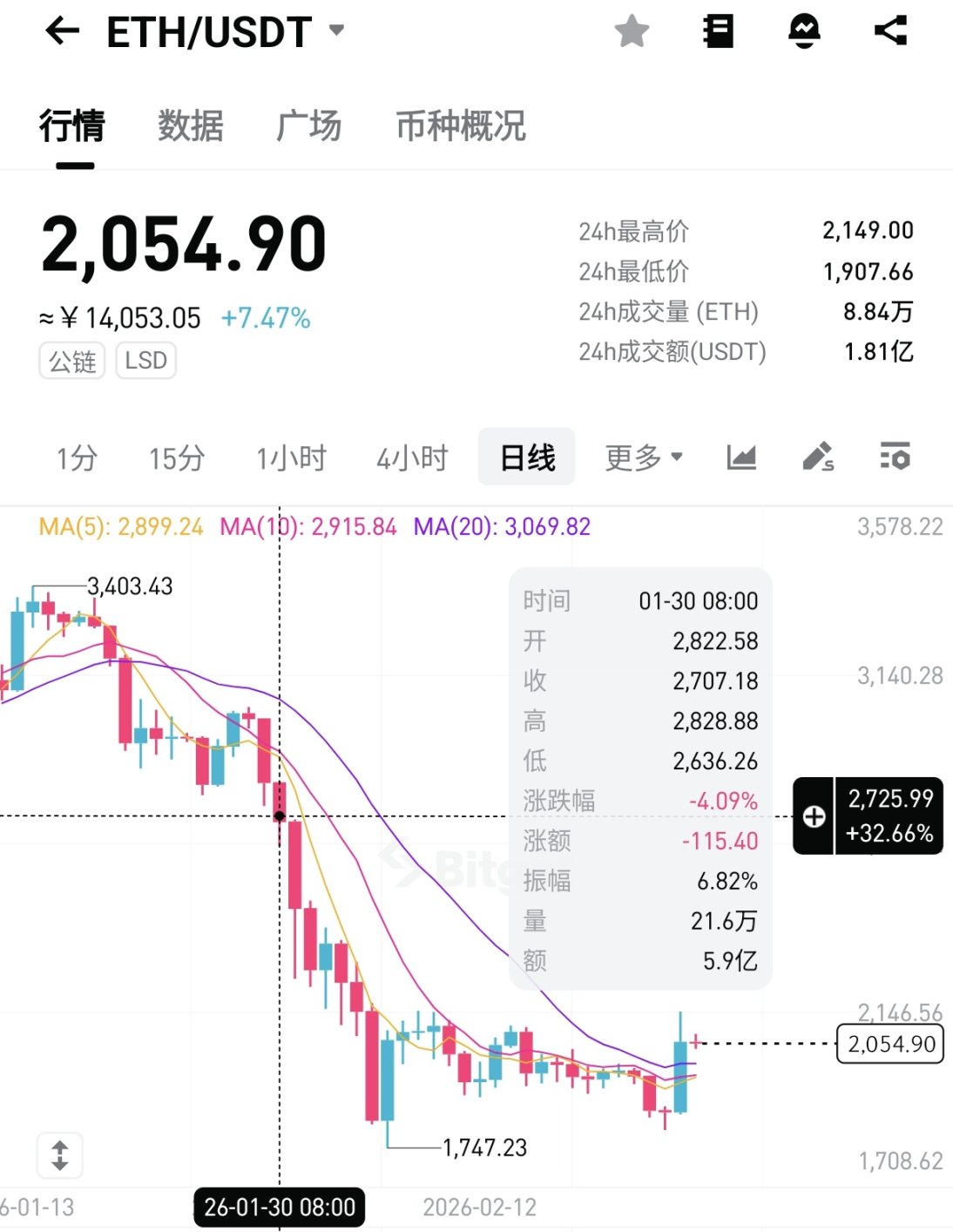
Image Source: Bitget Market

Three "Transparencies": Advance Notice, Purpose, and Public Execution

Vitalik's plan for this fund movement was announced in advance. On January 30, Vitalik published a long post via his personal X account, announcing that he would withdraw 16,384 ETH (worth approximately $44 million at the time) from his personal wallet and gradually liquidate it.
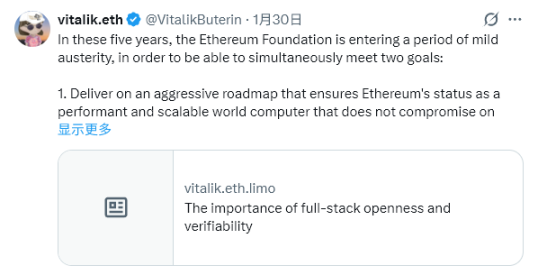
Image Source: Vitalik's Tweet

He explained that this move was his personal response to the Ethereum Foundation (EF) entering a phase of "mild austerity." The EF plans to reduce its annual spending from 15% of the treasury to 5% over 5 years, focusing more on core protocol development.

Vitalik also detailed the allocation of the funds in his post. The proceeds from this sale will be used to fund open-source projects and public goods, with a focus on privacy technologies (ZK proofs, fully homomorphic encryption FHE, differential privacy), secure hardware, verifiable computation, encrypted communication, local-first software, open-source operating systems, biotech/public health tools, and governance coordination mechanisms. These areas are mostly critical but marginalized sectors following EF's austerity. Vitalik emphasized that this was his personal decision to share the responsibility of EF's austerity.

Furthermore, the entire selling process was fully traceable through on-chain tools. Vitalik used a single address (0xfEB016D0D14AC0Fa6d69199608B0776d007203B2) and executed the sales in small batches via a single protocol (CoW Swap) to minimize market impact.

One "Unexpected": Execution Volume Slightly Higher Than Announced

Despite the high transparency, the execution result slightly differed from the initial announcement. The actual sales volume from Vitalik's address exceeded the previously announced 16,384 ETH, totaling approximately 19,326 ETH sold (an excess of about 2,942 ETH).

This sale began in the early hours of February 3, paused for about 10 days, and resumed on the 22nd, with acceleration occurring mainly in the last two days. Specifically, approximately 4,211.5 ETH were sold on February 5, about 2,283 on the 25th, and about 6,297 on the 26th.

Data Source: Etherscan & Bitget | Note: Data for the 26th is as of the time of the last sell operation

Whether the announced total was only a rough target or if unpublicized changes occurred during execution, Vitalik has not provided further explanation yet.

Vitalik has stated: "Since 2018, I have never sold ETH for personal wealth accumulation. Essentially all proceeds from sales have been used for donations, funding open-source projects, or charitable causes."
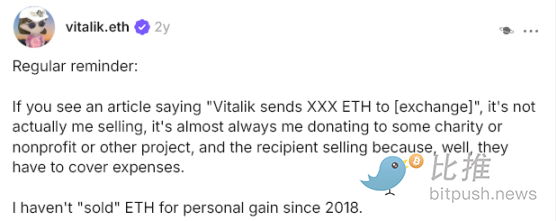
Image Source: Vitalik Farcaster Post

Moreover, compared to some project teams quietly offloading tokens, leading to post-factum crashes or trust crises, Vitalik's "open card selling" appears indeed healthier. This ETH sale plan, at least superficially, continues the path of transparency and non-personal profit.

However, objectively speaking, the founder accelerating coin sales at a rebound node during a continuous price decline may deal a blow to community and investor confidence. Market sentiment was already fragile; Vitalik's actions could amplify FUD (Fear, Uncertainty, Doubt), even compounding overall bear market pressures, pushing ETH to explore lower levels. In the short term, this may exacerbate selling by holders, affecting Ethereum's rebound trend and ecosystem stability.


Twitter:https://twitter.com/BitpushNewsCN

Bitpush TG Discussion Group:https://t.me/BitPushCommunity

Bitpush TG Subscription: https://t.me/bitpush

Original Link:https://www.bitpush.news/articles/7615139

Related Questions

QWhy did Vitalik Buterin sell nearly 20,000 ETH in February 2026?

AVitalik Buterin sold ETH as a personal response to the Ethereum Foundation's plan to reduce its annual spending from 15% to 5% of its treasury over five years, focusing more on core protocol development. The funds from the sale were intended to support open-source projects and public goods in areas like privacy technology, security hardware, and public health tools.

QHow did Vitalik's actual selling amount compare to his initial announcement?

AVitalik initially announced he would sell 16,384 ETH, but the actual amount sold was approximately 19,326 ETH, which is about 2,942 ETH more than planned. He has not provided further explanation for this discrepancy.

QWhat was the market impact of Vitalik's ETH sales during this period?

AThe sales occurred during a period of continuous decline for Ethereum, with a monthly drop of nearly 30%. Vitalik's actions, especially during a market rebound, potentially amplified FUD (Fear, Uncertainty, and Doubt), contributing to increased selling pressure and further price declines for ETH.

QHow transparent was Vitalik regarding his ETH sales?

AVitalik was highly transparent: he announced the sale plan in advance on his X account, detailed the intended use of the funds for public goods, and executed the sales through a single address and protocol (CoW Swap) in small batches to minimize market impact, with all transactions publicly traceable on the blockchain.

QWhat areas did Vitalik plan to fund with the proceeds from the ETH sale?

AThe proceeds were allocated to support open-source projects and public goods, including privacy technologies (such as ZK proofs and FHE), security hardware, verifiable computing, encrypted communication, local-first software, open-source operating systems, biotech/public health tools, and governance coordination mechanisms.

Related Reads

SpaceX Ties Up with Cursor: A High-Stakes AI Gambit of 'Lock First, Acquire Later'

SpaceX has secured an option to acquire AI programming company Cursor for $60 billion, with an alternative clause requiring a $10 billion collaboration fee if the acquisition does not proceed. This structure is not merely a potential acquisition but a strategic move to control core access points in the AI era. The deal is designed as a flexible, dual-path arrangement, allowing SpaceX to either fully acquire Cursor or maintain a binding partnership through high-cost collaboration. This "option-style" approach minimizes immediate regulatory and integration risks while ensuring long-term alignment between the two companies. At its core, the transaction exchanges critical AI-era resources: SpaceX provides its Colossus supercomputing cluster—one of the world’s most powerful AI training infrastructures—while Cursor contributes its AI-native developer environment and strong product adoption. This synergy connects compute power, models, and application layers, forming a closed-loop AI capability stack. Cursor, founded in 2022, has achieved rapid growth with over $1 billion in annual revenue and widespread enterprise adoption. Its value lies in transforming software development through AI agents capable of coding, debugging, and system design—positioning it as a gateway to future software production. For SpaceX, this move is part of a broader strategy to evolve from a aerospace company into an AI infrastructure empire, integrating xAI, supercomputing, and chip manufacturing. Controlling Cursor fills a gap in its developer tooling layer, strengthening its AI narrative ahead of a potential IPO. The deal reflects a shift in AI competition from model superiority to ecosystem and entry-point control. With programming tools as a key battleground, securing developer loyalty becomes crucial for dominating the software production landscape. Risks include questions around Cursor’s valuation, technical integration challenges, and potential regulatory scrutiny. Nevertheless, the deal underscores a strategic bet: controlling both compute and software development access may redefine power dynamics in the AI-driven future.

marsbit6m ago

SpaceX Ties Up with Cursor: A High-Stakes AI Gambit of 'Lock First, Acquire Later'

marsbit6m ago

Trading

Spot
Futures

Hot Articles

Discussions

Welcome to the HTX Community. Here, you can stay informed about the latest platform developments and gain access to professional market insights. Users' opinions on the price of ETH (ETH) are presented below.

活动图片