Visa Launches Stablecoin Settlement For US Financial Institutions With Circle’s USDC

bitcoinistPublished on 2025-12-17Last updated on 2025-12-17

Abstract

Global payments leader Visa has expanded its stablecoin settlement capabilities to the United States, enabling financial institutions to settle transactions with Visa using Circle’s USDC stablecoin on the Solana blockchain. This initiative, part of Visa's broader strategy to modernize its settlement infrastructure, offers partners like Cross River Bank and Lead Bank faster fund movement, 24/7 availability, and enhanced operational efficiency without altering the consumer card experience. Visa also plans to utilize Circle’s upcoming Arc blockchain and has launched a Stablecoins Advisory Practice to guide businesses on strategy and implementation. The company reported $3.5 billion in stablecoin settlement volume as of late November, highlighting growing institutional adoption.

Global payment giant Visa has announced the launch of stablecoin settlement in the United States using Circle’s USDC on the Solana Blockchain. The expansion follows the company’s ongoing efforts to modernize its settlement layer and be at the forefront of the emerging sector.

Visa Expands USDC Settlement To The US

On Tuesday, Visa unveiled the expansion of its stablecoin settlement service to financial institutions in the US, allowing local issuer and acquirer partners to settle with Visa in Circle’s USDC for the first time.

In the statement, the payments giant highlighted that issuers will benefit from faster fund movement over blockchains, seven‐day availability, and enhanced operational resilience across weekends and holidays “without any change to the consumer card experience.”

Initial participants include Cross River Bank and Lead Bank, which have started settling with Visa in USDC on the Solana blockchain. Meanwhile, a wider rollout in the US is planned through 2026.

In addition, Visa shared its plan to utilize Arc, a new Layer 1 blockchain developed by Circle, which is currently in public testnet, for USDC settlement within its network and to operate a validator node once Arc goes live.

The global payments giant underscored that the launch marks a significant milestone in the company’s stablecoin settlement pilot program and strategy to modernize its settlement layer, which underpins global commerce.

Notably, Visa first experimented with USDC settlement in 2021 and became one of the first major payments networks to pilot stablecoin settlement using USDC in 2023. Now, Visa has reported more than 130 stablecoin-linked card issuing programs in over 40 countries.

Last month, the company announced the expansion of its stablecoin settlement in Central and Eastern Europe, the Middle East, and Africa (CEMEA) with a partnership with crypto infrastructure company Aquanow.

“Visa is expanding stablecoin settlement because our banking partners are not only asking about it – they’re preparing to use it,” affirmed Rubail Birwadker, Global Head of Growth Products and Strategic Partnerships, Visa.

“Financial institutions are looking for faster, programmable settlement options that integrate seamlessly with their existing treasury operations. By bringing USDC settlement to the U.S., Visa is delivering a reliable, bank‐ready capability that improves treasury efficiency while maintaining the security, compliance and resiliency standards our network requires,” he added.

Meanwhile, Circle emphasized the importance of integrating fully reserved stablecoins into institutions’ settlement flows. Nikhil Chandhok, Chief Product and Technology Officer at Circle, noted that “it helps card-issuing financial institutions modernize treasury and unlock new services while retaining the transparency and trust that USDC is known for.”

Visa’s New Stablecoin Advisory Unit

This week, Visa also announced the launch of its Stablecoins Advisory Practice (SAP) service by Visa Consulting & Analytics (VCA) for insights and recommendations to guide banks, fintechs, merchants, and businesses on market fit, strategy, and implementation.

The new stablecoins advisory unit is set to offer a suite of services “designed to guide strategy and implementation amid the growing prevalence and stability of stablecoin infrastructure and emerging regulatory standards.”

Notably, it will provide training and market trend programs, including a new Visa University course, strategy development, market entry planning, use case sizing, go-to-market planning, and Technology enablement for stablecoin integration.

Visa affirmed that it recorded a $3.5 billion stablecoin settlement volume as of November 30, which has led businesses to its new Stablecoins Advisory Practice for growth opportunities.

Matt Freeman, senior vice president at the Navy Federal Credit Union, stated that “Stablecoins may represent an opportunity to enhance speed and lower cost in payments, so with the support of Visa, we are evaluating how this technology could fit into our broader strategy to deliver meaningful value to our 15 million members worldwide.”
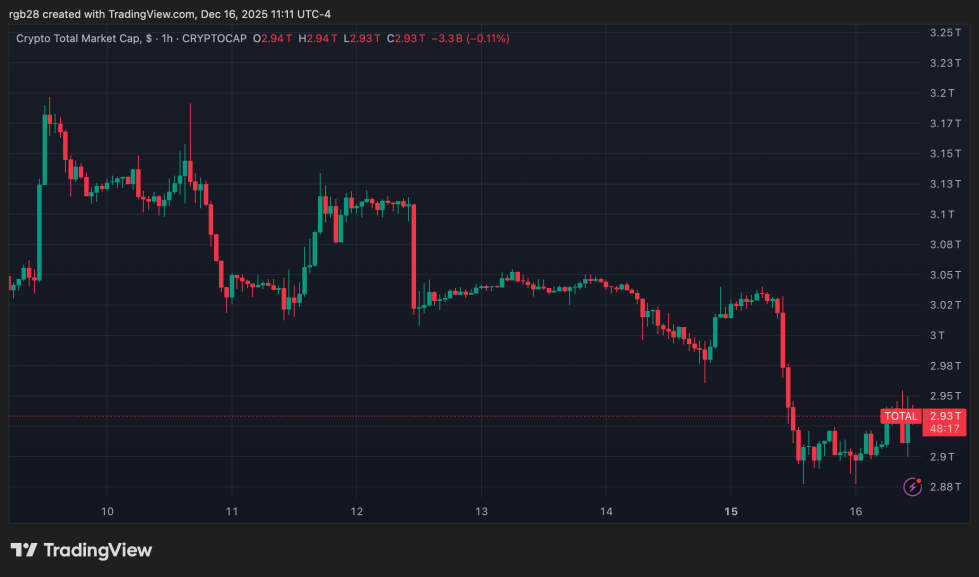
The total crypto market capitalization is at $2.93 trillion on the one-week chart. Source: TOTAL on TradingView


Trending Cryptos

Related Reads

human.tech Launches Clean SDK for Privacy-First Web3 Apps

human.tech has launched the Clean SDK, a toolkit enabling developers to build privacy-first Web3 applications with transparent accountability. Released alongside Aztec's version 5, the SDK provides components for integrating zero-knowledge identity verification, sanctions screening, and private transactions, without developers handling sensitive user data or building compliance infrastructure from scratch. It uses zero-knowledge proofs and programmable verification to allow apps to confirm user legitimacy and sanctions compliance while keeping identities confidential. The first application built on the SDK, Shield, a privacy bridge to Aztec, also launched. It allows users to transfer assets privately while proving a unique human is behind each transfer and that funds have passed sanctions checks, as verified by a May 2026 audit. The SDK offers three core verification techniques: Proof of Innocence (sanctions screening against 23 sources), Proof of Personhood (simpler verification via Human Passport), and Proof of Clean Hands (higher-assurance zero-knowledge government ID checks). This allows apps to authenticate users and transactions without exposing personal data. Designed for Aztec builders, the SDK lets developers add programmable privacy to decentralized apps, eliminating the need to create their own verification and ZK infrastructure. Shield demonstrates its practical use for private bridges, but the SDK aims to enable a wider ecosystem of private, accountable financial apps and services. The launch addresses growing demand for infrastructure that balances privacy and accountability. The SDK avoids traditional identity databases, storing encrypted data off-chain, screening at both entry and exit points, and including a gated disclosure mechanism for legal requests. human.tech's products, including the Clean SDK, focus on using zero-knowledge technology to enable verifiable personhood and privacy in digital systems.

TheNewsCrypto13m ago

human.tech Launches Clean SDK for Privacy-First Web3 Apps

TheNewsCrypto13m ago

Unlocking $100 Million in Liquidity? Pump.fun's New Policy Tests the 5-Minute Pump Technique

Pump.fun, a popular meme coin launchpad, has introduced a new standard mechanism called BOOST. It aims to address a significant capital efficiency issue: when a newly launched token graduates from its initial bonding curve to a liquidity pool (LP), roughly 20% of its liquidity becomes permanently locked as "dead liquidity," estimated to waste over $100 million annually. Instead of locking these funds permanently, BOOST repurposes them. Upon a token's migration, approximately 20% of the settlement funds (e.g., 17.6 SOL or ~$2516 USDC) are used to buy back the token on the open market over a 5-minute period via a Time-Weighted Average Price (TWAP) mechanism. All purchased tokens are immediately burned. This creates a brief, systematic buy pressure immediately after migration, potentially generating a short-term price surge ("pump") while permanently reducing the token's circulating supply. The goal is to enhance the immediate post-launch trading experience, potentially increasing trader retention and sustainable protocol revenue, which funds ongoing token buybacks. However, concerns exist that this artificial 5-minute boost could lower the barrier for launching low-quality tokens and lead to steeper price crashes once the buy pressure stops, if followed by large sell-offs. The feature automatically applies to tokens migrating after July 21, 2024, but not to previously migrated tokens or those launched via the Mayhem AI Agent lab.

marsbit21m ago

Unlocking $100 Million in Liquidity? Pump.fun's New Policy Tests the 5-Minute Pump Technique

marsbit21m ago

Podcast Notes | Conversation with GSR Asset Management Head: To Determine if This Crypto Rally is Real, Just Watch the Lending Rates on Aave

Podcast Summary: Dialogue with GSR's Head of Asset Management: To Determine if This Crypto Rally is Real, Just Check Lending Rates on Aave Andy Baehr, Managing Director of Asset Management at GSR, discusses the current crypto market, characterizing it as stuck in a state of "ambivalence" with short-lived, unsustainable rallies. He outlines a simple framework: the market moves between "ambivalence" and "conviction" (sustained upward momentum). Currently, every rally resembles a single-stage rocket booster that quickly fizzles out. Baehr identifies three key signals to watch: 1) DeFi lending rates, 2) the potential passage of the CLARITY Act, and 3) the market forming a consensus on the "Fed hawkish peak." He emphasizes that the most immediate indicator for the sustainability of the recent CPI-triggered rally is the USDC borrowing rate on Aave, currently around 3.75%—close to U.S. Treasury yields. The absence of a credit spread indicates low leverage demand and a lack of market energy. He explains that a healthy, sustained rally requires layered buying pressure. Last year's rally progressed from an ETH short squeeze to crypto-native trader influx and finally to ETF inflows. Currently, this structure is missing. Other potential structural buyers like Digital Asset Treasury (DAT) companies are absent, and ETF flows have proven transient. Baehr notes that while small-cap crypto tokens outperformed large caps in Q2—a potential sign of capitation in major assets—capital is also flowing to more exciting opportunities like AI stocks and tech IPOs, leaving crypto sidelined. Regarding DeFi, he highlights that platforms like Aave provide a clear, real-time signal of leverage demand through their supply/demand-driven interest rates. A significant, sustained rate increase would signal genuine market conviction. He also observes the quiet emergence of fixed-income-like products and vaults in DeFi. On regulation, the probability of the CLARITY Act passing before the August 7th deadline has dropped linearly from 75% to below 40% on Polymarket. Baehr suggests its passage would be treated as a bullish surprise, a potent driver for price movement. However, political hurdles, including ethical clause debates and disclosures about the First Family's crypto profits, remain significant obstacles. Ultimately, the market awaits clarity on the Fed's terminal rate under Chair Warsh. Until the "Fed Solstice"—the point where the market collectively understands the peak of hawkish policy—sustained conviction will be difficult to achieve.

marsbit52m ago

Podcast Notes | Conversation with GSR Asset Management Head: To Determine if This Crypto Rally is Real, Just Watch the Lending Rates on Aave

marsbit52m ago

Trading

Spot

Hot Articles

Discussions

Welcome to the HTX Community. Here, you can stay informed about the latest platform developments and gain access to professional market insights. Users' opinions on the price of S (S) are presented below.

活动图片














