Venezuela, Sanctioned and Kicked Out of the Dollar System by the U.S., Turns to USDT

marsbitPublished on 2026-02-22Last updated on 2026-02-22

Abstract

Venezuela, heavily sanctioned by the US and cut off from the dollar system, has turned to USDT (Tether) to manage a significant portion of its national revenue, particularly from oil sales. An estimated 80% of the country's oil transactions are now conducted using the stablecoin. This shift was not a voluntary adoption of cryptocurrency but a necessity due to the inability to legally transact in USD. The Venezuelan government, which once banned stablecoins, now facilitates their use for both corporate and retail payments, including salaries and groceries. However, the use of cryptocurrencies like USDT remains limited in large-scale illicit activities, such as drug trafficking, where traditional cash-based and trade-based money laundering methods still dominate. US authorities have not emphasized crypto in recent indictments, suggesting that digital assets may not yet be practical for moving very large sums illicitly. Nonetheless, Venezuela’s embrace of a digital dollar sets a precedent for other nations under sanctions and may paradoxically reinforce the global dominance of the dollar.

Author: Blockworks

Compiled by: Deep Tide TechFlow

Deep Tide Introduction: Venezuela's case is the most powerful real-world footnote for stablecoins—not because they chose crypto, but because they had no other choice. This article demonstrates the complete path of a sovereign nation forced to adopt USDT under sanction pressure, while also revealing the real limitations of stablecoins in large-scale money laundering scenarios.
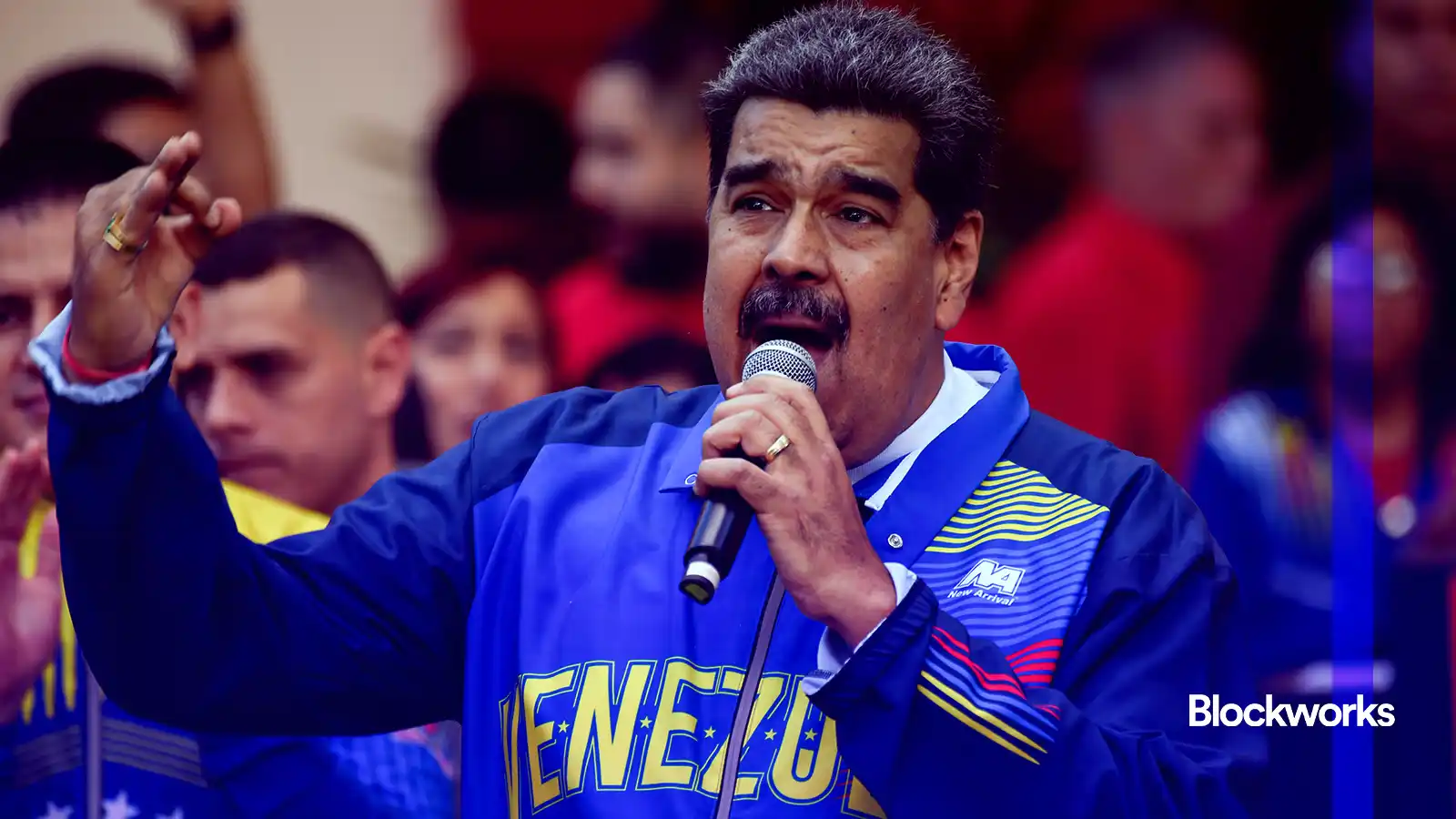
"I don't think it's a bad thing, this so-called 'dollarization' process... Thank God it exists."

— Nicolás Maduro

A recent report by The New York Times stated that Venezuela has become "the first country to manage a large portion of its fiscal revenue using cryptocurrency."

But this was not an active choice.

Approximately half of Venezuela's revenue comes from oil sales denominated in U.S. dollars. As a sanctioned country, Venezuela cannot legally send or receive dollars.

Previously, sanctioned governments typically exchanged oil for dollars—or bartered oil for goods or infrastructure investments—through a network of shell companies and offshore banks.

Now, they have a simpler option: accept stablecoins as payment. Economist Asdrúbal Oliveros estimates that Tether's USDT is the medium of exchange for about 80% of Venezuela's oil sales.

The Venezuelan government once banned the use of stablecoins for transactions, viewing them as a threat to the bolívar. But the devastating impact of U.S. sanctions left it with almost no choice, ultimately forcing it to embrace stablecoins.

Venezuela's current interim president, Delcy Rodriguez, acknowledged the inevitability of crypto-driven dollarization as early as August last year. She told business leaders at the time that "non-traditional management mechanisms" were being implemented to better manage the bolívar exchange rate.

Reuters reported shortly thereafter: "The Venezuelan government has allowed greater use of USDT since June." With state approval, banks now sell USDT obtained from oil sales to local businesses, which use these stablecoins to pay domestic and international suppliers.

They also hope stablecoins will circulate at the retail level: the head of Venezuela's National Supermarket Association recently stated on national television that grocery stores are advancing system upgrades to accept USDT payments.

In other words, the Venezuelan government is encouraging the use of dollars issued by Tether to replace its own currency, the bolívar.

As a result, USDT—which many Venezuelans call "Binance dollars"—is now used in various scenarios, "from buying groceries and paying apartment management fees to issuing salaries and paying suppliers."

So, for a stablecoin enthusiast like me, it was quite disappointing to see that the U.S. government's indictment against Nicolás Maduro didn't even mention cryptocurrency or stablecoins.

The indictment describes illegal fund flows using the old ways: planes returning from Mexico "loaded with drug proceeds"; weapons like grenades bartered for cocaine; protection fees paid by sharing shipments of cocaine; and a $2.5 million cash bribe.

Why no mention of cryptocurrency?

There are two possibilities: 1) The U.S. government has stopped publicly criticizing crypto, and prosecutors know when to skip it; or 2) Crypto and stablecoins are still inadequate for the scale of funding required by Maduro and his associates. The former is more interesting, but the latter is more likely the truth.

"It is difficult for the state to quickly liquidate these [crypto] assets," explained Asdrúbal Oliveros, "because transferring crypto funds requires going through various controls that are currently not being met."

A report by TRM Labs reached a similar conclusion: "Large-scale drug trafficking organizations still heavily rely on physical cash, trade-based money laundering, and the protection of state or quasi-state institutions when moving core proceeds. Cryptocurrency typically plays a secondary or complementary role rather than replacing these mechanisms."

Analysts from the national security think tank Lawfare also agree: "Cryptocurrency-based sanctions evasion remains a drop in the bucket compared to traditional illicit finance channels."

Some are more optimistic about the practicality of stablecoins and crypto in the field of "international payments."

For example, InSight Crime reported that Mexican drug cartels are sustained by an "industrial-scale crypto money laundering pipeline" that funnels black money through digital networks to Chinese chemical suppliers.

They detailed a niche market where stablecoins have found a fit: acting as intermediaries connecting Chinese money brokers who need dollars to sell to clients circumventing China's capital controls, and Mexican drug cartels who need to buy fentanyl precursor chemicals from China.

This isn't the product-market fit crypto enthusiasts hoped for, but in terms of actual behavior, the fit is quite strong. For instance, the DEA stated that its seizures of illicit cash have significantly decreased because criminal groups are "placing cryptocurrency above traditional cash laundering schemes."

Correspondingly, seizures of "virtual currency" have risen significantly: between 2020 and 2024, the DEA seized $2.5 billion in cryptocurrency, compared to only $2.2 billion in cash.

This might explain why Maduro and his associates stick to more traditional payment methods—traceable cryptocurrency and freezable stablecoins are not yet ready for the largest-scale money laundering needs.

Nonetheless, Venezuela's embrace of the digital dollar is setting a precedent. Lawfare concluded: "U.S. adversaries have established a working proof-of-concept, and emerging financial technologies may further consolidate it."

If that's the case, the U.S. dollar itself might be further consolidated as a result.

Being prohibited from using dollars did not push Venezuela to adopt the yuan for oil settlements—instead, it led the government to switch to the digital dollar.


Related Questions

QWhy has Venezuela turned to using USDT for its oil sales according to the article?

ADue to U.S. sanctions, Venezuela cannot legally send or receive U.S. dollars. Approximately 80% of its oil sales are now conducted using Tether's USDT as a transaction medium, as it provides a simpler alternative to traditional workarounds involving shell companies and offshore banks.

QWhat was the Venezuelan government's initial stance on stablecoins like USDT, and why did it change?

AThe Venezuelan government initially banned stablecoin transactions, viewing them as a threat to the Bolivar. However, the devastating impact of U.S. sanctions left them with almost no choice, forcing them to embrace stablecoins to manage revenue and economic activities.

QHow is USDT being used within Venezuela beyond oil sales, as mentioned in the article?

AUSDT is used for various daily transactions, including buying groceries, paying apartment management fees, disbursing salaries, and settling payments with suppliers. The government is encouraging its use at the retail level, with supermarkets adapting systems to accept USDT payments.

QWhy does the article suggest that cryptocurrencies and stablecoins were not mentioned in the U.S. government's indictment against Nicolás Maduro?

AThe article presents two possibilities: 1) The U.S. government has shifted away from publicly criticizing crypto, and prosecutors omitted it strategically, or 2) Cryptocurrencies and stablecoins are still inadequate for the scale of money laundering required by Maduro and his associates, with traditional methods like cash and trade-based laundering remaining dominant.

QWhat broader implication does the article highlight regarding the use of digital dollars like USDT in sanctioned economies?

AThe article suggests that Venezuela's adoption of USDT sets a precedent, creating a 'working proof-of-concept' for other U.S. adversaries. This could further entrench the use of digital dollars, ironically strengthening the U.S. dollar's role even in economies sanctioned by the U.S., rather than prompting a shift to alternatives like the Chinese yuan.

Related Reads

In Conversation with Ray Dalio: We Are Currently in an AI Bubble, with 1% of My Portfolio in Bitcoin

Ray Dalio, founder of Bridgewater Associates, warns in an interview that the current AI boom shows classic bubble characteristics, which could lead to significant economic downturns as seen in past cycles like 1929 or 2000. He explains that speculative enthusiasm, fueled by debt and overvaluation, often precedes a crash when rising rates or taxation force asset sales, causing widespread losses and recession. Dalio also outlines his "Big Cycle" theory, describing an approximate 80-year pattern where widening wealth gaps, massive government deficits, and shifting geopolitical power (like China's rise) create internal conflict and global instability. He emphasizes that we are in a late-cycle, transitional phase where traditional powers like the US and UK face decline. For personal wealth protection, Dalio advises diversification beyond cash into assets like stocks, bonds, real estate, and particularly gold, which he prefers over Bitcoin. While he holds about 1% of his portfolio in Bitcoin as a non-printable hard asset, he views gold as more secure from technological or governmental threats. Regarding AI's impact, Dalio believes it will disproportionately benefit capital owners, worsening inequality by replacing both physical and cognitive labor. He suggests that human intuition and emotional intelligence, combined with AI, will be key for future workers. On taxation, Dalio argues that wealth taxes are impractical and risk triggering asset sell-offs, reducing productive investment. He points to the UK as a cautionary example of debt, low productivity, and political strife. Geopolitically, Dalio foresees a more regionalized world, with the US showing weakness in prolonged conflicts like with Iran, akin to past imperial declines. The ideal outcome, he suggests, is coexisting powerful blocs (e.g., Americas, China-Asia Pacific) without major war.

marsbit1h ago

In Conversation with Ray Dalio: We Are Currently in an AI Bubble, with 1% of My Portfolio in Bitcoin

marsbit1h ago

Daily 7.2 Trillion KRW: Foreign Capital's Record Net Buying on Friday! Wall Street Says Headwinds for Korean Stock Fund Flows Have Subsided

South Korean stock market sees a dramatic shift in fund flows. On July 31, foreign investors made a record net purchase of approximately KRW 7.2 trillion in KOSPI stocks, marking a fundamental reversal from the persistent large-scale net outflows seen in previous months. This contributed to a significant narrowing of foreign net selling in July to KRW 9.8 trillion, down sharply from KRW 48.4 trillion in June and KRW 44.5 trillion in May. Simultaneously, domestic institutional pressure eased. South Korean pension funds and asset managers turned to a net buying position in July, purchasing KRW 1.0 trillion worth of KOSPI shares, contrasting with net sales in May and June. Market volatility is expected to be dampened by new financial regulations. Effective July 31, the Financial Services Commission tightened access for retail investors to single-stock leveraged ETFs by raising the minimum cash deposit requirement. Trading volumes for these products subsequently dropped to about 50% of their monthly average. Citigroup Research maintains its year-end KOSPI target of 10,000 points. The firm cites several supportive factors: the substantial easing of headwinds from capital outflows, a robust fundamental outlook for the semiconductor sector, historically low market valuations, strong economic fundamentals, and the potential for policy support from financial authorities if needed.

marsbit1h ago

Daily 7.2 Trillion KRW: Foreign Capital's Record Net Buying on Friday! Wall Street Says Headwinds for Korean Stock Fund Flows Have Subsided

marsbit1h ago

Thanks to Dice Rolls, Bitcoin Keys Are Stored Offline, But Not Everyone Will Do It

The article discusses using dice rolls to generate secure Bitcoin wallet seeds, providing entropy independent of potentially flawed hardware random number generators. It explains that each fair dice roll offers about 2.585 bits of entropy, with around 50 rolls needed for a standard 12-word seed phrase and 99+ recommended for higher security. This method gained attention after a vulnerability was revealed in some Coldcard hardware wallets, where a faulty firmware RNG (dating back to 2021) compromised generated keys. The analysis notes that while a dice-generated main seed was safe from this specific flaw, other Coldcard functions (like creating paper wallets, backup keys, or passwords) could still be vulnerable if they used the defective RNG. The piece argues that while dice-based entropy is technically robust, the manual process is error-prone, tedious, and unrealistic for most new users, who might make mistakes in recording or inputting rolls. It concludes that while manual entropy generation should remain an option for advanced users, the long-term goal is to develop reliable, user-friendly hardware and software that securely generates randomness without requiring specialized knowledge. Coldcard users are advised to check their firmware version and replace any secondary secrets (like paper wallet keys) created with vulnerable devices, while also considering multi-signature setups with devices from different manufacturers for added security.

cryptonews.ru6h ago

Thanks to Dice Rolls, Bitcoin Keys Are Stored Offline, But Not Everyone Will Do It

cryptonews.ru6h ago

Trading

Spot
活动图片




