Velvet crypto slides 75% in a week – Why bulls aren’t giving up yet

ambcryptoPublished on 2026-07-09Last updated on 2026-07-09

Abstract

Velvet (VELVET) has plummeted 75% in a week, with an additional 16% drop in the last 24 hours due to intense selling pressure. This bearish trend is reflected in a Taker Buy Sell Ratio below 1 and a 28% decline in Open Interest, indicating capital withdrawal from the perpetual market. Despite the sell-off, traders maintain a net long position, as shown by a positive Funding Rate. Their conviction is supported by Velvet's significant gains of 59% over the past month and 533% over the quarter. However, recent liquidations have favored short positions. Crucially, spot investors are accumulating, with $1.58 million in net purchases this week, nearly half in the last 48 hours, suggesting they view the price drop as a buying opportunity for a potential near-term rebound.

Velvet [VELVET] has fallen 75% over the past week, with losses continuing as bearish pressure intensifies. At press time, the asset had dropped another 16% in the last 24 hours under the same selling pressure.

The intriguing dynamic beneath the decline is that traders across both the spot and perpetual markets are holding buy-side positions, committing capital against the current tide for Velvet.

Velvet buckles under mounting sell pressure

Velvet is absorbing heavier selling pressure and bearish sentiment, a shift visible in the asset’s trading volume and the shrinking capital base across its perpetual market.

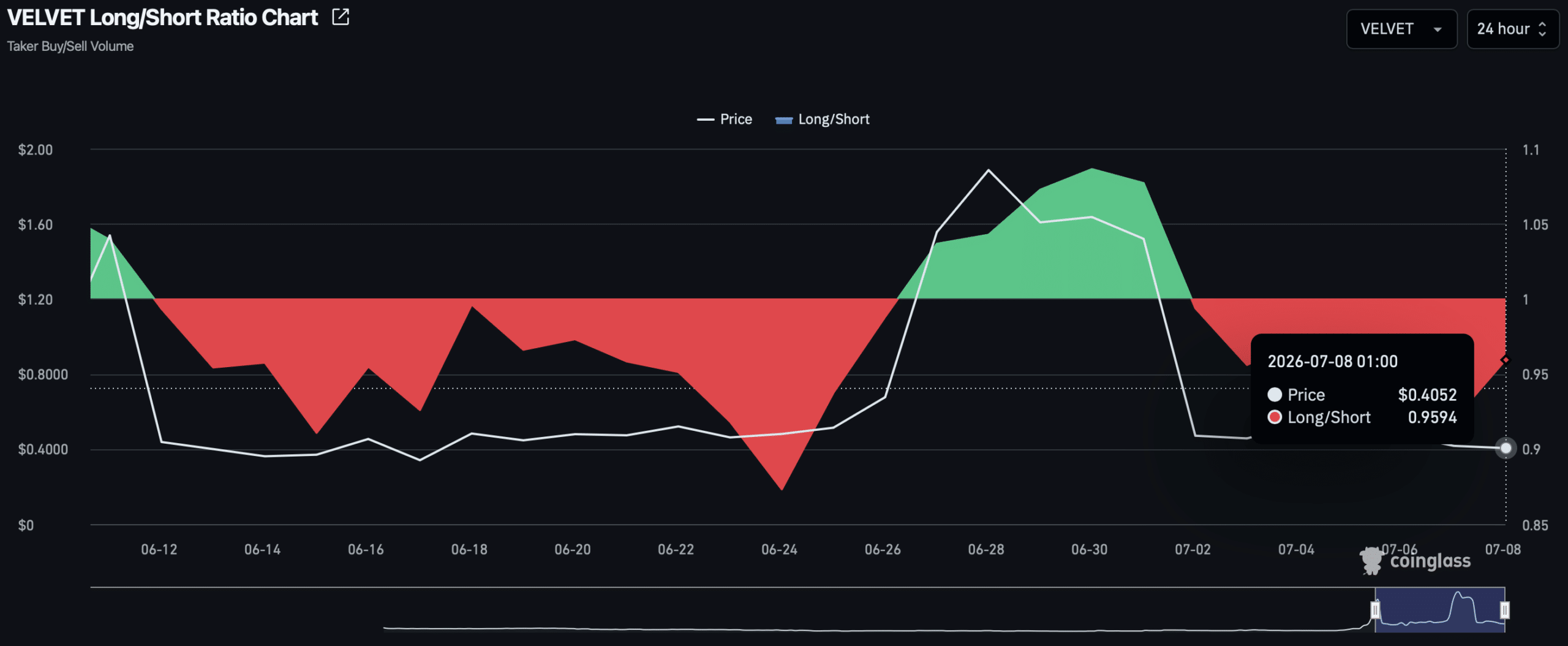
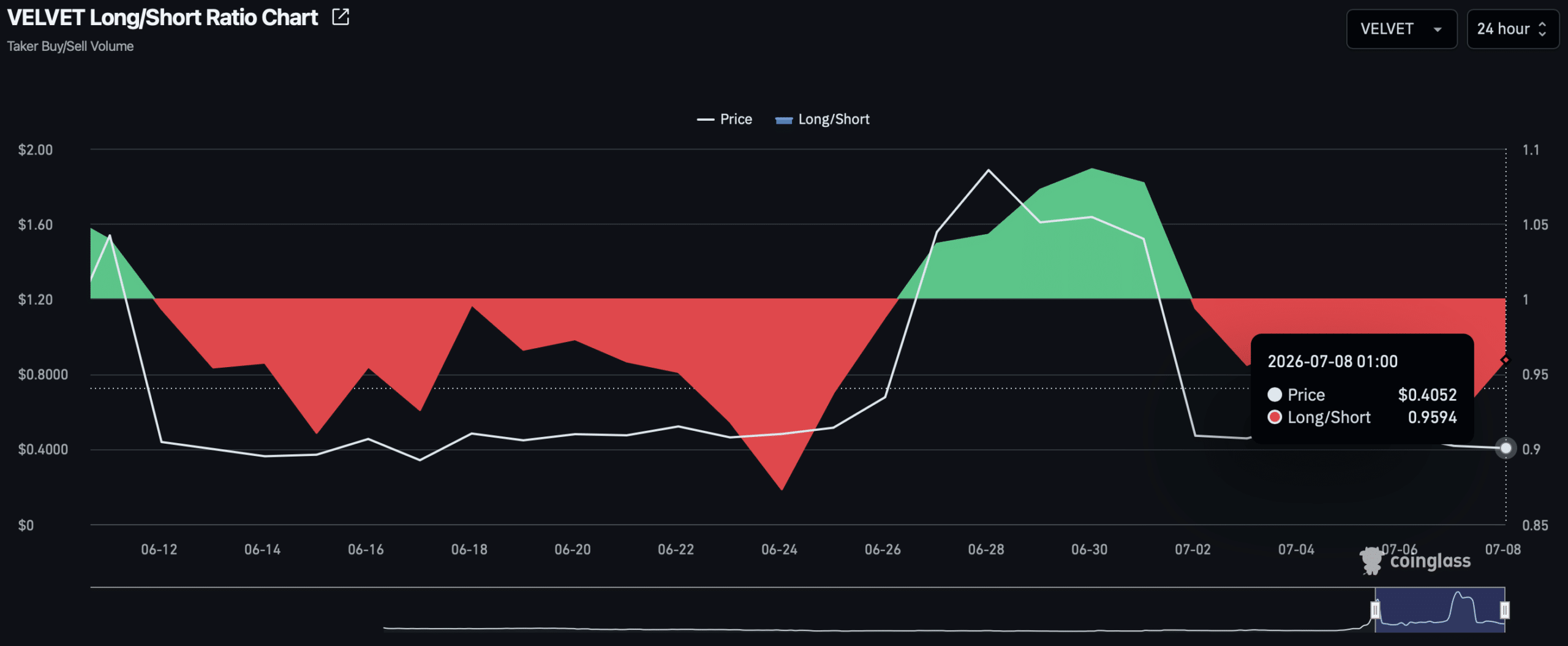
The Taker Buy Sell Ratio, which measures long trading volume against short trading volume in the perpetual market, has tilted toward the sell side as the reading slips to 0.95 as of writing.
Source: CoinGlass

A ratio below 1 signals that sellers are dominating volume across multiple accounts. The sell volume isn’t heavily exaggerated, though, since the figure sits only slightly beneath the 1 mark on the chart. That selling has coincided with a contracting capital base for Velvet in the perpetual market, as investors withdraw funds over concerns about high volatility.

CoinGlass data showed that Open interest, which tracks capital movement in the perpetual market, plunged from $29.36 million to $21.07 million, a 28% decline across the period.

Traders hold net long through the sell-off

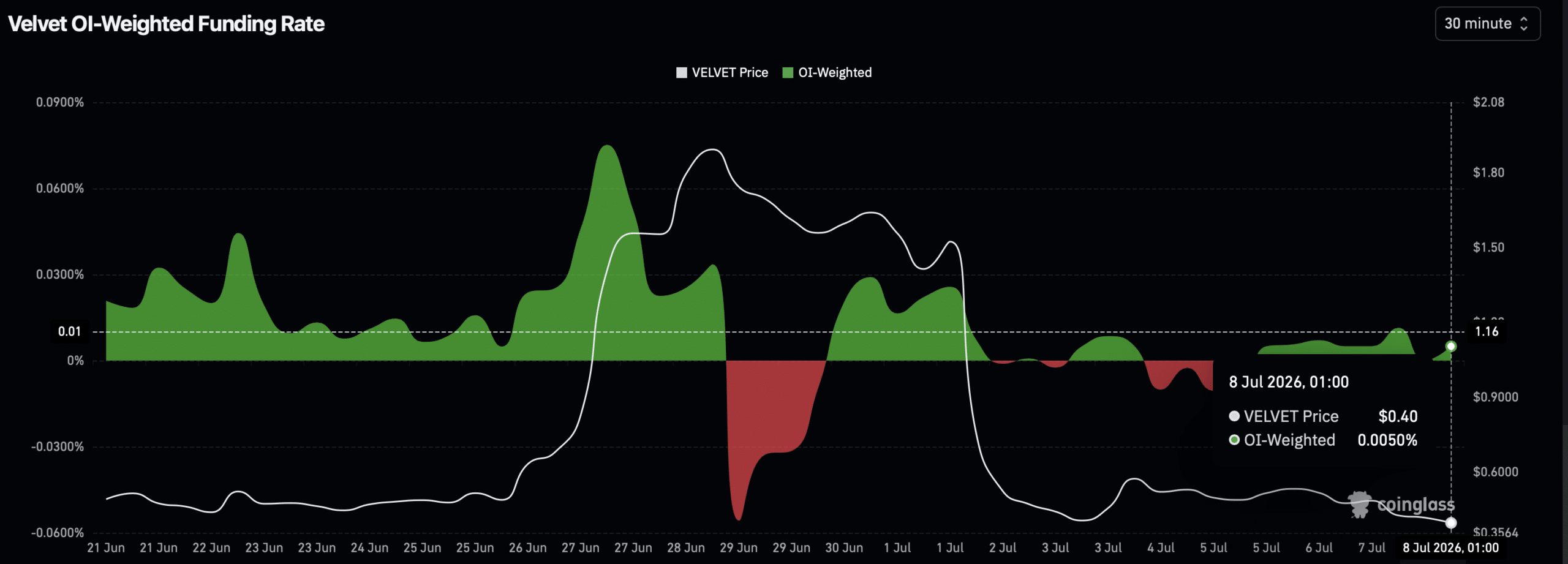
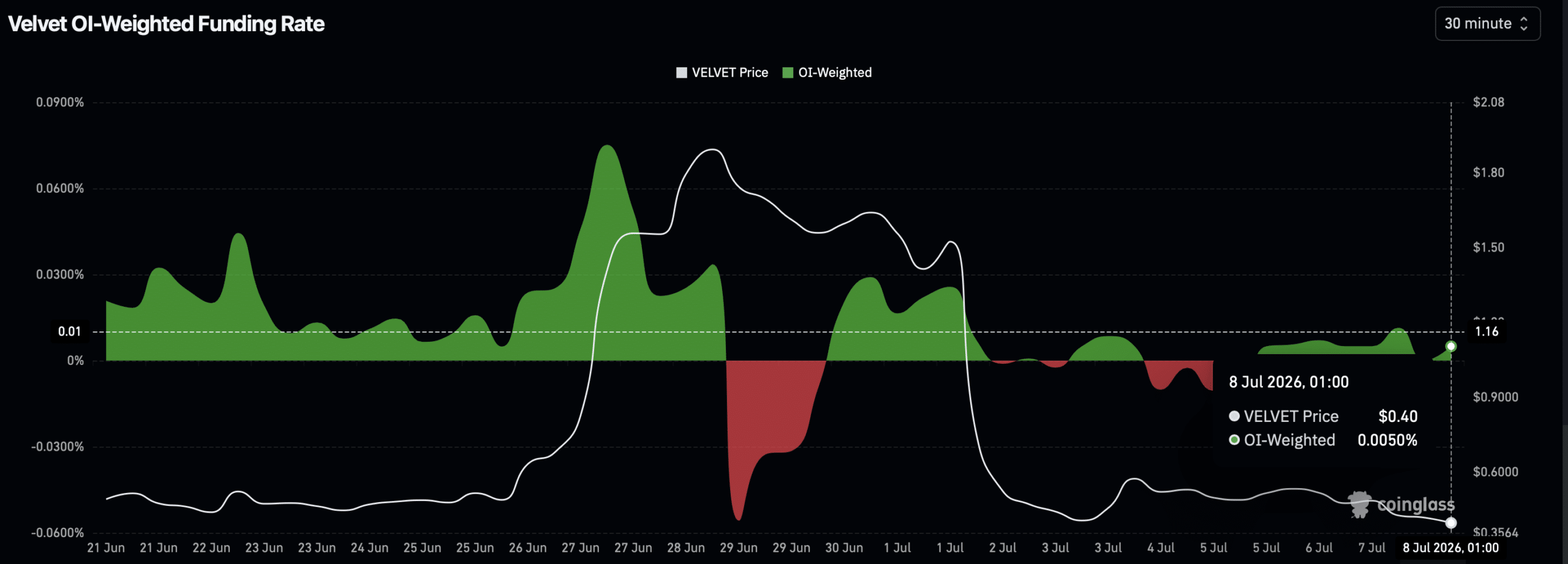
The compelling part of this picture is that trader positioning remains net long despite the rising sell volume and the capital contraction. The Funding Rate, which reflects whether market positioning favors buyers through long trades or sellers through short trades, printed a reading of 0.0050%.

A positive reading, as in this case and only mildly so, indicates that traders are still positioned net long ahead of an upward move ahead.
Source: CoinGlass

However, over a longer horizon, they have reason for conviction in an upswing, as Velvet has surged 59% over the past thirty days and climbed 533% across a quarter, nearly ten times the monthly figure.

The short-term conviction stays questionable, though, since longs have lost more than shorts, with the past 24 hours as the reference.

Total liquidations reached $558,320 over that stretch, and long liquidations constituted the majority at $490,520, an outcome that has made shorting Velvet more profitable than going long.

Spot buyers accumulate through the decline

Spot investors keep reinforcing the broader market narrative as their buying activity climbs.

At the time of analysis, total purchases from spot investors reached $1.58 million this week alone. Nearly half of that has arrived in the past 48 hours, with $781,000 worth of Velvet in netflow backing the buy side.

When netflow confirms stronger net buying in the spot market, it often suggests investors view the recent decline as a discount and an opportunity to accumulate. A continuation of this buying trend would hand Velvet a solid base for a rebound in the near term.


Final Summary

  • Velvet has dropped 75% over the past week and another 16% in a day, with traders pulling money out of the market as selling picks up.
  • Spot buyers have put $1.58 million into Velvet this week, betting the lower price is a chance to buy in before a possible recovery.


Trending Cryptos

Related Questions

QWhat has been the recent price performance of Velvet (VELVET)?

AVelvet (VELVET) has fallen by 75% over the past week. In the last 24 hours alone, it dropped another 16% due to intensifying selling pressure.

QDespite the price drop, what does the Funding Rate data suggest about trader positioning?

AThe Funding Rate for Velvet's perpetual market is positive at 0.0050%. This indicates that traders, on net, are still holding long positions, expecting an upward move in the future.

QWhat is the Taker Buy Sell Ratio, and what does its current reading for Velvet indicate?

AThe Taker Buy Sell Ratio measures long trading volume against short trading volume in the perpetual market. For Velvet, the ratio is 0.95, which is slightly below 1. This signals that sellers are currently dominating the trading volume.

QHow have spot market investors reacted to Velvet's price decline according to the article?

ASpot market investors have been accumulating Velvet during its decline. Their total purchases reached $1.58 million this week, with nearly half ($781,000) coming in the past 48 hours. This suggests they view the lower price as a buying opportunity.

QWhat is the trend in Open Interest for Velvet, and what might it imply?

AOpen Interest for Velvet in the perpetual market has plunged by 28%, from $29.36 million to $21.07 million. This decline indicates a contraction in the capital base, as investors withdraw funds likely due to concerns over high volatility and the ongoing sell-off.

Related Reads

Mass Production Timelines Shift Collectively, Is Glass Substrate Facing Its First Major Test?

The article discusses the shift in the glass substrate industry from initial announcements to practical delivery and reliability testing. In mid-to-late 2026, key developments include Intel and Lens Technology advancing AI-era glass substrate packaging cooperation, Avaco launching a TGV pilot line in South Korea, and reports that Samsung Electro-Mechanics is facing delays, potentially pushing mass production beyond 2028. The core challenge has moved from material comparisons to rigorous customer reliability certifications, focusing on thermal cycling, humidity resistance, and stable electrical performance post-processing. Samsung Electro-Mechanics' reported delay, linked to client sample reliability bottlenecks, reflects a broader industry trend where timelines are being adjusted. Other players like SKC/Absolics, LG Innotek, and DNP are also targeting initial supply systems or pilot lines between 2027-2028, with mainstream adoption potentially post-2030. The delays highlight that the current hurdle is supply-side technical maturity—particularly achieving stable yields and passing client certifications—rather than a lack of demand driven by AI and HPC. The collaboration between Intel and Lens Technology focuses on establishing design and verification standards. Meanwhile, Japanese firms like Shinko Electric and DNP are progressing with multi-layer wiring and stress control. Chinese panel makers, led by BOE, are rapidly entering with automated pilot lines and customer testing. On the material side, companies like Corning are exploring glass substrates for co-packaged optics (CPO), potentially offering an earlier application path than core substrates. Ultimately, the central barrier is TGV (Through Glass Via) yield, currently around 60-70%, lower than organic substrates, with higher costs due to glass brittleness and process complexity. The industry's current phase represents its first major test in transitioning from lab R&D to volume manufacturing, with success hinging on overcoming these yield and certification challenges.

marsbit1m ago

Mass Production Timelines Shift Collectively, Is Glass Substrate Facing Its First Major Test?

marsbit1m ago

Crypto Bull Is Back, Which Assets Bounced the Hardest?

The cryptocurrency market experienced a significant surge last week, with Bitcoin rallying over 26% to nearly $79,500, its strongest weekly gain since March 2023, fueling discussions of a renewed bull market. This rebound highlighted several key market dynamics. First, short-term directional shifts are increasingly tied to U.S. policy cycles. The rally was driven by two major catalysts: the U.S. Treasury's announcement to increase long-term bond buybacks, easing macro liquidity pressures, and former President Trump's push for clearer crypto legislation, boosting regulatory certainty and risk appetite. Second, Bitcoin spot ETFs solidified their role as a leading market indicator. In the week ending August 21, U.S. Bitcoin and Ethereum spot ETFs saw a combined net inflow of $2.6 billion, the highest since October 2025, signaling strong institutional re-entry. Third, the rally followed a clear capital rotation pattern: Bitcoin's breakout ignited broader gains, with Ethereum (up nearly 30%), major altcoins, and meme coins sequentially posting larger percentage increases. Analysis of the top performers among the top 50 altcoins by market cap revealed the week's biggest gainers: ENA (Ethena) led with a 100.75% surge, fueled by a Coinbase partnership. It was followed by PUMP (Pump.fun, up 88-99%), STX (Stacks, up 82-94%), TRUMP (Official Trump, up 79-91%), and ZEC (Zcash, up 75.15%), which uniquely reached a new all-time high. Meme coins like BOME on Solana also saw explosive gains, exemplifying the high-risk, high-reward sentiment. The rally illustrated a clear path: Bitcoin set the stage, major coins like Ethereum led the charge, and altcoins/meme coins delivered the most explosive returns, mapping the gradient of returning market enthusiasm.

marsbit14m ago

Crypto Bull Is Back, Which Assets Bounced the Hardest?

marsbit14m ago

Wuhan is About to Witness Its Largest IPO in History

Wuhan is poised for its largest-ever IPO as Yangtze Memory Technologies Co., Ltd. (YMTC) has officially applied for a listing on the Shanghai Stock Exchange's STAR Market, seeking to raise 33 billion yuan. The domestic leader in 3D NAND flash memory chips completed its IPO辅导 (tutoring) process in a record three months, with market expectations valuing the company at 300 billion yuan or higher. YMTC's roots trace back to 2006 with the founding of Wuhan Xinxin. After surviving the global financial crisis and periods of operational difficulty, the company was formally established in 2016 through a joint investment involving Tsinghua Unigroup, the National Integrated Circuit Industry Investment Fund (the "Big Fund"), and local Hubei government funds. With a distinct "national team" background, its major shareholders include provincial and municipal state-owned assets committees and the Big Fund. Based in Wuhan's Optics Valley (East Lake High-tech Development Zone), YMTC's potential listing highlights the region's rise as a tech hub. Optics Valley is already home to 72 listed companies and has ambitious plans to exceed 100 by 2030. The zone recently established four industry-focused母基金 (mother funds) totaling 18 billion yuan to further boost sectors like integrated circuits and optoelectronics. YMTC's IPO would complete the "Optics Valley Seven Stars," a group of leading local optoelectronic and communication giants.

marsbit14m ago

Wuhan is About to Witness Its Largest IPO in History

marsbit14m ago

Banks and Regulators Join Pilot Project to Test Quantum-Resistant Crypto Transfers

Banks and financial regulators from Europe, the Middle East, and Asia have joined a pilot project to test quantum-resistant crypto infrastructure for digital asset wallets and on-chain transactions. The initiative, announced by the Responsible Fintech Institute and infrastructure provider Safeheron, will use NEAR's quantum-resistant testnet. It will employ the ML-DSA-65 post-quantum digital signature standard, recently finalized by the U.S. National Institute of Standards and Technology (NIST). Participating regulators include the Abu Dhabi Global Market, Bhutan's Gelphu Financial Services Authority, and Malta's Financial Services Authority. Financial institutions involved are Bison Bank and DK Bank. In the pilot, banks will test wallet creation and transactions in a unified application environment, while regulators will initially observe and later contribute to governance mechanisms. The organizers plan to publish a technical paper detailing the research, protocol design, and test results, eventually open-sourcing the core technology. This effort comes as financial authorities prepare for the advent of quantum computers, which threaten current public-key cryptography. For instance, the Hong Kong Monetary Authority aims for the territory's banking sector to be fully prepared for quantum-related security risks by 2030. The Bank for International Settlements (BIS) also recommended in a 2025 document that financial institutions begin a coordinated, phased transition to post-quantum systems.

cryptonews.ru16m ago

Banks and Regulators Join Pilot Project to Test Quantum-Resistant Crypto Transfers

cryptonews.ru16m ago

Trading

Spot

Hot Articles

How to Buy T

Welcome to HTX.com! We've made purchasing Threshold Network Token (T) simple and convenient. Follow our step-by-step guide to embark on your crypto journey.Step 1: Create Your HTX AccountUse your email or phone number to sign up for a free account on HTX. Experience a hassle-free registration journey and unlock all features.Get My AccountStep 2: Go to Buy Crypto and Choose Your Payment MethodCredit/Debit Card: Use your Visa or Mastercard to buy Threshold Network Token (T) instantly.Balance: Use funds from your HTX account balance to trade seamlessly.Third Parties: We've added popular payment methods such as Google Pay and Apple Pay to enhance convenience.P2P: Trade directly with other users on HTX.Over-the-Counter (OTC): We offer tailor-made services and competitive exchange rates for traders.Step 3: Store Your Threshold Network Token (T)After purchasing your Threshold Network Token (T), store it in your HTX account. Alternatively, you can send it elsewhere via blockchain transfer or use it to trade other cryptocurrencies.Step 4: Trade Threshold Network Token (T)Easily trade Threshold Network Token (T) on HTX's spot market. Simply access your account, select your trading pair, execute your trades, and monitor in real-time. We offer a user-friendly experience for both beginners and seasoned traders.

13.0k Total ViewsPublished 2024.03.29Updated 2026.06.02

How to Buy T

Discussions

Welcome to the HTX Community. Here, you can stay informed about the latest platform developments and gain access to professional market insights. Users' opinions on the price of T (T) are presented below.

活动图片