By Rongzhong Finance
Another super IPO is on the way.
Recently, the Shanghai Stock Exchange website showed that the IPO review status of Yangtze Memory Technologies Co., Ltd. on the STAR Market has changed to "Accepted." The company plans to raise 33 billion yuan, with CITIC Securities and China Securities as its sponsors.
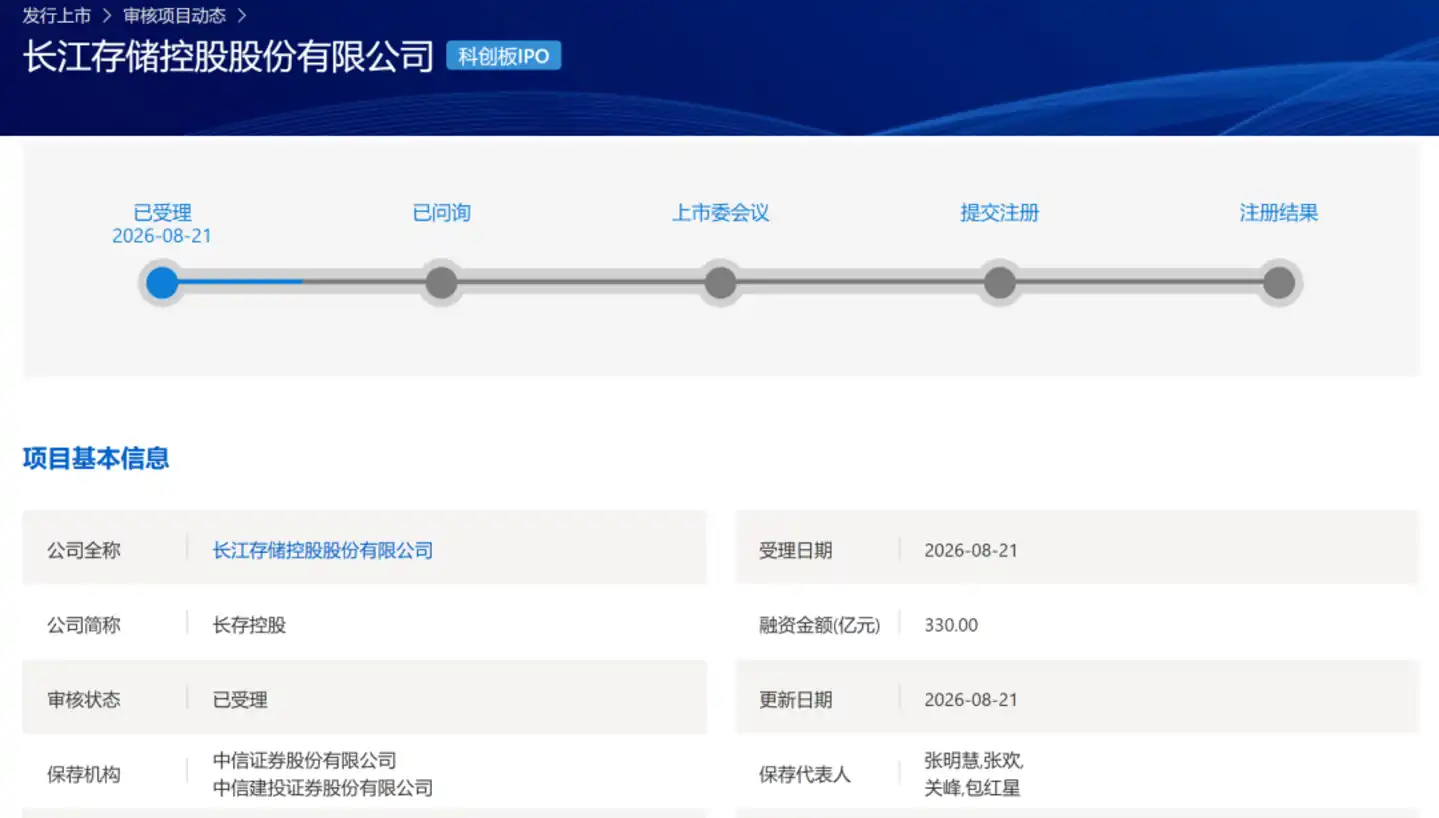
From completing the tutoring filing on May 19th to passing the tutoring acceptance on August 19th, Yangtze Memory took only three months, setting a record for the speed of IPO tutoring in the semiconductor industry. At the same time, this brings it closer to the title of "Wuhan's largest IPO in history." Previously, the Hurun Research Institute's "2025 Global Unicorn List" showed Yangtze Memory's valuation at 160 billion yuan. With the IPO process advancing, market expectations have been revised upwards to 300 billion yuan or even higher.
As we can see, this domestic-only 3D NAND flash memory IDM manufacturer is pushing Wuhan's Optics Valley into the spotlight of the capital market.
A Decade Sharpening the 'Memory Chip'
The story of Yangtze Memory is generally considered to have begun in 2016, but to understand where this hundred-billion behemoth unicorn came from, the clock needs to be turned back to 2000.
That year, the State Council issued the "No. 18 Document" on the integrated circuit industry, triggering the first wave of chip entrepreneurship in China. The landmark event was the return of "the father of Chinese chips," Zhang Rujing, to mainland China to found SMIC. Around the same time, Wuhan began planning to develop its integrated circuit industry.
The difficulty was considerable. Back then, Wuhan's traditional industry was dominated by steel. As a central city, it urgently needed to find an industrial engine for the next decade. Wuhan's leaders ambitiously looked toward this unfamiliar track. Zou Xuecheng, Director of the Research Center for Very Large Scale Integrated Circuits and Systems at Huazhong University of Science and Technology, later told the Yangtze River Daily, "If we don't do this, Hubei and Wuhan will have no name on the map of China's future semiconductor industry."
So, Wuhan spent two years fully preparing, contacting over a dozen well-known domestic and international chip manufacturers seeking cooperation. In 2006, an opportunity arose when SMIC executives were invited to inspect Wuhan. After repeated studies and expert evaluations, it was finally decided that the provincial, municipal, and East Lake High-tech Development Zone governments would jointly invest to establish XMC (Wuhan Xinxin Semiconductor Manufacturing Corp.), with the goal of building the first 12-inch integrated circuit production line in central China. Initially, it was fully managed by SMIC.
Looking back from a god's-eye perspective, this plan was not unanimously approved at the expert evaluation meeting at the time. The reason for opposition was simple: "An investment scale of tens of billions of yuan is too small, lacking economies of scale to be profitable, and the full-process management model is not conducive to subsequent independent development."
But amid such controversy, Phase I of XMC—the first 12-inch integrated circuit production line in central China—was established. According to statistics, provincial and municipal government investments at the time totaled 10.7 billion yuan, accounting for nearly one-tenth of Hubei Province's total state-owned economic investment that year. This production line, which started operations in 2008, coincidentally hit the global financial crisis. Affected by it, the semiconductor industry fell into a downturn, and XMC was severely hit upon its debut.
To survive, the company once shifted to manufacturing for the American flash memory manufacturer Spansion, relying on China's manufacturing cost advantages to secure orders. However, Spansion soon went bankrupt, plunging XMC back into dire straits. At that time, SMIC itself was struggling and unable to continue injecting capital. International giants like TSMC and Micron once eyed this production line, intending to take advantage of the situation.
As the saying goes, "No destruction, no construction." At the last critical moment, the Wuhan government chose to persist, deciding to develop XMC independently. In 2011, both parties established a joint venture; in 2013, SMIC officially withdrew. Wuhan East Lake High-tech Development Zone strongly invited Yang Shining, who had served as SMIC's COO and worked at Intel for over a decade, to become XMC's CEO. The company began to explore the market independently, and its 3D flash memory technology gradually caught up with international giants like SK Hynix, Micron, and Toshiba.
Thus, with the support of the new CEO and Wuhan's "national team," XMC secured orders from important clients like GigaDevice and gradually gained a foothold. In 2014, the National Integrated Circuit Industry Investment Fund launched a second round of large-scale investment in the domestic semiconductor industry. Wuhan decided to "gamble once more" in the memory track. After multiple efforts, in March 2016, the National Memory Base, with a total investment of approximately $24 billion, officially landed in Wuhan Optics Valley. Local media press releases described it as "the largest single high-tech industry investment project in our province since the founding of the People's Republic of China."
On July 26th of the same year, based on XMC, Yangtze Memory Technologies Co., Ltd. was established through joint investment by Tsinghua Unigroup, the National Integrated Circuit Industry Investment Fund, Hubei Guoxin Industry Investment Fund, and Hubei Provincial Science & Technology Investment Group.
Counting from the establishment of XMC in 2006 to the birth of Yangtze Memory in 2016, Wuhan's layout in the memory industry took a full decade.
Massive 'National Team' Background
Looking at the equity structure, Yangtze Memory currently has no controlling shareholder or actual controller.
Before the issuance, Hubei Changsheng is the largest shareholder, holding 26.54%; Xinfei Technology holds 25.35%; the National Integrated Circuit Industry Investment Fund Phase I and Phase II hold 11.97% and 11.38%, respectively; Optics Valley Industry Investment and Guoxin Fund hold 9.25% and 5.90%, respectively.
The prospectus states that the shareholding ratios of the four major shareholders holding more than 10% are relatively close, and none exceed 30%, meaning no single shareholder can significantly influence shareholder meeting resolutions. "During the reporting period, the main capital contributors behind the upward tracing of the company's major shareholders are the Hubei Provincial State-owned Assets Supervision and Administration Commission, Wuhan Municipal State-owned Assets Supervision and Administration Commission, East Lake High-tech Development Zone Management Committee, Big Fund Phase I, and Big Fund Phase II."
Reviewing Yangtze Memory's financing history, one can directly see its distinct "national team" colors.
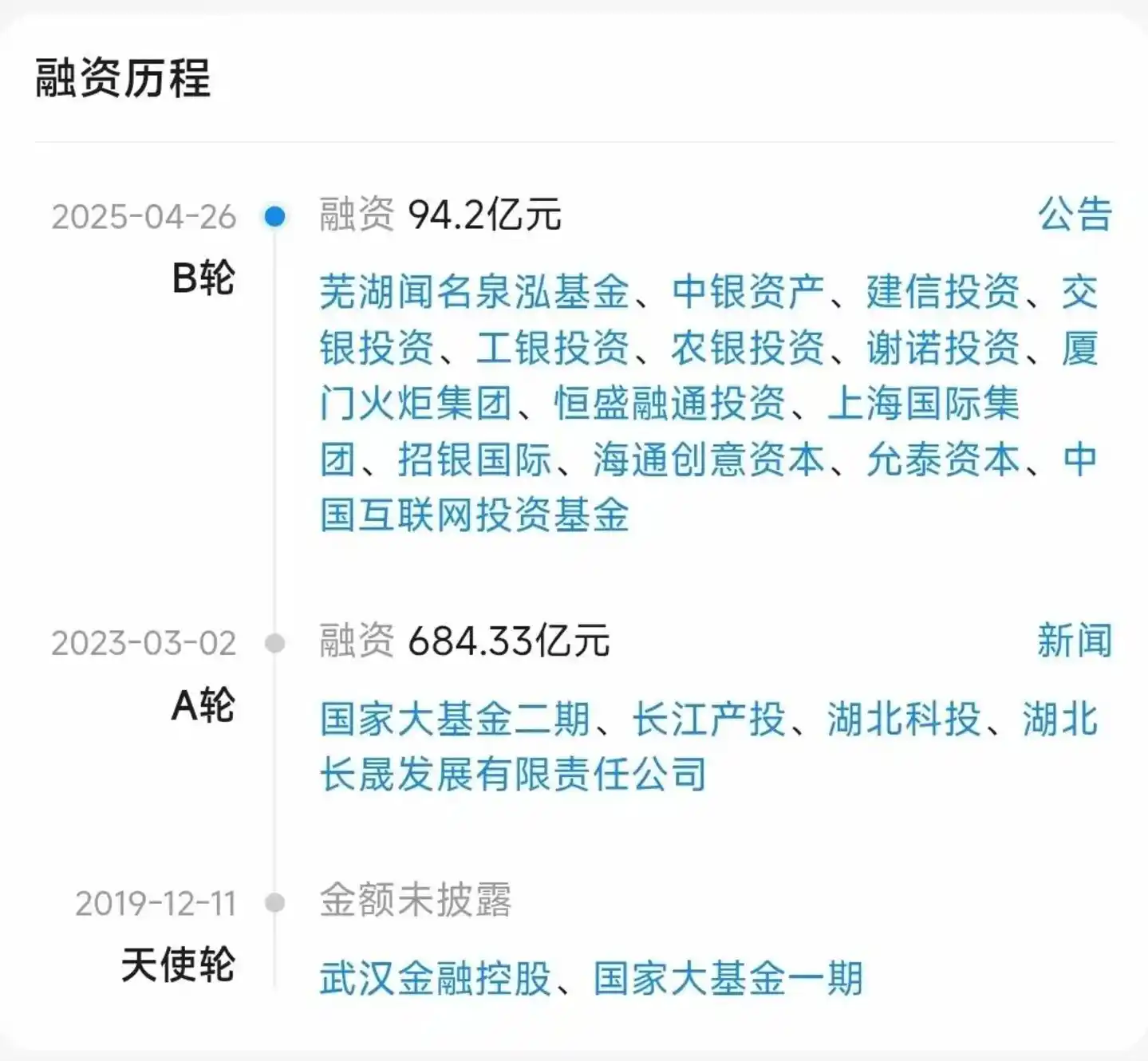
Qichacha data shows that in December 2019, the company completed its Angel round of financing, with Wuhan Financial Holdings and the National Big Fund Phase I investing. In March 2023, the company completed its Series A financing, raising 68.433 billion yuan, with the National Big Fund Phase II, Changjiang Industry Investment, Hubei Science & Technology Investment, and Hubei Changsheng entering successively. In April 2025, the company completed its Series B financing of 9.42 billion yuan. The investor lineup further expanded to include over ten institutions such as Wuhu Wenming Quanhong Fund, BOC Asset Management, CCB Investment, BoCom Investment, ICBC Investment, ABC Investment, Xienuo Investment, Xiamen Torch Group, Hengsheng Rongtong Investment, Shanghai International Group, CMBI, Haitong Creative Capital, Yuntai Capital, and China Internet Investment Fund.
The combined scale of these three rounds of financing far exceeds that of general market-oriented projects, also indirectly confirming the national-team nature of this company's capital structure. The aforementioned employee持股 platforms "Wuhan Zhixin Plan No. 1" to "No. 6" were implemented alongside the shareholding system reform around the Series B round, binding the core technical team to the company's long-term development.
Behind this continuously bolstered shareholder list is the direct financial support from the provincial, municipal, and East Lake High-tech Development Zone governments over a decade, on multiple occasions. Now, as the IPO enters the acceptance stage, this early investment spanning ten years is about to be priced by the capital market. According to estimates, the shares held by Wuhan's state-owned assets through various platforms alone, once Yangtze Memory successfully goes public, are expected to be worth hundreds of billions of yuan on paper, with paper gains being incalculable.
Optics Valley, More IPOs Are on the Way
Undoubtedly, if all goes smoothly, Wuhan will reap the city's largest IPO in history. For this enterprise, whose every step of growth bears the imprint of its locality, its location, "Optics Valley," is also pushed into the spotlight of the capital market.
As of June this year, Optics Valley has gathered 72 listed companies. The total market value of domestic and foreign listed companies has exceeded 1.8 trillion yuan, accounting for about one-third of Hubei Province's and over 60% of Wuhan's total.
Optics Valley authorities have stated more than once, "Listed companies are the main force of technological innovation, the strong engine of industrial development, and the spokesperson of urban vitality in Optics Valley." Centered on this positioning, Optics Valley has successively introduced special policies in recent years such as the "Action Plan for High-quality Development of Listed Companies," the "New 15 Articles for IPOs," and the "10 Articles for Venture Capital," established the Central China Service Base of the Beijing Stock Exchange, and launched the "IPO Seedling Loan" for technology-based SMEs, with single loans up to 50 million yuan supported by financing. The government sets up a risk compensation fund for financial institutions, with the proportion reaching up to 30%.
Currently, this report card is only a阶段性 achievement, as Optics Valley's latest goal has been updated—by 2030, the total number of listed enterprises in Optics Valley aims to exceed 100, and the number of companies with a market value of 100 billion yuan aims to double compared to the current number, reaching 8.
The liveliness of the secondary market cannot be sustained without the接力 of primary market investment; it is also a consensus that the source of活水 must first flow into early-stage projects. The latest move occurred at the World Optics Valley Science and Technology Financial Ecology Co-construction Conference held on June 27th.
At this conference, Optics Valley established four industrial-focused mother funds in one go, with a total scale of 18 billion yuan, targeting four major directions: optoelectronics information, life health, integrated circuits, and future industries. According to the plan, by 2030, these four mother funds will leverage a new fund cluster of no less than 100 billion yuan, driving total investment exceeding 300 billion yuan.
It is worth noting that tracks that sound distant, such as photonic integration, embodied intelligence, and quantum technology, have already been提前布局 by Optics Valley. Among them, Liuxin Optoelectronics' 8-inch wafer photonic integration chip technology is industry-leading; Yuwei Optics' full-spectrum industrial LiDAR and high-precision ranging products are already among the top domestic enterprises; Langyi Robot specializes in the "embodied cerebellum" for humanoid robots, and its products have become the first choice for many national robotics companies... The list goes on and on.
Moreover, new candidates are continuously being produced under this system. According to disclosures from Optics Valley, since 2026, there have been at least 40公开融资 events for tech companies in the region, covering seed rounds from the million-yuan level to industrial rounds in the billion-yuan level. In the past three years, Optics Valley's technology credit has累计 provided support exceeding 300 billion yuan to nearly 6,000 enterprises, with 426 registered funds in the region. These enterprises that have received financial support are the reserve army for the "Optics Valley sector."
Currently, the "Optics Valley Seven Stars," represented by seven optical communication giants including Yangtze Memory, Changfei Fiber, Huagong Tech, Accelink, FiberHome, Guide Infrared, and CITIC Mobile, are整链崛起 at an unprecedented speed and姿态. Among them, Yangtze Memory is the only unlisted company among the "Optics Valley Seven Stars." As its IPO process advances further, Optics Valley will also welcome the团圆时刻 of the "Seven Stars" in the capital market.