Valuation Surpasses 200 Billion, Kimi Reportedly Raises 13.6 Billion More, Speeds Up Hong Kong IPO

marsbitPublished on 2026-06-08Last updated on 2026-06-08

Abstract

Beijing-based AI unicoth MoonDark (Kimi) is reportedly in talks for a new funding round aiming to raise up to $20 billion (approximately RMB 136 billion), targeting a post-money valuation of $300 billion (approximately RMB 2.035 trillion). If successful, this would mark its third round in six months and a six-fold increase from its $43 billion valuation in December last year. Last month, the company completed a $20 billion funding round led by Meituan Longzhu, reaching a valuation exceeding $200 billion. According to reports, MoonDark has raised over RMB 376 billion across six rounds, making it the most funded large language model startup in China. Founded in 2023 by CEO Yang Zhilin, the company's core product is the Kimi AI Assistant. In April, it launched and open-sourced its flagship model, Kimi K2.6, which has demonstrated performance comparable to top models like GPT-5.4 in certain benchmarks. Recently, it began beta testing for Kimi Work, a local AI agent for knowledge workers. Commercially, the company's Annual Recurring Revenue (ARR) reportedly surpassed $2 billion in April. Regarding its IPO plans, Bloomberg reported in March that MoonDark is preparing for a listing in Hong Kong, though the process remains in early stages. The funding and IPO pace for leading Chinese AI firms has accelerated notably in 2026, mirroring global trends where companies like OpenAI and Anthropic are also setting new fundraising and valuation records. Securing substantial capital is bec...

Zhixi News, June 8 — According to reports, the Beijing-based AI large model unicorn Moon's Dark Side (Kimi) is currently negotiating a new round of financing, aiming for a maximum scale of 20 billion USD (approximately 136 billion RMB) and a target valuation of 300 billion USD (approximately 2,035 billion RMB).

If this round is completed as targeted, Moon's Dark Side's valuation would increase by about 6 times compared to its 4.3 billion USD (approximately 298 billion RMB) valuation in December last year. This would also be the third round of financing initiated by Moon's Dark Side in nearly six months.

Just last month, Moon's Dark Side completed a financing round of approximately 20 billion USD (approximately 136 billion RMB), with a post-money valuation exceeding 200 billion USD (approximately 1,356 billion RMB). This round was led by Meituan Dragon Ball, with participation from Tsinghua Capital, China Mobile, CPE (CITIC Private Equity), among others.

According to previous reports by Huafeng Capital, Moon's Dark Side has completed 6 rounds of financing, with a total funding amount exceeding 37.6 billion RMB, making it the domestic large model startup with the highest cumulative financing.
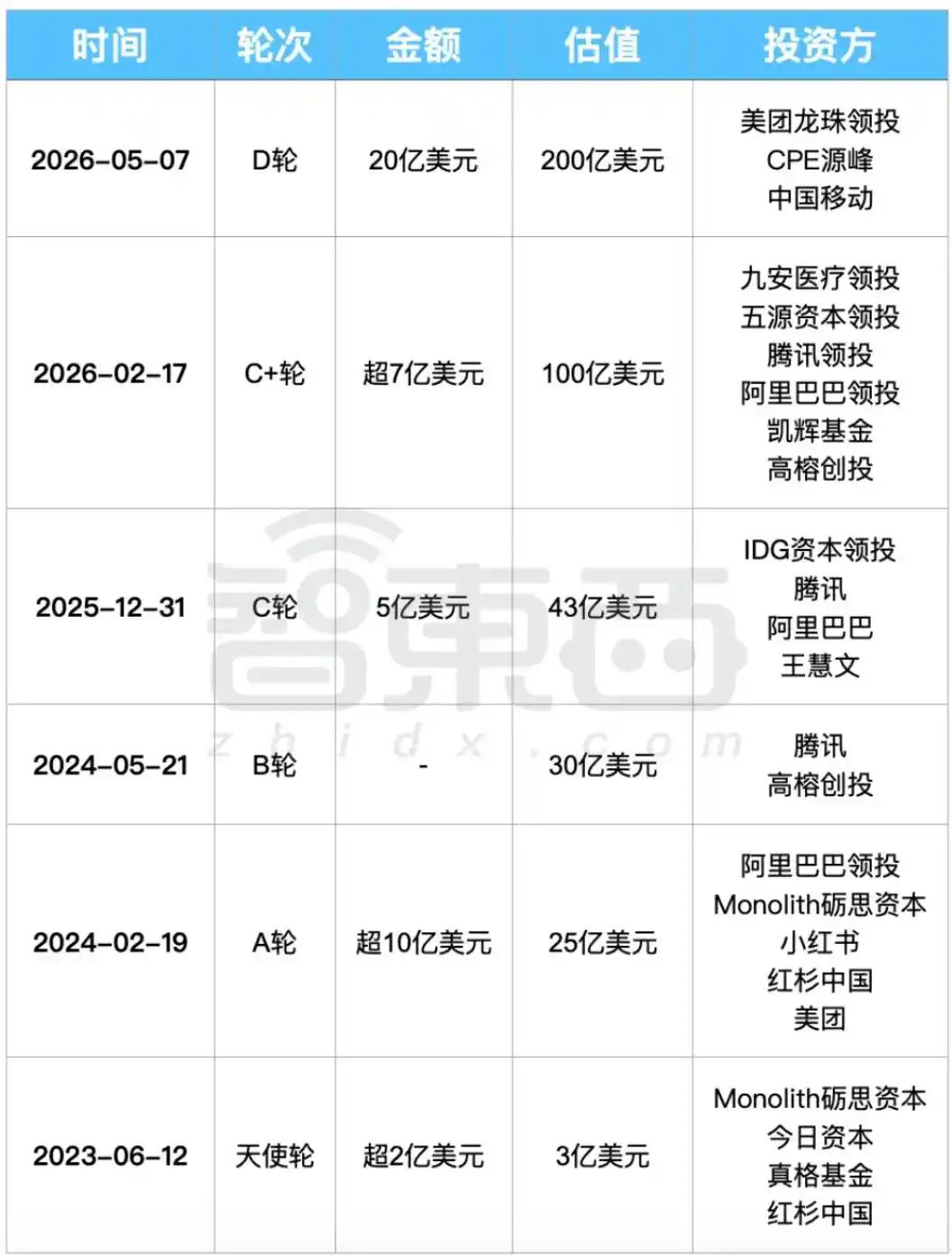
▲ Moon's Dark Side's past financing situation (Chart by Zhixi News, data source: Qichacha)

Moon's Dark Side was founded in 2023 in Beijing. Its founder and CEO, Yang Zhilin, earned his bachelor's degree from the Department of Computer Science at Tsinghua University and his Ph.D. from Carnegie Mellon University (CMU). He previously worked at Google Brain and Meta AI.

The core product of Moon's Dark Side is the Kimi Intelligent Assistant. On April 20, Moon's Dark Side released and open-sourced its flagship model Kimi K2.6. In multiple global authoritative benchmark tests, K2.6's performance in certain dimensions matched or even surpassed top closed-source models such as GPT-5.4, Claude Opus 4.6, and Gemini 3.1 Pro.

As of today, on the OpenRouter Benchmarks list, Kimi K2.6 ranks 9th on the Artificial Analysis Intelligence Index list with a score of 53.9, placing it after MiniMax-M3 and before Xiaomi MiMo-V2.5-Pro.
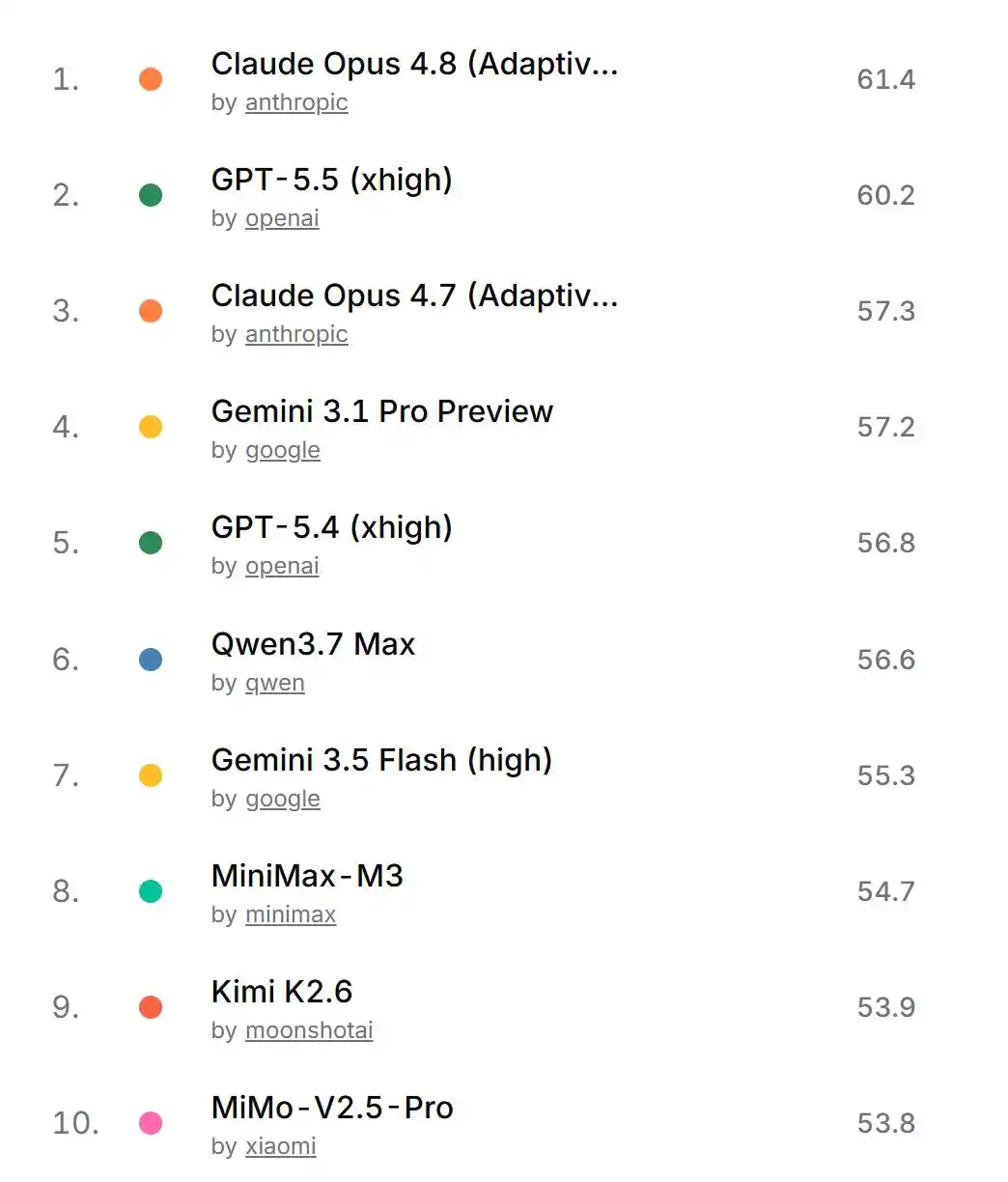
▲ Kimi K2.6 ranks 9th on the Artificial Analysis Intelligence Index list (Source: OpenRouter)

On the product side, on June 3, Moon's Dark Side began the beta testing of Kimi Work Beta, positioned as a local universal Agent for knowledge workers. Users can describe task goals in natural language, and Kimi Work can decompose tasks, call tools, use browsers, create and organize files locally on the computer, and deliver work products such as documents, spreadsheets, and PPTs.

Regarding commercialization, Moon's Dark Side has begun to generate a certain scale of revenue. According to previous disclosures by Huafeng Capital, Moon's Dark Side's Annual Recurring Revenue (ARR) in April had already exceeded 200 million USD (approximately 1.36 billion RMB), with accelerated growth in paid subscriptions and API revenue.

In terms of IPO progress, on March 26, Bloomberg reported that Moon's Dark Side is recently preparing for a Hong Kong IPO. Sources familiar with the matter stated that Moon's Dark Side is in the early stages, with the aim of stimulating investor interest in AI. Another source revealed that related preparations are still ongoing, and an IPO launch may not ultimately proceed.

Overall, since entering 2026, the capitalization process of leading domestic large model companies has significantly accelerated. On one hand, companies like Moon's Dark Side and Stepwise Stars have densely completed large-scale financing rounds, and DeepSeek was also reported last week to be about to complete its first external financing since its founding. On the other hand, companies like Zhipu and MiniMax have already taken the lead in opening the door to the Hong Kong stock market and are continuing to advance related work for A-share listings.

Looking globally, leading overseas AI companies like OpenAI and Anthropic are also preparing for IPOs, continuously setting new records for financing and valuation. In March this year, OpenAI completed a financing round of 122 billion USD (approximately 8,272 billion RMB), achieving a post-money valuation of 852 billion USD (approximately 57.8 trillion RMB). On June 1, Anthropic announced the completion of a 65 billion USD (approximately 4,407 billion RMB) Series H financing round, with a post-money valuation reaching 965 billion USD (approximately 65.3 trillion RMB), and secretly filed its IPO prospectus the following day.

Against this backdrop, the financing and IPO pace of domestic large model companies has noticeably quickened. Capital, computing power, and commercialization capabilities are becoming key variables alongside model competition. For large model companies still in a high-investment cycle, large-scale financing and IPOs are not only ways to replenish ammunition but will also become important chips in the next phase of competing for top positions.

This article is from the WeChat public account "Zhixi News" (ID: zhidxcom), author: Yang Jingli

Trending Cryptos

Related Questions

QWhat is the rumored size of Moonshot AI's (Kimi) new funding round and its target valuation?

AMoonshot AI is reportedly in talks for a new funding round aiming to raise up to $20 billion, with a target valuation of $300 billion.

QHow many funding rounds has Moonshot AI completed, and what is its total cumulative funding amount?

AAccording to the article, Moonshot AI has completed 6 funding rounds, with a total cumulative funding exceeding 37.6 billion RMB.

QWhat is the name of Moonshot AI's core product and its recently launched flagship model?

AMoonshot AI's core product is the Kimi Intelligent Assistant. It recently released and open-sourced its flagship model, Kimi K2.6.

QWhat significant beta testing did Moonshot AI begin in early June 2026?

AOn June 3rd, Moonshot AI began the beta test of 'Kimi Work,' a local universal Agent designed for knowledge workers to perform complex tasks on their computers.

QWhat is the reported Annual Recurring Revenue (ARR) for Moonshot AI as of April, and what is its potential IPO plan?

AAs of April, Moonshot AI's Annual Recurring Revenue (ARR) reportedly exceeded $200 million. The company is reportedly preparing for a potential IPO in Hong Kong.

Related Reads

Why Are Leveraged ETFs like 7709 Inherently Negative EV Products?

This article argues that the SK H力士 2x Leveraged ETF (7709) is fundamentally a negative expected value (EV) product, rather than simply a "double SK H力士" investment. Its core issue stems from its daily rebalancing mechanism to maintain a 2x leverage target. After a price move, the fund must buy more after a rise or sell after a fall to readjust its leverage, creating a systematic pattern of buying high and selling low. This introduces a "delay loss": it always reacts to past price changes, missing potential gains from adjusting earlier during an uptrend and suffering greater losses from adjusting later during a downtrend. While more frequent intraday rebalancing would improve returns in strong, smooth trending markets by reinvesting profits or cutting losses sooner, it also dramatically increases volatility drag (frictional losses) during choppy, oscillating markets due to more frequent high-buy/low-sell trades. The author draws a parallel to an option seller who delta hedges (short gamma), which involves similar "buy high, sell low" dynamic hedging. However, unlike an option seller who receives upfront premium (IV and theta) as compensation for this risk, the leveraged ETF investor receives no such compensation. Instead, they bear all the path-dependent volatility decay, plus additional costs like swap/derivatives financing, management fees, and trading slippage. Thus, the product's return profile can be framed as: 2x directional return minus realized variance drag minus financing costs minus derivatives costs minus management fees minus transaction costs. For the investor to profit, SK H力士's price must not only rise significantly but do so in a strong, sustained, and smooth trend to overcome these inherent structural costs. High volatility and frequent price reversals are particularly damaging. The article also notes that while the ETF has no explicit liquidation line like perpetual futures, avoiding a sudden "blow-up," its net asset value can still decay towards zero over time through this combination of volatility drag and fees. For experienced traders, directly managing leverage via perpetual contracts may offer more control and potentially lower costs than this packaged, mechanistic product.

marsbit4m ago

Why Are Leveraged ETFs like 7709 Inherently Negative EV Products?

marsbit4m ago

'Backstabbing' or 'Win-Win'? How Likely Is TradeXYZ to Break Away from Hyperliquid and Go Solo?

The article discusses the growing debate over whether TradeXYZ, which dominates Hyperliquid's HIP-3 market with over 90% of its volume, might break away to build its own independent trading platform. This possibility is fueled by TradeXYZ's immense market influence and the common industry trend of successful projects seeking more control and profit capture. Key arguments for a potential split include TradeXYZ's overwhelming contribution to Hyperliquid's metrics and the financial incentive to retain all transaction fees, as it currently splits them 50/50 with Hyperliquid. The piece draws parallels to other cases, like Anthropic's "Claude Code" competing with its former partner Cursor, suggesting "betrayal" can occur when business leverage shifts. However, strong counterarguments suggest a split is unlikely or would be detrimental. TradeXYZ relies on Hyperliquid's high-performance infrastructure and its platform as a primary user acquisition channel. Building a comparable system would be challenging. Furthermore, the founders of both projects share a history of trust and mutual admiration. The analysis concludes that a separation would likely be a lose-lose scenario: Hyperliquid would lose a major growth narrative and trading volume, while TradeXYZ would face technical hurdles, user migration issues, and reputational damage, potentially allowing competitors to seize market share. The most rational path is seen as continued collaboration, with TradeXYZ potentially negotiating better terms while leveraging Hyperliquid's established strengths.

marsbit14m ago

'Backstabbing' or 'Win-Win'? How Likely Is TradeXYZ to Break Away from Hyperliquid and Go Solo?

marsbit14m ago

The Artificial Intelligence Economy Could Accelerate the Establishment of Dominance for Dollar-Pegged Stablecoins

Economists from the ASEAN+3 Macroeconomic Research Office (AMRO) suggest that the winner in the artificial intelligence (AI) race may not be the country developing the most powerful AI model, but the one whose currency underpins these models and their infrastructure. Their thesis outlines a potential cycle where AI-related costs—such as energy for data centers, infrastructure, and usage fees—are denominated in U.S. dollars. As AI grows into a massive industry, this could significantly increase global demand for U.S. dollar liquidity (first channel of dollar dominance). A second channel involves the currency used for payments between AI agents, expected to become widespread in logistics, inventory, and treasury management. Dollar-pegged stablecoins could provide the programmable settlements required for such agent commerce. These two channels may converge, creating a self-reinforcing "dollar loop" where AI computational payments are settled in stablecoins. Stablecoins could gain an early advantage over alternatives like CBDCs due to existing network effects, further entrenching dollar dominance. This would also boost demand for U.S. Treasury bonds used as collateral for stablecoin reserves. The report warns ASEAN+3 nations of over-reliance on this dollar loop and suggests developing regional data centers and tokenized money based on local currencies to participate in the AI economy without reinforcing dollar dependency.

cryptonews.ru16m ago

The Artificial Intelligence Economy Could Accelerate the Establishment of Dominance for Dollar-Pegged Stablecoins

cryptonews.ru16m ago

Base Claims Its Distribution Advantage Can Outlast Robinhood Chain's Initial Surge

Base, a layer-2 blockchain, argues that its established distribution network will outlast Robinhood Chain's initial popularity surge. While Robinhood Chain quickly attracted 230,000 daily active users and over $9 billion in DEX volume (primarily from meme coins) shortly after launch, its core feature of tokenized stocks saw minimal use. Base acknowledged shortcomings in focusing on social blockchain products and lagging in areas like perpetual contracts, predictions markets, and on-chain tokenized stocks—a move Robinhood got right. In response, Base highlights its nearly three-year head start in building infrastructure. It emphasizes its x402 payment protocol, which has processed 187.8 million agent payments, its $3.9 billion in stablecoin deposits (mostly USDC), and its integration with partners like Visa, Shopify, and JPMorgan for institutional and merchant settlements. Base contends these capabilities for corporate payments and stablecoin liquidity represent a more durable and defensible ecosystem than Robinhood's retail trading metrics. Coinbase plans to launch its own on-chain, share-backed tokenized stocks on Base, which would directly challenge Robinhood's key differentiating feature. Base's strategy bets that its deep-rooted distribution and institutional partnerships will prove harder to overcome than Robinhood's early, meme-driven volume, which may fade after the initial launch hype.

cryptonews.ru19m ago

Base Claims Its Distribution Advantage Can Outlast Robinhood Chain's Initial Surge

cryptonews.ru19m ago

Trading

Spot

Hot Articles

Sign up to HTX

Sign up to HTX

1.4k Total ViewsPublished 2023.06.19Updated 2024.01.10

Sign up to HTX

How to Buy UP

Welcome to HTX.com! We've made purchasing Superform (UP) simple and convenient. Follow our step-by-step guide to embark on your crypto journey.Step 1: Create Your HTX AccountUse your email or phone number to sign up for a free account on HTX. Experience a hassle-free registration journey and unlock all features.Get My AccountStep 2: Go to Buy Crypto and Choose Your Payment MethodCredit/Debit Card: Use your Visa or Mastercard to buy Superform (UP) instantly.Balance: Use funds from your HTX account balance to trade seamlessly.Third Parties: We've added popular payment methods such as Google Pay and Apple Pay to enhance convenience.P2P: Trade directly with other users on HTX.Over-the-Counter (OTC): We offer tailor-made services and competitive exchange rates for traders.Step 3: Store Your Superform (UP)After purchasing your Superform (UP), store it in your HTX account. Alternatively, you can send it elsewhere via blockchain transfer or use it to trade other cryptocurrencies.Step 4: Trade Superform (UP)Easily trade Superform (UP) on HTX's spot market. Simply access your account, select your trading pair, execute your trades, and monitor in real-time. We offer a user-friendly experience for both beginners and seasoned traders.

5.4k Total ViewsPublished 2026.02.10Updated 2026.06.02

How to Buy UP

Discussions

Welcome to the HTX Community. Here, you can stay informed about the latest platform developments and gain access to professional market insights. Users' opinions on the price of UP (UP) are presented below.

活动图片