A cross-party group of UK lawmakers jointly expressed concerns about the Bank of England (BOE)’s proposal to limit stablecoin holdings in the country, urging Chancellor Rachel Reeves to push back on the controversial policy.
UK Lawmakers Fight Stablecoin Cap Plans
On Thursday, a coalition of UK lawmakers sent a letter asking Chancellor Rachel Reeves to oppose some of the Bank of England’s stablecoin-related policies that could undermine the government’s efforts to position the UK as one of the leading nations in the digital assets industry.
In the letter reviewed by Bloomberg, members of the House of Lords, the House of Commons, and peers highlighted how stablecoins are reshaping financial infrastructure by lowering costs, accelerating settlements, and promoting financial inclusion.
“Their rise is also enabling traditional institutions to connect with the digital asset ecosystem and modernise legacy infrastructure,” it noted, “Powerful tailwinds are rapidly driving a major shift across financial services as we know them.”
However, they argued that BOE’s proposal to cap stablecoin ownership could “risk preventing the UK from fully capitalising on these opportunities,” drive innovation offshore and investors to USD-pegged alternatives, while potentially positioning the UK “as a global outlier.”
“We are deeply concerned that the UK is drifting towards a fragmented and restrictive approach that will deter innovation, limit adoption, and push activity overseas,” the coalition wrote in the letter.
As reported by Bitcoinist, the BOE released a new consultation paper on its proposed regulatory framework for sterling-denominated systemic stablecoins in November. The proposed rules, built on feedback received on the November 2023 Discussion Paper, addressed backing rules and holding limits.
Among the controversial policies, the Bank proposed to temporarily cap stablecoin ownership to “mitigate financial stability risks stemming from large and rapid outflows of deposits from the banking sector.”
The restriction would impose limits of £10,000 to £20,000 for individuals and £10 million for businesses, resembling its proposed approach to the digital pound, also aimed at addressing financial stability risks.
MPs Call BOE’s Policies ‘An Own Goal’
In a statement to Bloomberg, a Treasury spokesperson said that they “want the UK to be a global leader in digital assets, providing certainty for firms and boosting consumer confidence by bringing cryptoassets under regulation.”
“Our approach will be fair and proportionate, and we continue to work closely with the Bank of England on the UK approach to stablecoins,” the spokesperson affirmed, adding, “Their recent consultation provides an invaluable opportunity for stakeholders to provide views.”
Earlier this week, the Financial Conduct Authority (FCA) stated that stablecoin payments will be a priority for the next year. In a letter sent to the Prime Minister on Tuesday, the regulatory agency pledged to “finalise digital assets rules and progress UK-issued sterling stablecoins” in 2026.
However, the report noted that the overall perception among lawmakers and market participants is that the UK is falling behind other jurisdictions, including the US, which introduced a comprehensive regulatory framework for stablecoins in July.
It’s worth noting that the BOE suggested that systemic stablecoin issuers be required to hold at least 40% of the reserves backing the token as unremunerated deposits at the central bank to ensure “robust redemption and public confidence, even under stress.” Meanwhile, issuers would be allowed to hold up to 60% of backing assets in short-term UK government debt.
Lawmakers consider that requiring all reserves backing sterling-pegged tokens to be held in the UK is a “massive own goal” that will limit the relevance of the pound. “To remain globally competitive, the UK must ensure its stablecoin framework is benchmarked against leading international models,” the lawmakers concluded.
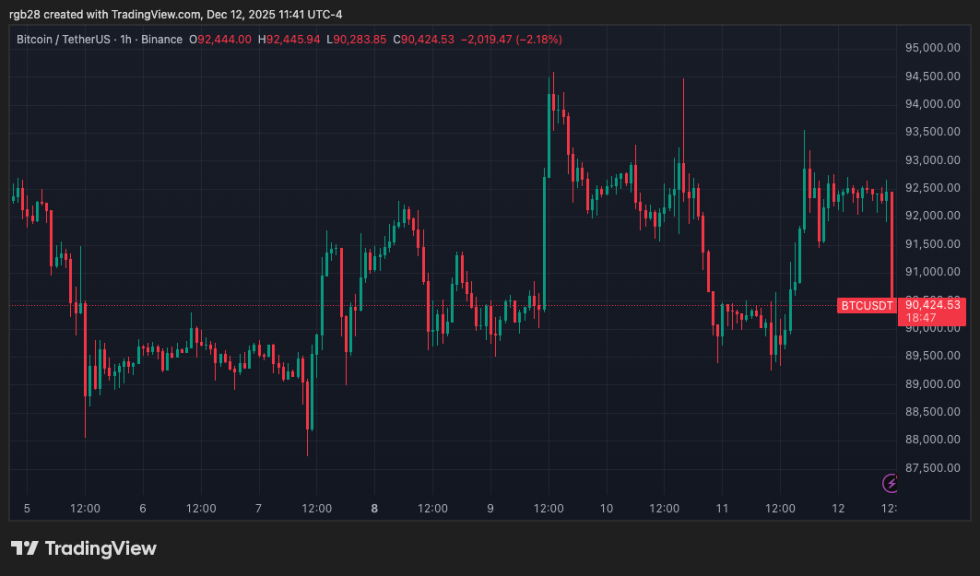
Bitcoin (BTC) trades at $90,424 in the one-week chart. Source: BTCUSDT on TradingView