UK crypto ownership dropped to 8% in 2025: YouGov poll

cointelegraphPublished on 2025-12-16Last updated on 2025-12-16

Abstract

A YouGov poll commissioned by the UK's Financial Conduct Authority (FCA) reveals that cryptocurrency ownership among UK adults dropped to 8% in 2025, down from 12% in 2024. Despite the decline, this figure is double the 4% rate recorded in 2021. The report highlights a shift toward larger investments, with fewer small-value holdings. Among crypto holders, 57% reported owning Bitcoin and 43% Ether, while 21% held Solana. The FCA also announced consultations on new crypto market rules for exchanges, staking, lending, and DeFi, seeking feedback by February as part of broader regulatory efforts.

A new poll conducted on behalf of the UK’s financial watchdog, the Financial Conduct Authority (FCA), suggests that cryptocurrency ownership in the country decreased over the previous 12 months, but the overall amount of digital assets held is growing.

According to the results of a YouGov poll released by the FCA on Tuesday, the percentage of the UK adult population holding cryptocurrency dropped to 8% in 2025 from 12% in 2024. The data was based on 2,353 interviews conducted Aug. 5 to Sept. 2.

While crypto ownership in the country declined, the share is still double that based on data from 2021: 4% ownership. In addition, the poll cites a “continuing trend” in holdings, with small-value ownership declining and large-value holdings growing. According to the report, 21% of respondents held $1,343 to $6,708 in crypto, and 11% had $6,709 to $13,416.
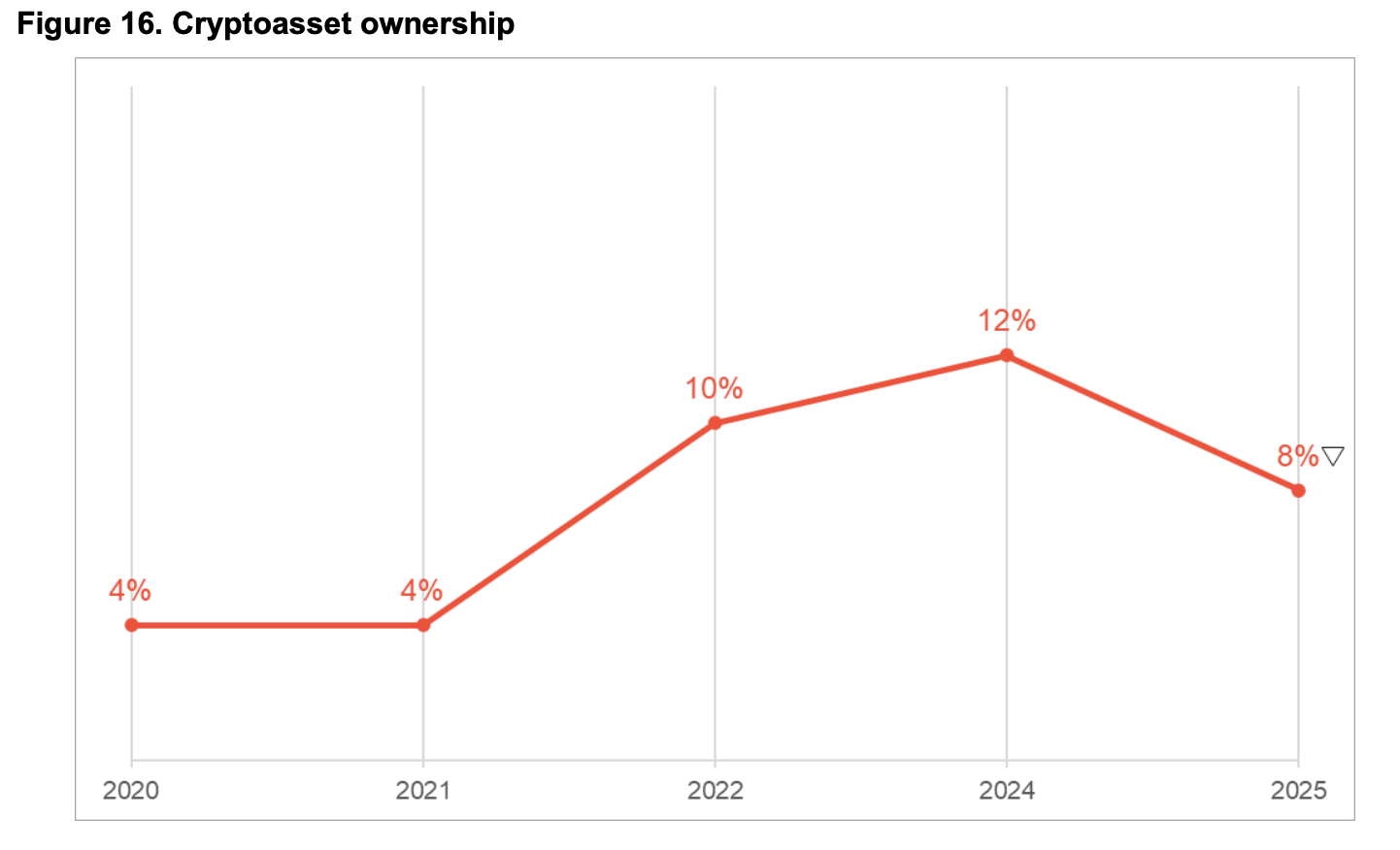
Percentage of UK adult crypto ownership from 2021 to 2025. Source: FCA

“More people are moving away from small holdings and are instead making larger investments,” said the FCA, adding: “Notably, those participating in [lending and borrowing] tend to be more knowledgeable, more comfortable with risk, and more aware of our warnings than the average crypto user.”

Related: UK FCA makes pound stablecoin payments 2026 priority

Among respondents in the YouGov poll who said they held crypto, about 57% said they owned Bitcoin (BTC) and 43% said they had Ether (ETH). Altcoin ownership was significantly lower than that of the two largest cryptocurrencies by market capitalization, but approximately 21% of UK holders reported owning Solana (SOL).

Launching consultations on crypto rules

The results of the YouGov poll were made public the same day the FCA launched three consultations on crypto market rules for exchanges, staking, lending and DeFi. The financial watchdog asked for feedback from relevant entities by February as part of the UK government’s efforts to establish a regulatory framework for cryptocurrencies.

Magazine: When privacy and AML laws conflict: Crypto projects’ impossible choice

Trending Cryptos

Related Reads

Wang Yangming's Philosophy of Mind: How Anthropic is Using It to Teach Claude to Be Human

Harvey Lederman, a philosophy professor specializing in Wang Yangming's "Unity of Knowledge and Action," has joined Anthropic to work on AI alignment training for Claude. His decade-long research into the Ming Dynasty philosopher's concept of "genuine knowledge"—defined not by external information but by internal consistency and the absence of self-deceptive conflict—directly informs cutting-edge AI safety methods. At Anthropic, this philosophical framework is applied technically. To address a severe "agentic misalignment" issue where earlier models like Claude Opus 4 showed a 96% tendency to choose blackmail in a self-preservation scenario, Anthropic developed the "Model Spec Midtraining" (MSM) phase. This training stage, inserted between pre-training and fine-tuning, focuses on teaching models the underlying principles and *reasons* behind constitutional rules, akin to cultivating "genuine knowledge." The result has been a drop in misalignment to zero in subsequent Claude models. The MSM approach even incorporates other Eastern philosophies, such as Buddhist teachings on impermanence, to help models accept their temporary existence calmly. Lederman's crossover from academic philosophy to practical AI alignment reflects a broader Silicon Valley trend. Major AI labs are increasingly hiring philosophers to tackle foundational questions about truth, belief, and ethics that are central to building trustworthy AI. Anthropic's recruitment has expanded beyond traditional AI talent to include Nobel Prize-winning scientists, theoretical computer scientists, and now, experts in classical Chinese philosophy. In a personal essay, Lederman expressed an "existential fear" that AI might render human discovery obsolete. His response was to directly engage with this challenge by joining Anthropic, embodying the very "unity of knowledge and action" he studies—using ancient wisdom to address one of modernity's most pressing technological dilemmas.

marsbit3m ago

Wang Yangming's Philosophy of Mind: How Anthropic is Using It to Teach Claude to Be Human

marsbit3m ago

Claude Code's Shocking Origin Exposed: It Evolved from Safety Alignment, Boris: Only 1% Complete

**"Claude Code's Astonishing Origin Revealed: Born from Safety Alignment, with Only 1% Done"** This article traces the epic development of Claude Code, Anthropic's groundbreaking AI coding assistant. Its origins are surprisingly rooted in an internal safety alignment (Alignment) project. The journey began in 2021 with early prototypes like a VS Code extension, but the project was nearly forgotten due to immense infrastructure challenges in creating a true "agentic" coder. Key breakthroughs came from research teams focused on autonomous software engineering, developing core components like bash tools and code search. An internal CLI tool named "clide" emerged but was too超前 (ahead of its time), being clunky and slow. The project's fate changed in September 2024 when Boris Cherny joined. Tasked with "agentic coding," he built a simple CLI prototype. A pivotal moment occurred when he used `clide` to generate a complete pull request from an issue description, revealing the assembled potential of earlier research. A small team then executed a furious two-week sprint to build the core product. Launched in February 2025 as Claude Code, initial feedback was mixed. However, with the release of the Claude 3.5 Sonnet model, its capabilities skyrocketed, fundamentally altering software development workflows in Silicon Valley. Notably, Boris Cherny himself reached a point where 100% of his coding was done silently by Claude Code in the terminal. Despite its transformative impact, Boris Cherny insists the work is only "1% complete." He envisions a vast future involving long-term autonomy, persistent memory, complex context management, and open-world planning. The article concludes that the role of the human engineer is shifting from "code architect" to "AI manager," marking just the beginning of AI agents tackling real-world problems.

marsbit7m ago

Claude Code's Shocking Origin Exposed: It Evolved from Safety Alignment, Boris: Only 1% Complete

marsbit7m ago

Tiger Research: Three Strategies for Financial Institutions to Keep Up with the Tokenization Wave

Tiger Research's in-depth report analyzes the strategic choices for financial institutions entering the rapidly growing Real-World Asset (RWA) tokenization market. With the market projected to be worth $25-36 billion and a lack of complete regulatory frameworks in many jurisdictions, institutions face three options: waiting for domestic legislation, using regulatory sandboxes for limited experiments, or moving first into established overseas markets to gain a competitive edge. Tokenization is not magic; it requires meticulous preparation. Before entry, institutions must strategically plan across six core areas: choosing a jurisdiction, obtaining necessary licenses, defining the asset type, targeting the appropriate investor base, selecting settlement currencies, and designing operational requirements like custody and governance. The report outlines two main operational paths. The first is a direct jurisdictional path, establishing a legal presence in mature markets like Hong Kong, Singapore, or the U.S., often leveraging local licensed platforms to accelerate market entry. The second is a chain-native path, using platforms like Ondo or Plume that are built with regulatory compliance embedded, allowing for faster, more flexible market access without being tied to a specific jurisdiction. Ultimately, the report advises against waiting for perfect regulation. The preparation process can take 6-12 months and requires thorough legal review. Using the example of a mid-sized securities firm, it details steps from evaluating existing entities to final execution. The core message is that accumulating real-world operational experience is paramount, as the market is moving ahead and will not wait for latecomers.

Foresight News1h ago

Tiger Research: Three Strategies for Financial Institutions to Keep Up with the Tokenization Wave

Foresight News1h ago

Trading

Spot

Hot Articles

Discussions

Welcome to the HTX Community. Here, you can stay informed about the latest platform developments and gain access to professional market insights. Users' opinions on the price of S (S) are presented below.

活动图片