Turkey & Tether Freeze $544M: Why $BMIC Is The Safe Haven

bitcoinistPublished on 2026-02-09Last updated on 2026-02-09

Abstract

Turkish authorities, in collaboration with Tether, froze approximately $544M in assets linked to a money laundering network. This event highlights the power centralized stablecoin issuers have to blacklist addresses, challenging crypto's censorship-resistant narrative and exposing the fragility of centralized infrastructure. This vulnerability, combined with the looming threat of quantum decryption, is shifting the value proposition toward unbreakable security. BMIC ($BMIC) is presented as a solution, offering a quantum-secure finance stack with features like 'Zero Public-Key Exposure' to protect against both regulatory overreach and future quantum attacks. Its ongoing presale, having raised over $444K, is attracting investors seeking a safe haven in defensive, next-generation infrastructure.

The clash between centralized enforcement and decentralized speculation hit a fever pitch this week. Turkish authorities, working alongside Tether, executed one of the largest asset freezes in recent memory. The operation targeted a massive money laundering network, resulting in the seizure and freezing of roughly $544M in value. Originally, the authorities did not disclose which crypto company was involved, but Tether CEO Paolo Ardoino confirmed it was Tether to Bloomberg.

It’s a stark reminder of the reach centralized stablecoin issuers actually possess. While Tether ($USDT) remains the liquidity backbone of the crypto economy, its ability to blacklist addresses at the request of law enforcement, like Turkey’s Interior Ministry, shows that the wild west era of digital finance is closing fast.

That challenges the censorship-resistance narrative many early adopters cling to. While the seizure targets illicit actors, a net positive for industry legitimacy, it also exposes the fragility of relying on centralized infrastructure.

Smart money, however, is watching this closely. The juxtaposition of a half-billion-dollar freeze and retail exuberance suggests a massive blind spot in the market. As centralized vectors like Tether become more compliant and quantum computing threats loom, the real value proposition is shifting.

It’s moving toward genuine, unbreakable security. This is where the conversation pivots from simple price speculation to infrastructure that can actually withstand both regulatory overreach and future tech assaults. Right in that gap, between the desire for safety and the reality of vulnerable legacy tech, BMIC ($BMIC) is emerging as a critical solution for the post-quantum era.

CHECK OUT BMIC ON ITS OFFICIAL PRESALE PAGE

Quantum-Proofing Finance In An Era of Centralized Vulnerability

While the Turkey-Tether collaboration highlights legal vulnerabilities in current crypto holdings, a far more dangerous technical threat is quietly developing: the quantum decryption crisis. Most current blockchain cryptography (including the keys securing those very frozen wallets) relies on math that quantum computers will eventually trivialize.

Industry veterans call this the ‘Harvest Now, Decrypt Later’ threat. Bad actors are collecting encrypted data today to unlock it once quantum processing power matures.

BMIC addresses this existential risk by introducing a Full Quantum-Secure Finance Stack. Unlike legacy wallets that leave public keys exposed on-chain, making them sitting ducks for future quantum algorithms, BMIC uses post-quantum cryptography combined with ‘Zero Public-Key Exposure.’ This approach ensures that even if the underlying network is scrutinized or attacked by advanced computational power, the user’s assets remain mathematically invisible to unauthorized decryption.
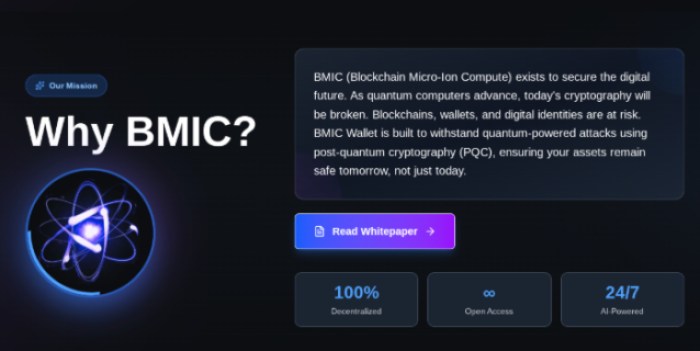
The platform integrates these defenses directly into a usable ecosystem, featuring ERC-4337 Smart Accounts and AI-Enhanced Threat Detection. This isn’t just about paranoia; it’s about future-proofing. If a centralized issuer can freeze $544M with a keystroke, and a quantum computer can eventually crack a standard private key in seconds, the only safe harbor is an architecture built explicitly to resist both.

BMIC’s ‘Burn-to-Compute’ model and Quantum Meta-Cloud extend this utility further, offering a decentralized alternative to the fragile infrastructure currently dominating the headlines.

Smart Money Pivots to BMIC as Presale Metrics Climb

The market’s appetite for defensive infrastructure is showing up in the BMIC capital raise. Sophisticated allocators are positioning themselves in protocols that solve fundamental security flaws. $BMIC has already raised over $444K, a significant figure for an early-stage infrastructure play.

With the token sitting at $0.049474, early participants are entering at a valuation that reflects the project’s development phase rather than its fully realized utility. The appeal lies in the dual-layer value proposition: $BMIC serves as both a governance token for the Quantum Meta-Cloud and the fuel for a wallet ecosystem that enterprises and privacy-conscious individuals desperately need. It’s not surprising that $BMIC made our list of best crypto to watch.

The risk here is inaction. History suggests that security solutions are often undervalued until a catastrophic event, like a major exchange hack or a cryptographic breakthrough, forces a repricing of ‘safety.’ By combining quantum-secure staking with no exposed keys, BMIC offers a yield-bearing asset that doesn’t compromise on security. As the presale continues to draw liquidity away from purely speculative assets, the window to acquire allocation at sub-five-cent levels is narrowing.

SEE HOW THE QUANTUM FUTURE IS BEING BUILT BEFORE LEGACY SYSTEMS FAIL

This article is for informational purposes only and does not constitute financial advice. Cryptocurrency investments carry high risks, including the potential loss of all invested capital. Always conduct independent research before investing.


Related Questions

QWhat was the amount frozen in the joint operation between Turkish authorities and Tether, and what was the stated reason?

ATurkish authorities, working with Tether, froze approximately $544 million. The operation targeted a massive money laundering network.

QAccording to the article, what does the Tether ($USDT) asset freeze demonstrate about centralized stablecoin issuers?

AIt demonstrates that centralized stablecoin issuers possess the ability to blacklist addresses at the request of law enforcement, showing that the 'wild west era' of digital finance is ending and challenging the censorship-resistance narrative.

QWhat is the 'Harvest Now, Decrypt Later' threat mentioned in the article?

AThe 'Harvest Now, Decrypt Later' threat is a strategy where bad actors collect encrypted data today with the intention of decrypting it once quantum computing power becomes advanced enough to break current cryptographic standards.

QHow does BMIC ($BMIC) claim to protect against the quantum decryption crisis?

ABMIC uses a Full Quantum-Secure Finance Stack featuring post-quantum cryptography and 'Zero Public-Key Exposure.' This ensures a user's assets remain mathematically invisible to unauthorized decryption, even from future quantum algorithms.

QWhat is the dual-layer value proposition of the $BMIC token as described in the article?

AThe $BMIC token serves as both a governance token for the Quantum Meta-Cloud and as the fuel for a wallet ecosystem designed for enterprises and privacy-conscious individuals.

Related Reads

US Stocks Suffer Worst Plunge Since 2025: Three Triggers Ignite Tech Stock Valuation Reset

The US stock market experienced its most severe sell-off since the 2025 tariff crisis on June 5th, 2025. The Nasdaq Composite plummeted 4.18%, the S&P 500 fell 2.64%, and the Dow Jones dropped 695 points. The panic stemmed from three converging factors. First, Broadcom's earnings report ignited fears of a slowdown in AI growth. While its AI chip revenue surged 143% YoY to $10.8B, its Q3 AI revenue guidance of $16B fell short of the $17.2B consensus. This triggered a massive sector-wide sell-off, with the Philadelphia Semiconductor Index crashing 10.26% and semiconductor stocks losing roughly $1.3 trillion in market value in a single day. Second, a shockingly strong May jobs report crushed hopes for Federal Reserve rate cuts. Non-farm payrolls added 172,000 jobs, doubling expectations. This robust data, combined with persistently high oil prices above $92/barrel due to the ongoing Iran war and blockade of the Strait of Hormuz, drastically increased market expectations for a potential Fed rate hike instead of a cut. Higher interest rates compress the valuations of growth-heavy tech stocks. Third, the prolonged Iran conflict continues to fuel inflationary pressures, complicating the Fed's policy decisions and undermining the "inflation is tamed" narrative. Together, these events challenged the twin pillars of the market rally: the "limitless AI growth" story and expectations for imminent monetary easing. The sell-off spread globally, impacting Asian and European markets and cryptocurrencies. The article posits this is likely a severe "valuation repricing" rather than the end of the AI story. The underlying demand for AI remains strong, but investor expectations for growth speed and the prices they are willing to pay are being recalibrated. Key upcoming factors include the June FOMC meeting, future AI company earnings, and developments in the Iran conflict.

marsbit1h ago

US Stocks Suffer Worst Plunge Since 2025: Three Triggers Ignite Tech Stock Valuation Reset

marsbit1h ago

From Madison Square Garden to Kalshi: Prediction Markets Break into the NBA Finals

From Madison Square Garden to Kalshi: Prediction Markets Break into the NBA Finals Prediction markets are playing a significant role in the 2026 NBA Finals, particularly around the New York Knicks' unexpected 2-0 series lead. Platforms like Kalshi and Polymarket have seen massive trading volumes, exceeding hundreds of millions of dollars on championship and related markets. Their influence extends beyond online trading. Kalshi's official partnership with Madison Square Garden has given it prominent physical branding at the arena. Furthermore, local businesses like The Jeffrey bar are using prediction market contracts to hedge the risk of game-result-based promotions, turning potential losses into manageable costs—a concept similar to the famous "Mattress Mack" strategy from traditional sports betting. These markets differentiate themselves by offering a wider, more entertainment-focused range of "event contracts" beyond typical game outcomes, such as predicting celebrity attendance. They also have broader accessibility across the U.S. compared to age- and location-restricted traditional sportsbooks. However, their rapid integration into sports raises regulatory and ethical questions. The NBA is cautiously engaging, discussing integrity frameworks with regulators like the CFTC. While the league permits minor investments like Giannis Antetokounmpo's stake in Kalshi, it advocates for strict rules to prevent insider trading. Many fans express concern on platforms like Reddit, fearing that the close ties between prediction markets, the league, and players could compromise the game's integrity. The NBA Finals has thus become a high-stakes testing ground, showcasing prediction markets' commercial potential while challenging traditional boundaries between financial trading, entertainment, and gambling.

marsbit3h ago

From Madison Square Garden to Kalshi: Prediction Markets Break into the NBA Finals

marsbit3h ago

Recursive Self-Improvement AI Gains Traction, Google Pours Cold Water, While DeepSeek and Others Approach the Fringes

The term "recursive self-improvement" (RSI), where AI improves itself autonomously, is gaining momentum in the AI industry. Startups like Recursive Superintelligence and projects such as Andrej Karpathy's Auto-Research aim to create systems where AI designs, implements, and validates its own research, moving toward superintelligence. While Google CEO Sundar Pichai cautions that such exponential acceleration is not yet a reality, progress is evident. For instance, Anthropic reported its Claude Code writes nearly 100% of the team's code, though it still lacks true self-direction. Analysts frame RSI development in stages: "adequacy" (systems functioning without humans), "parity" (matching human research quality), and "supremacy" (exceeding human-AI collaboration). Reaching parity could trigger rapid, unpredictable advancement due to AI's continuous operation. In China, companies like DeepSeek and Baidu incorporate self-optimization techniques without explicitly branding them as RSI, focusing on algorithmic efficiency and reinforcement learning. However, challenges remain, including "model collapse" from training on AI-generated data and the immense computational and open-collaboration requirements. Ultimately, RSI represents a trend of increasing automation in AI development, potentially reducing human oversight in the creation process itself.

marsbit3h ago

Recursive Self-Improvement AI Gains Traction, Google Pours Cold Water, While DeepSeek and Others Approach the Fringes

marsbit3h ago

Trading

Spot
Futures
活动图片




