Trump's Post Leaked in Advance? Polymarket Abnormal Betting Points to US-Iran Ceasefire Before Next Week

marsbitPublished on 2026-03-24Last updated on 2026-03-24

Abstract

Former US President Donald Trump announced on Truth Social that "very good and productive discussions" were taking place to resolve the Middle East conflict. Prior to this public statement, several accounts on the prediction market platform Polymarket placed large bets, totaling approximately $160,000, that a ceasefire between the US would occur by March 31 or April 15. These bets, which would yield over $1 million if successful, were made by 10 newly created accounts and had already generated over $300,000 in floating profits after Trump's post. The timing and success of these wagers, particularly from an account with a history of profitable bets on geopolitical events, have raised suspicions of insider trading. In response, Polymarket announced new rules explicitly prohibiting trading on stolen confidential information, illegal insider knowledge, or by users who can influence event outcomes. Concurrently, unusual trading activity was detected in S&P 500 e-mini futures and WTI crude oil futures just minutes before Trump's post. A significant, isolated spike in volume occurred in these typically illiquid pre-market sessions. Shortly after the post, S&P futures surged over 2.5% while oil prices fell nearly 6%, suggesting that some entities may have traded on advance knowledge of the announcement. The SEC and CME Group declined to comment.

Author: Jinshi Data

On Monday morning local time, US President Trump posted on Truth Social, stating that the US and Iran had "very good and productive discussions" regarding resolving the Middle East war.

However, before Trump publicly disclosed this news, several accounts on the prediction market platform Polymarket had already placed large bets that the war would end within this week.

Ten recently opened accounts invested thousands of dollars in Polymarket's "US-Iran Ceasefire" market, betting on a ceasefire being reached by March 31 or April 15; these accounts collectively wagered approximately $160,000, and if a ceasefire is achieved before the end of the month, they stand to profit over $1 million.

These accounts were identified by X platform user Lirrato on Sunday and were subsequently shared and spread by the PolymarketHistory account. After Trump's post on Monday, the unrealized gains of these 10 accounts have already exceeded $300,000.
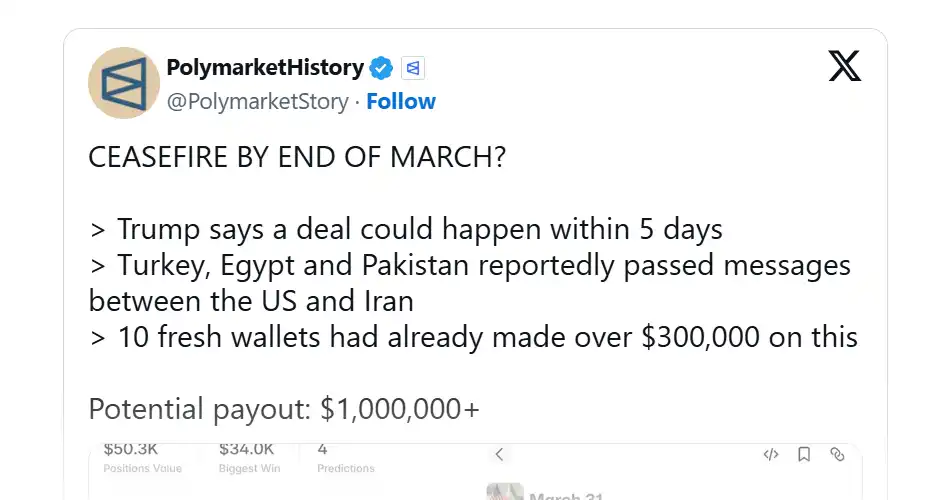
One account named "NOTHINGEVERFRICKINGHAPPENS" was particularly noteworthy. This account was registered in late February. Its first two trades were betting $7,600 on a US strike against Iran before February 28 and betting $11,283 on a strike before March 1; these two bets yielded profits totaling over $85,000. Now, the account has bet $8,005 on a US-Iran ceasefire before March 31 and another $15,614 on a ceasefire before April 15; these two bets have already generated unrealized gains of over $30,000.

The scale, timing, and past performance of these bets have led to external speculation about whether these Polymarket accounts belong to insiders—individuals connected to US or Iranian political circles who possess non-public information about diplomatic progress.

Prediction markets have previously been mired in insider trading scandals. A recent example involves a Polymarket trader who bet on the US taking military action against Venezuela, profiting over $400,000; a few days later, the US announced the capture of Venezuelan strongman Nicolás Maduro. Its competitor, Kalshi, recently also banned two users for insider trading, marking the platform's first public investigation into such activities.

On Monday, Polymarket announced an upgrade to its insider trading rules, explicitly prohibiting three types of behavior: trading using stolen confidential information, trading using illegal insider information, and trading when a user has the ability to influence the outcome of an event.

Polymarket's Chief Legal Officer, Neal Kumar, stated in a declaration: "Market prosperity relies on clear rules. The new regulations provide clarity for all participants and also demonstrate the compliance system we have built."

This rule adjustment may indicate that Polymarket will follow Kalshi's lead and initiate insider trading investigations. Although it is not yet certain whether the accounts betting on a US-Iran ceasefire are insiders, a platform investigation is expected to uncover the truth.

Abnormal Volume Spikes in S&P and Crude Futures Before Trump's Post

Furthermore, several minutes before Trump posted his market-moving social media update, abnormal trading volume spikes were also observed in S&P 500 futures and crude oil futures.

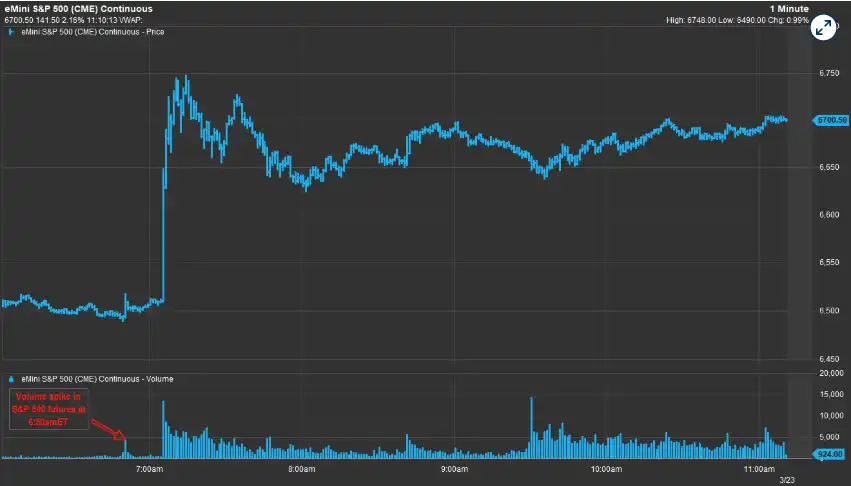
Around 6:50 AM New York time on Monday, the trading volume of S&P 500 e-mini futures traded on the Chicago Mercantile Exchange (CME) experienced a sharp and isolated surge, breaking the typically quiet pre-market backdrop. The early session is usually characterized by thin liquidity, making this sudden volume spike one of the largest moments of on-screen volume for that session up to that point.
A similar pattern emerged in the crude oil market. WTI crude oil futures also showed a noticeable uptick in trading activity around the same time, with a significant volume spike disrupting the previously calm market conditions.
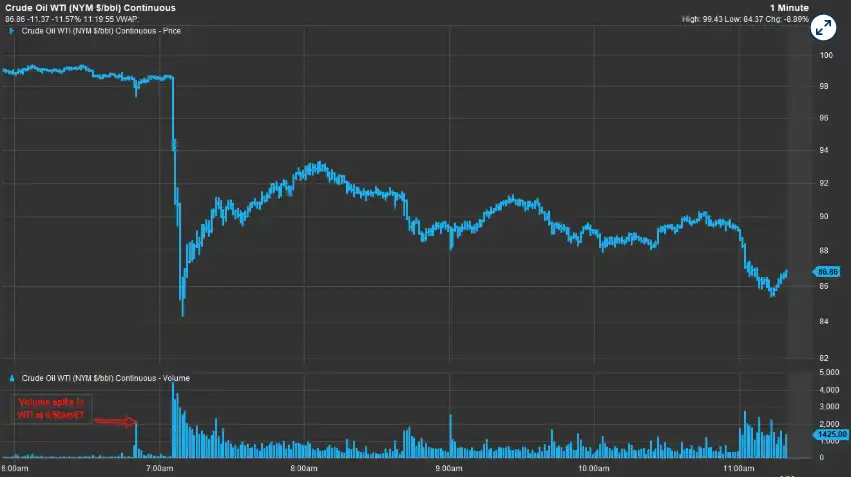
Approximately 15 minutes later, at 7:05 AM, Trump's statement about delaying strikes on Iranian power plants immediately triggered a rally in risk assets. S&P 500 futures surged over 2.5% before the open, while West Texas Intermediate (WTI) crude futures fell nearly 6% following the announcement.

The timing of the synchronized volume spikes in the stock and oil markets during the early session caught traders' attention—especially since there was no apparent catalyst driving the movement at the time of the spikes.

Pre-market futures trading typically has lower liquidity, making brief bursts of buying and selling more conspicuous than during regular trading hours. Nonetheless, these trades were still notable because anyone who bought stock futures in large quantities while simultaneously selling or shorting crude oil futures at that moment would have made huge profits just minutes later.

The US Securities and Exchange Commission (SEC) and the CME Group both declined to comment.

Algorithmic trading strategies and macro-driven strategies could also trigger rapid cross-asset capital flows during pre-market trading, even in the absence of a single identifiable catalyst.


Related Questions

QWhat did President Trump post on Truth Social regarding US-Iran relations?

APresident Trump posted on Truth Social that there had been 'very good and productive conversations' regarding resolving the Middle East war.

QWhat suspicious activity was observed on the Polymarket prediction platform before Trump's announcement?

ATen recently created accounts placed large bets, totaling approximately $160,000, predicting a ceasefire between the US and Iran would be reached by March 31st or April 15th.

QWhat is the name of one notable account that made profitable bets on these events, and what were its wagers?

AOne notable account was named 'NOTHINGEVERFRICKINGHAPPENS'. It previously profited over $85,000 from bets on US strikes on Iran and had new bets on a ceasefire that were already up over $30,000 in profit.

QWhat other financial markets showed unusual activity just before Trump's post?

AS&P 500 e-mini futures and WTI crude oil futures showed isolated, sharp spikes in trading volume approximately 15 minutes before Trump's post, in an otherwise quiet pre-market session.

QHow did Polymarket respond to concerns about potential insider trading on its platform?

APolymarket announced upgraded insider trading rules, explicitly prohibiting trading on stolen confidential information, illegal insider information, and trading by users with the ability to influence event outcomes.

Related Reads

Apple Finally Admits, Siri Is Getting Old

In a significant shift, Apple has rebranded Siri to "Siri AI" at WWDC 2026, acknowledging the assistant's limitations after years of stagnation. The company announced a deep partnership with Google, leveraging Gemini's model capabilities to train its new Apple Foundation Models. This collaboration extends Apple's Private Cloud Compute to Google Cloud and Nvidia GPUs for the first time. The article traces Siri's history from its groundbreaking 2011 debut to its subsequent confinement within Apple's closed ecosystem, prioritizing control and privacy over expansive functionality. While Apple integrated AI into its hardware and systems over the years (e.g., Neural Engine, Core ML), it missed the paradigm shift brought by generative AI models like ChatGPT. Facing pressure, Apple restructured its AI leadership and opted to license Google's Gemini technology—reportedly paying around $1 billion annually—to power the revamped Siri. The strategy involves "distilling" knowledge from the large Gemini model into smaller, on-device models. Apple also plans to use Google Cloud's Nvidia GPUs for complex cloud inference tasks. The core vision for "Apple Intelligence" is a system-level assistant that reduces cognitive load: summarizing notifications and emails, drafting context-aware replies, and retrieving relevant information across apps. Siri gains a dedicated app with memory and cross-device sync. However, this AI push comes with hardware requirements, potentially excluding older iPhones. A major challenge is China, where Apple Intelligence will likely be a different product due to local regulations, requiring partnership with a domestic AI provider. The article concludes by questioning the future of personal AI, noting that true understanding involves more than data access—it requires knowing where to stop. Apple's partnership marks a humble beginning in its quest to build a genuinely helpful, yet respectful, personal assistant.

marsbit5m ago

Apple Finally Admits, Siri Is Getting Old

marsbit5m ago

When Doing Cryptocurrency Payment, the First Thing is Licenses, What is the Second?

When launching a crypto payment business, obtaining the necessary licenses is the crucial first step. However, the second, and arguably more critical, step is designing a comprehensive operational framework that forms a coherent business loop. This loop must be clearly understood and executable by all stakeholders: banks, payment partners, exchanges, on-chain analytics providers, regulators, and your internal team. Many projects mistakenly believe a single license permits all operations. Licenses merely grant entry; they don't define how the specific business functions. The real challenge lies in detailing every aspect of the workflow. This involves clarifying the customer base, the flow of fiat and crypto assets, the settlement process, and establishing clear lines of responsibility for risks like AML compliance, sanctions screening, chargebacks, and regulatory inquiries. A robust framework must answer seven core questions: Who are the clients and merchants? Who collects fiat and crypto? Who handles conversion and custody? And who is ultimately accountable for compliance and risk management? Projects often fail not from a lack of licensing, but during due diligence when they cannot convincingly explain these operational details. Therefore, beyond securing licenses, the priority must be constructing a closed-loop system. This system ensures the business model is transparent, risks are managed, responsibilities are delineated, contracts are aligned, and the entire process is comprehensible to partners and regulators. The true competitive edge in crypto payments lies not in acquiring a license quickly, but in integrating licensing, banking, compliance, and operations into a sustainable and executable whole.

marsbit50m ago

When Doing Cryptocurrency Payment, the First Thing is Licenses, What is the Second?

marsbit50m ago

Arthur Hayes Analysis: AI Bubble Nears Burst, Crypto Market Faces Short-Term Pressure

Arthur Hayes argues that the current AI market is a bubble poised to burst, which will exert downward pressure on the crypto market in the near term. The core trigger is rising oil prices due to the US-Iran conflict and a blockade of the Strait of Hormuz. Higher energy costs directly increase the operational expenses of AI data centers, squeezing profit margins for companies like Google, Anthropic, and OpenAI. Hayes predicts that persistent inflation from high oil prices will force Trump, in a bid to win the November election, to turn public sentiment against the AI industry. He may propose regulations and taxes on data centers and AI companies to appeal to voters concerned about costs and job displacement. Such political rhetoric could shatter market confidence. Furthermore, the market is unlikely to healthily absorb the massive concurrent IPOs of SpaceX, Anthropic, and OpenAI, which together seek valuations in the trillions. The combination of soaring energy costs, overwhelming equity supply, and negative political pressure will puncture the AI bubble. Hayes notes that nearly all new USD liquidity since 2022 has flowed into AI, leaving crypto like Bitcoin behind. When the AI bubble bursts, liquidity will contract sharply, pulling down all risk assets, including cryptocurrencies. In response, Hayes's fund, Maelstrom, has sold all AI-related stocks and non-core cryptocurrencies. It maintains core positions in Bitcoin and Ethereum while increasing exposure to energy sector equities, betting on rising oil and gas prices. He expects Bitcoin to bottom after the AI-led market decline, before rallying again with future monetary easing.

Foresight News1h ago

Arthur Hayes Analysis: AI Bubble Nears Burst, Crypto Market Faces Short-Term Pressure

Foresight News1h ago

Trading

Spot
Futures
活动图片




