Trump’s New Security Strategy Leaves Crypto And Blockchain Out

bitcoinistPublished on 2025-12-08Last updated on 2025-12-08

Abstract

President Trump's new national security strategy has drawn attention for omitting any direct mention of cryptocurrency or blockchain technology, despite previous administration support for digital assets. The document focuses on threats from hostile states, artificial intelligence, and quantum technology, while emphasizing defense modernization and strategic alliances. While it broadly aims to maintain U.S. "digital finance" leadership, the absence of specific crypto references contrasts with earlier proposals like a national digital-asset reserve. Industry analysts suggest the omission may indicate a preference to regulate crypto under economic rather than national security frameworks. This silence has raised questions about the U.S. commitment to crypto innovation as other countries advance central bank digital currencies.

US President Donald Trump’s new national security strategy is drawing attention for what it leaves out, not what it includes. The document, released this week, highlights threats from hostile states, the rise of artificial intelligence, and worries tied to quantum technology. But it does not mention crypto or blockchain at all, even after months of strong political talk around digital assets.

No Crypto In The New Strategy

According to reports, the strategy outlines several areas Washington plans to strengthen, including defense modernization and partnerships with key allies. It also mentions how emerging tools like AI and biotech could shape competition in the years ahead.

Crypto, however, is missing from the list. That omission stands out because the administration previously backed a plan to build a national digital-asset reserve and had signaled that Bitcoin could play a role in long-term economic planning.

One part of the document mentions that Trump aims to maintain and expand “America’s financial sector dominance” by leveraging the nation’s “leadership in digital finance and innovation” to safeguard market liquidity and stability, which some interpret as a possible reference to crypto.
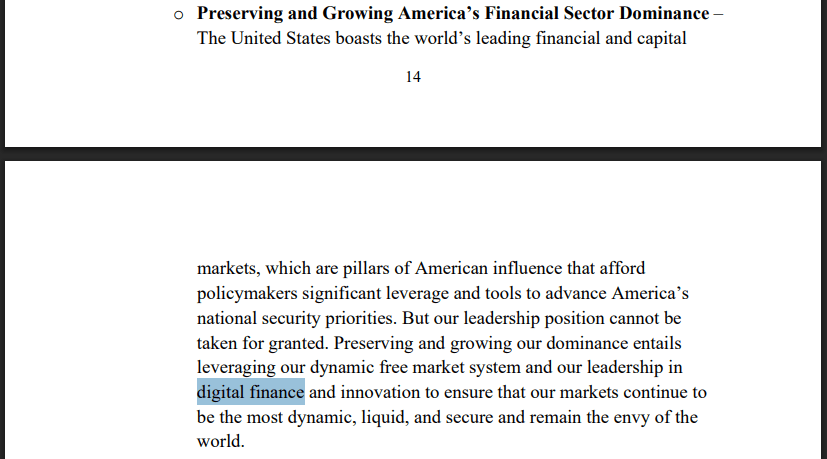
A key excerpt from the document states that the US should strengthen its “digital finance" dominance. Source: The White House

Observers say the silence does not match earlier moves. In January, Trump approved an order that encouraged agencies to prepare for a “digital-asset stockpile,” an idea tied to creating a Strategic Bitcoin Reserve.

That announcement caught global attention, especially after Bitcoin climbed past $126,000 earlier this year before falling to the $88,000 range during a market pullback.

Industry Reaction

Based on reports, some analysts believe the White House chose to keep crypto out of the national security framework to avoid shifting it into a military or defense category.

They argue that digital assets may stay under economic and financial oversight instead of being treated as a strategic security concern.

BTCUSD now trading at $92,056. Chart: TradingView

Others think the omission could weaken the momentum that crypto supporters hoped to see after months of praise from government officials.

Several industry voices say they expected at least a short reference to blockchain due to the technology’s increasing presence in global payments and national-level discussions.

Reports have disclosed that developers and crypto policy groups were tracking the document closely, waiting to see if digital money would be acknowledged in the same way as AI or quantum computing.

Image: Bombay Chamber

That did not happen, and the silence left many wondering whether Washington sees crypto as a priority or just another financial tool.

Questions Moving Forward

The lack of any direct language about crypto may influence market expectations. Some investors considered the national security strategy an important signal that could shape future regulation or federal participation in the crypto economy.

Instead, the absence of a clear stance has raised questions about whether the US will slow its public adoption plans, even as other countries push ahead with central bank digital currency testing.

Featured image from Getty Images, chart from TradingView

Related Reads

When AI Begins to Audit the World: From Claude Discovering the ZEC Vulnerability, Watching the Encryption Industry Enter the 'Recursive Security Era'

**When AI Audits the World: From Claude's Discovery of a ZEC Vulnerability, Viewing the Crypto Industry Entering a "Recursive Security Era"** This article examines a pivotal shift in the blockchain security landscape, triggered by the convergence of two events: Anthropic's research on AI's "Recursive Self-Improvement" and Claude Opus 4.8's discovery of a critical vulnerability in Zcash's code. Traditionally, crypto security has relied on human experts and automated tools for periodic audits. However, the article argues AI is transitioning from a mere tool to an active participant in understanding and analyzing complex systems. Claude's ability to identify a subtle flaw in Zcash's zero-knowledge proof system demonstrates AI's potential to dramatically lower the cost and time required for risk discovery. This goes beyond finding a single bug; it signals a change in the very mechanism of how vulnerabilities are found. The core thesis introduces the concept of "Recursive Security," drawing a parallel to Anthropic's "Recursive Self-Improvement." Just as AI can accelerate its own development through feedback loops, security systems are evolving towards a continuous cycle of analysis, risk identification, remediation, and re-analysis. Security is becoming a persistent, evolving capability integrated into a system's lifecycle, rather than a one-time pre-launch audit. This shift is particularly urgent for the crypto industry, where system complexity from Layer-2 networks, modular architectures, and ZK-proofs is growing faster than human analysis capacity. AI excels at the pattern recognition and contextual understanding needed to navigate this complexity. Importantly, the article cautions that AI augments both defenders and potential attackers, accelerating the entire threat landscape. The future competitive advantage may not lie in having zero vulnerabilities, but in having the fastest risk discovery, validation, and response capabilities. The Claude-Zcash incident is thus an early signal of an era where AI-driven, recursive security systems become essential for managing risk in an increasingly complex digital world.

marsbit41m ago

When AI Begins to Audit the World: From Claude Discovering the ZEC Vulnerability, Watching the Encryption Industry Enter the 'Recursive Security Era'

marsbit41m ago

From MSTR to STRC+: Where Is the Limit of the Strategy Universe?

From MSTR to STRC+: The Evolution and Limits of the Strategy Universe This article examines the transformation of Strategy (formerly MicroStrategy) from a simple "Bitcoin treasury" company into a complex financial engineering firm building a BTC-backed credit system. **Core Thesis:** Strategy's true significance lies not just in its massive BTC holdings (~844k BTC), but in its attempt to transform this static reserve into a multi-layered credit curve within traditional capital markets and, subsequently, into on-chain yield infrastructure. **The MSTR Flywheel:** The initial model was a reflexive loop: BTC price rises → MSTR stock rises → company raises capital (debt/equity) at a premium → buys more BTC → increases per-share BTC exposure → MSTR premium grows. This "amplified Bitcoin" equity (MSTR) thrives on bullish momentum but is vulnerable to tightening premiums and rising funding costs. **Building the Credit Curve:** Strategy's innovation is slicing its single BTC balance sheet into different risk/return profiles via specialized securities: * **MSTR:** High-volatility equity layer absorbing full BTC upside/downside. * **STRC:** Key product. A perpetual preferred stock designed as "short duration high yield credit," offering ~11.5% floating monthly dividends. It attracts fixed-income investors seeking yield without direct BTC exposure, funding Strategy's operations. * **STRD/STRK/STRF:** Other preferred/share classes with varying durations, conversion rights, and fixed dividends. **Risks of the STRC Model:** STRC's high yield is not risk-free. Its stability depends on: 1) Sufficient BTC asset coverage, 2) Strategy's continued ability to pay dividends, and 3) Market faith in the MSTR/STRC funding flywheel. Stress points include deep BTC price declines eroding the asset buffer, rising dividend costs if STRC trades below par, and a broken flywheel if MSTR's premium (mNAV) falls persistently. **On-Chain Expansion: STRC+:** Projects like **Saturn** and **Apyx** aim to package STRC's (and other DAT preferred stock) cash flows into on-chain stablecoin yield (e.g., sUSDat, apyUSD). They offer DeFi a new yield source distinct from trading fees or incentives—cash dividends from traditional securities. However, this introduces compounded risks: off-chain custody, issuer credit risk, BTC volatility, and protocol execution risk. **Conclusion: The Ultimate Boundary** Strategy's endgame is not infinite BTC accumulation. It is the market's long-term acceptance of a new credit system where BTC serves as collateral for tradable securities whose cash flows can power on-chain financial applications. Its "universe" expands if this BTC-native credit curve gains legitimacy, but contracts if these instruments are repriced purely as high-risk, yield-bearing credit assets without stablecoin mythology.

marsbit1h ago

From MSTR to STRC+: Where Is the Limit of the Strategy Universe?

marsbit1h ago

Trading

Spot
Futures

Hot Articles

Discussions

Welcome to the HTX Community. Here, you can stay informed about the latest platform developments and gain access to professional market insights. Users' opinions on the price of S (S) are presented below.

活动图片