Trend Research quietly becomes one of Ethereum’s largest whales with 46K ETH buy

cointelegraphPublished on 2025-12-24Last updated on 2025-12-24

Abstract

Trend Research, associated with LD Capital founder Jack Yi, has become one of the largest Ethereum whales after purchasing 46,379 ETH, bringing its total holdings to around 580,000 ETH. This accumulation surpasses most public companies except SharpLink Gaming and BitMine Immersion Technologies, which hold larger amounts. Yi announced plans to invest another $1 billion in ETH, urging traders not to short. Meanwhile, BitMine aims to control 5% of ETH's supply, staking much of its holdings to earn yield and dominate Ethereum's consensus. In contrast, some firms like ETHZilla and FG Nexus are selling ETH to manage debt or fund stock buybacks, creating what analysts call a "transfer of wealth" to strategic accumulators.

Trend Research purchased 46,379 Ether (ETH) on Wednesday to raise its holdings to about 580,000 ETH, making it larger than most public Ethereum treasuries tracked by CoinGecko.

Only two listed companies, SharpLink Gaming and BitMine Immersion Technologies, currently report bigger ETH balances, with 859,853 ETH and 4,066,062 ETH, respectively.

Trend Research is not a publicly listed company and therefore does not appear in most Ethereum treasury rankings. Still, it has drawn industry attention for its rapid ETH accumulation.

Trend Research is a secondary investment institution associated with LD Capital founder Jack Yi, who has been behind a series of large ETH purchases that began in October, blockchain records show.

A machine translation of Yi’s Thursday X post states that his company is preparing another $1 billion to keep buying Ether as he urged traders not to short.
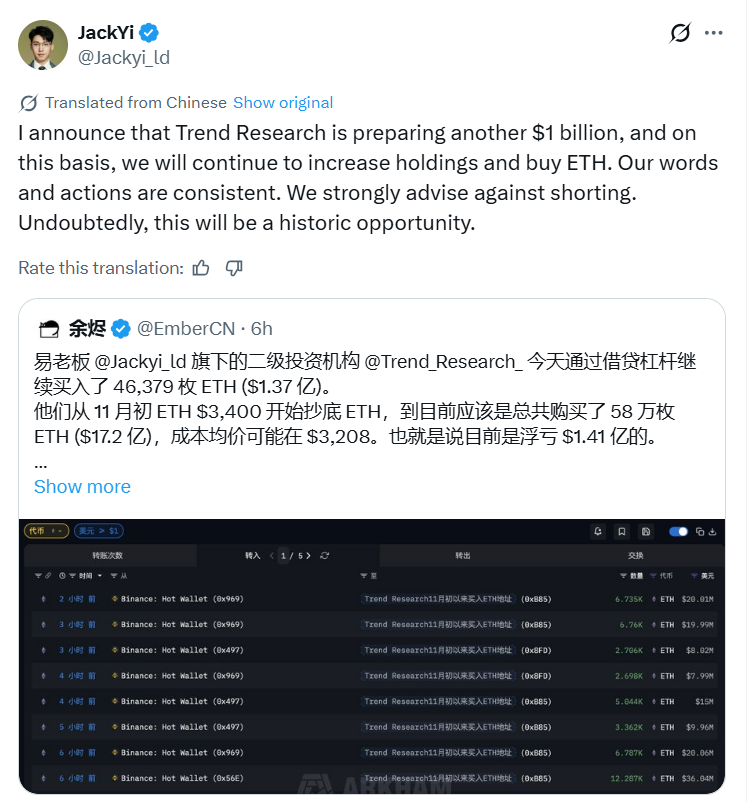
Trend Research is preparing another $1 billion to buy ETH | Source: Jack Yi

The rapid accumulation by a non‐listed player, alongside Bitmine and SharpLink’s public hoards, pushes Ether treasury concentration higher even as broader market sentiment remains fragile.

Lacie Zhang, research analyst at Bitget Wallet, told Cointelegraph that companies buy ETH during downturns to transform passive treasuries into “productive, yield-bearing infrastructure.” However, unlike retail "dip buying," corporate accumulation is “often a strategic play for network dominance.”

Related: BitMine, Strategy, SharpLink stocks outpace crypto market recovery

BitMine’s ‘alchemy of 5%’

The buying spree comes as BitMine announced a milestone of more than 4 million ETH on its balance sheet on Tuesday, or over 3.3% of the circulating supply, cementing its status as the largest known publicly listed ETH holder.

BitMine aims to keep increasing its Ether treasury well beyond the current 4 million ETH, with a target of 5% of the ETH supply.

It plans to stake a substantial portion of those holdings through its “Made in America Validator Network”, to generate yield on its long-term bet on Ethereum.

Zhang said that the staking engine was a “key motivator” for BitMine, and that, by reaching for a 5% supply target, it aimed to “dominate Ethereum’s proof-of-stake consensus,” earning consistent validation rewards and effectively “lowering their average cost basis regardless of price action.”

Related: Why BitMine is accumulating Ether despite broader market fear

ETHZilla, FG Nexus and the sellers

Not every balance sheet is leaning in. ETHZilla, one of the higher‐profile Ether treasury plays, disclosed that it sold 24,291 ETH for roughly $74.5 million to redeem senior secured convertible notes, trimming its stash to around 69,800 ETH.

FG Nexus, a US-listed holding company focused on specialty finance and insurance, has also been liquidating Ether to fund an aggressive share repurchase program.

Zhang called the sales a “balance sheet maneuver,” and said that ETHZilla and FG Nexus were liquidating ETH to redeem debt or to execute stock buybacks when their share price trades at a discount to their crypto holdings.

She added, “For aggressive buyers, these liquidations represent a ‘transfer of wealth’ from distressed entities to those positioned to own the network's future rails.”


Related Questions

QHow much ETH did Trend Research purchase on Wednesday, and what is their total holding after this purchase?

ATrend Research purchased 46,379 ETH on Wednesday, raising its total holdings to about 580,000 ETH.

QWhich two publicly listed companies have larger ETH balances than Trend Research, according to CoinGecko?

ASharpLink Gaming and BitMine Immersion Technologies have larger ETH balances, with 859,853 ETH and 4,066,062 ETH, respectively.

QWhat is the name of the founder associated with Trend Research, and what did he announce regarding future ETH purchases?

ATrend Research is associated with LD Capital founder Jack Yi, who announced that his company is preparing another $1 billion to keep buying Ether.

QWhat is BitMine's target for its Ether treasury supply, and how does it plan to generate yield on its holdings?

ABitMine aims to hold 5% of the ETH supply and plans to stake a substantial portion through its 'Made in America Validator Network' to generate yield.

QWhy did ETHZilla sell a portion of its ETH holdings, and what was the amount sold?

AETHZilla sold 24,291 ETH for roughly $74.5 million to redeem senior secured convertible notes, reducing its stash to around 69,800 ETH.

Related Reads

$9.4 Billion: The Largest Robotics Funding This Year Has Emerged

Munich-based humanoid robotics company Neura has completed a $1.4 billion (approximately RMB 94.9 billion) Series C funding round, valuing the company at around $7 billion and positioning it among the global leaders in the sector. The investment round is notable not just for its size—reportedly the largest in robotics this year—but also for its strategic backers, which include tech giants like NVIDIA and Amazon, alongside established industrial players such as German engineering firms Bosch and Schaeffler. This mix of investors signals a significant shift in the industry's focus from technological demonstrations and general-purpose narratives toward practical, industrial deployment and commercialization. Neura's approach centers on developing humanoid robots for defined, high-value industrial tasks rather than pursuing a general-purpose model. Its early validation comes from a partnership with BMW, where its robots are being tested on actual production lines. The involvement of Bosch and Schaeffler, companies deeply embedded in global manufacturing, underscores a growing belief that humanoid robots are transitioning from labs to viable factory-floor solutions. The article highlights two converging trends driving investment: advancements in AI and large language models, which enhance robots' perception and decision-making in unstructured environments, and mounting pressure from labor shortages and rising costs in major manufacturing regions. The funding landscape is now bifurcating between companies like Figure AI, focusing on versatile general-purpose robots, and firms like Neura, targeting specific vertical industrial applications with clearer, shorter paths to ROI. While technical hurdles remain, the core challenges for widespread adoption are increasingly seen as engineering and commercial in nature: managing the high integration and customization costs for different factory environments and establishing robust, localized maintenance and service networks. The record investment in Neura, particularly from industrial capital, indicates the industry's growing confidence in moving from proving feasibility to solving the practical problems of scalability, reliability, and building sustainable business models around humanoid robots in real-world settings like automotive manufacturing and hazardous labor environments.

marsbit4h ago

$9.4 Billion: The Largest Robotics Funding This Year Has Emerged

marsbit4h ago

"119 to 176 Dollars": Behind SpaceX's Listing, MSX Once Again Successfully Executes the Pre-IPO Closed Loop

Following May's 300% gain on Cerebras, MSX delivered another outstanding performance during SpaceX's listing night. On June 12, SpaceX (SPCX) launched on Nasdaq, reaching a high of $176. This marked the successful culmination of MSX's Pre-IPO project launched in March, where users subscribed at $119, achieving gains of approximately 40-48%. This event validated MSX's complete Pre-IPO mechanism, a crucial advantage in a market where access to top-tier private company equity is typically limited to institutions. MSX's model provides a full cycle for users: subscription (at $119 for SpaceX), real-time on-chain portfolio tracking, optional early redemption, seamless conversion to tradable spot assets (SPCX.M) upon IPO, and final settlement in stablecoins. This end-to-end process distinguishes MSX from platforms that faced settlement issues during the SpaceX IPO, highlighting that the core challenge of Pre-IPO is not just access, but a clear exit and conversion path post-listing. This success with SpaceX is MSX's second major Pre-IPO verification, following the Cerebras listing in May, which yielded ~300% returns for early participants. These back-to-back achievements demonstrate MSX's capability to source, structure, and deliver real assets through a replicable on-chain model. The true barrier for Pre-IPO products lies not in providing an entry point, but in ensuring reliable fulfillment from subscription through to post-IPO liquidity. MSX's proven闭环 (closed-loop) process addresses this, offering Web3 users a structured way to access high-growth, pre-public companies in sectors like AI and frontier tech. MSX plans to continue expanding its Pre-IPO portfolio with this focus on authenticity, transparency, and post-listing execution.

Odaily星球日报16h ago

"119 to 176 Dollars": Behind SpaceX's Listing, MSX Once Again Successfully Executes the Pre-IPO Closed Loop

Odaily星球日报16h ago

Trading

Spot
Futures

Hot Articles

Discussions

Welcome to the HTX Community. Here, you can stay informed about the latest platform developments and gain access to professional market insights. Users' opinions on the price of S (S) are presented below.

活动图片














