
Trading Moment: Japan's Rate Hike Boot Lands, Bitcoin Faces Key Test at $81,000, Ethereum Struggles to Rebound

marsbitPublished on 2025-12-19Last updated on 2025-12-19

Abstract

Japan's central bank raised its benchmark interest rate to 0.75%, a 30-year high, tightening global liquidity. Despite a surprise drop in U.S. CPI, market uncertainty remains due to data reliability concerns. Bitcoin is consolidating between $81,000 support and $93,000 resistance. Analysts warn a break below $81,300 could trigger further selling, with some targets as low as $68,000. Ethereum struggles to hold $2,800; a break below may lead to a drop toward $2,100. Market fear is extreme (greed index at 16). Over $5.1 billion was liquidated in 24 hours. Crypto ETFs saw outflows, with Bitcoin ETFs down $161M and Ethereum ETFs down $96.6M. Major options expiries and long-term holder selling add downward pressure, though some analysts anticipate a potential Santa Rally toward $100,000.

Daily key market data review and trend analysis, produced by PANews.

1. Market Observation

Although the US November CPI annual rate unexpectedly dropped to 2.7% and core CPI fell to 2.6%, hitting a new low since 2021, which once ignited market expectations for the Federal Reserve to accelerate interest rate cuts, the reliability of this report has been widely questioned due to data collection disruptions caused by the government shutdown. The market is swinging amidst complex signals. On one hand, White House officials believe the Fed has "significant room for rate cuts"; on the other hand, the Bank of Japan raised its benchmark interest rate to 0.75%, a 30-year high, continuing to tighten global liquidity. On the regulatory front, the "CLARITY Act," aimed at clarifying rules for the crypto market, is expected to enter Senate deliberations in January next year, bringing positive expectations for the industry. However, financial markets are facing the largest quarterly derivatives concentration in history, with approximately $7.1 trillion in risk exposure potentially exacerbating volatility. Against this backdrop, Wall Street analysts are cautious about the end of 2025, but institutions like Goldman Sachs remain optimistic about the long-term performance of assets like gold, believing gold could climb to $4,900 by 2026. The crypto market, while possessing bull market conditions, appears weak and may have structural issues, making the overall outlook full of uncertainty.

The Bitcoin market is in a fragile consolidation phase, oscillating between a support level around $81,000 and a selling pressure zone around $93,000. Glassnode data shows that high supply pressure, increased realized losses, and weakened demand are limiting its upside potential. It indicates that if Bitcoin falls below $81,300, it could trigger more selling. The market faces multiple pressures: Firstly, long-term holders are experiencing the most intense selling wave in over five years, as confirmed by analyst James Check; Secondly, the upcoming option expirations on December 19th and 26th (with a nominal value of up to $23.8 billion) are also putting downward pressure on the price, with the "max pain" price for December 26th being $100,000. Analyst views are significantly divided: Killa, using the USDT.D chart, suggests the bear market may continue, targeting $74,000 and $68,000; However, Mayne believes the current trend is similar to the bottom in April, potentially testing $80,000 in the short term; AlphaBTC is hoping for a "Santa Claus rally" to around $100,000; Astronomer has already started building long positions targeting $112,000. For the long-term trend in 2026, analyst "Distant Cave Insight" predicts the most likely scenario is BTC consolidating and building a base in the $70,000 to $100,000 range, with a 60% probability, suggesting the year is for accumulating chips rather than chasing high profits.

Ethereum's performance is also under pressure. After failing to break through the descending trendline, the key $2,800 support level is being tested. Analyst Ted pointed out that if this price level holds, a rebound to $3,000 is possible; if it breaks, it could fall further to $2,500. Daan Crypto Trades even believes that breaking below $2,800 would open the path to the next major support zone at $2,100. However, in contrast to the market's pessimistic sentiment, institutions are still actively accumulating. Data shows that an address suspected to belong to Bitmine has bought at least $229 million worth of ETH this week.

2. Key Data (As of December 19, 13:00 HKT)

(Data Source: GMGN, CoinAnk, Upbit, SoSoValue, CoinMarketCap)

  • Bitcoin: $87,058 (Year-to-date -7.1%), Daily Spot Trading Volume $62.57 billion

  • Ethereum: $2,920 (Year-to-date -12.33%), Daily Spot Trading Volume $35.59 billion

  • Fear & Greed Index: 16 (Extreme Fear)

  • Average GAS: BTC: 1.2 sat/vB, ETH: 0.04 Gwei

  • Market Dominance: BTC 58.5%, ETH 12.4%

  • Upbit 24h Trading Volume Ranking: XRP, BTC, ETH, SOL, DOGE

  • 24h BTC Long/Short Ratio: 49.93% / 50.07%

  • Sector Performance: Crypto market continues to decline, AI sector down over 5%, NFT sector down 2.2%

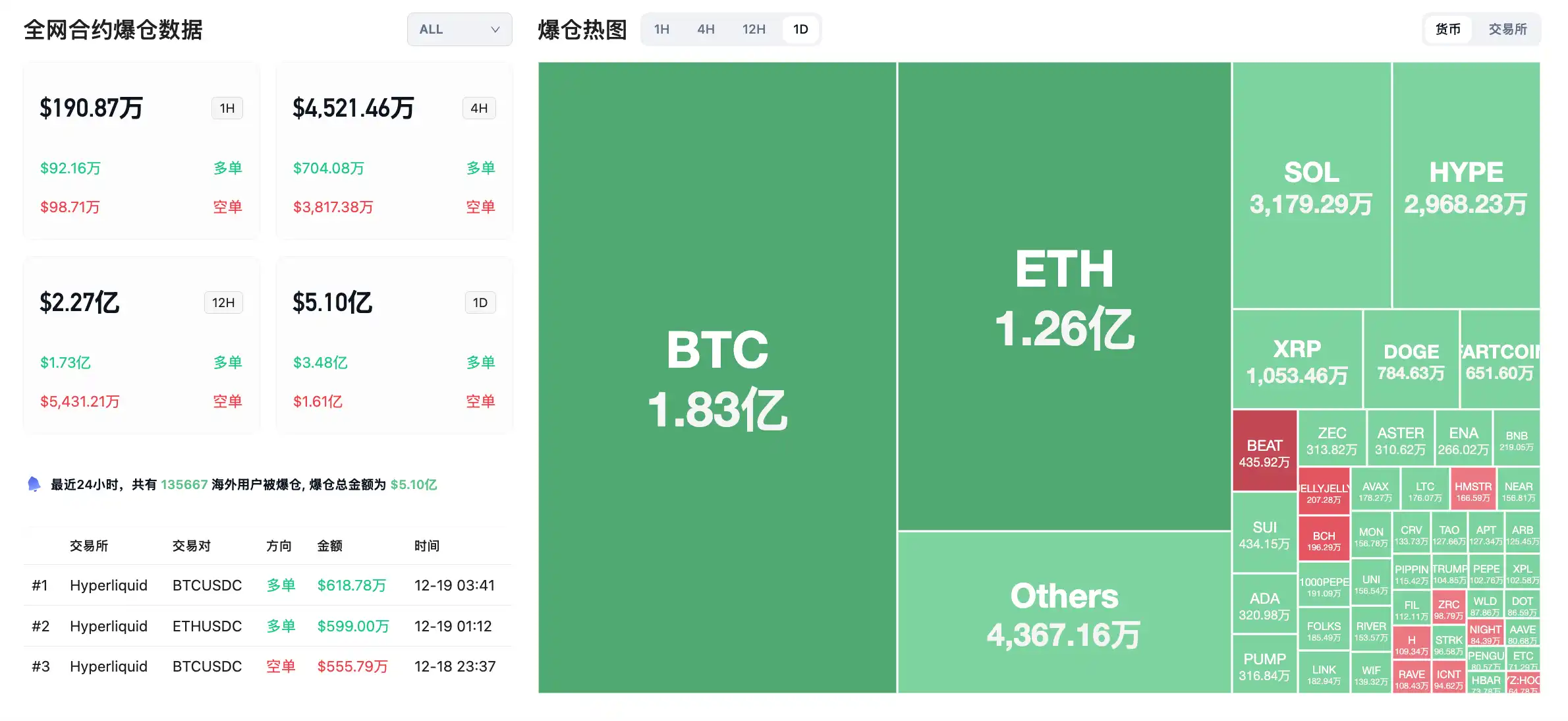
  • 24h Liquidation Data: 135,667 people liquidated globally, total liquidation amount $510 million, including BTC liquidations $183 million, ETH liquidations $126 million, SOL liquidations $31.79 million
3. ETF Flows (As of December 18)

  • Bitcoin ETF: -$161 million, only BlackRock's IBIT saw net inflows

  • Ethereum ETF: -$96.6166 million, net outflows for 6 consecutive days

  • Solana ETF: +$13.16 million

  • XRP ETF: +$30.41 million

4. Today's Outlook

  • Binance Alpha will list zkPass (ZKP) on December 19

  • Binance will remove various spot trading pairs including AI/FDUSD, BICO/BTC on December 19

  • The LayerZero community will initiate the third fee switch vote on December 20

  • Binance Alpha will list TradeTide (TTD) on December 20

  • LayerZero (ZRO) will unlock approximately 25.71 million tokens at 7:00 PM Beijing Time on December 20, representing 6.79% of the circulating supply, valued at approximately $38.6 million;

  • Lista DAO (LISTA) will unlock approximately 33.44 million tokens at 5:00 PM Beijing Time on December 20, representing 6.85% of the circulating supply, valued at approximately $5.5 million.

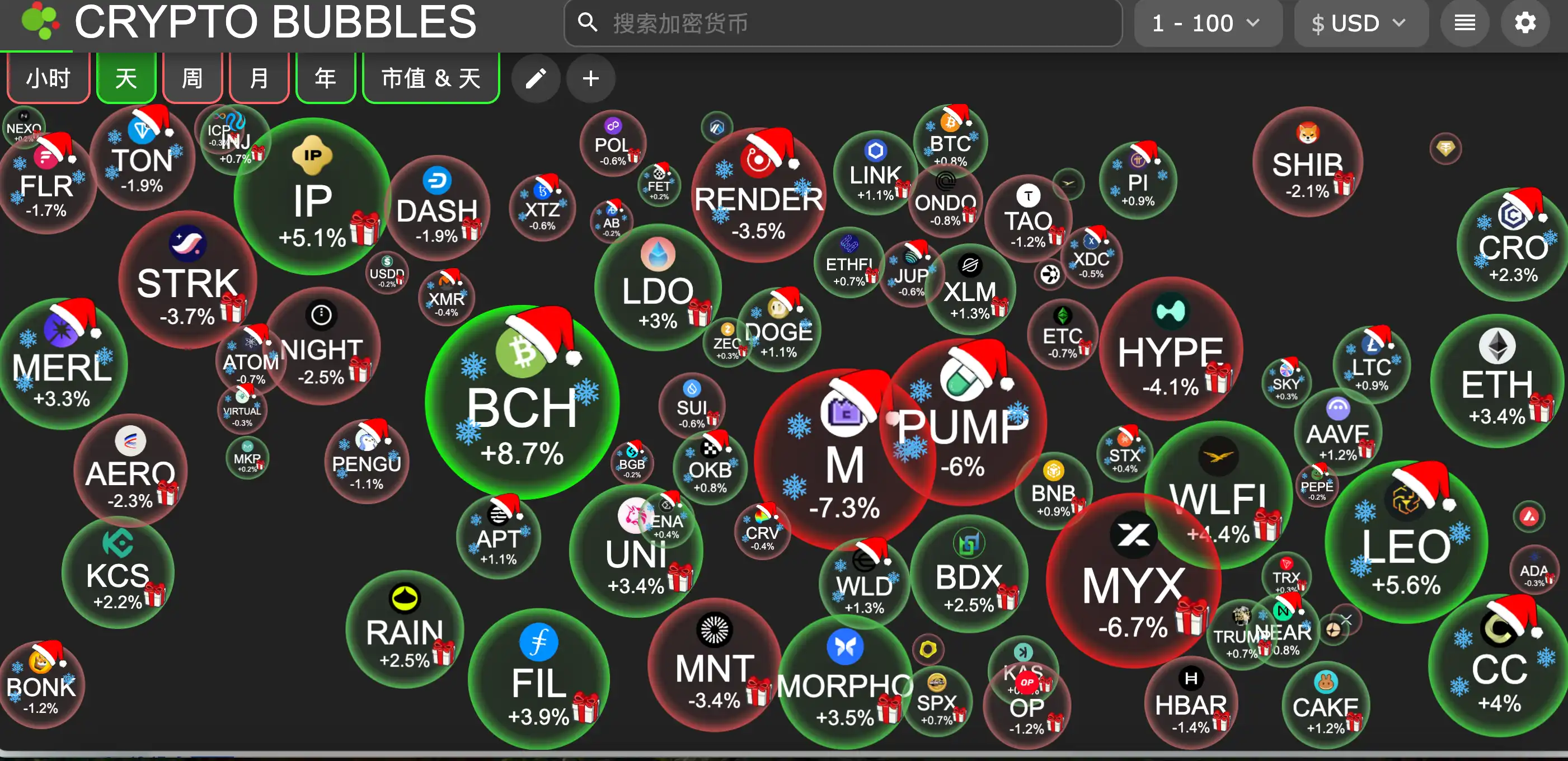
Today's top gainers among top 100 coins by market cap: Bitcoin Cash up 8.7%, LEO Token up 5.6%, Story up 5.1%, World Liberty Financial up 4.4%, Canton Network up 4%.
5. Hot News

  • Arthur Hayes: Maelstrom is aggressively buying the dip on quality altcoins

  • New Lido proposal suggests allocating $60 million in 2026 to execute the GOOSE-3 plan

  • The "1011 Insider Whale" has a floating loss of $77.22 million on a long position worth $695 million

  • CF Benchmarks views Bitcoin as a core portfolio asset, predicting its price will reach $1.4 million by 2035

  • CZ's counterparty whale holds $237 million in long positions with a current floating loss of $40.3 million, its ETH long position is again nearing liquidation

  • Jeff Huang (Machi Big Brother) closed profitable short-term long positions on BTC, ZEC, and HYPE, his ETH long position again realized a loss of $359,000

  • US November unadjusted CPI annual rate 2.7%, core CPI annual rate 2.6%

  • Trump Media & Technology Group pre-market gains expanded to 37.5%

  • Taiwan region's Ministry of Justice announces seizure of 210.45 Bitcoin assets

  • JPMorgan deploys JPM Coin to Base blockchain, transfers limited to whitelisted users

  • Uniswap submits UNIfication proposal, plans to burn 100 million UNI

Related Questions

QWhat is the key support level for Bitcoin mentioned in the article, and what could happen if it breaks?

AThe key support level for Bitcoin is around $81,000. If it breaks below this level, it could trigger more selling pressure.

QWhat was the primary reason for the market's skepticism regarding the U.S. November CPI data?

AThe reliability of the U.S. November CPI data was widely questioned due to disruptions in data collection caused by a government shutdown.

QWhat is the 'maximum pain' price for the Bitcoin options expiring on December 26th?

AThe 'maximum pain' price for the Bitcoin options expiring on December 26th is $100,000.

QAccording to the article, what is the critical support level for Ethereum, and what are the potential price targets if it holds or breaks?

AThe critical support level for Ethereum is $2,800. If it holds, a rebound to $3,000 is possible; if it breaks, the price could fall further to $2,500 or even $2,100.

QWhich cryptocurrency ETF was the only one to see net inflows according to the data up to December 18th?

ABlackRock's IBIT (iShares Bitcoin Trust) was the only Bitcoin ETF to see net inflows.

Related Reads

From Banning Doubao to Embracing Honor: Why Did WeChat Suddenly 'Change Its Face'?

The article explores the sudden shift in WeChat's strategy towards AI assistants from mobile phone manufacturers, transitioning from strict opposition to active collaboration. For over a year, WeChat fiercely resisted attempts by phone AI assistants (like ByteDance's Doubao in late 2025) to control its features via GUI automation ("simulated clicking"), citing security and data control concerns. This stance created a significant barrier for system-level AI integration. Now, Tencent has initiated A2A (Agent-to-Agent) partnerships with major phone brands like Honor, Xiaomi, OPPO, and vivo. This model allows a phone's system AI (e.g., Honor's YOYO) to parse a user's voice command and send a structured request directly to WeChat's own internal AI agent via secure APIs. WeChat then executes the action (e.g., sending a message) and returns the result. The article attributes Tencent's "change of face" to strategic pressure. While leading in social app usage, Tencent trails rivals like ByteDance and Alibaba in standalone AI app popularity. WeChat, with its vast mini-program ecosystem, is Tencent's key asset for an AI comeback. The upcoming WeChat AI agent aims to handle tasks like booking and payments within the app. However, phone system assistants remain the primary AI entry point for most users. The A2A collaboration allows Tencent to extend WeChat's AI reach to this crucial system layer while maintaining control over its core functions and data. For phone manufacturers, embracing A2A is a pragmatic move. The GUI route proved unviable due to WeChat's blocks. A2A offers a compliant path to integrate a vital service, enhancing their AI assistants' usefulness. It allows them to focus on developing their own AI ecosystems for other services while cooperating on WeChat access. The collaboration is framed as a mutual, strategic necessity: Tencent gains a distribution channel, and manufacturers gain a key functionality. The partnership relies on a "dual authorization" mechanism for security, requiring both user and app consent for each action. While questions about long-term data privacy practices remain, experts note A2A is more secure and compliant than GUI automation. Ultimately, this cooperation is seen as a tentative, calculated truce. Tencent's long-term goal is to make WeChat an AI-powered "service OS." Phone manufacturers aim to make their system AI the central user interface. Their paths may converge or clash in the future, but for now, the A2A deal represents the opening chapter in the battle for the AI-era user入口, driven by necessity and strategic calculus on both sides.

marsbit27m ago

From Banning Doubao to Embracing Honor: Why Did WeChat Suddenly 'Change Its Face'?

marsbit27m ago

On-Chain Figures on the Eve of Kickoff: 1.6 Billion Traded Before the World Cup Even Begins

"On-Chain Numbers on the Eve of the World Cup: $1.6 Billion Traded Before Kick-off" Analysis of on-chain markets before the 2026 FIFA World Cup reveals significant crypto integration into football. The most striking figure is the approximately **$1.6 billion** in total trading volume on the single "World Cup Winner" contract on the Polymarket prediction market platform, accumulated before a single match was played. This represents explosive growth for a sector whose annual volume surged from ~$16B in 2024 to ~$64B in 2025. The ecosystem is maturing beyond speculation. Key developments include: 1) **Infrastructure upgrades** like Polymarket's migration to native, regulated USDC stablecoin for settlements; 2) **Reliable data oracles**, such as Chainlink, being used to resolve real-world match outcomes on-chain; and 3) **Official recognition**, with FIFA appointing its first-ever "Prediction Markets" partner. Over 100 contracts now cover everything from the outright winner to individual match results and even non-sporting risks like venue relocation. This evolution marks a fundamental shift. While crypto firms are absent from FIFA's top-tier sponsor list, the technology has deeply penetrated the tournament's financial and predictive infrastructure through regulated stablecoin settlements, decentralized oracles, and new official partnership categories. The regulatory landscape remains complex and varies by jurisdiction, but on-chain markets for the World Cup are already a multi-billion-dollar reality.

marsbit1h ago

On-Chain Figures on the Eve of Kickoff: 1.6 Billion Traded Before the World Cup Even Begins

marsbit1h ago

From SpaceX's IPO to the Future of Crypto: Which Crypto Sectors Will Host the Trillion-Dollar Narrative?

From the SpaceX IPO, which targets a $750 billion raise at a $1.77 trillion valuation, we can extrapolate capital flow trends relevant to crypto. The focus shifts from speculative narratives to foundational infrastructure and real-world asset (RWA) integration. Key crypto sectors poised to benefit include: 1. **AI Infrastructure**: The narrative is moving from consumer-facing AI applications to underlying, scarce resources like compute power and decentralized GPU networks (e.g., TAO, RENDER, AKT, IO). These protocols are positioning as the essential "picks and shovels" providers for the AI economy. 2. **Real-World Assets (RWA)**: Beyond tokenized treasury bonds, RWA's future lies in on-chain equity and pre-IPO assets like SpaceX. This could democratize access to high-growth assets and reshape global capital flows, benefiting infrastructure projects like ONDO, LINK, and Plume that facilitate issuance, data, and liquidity. 3. **Core Financial Infrastructure**: Stablecoins, payment networks, and DePIN (Decentralized Physical Infrastructure Networks) are critical for settling the future on-chain economy. Their role expands from internal trading tools to foundational layers for global finance, AI systems, and real-world asset networks, leading to potential value reassessment. In summary, the next cycle may prioritize long-term infrastructure value—AI compute, asset tokenization networks, and settlement layers—over short-lived application hype, mirroring the broader market's shift towards funding the foundational systems of the future.

marsbit1h ago

From SpaceX's IPO to the Future of Crypto: Which Crypto Sectors Will Host the Trillion-Dollar Narrative?

marsbit1h ago

Trading

Spot
Futures

Hot Articles

Discussions

Welcome to the HTX Community. Here, you can stay informed about the latest platform developments and gain access to professional market insights. Users' opinions on the price of S (S) are presented below.

活动图片











