Towns Across the U.S. Resist Data Center Construction, Bitcoin Miners Become the Biggest Beneficiaries

marsbitPublished on 2026-08-25Last updated on 2026-08-25

Abstract

Across numerous U.S. states, governors and local governments are slowing or halting approvals for new data center construction due to intense public opposition and political pressure. This creates a significant hurdle for AI and other data center projects, which require years of grid connection approval. According to Morgan Stanley, this grid access bottleneck unexpectedly benefits Bitcoin mining companies like Cipher, Hut 8, and Riot Platforms. These miners already possess pre-approved, valuable power contracts and grid connections. With new supply constrained, their existing infrastructure becomes more valuable. This dynamic accelerates a pre-existing trend: miners are pivoting to supply power and data center capacity to the AI industry, signing large contracts like the $9.1 billion deal between Riot Platforms and Anthropic. Companies with AI/high-performance computing contracts command higher valuations than pure-play Bitcoin miners. However, the shift faces uncertainty. Regulatory reviews, like one in Texas targeting both data centers and crypto mines, could also impact miners' permits. Furthermore, a recent sharp rally in Bitcoin's price, pushing toward $80,000, could make mining profitable again, potentially altering the economic calculus of diverting power to AI. The core conflict pits growing AI demand against community resistance to large, power-intensive facilities.

On August 24, Morgan Stanley analyst Stephen Byrd offered a counterintuitive judgment: Governors across multiple U.S. states are slowing down or even halting data center construction, and the biggest beneficiaries of this development are Bitcoin mining companies—because their facilities are already connected to the power grid.

He named Cipher, Hut 8, Galaxy Digital, MARA Holdings, and Riot Platforms. This reasoning sounds convoluted but is actually straightforward: When new electricity cannot be connected, the existing electricity becomes more valuable.

What's Really Happening Across the U.S.?

Over the past month, opposition to data centers has evolved from scattered NIMBY incidents into an organized political movement.

A Gallup survey in August showed that 71% of Americans oppose building data centers in their local areas. More than 500 towns across the U.S. have imposed restrictions on data center construction. Some local officials have received death threats or even been shot due to approval issues, and some councils have directly closed public comment sessions.

State-level actions are more decisive. New York Governor Kathy Hochul proposed a one-year moratorium on data center construction. Pennsylvania Governor Josh Shapiro signed an executive order imposing strict restrictions on new data center builds.

Texas Governor Greg Abbott shifted from a warm welcome to a suspension of approvals within three months. His reasoning was almost a direct jab at these companies: Data center firms failed to win community support and dug their own graves; this backlash is what they deserve.

Virginia became the first state in the U.S. to tax data centers based on electricity consumption, expecting to collect $6 billion next year; Loudoun County within the state already has over 250 data centers and has now begun restricting new construction.

The cost is quantifiable. In the first quarter of this year, at least 75 data center projects were shelved or delayed due to local opposition, involving approximately $130 billion.

On this issue, the White House and the governors are moving in opposite directions. In an interview on August 23, Trump said communities rejecting data centers are making a mistake because data centers bring substantial employment and wealth. But the approval authority is not in his hands.

Why Has "Already Being Grid-Connected" Suddenly Become Valuable?

To understand Morgan Stanley's judgment, one must first grasp what is truly difficult about building a data center.

The difficulty is not in constructing the building, but in getting power. A large AI data center often requires hundreds of megawatts of electricity, necessitating that the utility company specifically run lines, expand capacity, and queue for approvals—a process taking several years. This link is now politically blocked. The Texas Public Utility Commission has even scheduled a timeline to re-review all grid connection applications for data centers and crypto mining farms by December 10, with a report due on December 17.

And what do Bitcoin mining companies have? What they have been doing for the past decade is searching the world for cheap electricity and then connecting their facilities to it. These power connection contracts, substation facilities, and grid interconnection permits are all ready-made, already approved, and no longer subject to public vote or veto.

In an era when data centers could be built anywhere, this was nothing special. In an era when they cannot be built, this is one of the scarcest resources in the entire United States.

Miners Have Been Pivoting for a While

This is not a new story; it has just been accelerated by politics.

Over the past three quarters, listed mining companies have collectively reduced their hash rate by 21%—not by quitting, but by freeing up electricity for AI use. On August 11, Anthropic signed a $91 billion computing power agreement with Riot Platforms.

The market has long priced in this pivot.

According to CoinShares' statistics, mining companies undertaking AI and high-performance computing contracts have an enterprise value multiple of 12.3x; those purely mining Bitcoin have only 5.9x. The same electricity, the same facilities, the same operations team—connecting to AI contracts more than doubles the valuation.
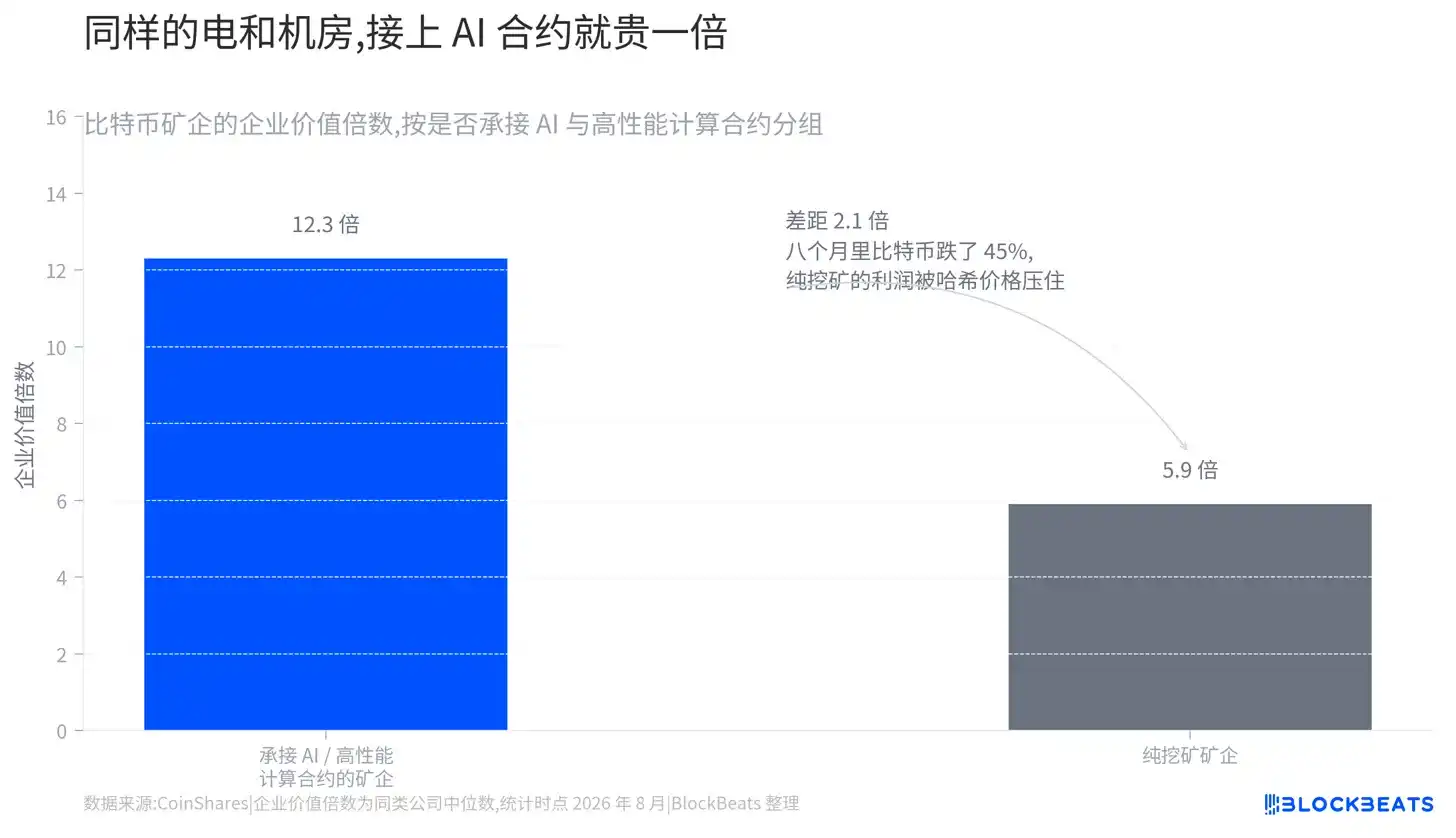
The underlying reason is that the pure mining business is indeed struggling. When CoinShares released that report, Bitcoin had fallen 45% in eight months, and the hash price (the revenue miners earn per unit of computing power) was depressed.

To survive, listed mining companies have sold approximately 28,000 Bitcoins this year, equivalent to $1.78 billion; MARA Holdings mortgaged 18,750 Bitcoins to secure two loans totaling $600 million.

This Calculation Has Two Issues

First, the list for re-review in Texas includes both "data centers and crypto mining farms." Mining farms are not exempted. Whether the grid interconnection permits that mining companies pride themselves on are completely untouchable depends on the report due on December 17.

The backlash targets "large, power-hungry facilities," not specifically "the ones called data centers"—this scenario has already played out in Alabama: Local residents failed to block a large Bitcoin mining data center by exploiting a loophole in the state's zoning laws, not because it was any less disliked.

Second, Bitcoin has just rallied. On August 24, it approached $80,000, hitting a multi-year high and rising 21% in a week. CoinShares calculated that if Bitcoin returns to its historical high of $126,000, the hash price could recover to about $59 per PH/s, making mining economically viable again.

Looking back then, whether freeing up electricity for AI was a pivot or a sell-off might have a different answer.


Trending Cryptos

Related Questions

QAccording to Morgan Stanley analyst Stephen Byrd, why are Bitcoin mining companies becoming major beneficiaries when U.S. governors slow down or halt data center construction?

ABecause Bitcoin mining companies already have their facilities connected to the power grid. When new electricity connections become difficult or impossible to obtain due to political opposition to new data centers, the existing grid access held by miners becomes more valuable.

QWhat significant political trend regarding data center construction has emerged across the United States in the past month, according to the article?

AOpposition to data center construction has evolved from isolated NIMBY incidents into an organized political movement. Over 500 towns have imposed restrictions, and state governors are enacting moratoriums and strict limits on new data centers.

QWhat is the primary practical challenge in building a new large-scale data center that makes existing Bitcoin mining facilities valuable?

AThe primary challenge is obtaining a reliable and massive power supply. A large AI data center requires hundreds of megawatts of electricity, which involves lengthy processes of grid connection, capacity expansion, and regulatory approval. This process is now being politically blocked, making pre-approved grid access extremely scarce.

QHow has the market valuation of Bitcoin mining companies changed when they shift to providing computing power for AI, compared to purely mining Bitcoin?

AThe market valuation multiples differ significantly. According to CoinShares, mining companies that take on AI and high-performance computing contracts trade at an enterprise value multiple of 12.3x, while those focused solely on Bitcoin mining trade at only 5.9x.

QWhat are the two potential complications or counter-arguments mentioned in the article regarding the benefits for Bitcoin miners from the data center backlash?

AFirst, in Texas, the regulatory review applies to both 'data centers and crypto mining sites,' meaning miners' grid permits might not be completely safe from scrutiny. Second, a sustained surge in Bitcoin's price could make mining profitable again, potentially making the decision to sell computing power to AI look like a undervalued sale rather than a smart转型.

Related Reads

NVIDIA Stuns with First Vera Rubin Test, DeepSeek Throughput Skyrockets 30x

NVIDIA has unveiled the first on-silicon test results for its next-generation flagship cabinet, the Vera Rubin NVL72, using DeepSeek-V4-Pro on real "agent coding" workloads. The results are staggering: compared to the current leading GB300 NVL72, Vera Rubin delivers up to a 30x increase in throughput per megawatt and reduces token generation cost by up to 35x. The benchmark used was the AgentX test from SemiAnalysis, which captures full AI agent workflows with growing context, tool calls, and sub-agent generation, moving beyond traditional LLM benchmarks. This highlights a shift from the LLM era to the Agent era. Key innovations behind Vera Rubin's performance include extreme co-design, separation of services, distributed KV cache, KV-aware routing, MegaMoE architecture, 4-bit NVFP4 quantization, and 6th-gen NVLink for efficient MoE model execution. Simultaneously, NVIDIA announced the full-scale production of two new chips: 1. **Groq 3 LPX:** A low-latency inference accelerator designed for the Vera Rubin platform. When paired with Rubin GPUs for context processing, it achieves record-breaking output speeds—e.g., running Gemma 4 31B at 3,400 tokens/sec—drastically reducing multi-step agent task times. 2. **Vera CPU:** A processor specifically built for agentic AI, featuring 88 custom Olympus cores and 1.2TB/s memory bandwidth to handle the complex orchestration of agent tasks. SpaceXAI is already deploying it, with plans for space-based Vera Rubin systems by 2028. NVIDIA's strategy has evolved from selling GPUs to providing a complete, optimized "AI factory" stack—encompassing GPU, CPU, and specialized accelerators—to power the emerging Agent AI economy.

marsbit40m ago

NVIDIA Stuns with First Vera Rubin Test, DeepSeek Throughput Skyrockets 30x

marsbit40m ago

Bessent Repurchases U.S. Treasury Bonds, So Why Is Bitcoin Rising?

On August 19, U.S. Treasury Secretary Scott Bessent significantly increased the limits for buying back long-term Treasury bonds (10, 20, and 30-year maturities), calling it a "Treasury Twist Operation." The goal was to lower soaring long-term yields, which had recently hit multi-decade highs, by boosting demand for these bonds. However, the effect on yields was brief and limited. The article explains that the Treasury's bond buybacks, funded by issuing more short-term debt or using its cash reserves, do not create new money but merely restructure government debt. Major factors pushing yields higher—such as large budget deficits, corporate borrowing for AI investments, inflation driven by rising oil prices, and Federal Reserve policy uncertainty—remained unaddressed, limiting the operation's impact. Instead of taming bond yields, the intervention was interpreted by markets as a sign of official concern over debt sustainability and potential future currency depreciation. This triggered a rally in assets perceived as hedges against such risks: Bitcoin surged toward $80,000, gold rose, and the U.S. dollar weakened. Further context includes Bessent's unusual suggestion for corporations to issue more medium-term ("belly") debt and the potential long-term role of dollar-pegged stablecoins (backed heavily by Treasuries) in influencing government borrowing costs. The move broke with the Treasury's traditional "regular and predictable" debt management approach. Analysts warn that such unexpected interventions could ultimately increase long-term borrowing costs if they erode investor confidence, creating a potential "Bessent put" similar to the "Greenspan put" for equities. Ultimately, the operation twisted markets for currencies and alternative assets more than the Treasury yield curve itself.

marsbit46m ago

Bessent Repurchases U.S. Treasury Bonds, So Why Is Bitcoin Rising?

marsbit46m ago

DeFi Sector Bounces Back Strongest: Which High-Revenue Projects Offer Entry Opportunities?

DeFi Sector Leads Recovery: Which High-Revenue Projects Are Worth Watching? DeFi has been one of the most active sectors during the recent market rebound. Beyond chasing price action, a key fundamental metric for evaluating DeFi protocols is sustainable revenue, which indicates real user demand. This analysis highlights high-revenue projects across key categories, using protocol fee data (net of supplier payouts). **DEX** * **Uniswap (UNI)**: Leads with $7.18M in 30-day revenue. Protocol fees from v2 and select v3 pools are used for UNI token burns. * **Solana DEXs**: Jupiter (JUP, $4.69M 30-day revenue) uses 50% of revenue for JUP buybacks. Meteora (MET, $1.67M) and Raydium (RAY, $1.13M) also allocate portions of fees to token buybacks. * **PancakeSwap (CAKE)**: Earned $5.16M in 30 days, with part of its fees used for CAKE burns, maintaining a net deflationary supply. * **Aerodrome (AERO)**: On Base, it generated $4.11M in 30 days. Revenue is directly distributed to veAERO holders rather than used for buybacks. **Lending** * **World Liberty Financial (WLFI)**: Top earner with $10.47M in 30-day revenue. A proposal passed to use 100% of fees from its Protocol-Owned Liquidity (POL) for WLFI buybacks, but holder net income remains zero. * **Aave (AAVE)**: Generated $4.12M in 30 days. Its buyback program was paused in April 2026 following the rsETH bridge attack. **ETH Staking** * **ether.fi (ETHFI)**: Earned $3.03M in 30 days. Revenue from eETH withdrawals is used for ETHFI buybacks, which are then distributed to sETHFI stakers. * **Lido (LDO)**: Generated $2.31M. Its new NEST mechanism automatically uses 50% of annual revenue exceeding $40M for LDO buybacks. In summary, several DeFi protocols are generating significant revenue, with many employing token buyback or direct distribution mechanisms. This revenue provides a fundamental basis for evaluation amid market volatility.

marsbit50m ago

DeFi Sector Bounces Back Strongest: Which High-Revenue Projects Offer Entry Opportunities?

marsbit50m ago

Trading

Spot

Hot Articles

How to Buy TOWNS

Welcome to HTX.com! We've made purchasing TOWNS (TOWNS) simple and convenient. Follow our step-by-step guide to embark on your crypto journey.Step 1: Create Your HTX AccountUse your email or phone number to sign up for a free account on HTX. Experience a hassle-free registration journey and unlock all features.Get My AccountStep 2: Go to Buy Crypto and Choose Your Payment MethodCredit/Debit Card: Use your Visa or Mastercard to buy TOWNS (TOWNS) instantly.Balance: Use funds from your HTX account balance to trade seamlessly.Third Parties: We've added popular payment methods such as Google Pay and Apple Pay to enhance convenience.P2P: Trade directly with other users on HTX.Over-the-Counter (OTC): We offer tailor-made services and competitive exchange rates for traders.Step 3: Store Your TOWNS (TOWNS)After purchasing your TOWNS (TOWNS), store it in your HTX account. Alternatively, you can send it elsewhere via blockchain transfer or use it to trade other cryptocurrencies.Step 4: Trade TOWNS (TOWNS)Easily trade TOWNS (TOWNS) on HTX's spot market. Simply access your account, select your trading pair, execute your trades, and monitor in real-time. We offer a user-friendly experience for both beginners and seasoned traders.

4.2k Total ViewsPublished 2025.08.08Updated 2026.06.02

How to Buy TOWNS

Discussions

Welcome to the HTX Community. Here, you can stay informed about the latest platform developments and gain access to professional market insights. Users' opinions on the price of TOWNS (TOWNS) are presented below.

活动图片