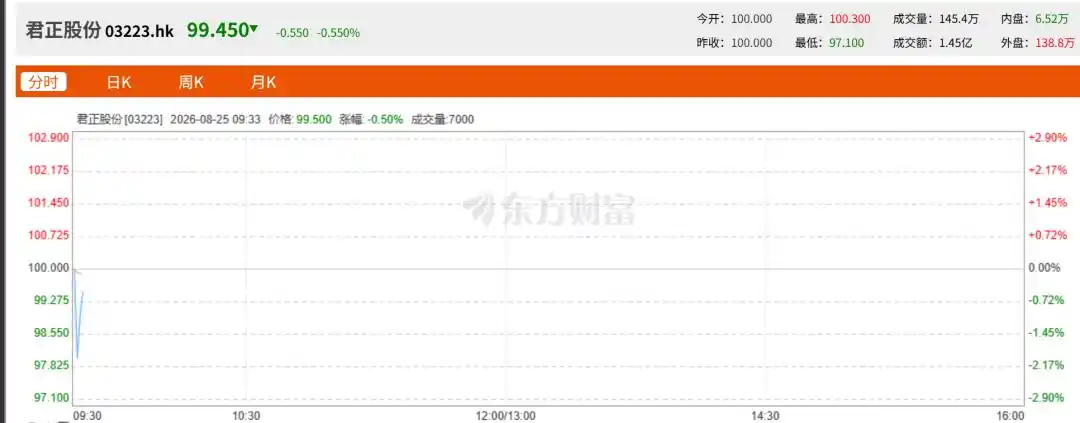
Just now, Ingenic H rang the bell for listing on the Hong Kong Stock Exchange, with an opening price of HK$100 per share and an opening market capitalization of approximately HK$51.5 billion. As early as May 31, 2011, the company was listed on the ChiNext Board of the Shenzhen Stock Exchange, with the stock code "300223". The IPO price was RMB 43.80 per share, with 20 million shares issued, raising RMB 876 million. It was called the "first embedded CPU stock in China." Following this Hong Kong listing, Ingenic H officially joins the ranks of semiconductor companies with dual A+H listings.
Most chip companies emphasize "specialization and focus"—storage companies stick to storage, computing companies delve into computing, and analog companies deepen their analog expertise, each guarding their own turf. However, Ingenic H has charted a different course, simultaneously laying out three major product lines: storage, computing, and analog, building a platform-based chip enterprise.
This platformization capability stems from a major acquisition completed in 2020. That year, Ingenic completed the acquisition of Beijing ISSC and achieved financial consolidation, indirectly controlling the U.S.-based Integrated Silicon Solution, Inc. (ISSI). Consequently, the originally "small but beautiful" company focused on embedded CPUs transformed into a chip platform spanning three segments. Now, as it lists in Hong Kong, we can examine the operational logic behind its journey through the data in its prospectus.
Performance Recovery: Numbers Don't Lie
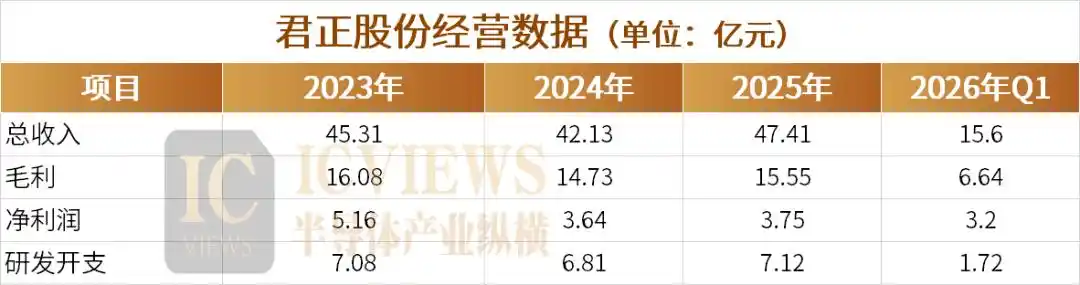
Let's first look at the overall performance. Ingenic's revenue was RMB 4.531 billion in 2023. It dropped to RMB 4.213 billion in 2024 amid industry downturn but rebounded to RMB 4.741 billion in 2025. In the first quarter of 2026, it surged to RMB 1.560 billion, a 47.1% increase from RMB 1.060 billion in the same period last year.
As revenue recovered, profit rebounded even more sharply. Net profit was RMB 516 million in 2023 with a net profit margin of 11.4%; it fell to RMB 364 million in 2024, with the margin dropping to 8.6%; it barely climbed back to RMB 375 million in 2025, but the net margin further compressed to 7.9%. Then, in the first quarter of 2026, net profit soared to RMB 320 million, more than triple the RMB 74 million from the same period last year. The net margin jumped to 20.5%, even higher than during the prosperous period of 2023. The latest financial report shows its net profit for the first half of the year is expected to increase by over 531%, reaching RMB 1.28 billion.
Gross profit margin also recovered. It was 35.5% in 2023, 35.0% in 2024, dropped to 32.8% in 2025, and then suddenly rebounded to 42.6% in the first quarter of 2026. Gross profit rose by 79% from RMB 371 million in Q1 2025 to RMB 664 million.
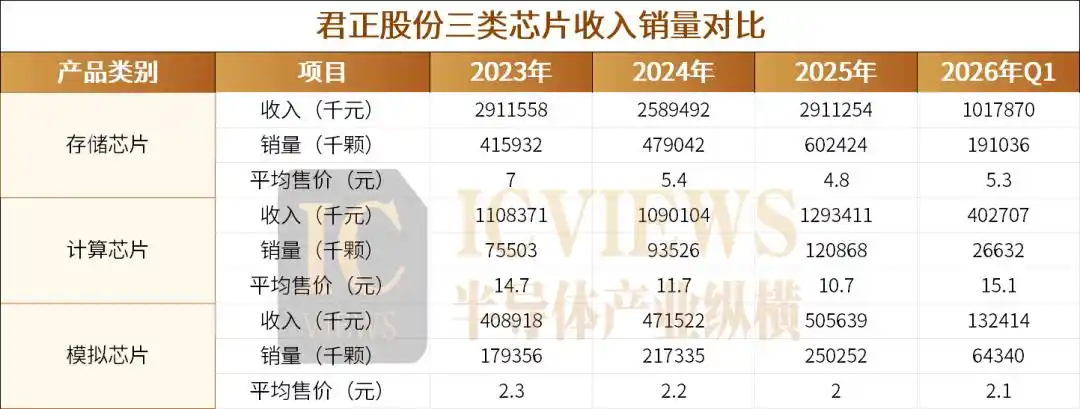
Breaking down the three product lines, memory chips remain the absolute mainstay, accounting for about sixty percent of revenue. From 2023 to 2025, memory chip revenue was RMB 2.912 billion, RMB 2.590 billion, and RMB 2.911 billion, respectively; it was RMB 1.018 billion in Q1 2026. Sales volume has also been continuously expanding, increasing from 416 million units in 2023 to 602 million units in 2025, with another 191 million units sold in Q1 2026. However, prices have experienced a rollercoaster ride: the average selling price (ASP) was RMB 7.0/unit in 2023, RMB 5.4 in 2024, RMB 4.8 in 2025, and finally recovered to RMB 5.3 in Q1 2026.
Revenue from computing chips has seen greater fluctuations. It was RMB 1.108 billion in 2023, dropped to RMB 1.090 billion in 2024, rebounded to RMB 1.293 billion in 2025; and reached RMB 403 million in Q1 2026. Sales volume grew from 75.5 million units in 2023 to 121 million units in 2025. The ASP fell sharply and rebounded strongly: RMB 14.7/unit in 2023, RMB 11.7 in 2024, RMB 10.7 in 2025, and suddenly jumped to RMB 15.1 in Q1 2026.
The analog chip line has been the most stable. Revenue increased from RMB 409 million in 2023 to RMB 472 million in 2024 and RMB 506 million in 2025; it was RMB 132 million in Q1 2026. Sales volume rose from 179 million units to 250 million units. Prices have also been stable: RMB 2.3, RMB 2.2, and RMB 2.0 from 2023 to 2025, respectively, remaining at RMB 2.1 in Q1 2026.
It's noteworthy that Ingenic's customer and supplier concentration has been decreasing. The revenue share of the top five customers dropped from 54.5% in 2023 to 50.3% in Q1 2026, with the largest customer's share decreasing from 21.0% to 15.6%. The procurement share of the top five suppliers decreased from 58.3% to 41.6%, with the largest supplier's share falling from 26.5% to 12.3%. This indicates its business scale is expanding, becoming less reliant on any single major customer or supplier.
In terms of R&D investment, RMB 708 million, RMB 681 million, and RMB 712 million were spent from 2023 to 2025, respectively, with absolute amounts largely unchanged. As a percentage of revenue, it decreased from 15.6% to 15.0%. R&D expenses were RMB 172 million in Q1 2026, accounting for 11.0% of revenue, with the percentage decrease due to rapid revenue growth. As of the end of March 2026, the company had 822 R&D personnel, accounting for 65.7% of total employees.
From "Single Point" to "Platform": A Product Map Pieced Together by Acquisition
The current form of Ingenic took shape after the acquisition of ISSI in 2020. Before the acquisition, it primarily focused on computing chips; afterwards, it added memory and analog chip product lines. Thus, with the three brands—ISSI (Memory), Ingenic (Computing), and Lumissil (Analog)—Ingenic's product portfolio was instantly completed.
Memory Chips (ISSI brand) include DRAM, SRAM, NOR Flash, and NAND Flash, all targeting "tough" applications like automotive electronics and industrial/medical sectors. Based on 2025 revenue, Ingenic ranks seventh globally in niche DRAM and second among mainland Chinese companies; first in SRAM in mainland China and second globally; seventh globally and third in mainland China for NOR Flash. These are not ordinary memory products; they must operate stably in environments from -40°C to 85°C, with requirements for data retention, endurance, and defect rates far exceeding consumer-grade levels. ISSI's over thirty years of accumulation have secured Ingenic's ticket into the automotive-grade supply chain.
Computing Chips (Ingenic brand) are based on CPU cores self-developed by Ingenic. Starting in 2005 with the XBurst series based on MIPS architecture; in 2014, it began betting on RISC-V, launching the Victory series, which is now used in its computing chip product line. Computing chips are divided into three lines: Smart Vision SoCs, Embedded MPUs, and AI-MCUs. Among these, its IP-Camera SoC ranks second globally. This is a type of semiconductor device that integrates ISP, video encoding logic, and other dedicated modules within a single chip, providing integrated computing power for network cameras.
Analog Chips (Lumissil brand) mainly include LED driver chips and Combo chips. LED driver chips are widely used in automotive exterior and interior lighting systems. In non-automotive markets, they are used in high-end gaming devices and home appliances. Combo chips integrate MCU, LED driver, touch sensor, and LIN/CAN bus interfaces into a single chip, specifically serving applications like automotive ambient lighting and touch controls.
How do these three lines interlock? For example, in an automotive electronic system, ISSI memory chips store data and code, Ingenic computing chips handle vision and AI tasks, and Lumissil analog chips manage power and communication. Customers can select storage, computing, and analog devices within the same supplier ecosystem, reducing multi-supplier management costs and achieving better hardware-software synergy. This is the value of platformization.
Niche Memory and Edge AI: Two Visible Growth Lines
Ingenic's memory chips have taken a "avoid the main battlefield" path. Instead of competing with Samsung and SK Hynix in standard DRAM, it specializes in niche types—segments with stringent reliability requirements like automotive-grade, industrial control, and aerospace. These markets have long order cycles and strong customer stickiness; once in the supply chain, replacement is difficult.
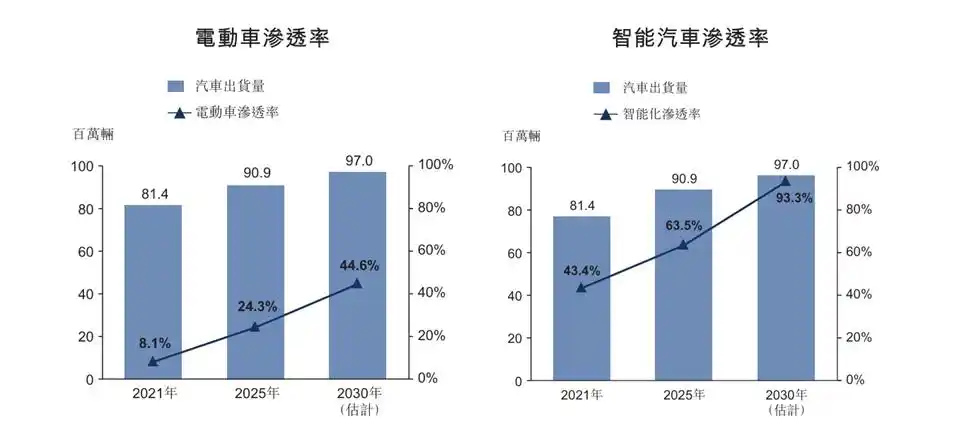
This path coincidentally steps into the trend of automotive intelligence. According to data from Frost & Sullivan, global passenger car shipments are expected to reach 90.9 million units in 2025, with electric vehicle penetration rising from 24.3% in 2025 to 44.6% in 2030; smart vehicle system penetration is expected to increase from 63.5% in 2025 to 93.3% in 2030. As cars become smarter, memory demand changes—L2+ and above autonomous driving models generate over 1TB of data daily, and memory chips must withstand high-intensity read/write operations in extreme environments.
Edge AI represents the growth logic for computing chips. In the prospectus, Frost & Sullivan predicts edge AI device shipments will reach 1.9 billion units by 2030. Ingenic's computing chips happen to catch this wave: computing chip revenue surged 49.1% in Q1 2026, partly due to increasing demand from security, AIoT, and edge AI devices. Additionally, the robotics market is expected to expand at a CAGR of 10.5% from 2025 to 2030. Ingenic's chips are already used in sweeping robots, industrial robots, and service robots. As robots become more intelligent, demand for motor control, power analog, and low-power memory will only grow.
In terms of forward-looking布局, Ingenic is also involved. 1x-nm high-density LPDDR4 products have been sampled, with ramp-up starting in the second half of 2025, and have entered mass production in Q1 2026; LPDDR5 is under planning. 3D DRAM is receiving significant investment, targeting the demand for high-bandwidth, large-capacity memory in AI servers and edge computing. For NAND Flash, it has established serial NAND and parallel NAND product lines in the 2D NAND field, while development of high-bandwidth 8IO serial NAND Flash is underway. In the 3D NAND field, eMMC and UFS product solutions can meet the requirements of automotive cockpit and autonomous driving scenarios.
Hong Kong Listing: Ammunition, Risks, and the Platformization Challenge
For this Hong Kong listing, Ingenic H has set the final offer price at HK$100 per H share and is expected to raise approximately HK$3.13 billion. How will this money be allocated? Half will be invested in R&D to strengthen innovation and product development across the three core product lines; a quarter will be reserved for strategic investments and acquisitions, targeting chip design companies and enterprises along the semiconductor value chain, including upstream and downstream players like IP or EDA suppliers, wafer manufacturers, and packaging and testing service providers; 15% for expanding the sales network; and 10% for working capital and other general corporate purposes.
This allocation ratio reveals two intentions: first, Ingenic does not plan to live off past achievements, with R&D still being a major focus; second, M&A holds significant weight in its strategy. After all, the 2020 acquisition of ISSI completely rewrote the company's fate. Keeping ample ammunition on hand clearly indicates waiting for the next "ISSI" to appear.
Why list in Hong Kong when already listed on the A-share market? Besides gaining an additional financing channel, the higher international profile of the Hong Kong market helps enhance overseas brand recognition for a company like Ingenic, whose products are sold in over 50 countries across Asia, the Americas, and Europe. It also facilitates future cross-border transactions and collaborations.
However, this path is not without risks. The semiconductor industry is cyclical; the drop in memory chip ASPs in 2024 directly dragged down revenue. Ingenic operates a fabless model, limiting its bargaining power when upstream wafer capacity tightens. The consumer market for computing chips is fiercely competitive, with price wars being the norm. Additionally, part of the reason the gross margin surged to 42.6% in Q1 2026 involved an element of "luck"—Ingenic had purchased a batch of inventory at low prices before key raw materials like KGD experienced price hikes, helping control costs temporarily. This inventory红利 is not sustainable. Whether subsequent gross margins can hold steady depends on real product competitiveness and market supply and demand.
But returning to the industrial level, Ingenic's choice logic is sound: rather than being a "lone warrior" in a single segment, it aims to be a "platform player" providing system-level solutions. In today's chip industry with increasingly refined specialization, whether this "counter-consensus" integration path can succeed might be the most intriguing proposition Ingenic's Hong Kong listing leaves for the industry to observe.
This article is from the WeChat public account "Semiconductor Industry Perspective" (ID: ICViews), author: ICVIEWS Editorial Department.