Tonight's Non-Farm Payrolls Report Is Unconventional! October Data 'Missing', But November Unemployment Rate Set to Soar?

marsbitPublished on 2025-12-16Last updated on 2025-12-16

Abstract

The US November nonfarm payrolls report, unusually delayed to a Tuesday in mid-December due to the government shutdown, is the market's key focus. This release will include both November data and October's job growth figures, though October's unemployment rate is missing due to the shutdown's disruption. Economists expect a modest 50,000 job gain in November, with the rate holding at 4.4% or potentially rising. The report is expected to be volatile and complex due to the shutdown's impact, including federal worker furloughs and extended data collection windows. Beyond the headline numbers, details on sectoral job growth, wage trends, and labor force participation will be crucial for assessing the economy's health. The data will significantly influence the Federal Reserve's future interest rate decisions. Bitcoin may see volatility in reaction, with strong data potentially pressuring prices via a stronger dollar, while weak data could boost expectations for rate cuts.

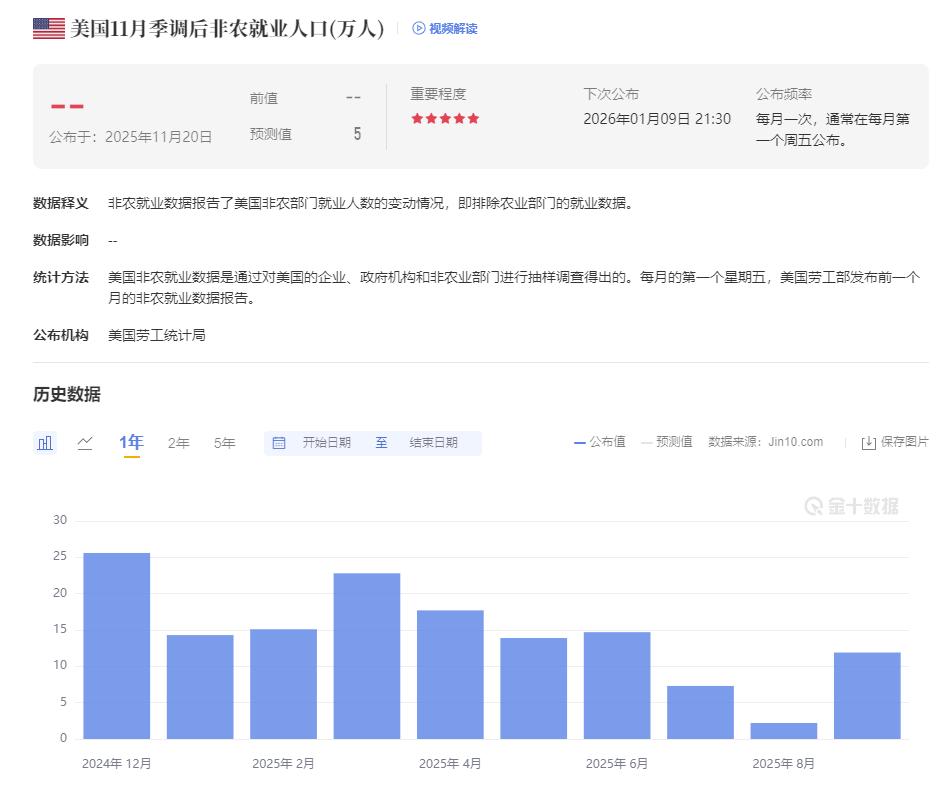
This week, the US economic calendar welcomes a dense release period, with the November Non-Farm Payrolls (NFP) report, originally scheduled for 9:30 PM Beijing Time on Tuesday, undoubtedly becoming the focal point of market attention.

The release of this data has been unusually postponed to a Tuesday in mid-December due to the impact of the government shutdown, breaking the conventional practice of being released on the first Friday of each month.

Over the past month, the backlog of economic data due to the government shutdown is gradually being released, creating a situation this week where multiple important data sets will be unveiled consecutively: over the next three days, heavyweight reports on retail sales, inflation, and the labor market will be released, providing the market with crucial evidence to assess the state of the US economy.

Technical Background of the Unconventional Data Release

The uniqueness of this NFP report lies in the fact that it will essentially contain "two" sets of data—besides the new employment numbers and unemployment rate for November, the Bureau of Labor Statistics (BLS) will also release the October non-farm payroll data concurrently.

As the statistical agency cannot retrospectively collect unemployment rate information for October, the October unemployment rate data will definitely be absent from this report. This "buy one, get half" release format stems from the previous federal government shutdown that lasted 43 days. This historically long shutdown prevented the BLS from conducting the collection and processing of October data according to the常规流程 (conventional process).

The market普遍预期 (widely expects) that November non-farm payrolls will increase by 50,000, with the unemployment rate预计 (expected) to remain at 4.4%.

However, the importance of this report lies not only in revealing the true state of the US labor market but also in providing key guidance for the Federal Reserve's interest rate policy path next year.


Data Expectations and Potential Volatility

In recent months, US employment data has shown significant volatility, swinging between declines and robust growth.

Economists expect Tuesday's report may continue this trend and appear particularly chaotic due to the后续影响 (knock-on effects) of the government shutdown.

Following stronger-than-expected job growth in September, some analysts predicted October employment could turn negative. This expectation primarily stems from approximately 144,000 federal workers accepting "delayed resignation plans" and leaving government positions after September 30th. Goldman Sachs economists estimate this factor will lead to a decrease of 70,000 in October employment and another 10,000 decrease in November. Despite the uncertainty, most economists still expect positive job growth, but the forecast range is unusually wide, spanning from a decrease of 20,000 to an increase of 127,000.

Nancy Vanden Houten, Chief US Economist at Oxford Economics, pointed out that healthcare and private education services sectors are likely to be the main drivers of job growth for the month.

Daniel Zhao, Chief Economist at Glassdoor, stated: "Government shutdowns don't happen often, so there's always some uncertainty when dealing with a large-scale statistical operation like the BLS. Caution should be exercised when interpreting this report, and one should be prepared for various possible outcomes." He believes the pace of job growth is most likely to remain steady, but同时强调 (simultaneously emphasized) that "there's a big variable on top of this."


Impact of Statistical Technical Factors on the Data

The BLS is known for its transparency and usually adds explanatory notes to its reports to account for major contextual or technical issues. Shruti Mishra, an economist at Bank of America, noted in a recent report that despite over 700,000 federal workers being furloughed during the shutdown, a scenario of sharply negative October data followed by a surge in November employment is not expected.

Mishra explained: "The establishment survey counts workers who were paid or expected to be paid for any part of the reference week.

Historical experience shows that the 2013 and 2019 government shutdowns had minimal impact on employment numbers." Daniel Zhao further pointed out that due to the extended timeframe for data submission and collection, the October and November employment data might actually be more complete, with less room for subsequent revisions. Although the October unemployment rate data is confirmed missing, economists expect the November unemployment rate to either remain at 4.4% or face upward pressure. In the three months leading up to September, the unemployment rate had climbed consecutively each month due to a subdued hiring environment and rising labor force participation. Meanwhile, recent layoff announcements have increased significantly, with the October layoff indicator reaching its highest level since early 2023. Some forecasters believe that the decline in federal government employment could push the November unemployment rate higher, potentially to 4.5% or even 4.6%.

Bloomberg Economics also noted that the absence of October unemployment data and the later-than-usual collection cycle for November data could trigger the "technical issues" mentioned by Fed Chair Jerome Powell, such as distortions in seasonal adjustments.


Report Details and Related Data Indicators

Beyond the two core indicators of overall employment numbers and the unemployment rate, economists believe the internal details of the establishment survey and household survey provide a more important perspective for understanding the performance of key sectors of the US economy. Dean Baker, Senior Economist at the Center for Economic and Policy Research, emphasized that the breakdown of job growth by industry deserves close attention. He expects employment in the goods-producing sector may decline again, while healthcare and the restaurant industry are expected to continue leading job growth. Meanwhile, slowing wage growth is expected to put further pressure on consumer spending. Cory Stahle, an economist at Indeed Hiring Lab, pointed out that the labor force participation rate, the employment-population ratio, and the trajectory of unemployment data are crucial indicators for measuring how Americans perceive the job market. "Ultimately, if 100,000 jobs are created every month, but the unemployment rate is rising, or people are saying 'can't find any work, not planning to search anymore,' that will eventually come back to bite the labor market." At the same time on Tuesday, the US Commerce Department will also release October retail sales data. Excluding auto and gasoline sales, economists expect accelerating支出 (spending) to show robust consumer demand at the start of the fourth quarter. Unadjusted overall retail sales are预计 (expected) to grow by just 0.1%. Later this week, the BLS will also release the November Consumer Price Index (CPI) report. The October CPI report was canceled due to insufficient price data collection during the government shutdown. Due to the lack of a comparable October baseline, the statistical agency cannot release the month-over-month figures for the CPI and core measures; investors will need to focus on the year-over-year indicators for signals on the direction of inflation.


Bitcoin Price Forecast

As an asset highly sensitive to macroeconomic data, Bitcoin's price may react noticeably to this NFP data. If the NFP data is significantly stronger than expected, especially if the unemployment rate remains stable and wage growth is robust, it could strengthen the Fed's stance on maintaining high interest rates, thereby boosting the US Dollar Index and creating short-term pressure on non-yielding assets like Bitcoin.

Conversely, if employment data is weak, showing a significant cooling in the labor market, it could strengthen market expectations for an earlier Fed rate cut, potentially benefiting Bitcoin's price.

Given that the market has already priced in considerable rate cut expectations, any data that deviates significantly from forecasts could trigger剧烈波动 (sharp volatility) in Bitcoin's price. Technically, Bitcoin needs to hold the key support level at $85,000; a break below could lead to a further test of the $83,000-$84,000 region.

However, from a medium-to-long-term perspective, Bitcoin's fundamental factors, including the upcoming halving event and the持续提升 (continually increasing) rate of institutional adoption, still provide a solid foundation. Every pullback caused by macroeconomic data could potentially offer strategic entry opportunities for long-term investors.


Related Questions

QWhy was the November non-farm payroll report unusually delayed and what is its special format?

AThe report was delayed to a Tuesday in December due to the government shutdown, breaking the usual first-Friday-of-the-month release pattern. It will contain November's new employment numbers and unemployment rate, plus October's new non-farm payroll data, but the October unemployment rate will be missing.

QWhat is the market consensus for the key figures in the November non-farm payroll report?

AThe market generally expects an increase of 50,000 in non-farm payroll employment for November, with the unemployment rate expected to remain at 4.4%.

QHow did the government shutdown specifically impact the collection and reporting of the October employment data?

AThe 43-day federal shutdown prevented the Bureau of Labor Statistics from collecting and processing October data through its常规流程. This is why the October unemployment rate is unavailable, and the data for that month is being released alongside November's figures.

QWhat potential impact could a significantly stronger or weaker than expected non-farm payroll report have on Bitcoin's price?

AA significantly stronger report (e.g., higher job growth, stable unemployment, strong wage growth) could strengthen the case for the Fed maintaining high interest rates, potentially boosting the USD and putting short-term downward pressure on Bitcoin. A weaker report, signaling a labor market cool-down, could increase expectations for earlier Fed rate cuts, potentially benefiting Bitcoin's price.

QBesides the headline unemployment rate and payroll numbers, what other details in the report do economists consider crucial for assessing the economy?

AEconomists emphasize the details within the establishment and household surveys, particularly the breakdown of job growth by sector (e.g., goods-producing vs. healthcare/leisure), the labor force participation rate, the employment-population ratio, and the trajectory of unemployment data to gauge the true health of the labor market.

Related Reads

Promised Year of Crypto IPOs? Only One Went Public in Six Months, Down 70%

The much-anticipated wave of crypto IPOs in 2026 has failed to materialize, with market conditions worsening dramatically. While SpaceX prepares for the largest IPO in history, raising $75 billion at a $1.75 trillion valuation, the crypto sector faces a frozen pipeline. The sole crypto IPO success this year, BitGo, serves as a cautionary tale. After launching on the NYSE in January at $18, its stock has plummeted approximately 70%. Other major contenders have stalled or delayed. Kraken, which secretly filed in late 2025, has put its plans on ice, seeing its valuation drop 33% to $13.3 billion. Consensys has postponed its filing until autumn at the earliest, and Bitpanda is poised to miss its self-imposed H1 deadline for a Frankfurt listing. This widespread retreat is driven by a severe liquidity crunch. Bitcoin has fallen below $60,000, with capital being diverted to AI stocks and the massive SpaceX offering. The poor performance of earlier crypto listings like Gemini and the stagnant price of Coinbase further dampen investor appetite. A key underlying pressure is the impending US midterm elections in November, which could alter the currently favorable regulatory landscape. Companies had hoped to go public during this window of policy certainty, but challenging market dynamics have overridden those plans. The transparency that comes with being a public company is now seen as a potential liability rather than a benefit in a down market. The industry's fate now hinges on a few critical watchpoints: whether Kraken restarts its process in H2, if Consensys files in the fall, and if SpaceX's debut can revitalize market liquidity. Otherwise, the promised "crypto IPO year" will likely be pushed beyond the election.

marsbit10m ago

Promised Year of Crypto IPOs? Only One Went Public in Six Months, Down 70%

marsbit10m ago

Behind Musk and Huang Jen-hsun's 'AI Factories', an Unseen Battle for Freshwater Has Begun

Behind the "AI factories" of Elon Musk and Jensen Huang lies a hidden battle for a critical resource: fresh water. As AI models like ChatGPT and Claude process billions of prompts daily, they consume vast amounts of water for cooling. By 2030, global AI infrastructure is projected to use 9.3 trillion liters annually—enough to meet the basic needs of 1.3 billion people. This "water grab" stems from the massive heat generated by high-powered GPUs. Over 70% of data centers use evaporative cooling systems, where water absorbs heat and evaporates into the atmosphere, depleting local groundwater. Training models like GPT-4 can consume over 600 million liters of water. Tech giants like Google and Microsoft report skyrocketing water usage, sparking conflicts with local communities over resources. A flashpoint occurred in Memphis, Tennessee, where Musk's xAI built the Colossus supercomputer. It draws nearly 3.8 million liters of drinking water daily from local aquifers, leading to public outrage and legal action. In response, xAI is building an $80 million water recycling plant to use treated wastewater instead. Facing pressure, companies like Microsoft promote "waterless" closed-loop cooling systems. However, these systems increase electricity consumption by 20-30%, shifting the water burden to power plants, which require immense cooling water themselves—a case of indirect water footprint transfer. For China's AI industry, this crisis offers a strategic warning and opportunity. Instead of replicating the West's resource-intensive model, China can leverage its "East Data, West Computing" policy to locate data centers in cooler, water-rich regions like Guizhou. Furthermore, developing lightweight edge computing for smart homes and embodied AI robots can drastically reduce the need for constant cloud queries, cutting both water and energy consumption at the source. The freshwater war underscores a fundamental question: Will AI be a tool for human advancement or a silicon-based monster competing for our planet's last drops of clean water? The answer is becoming clearer as the water vapor rises.

marsbit56m ago

Behind Musk and Huang Jen-hsun's 'AI Factories', an Unseen Battle for Freshwater Has Begun

marsbit56m ago

AGI is Just One Step Away

The article discusses Anthropic's release of the Fable 5 model, a heavily restricted version of its powerful Mythos model. Initially unveiled in April, Mythos reportedly identified over 10,000 high-risk vulnerabilities for 50 enterprise clients, causing significant concern. Due to its dangerous capabilities in areas like autonomous cyber-attacks and biochemical weapons design guidance (classified as CB-1 level), the unaltered Mythos 5 remains limited to about 200 vetted entities like government agencies. Fable 5, released with a safety classifier, demonstrates extraordinary performance, leading benchmarks in coding (SWE-Bench Pro), software engineering, and research. It exhibits true "long-horizon agency," autonomously planning and executing complex, multi-step tasks like migrating 50 million lines of code in a day, moving beyond simple question-answering. The article positions Fable 5 at OpenAI's Level 3 ("Agent") and progressing toward Level 4 ("Innovator"), suggesting AGI (Artificial General Intelligence) is within reach, potentially 18-24 months away. To mitigate risks, Anthropic implemented a two-layer safety "cage": a silent routing system that redirects dangerous queries to a weaker model, and a mandatory 30-day data retention policy for all Mythos traffic to detect patterns of malicious use. Despite its high cost ($10/$50 per million input/output tokens), the model targets the enterprise market, where its unparalleled productivity and defensive capabilities against AI-powered cyber threats justify the premium. This signals a market maturation where top-tier AI becomes a strategic, high-value tool for businesses, potentially widening the gap with consumer-focused models and accelerating the rise of "one-person companies" while disrupting labor markets.

marsbit1h ago

AGI is Just One Step Away

marsbit1h ago

Trading

Spot
Futures

Hot Articles

Discussions

Welcome to the HTX Community. Here, you can stay informed about the latest platform developments and gain access to professional market insights. Users' opinions on the price of S (S) are presented below.

活动图片