Tokenized US Treasurys surge 50x since 2024, marking shift toward on-chain finance

cointelegraphPublished on 2025-12-22Last updated on 2025-12-22

Abstract

Tokenized US Treasurys have experienced explosive growth, surging 50x from under $200 million in January 2024 to nearly $7 billion by late 2025. This rapid expansion is driven by rising institutional demand for on-chain yield and marks a significant shift toward blockchain-based finance. BlackRock's USD Institutional Digital Liquidity Fund (BUIDL) leads this market with almost $2 billion in assets, offering daily yield accrual and on-chain settlement. Other key products include offerings from Circle, Superstate, and Ondo Finance. Tokenized Treasury bills are becoming a crucial gateway for institutional DeFi adoption, combining the safety of US government debt with the efficiency of blockchain settlement. They are increasingly used for collateral management, margining, and improving capital efficiency.

Tokenized US Treasurys have emerged as one of the fastest-growing segments of the real-world asset (RWA) market, with data pointing to 50x growth in less than two years amid rising institutional demand for on-chain yield.

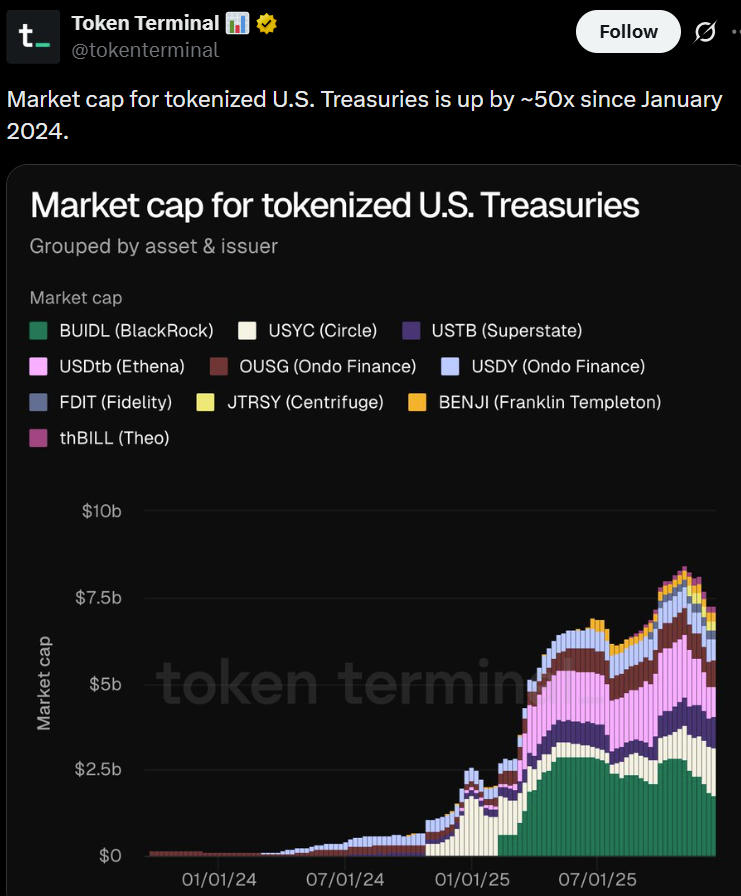
Data from Token Terminal shows that the combined market capitalization of tokenized US Treasury products has exploded from well under $200 million in January 2024 to almost $7 billion in late 2025. The growth underscores the rapid acceleration of onchain adoption for government-backed debt instruments.
Source: Token Terminal

At the center of this expansion is BlackRock’s USD Institutional Digital Liquidity Fund (BUIDL), which is widely regarded as the flagship product of the tokenized Treasury market.

The blockchain-based fund provides investors with exposure to short-term US Treasurys while offering daily yield accrual and onchain settlement. Industry data shows that BUIDL has amassed close to $2 billion in assets under management.

Other prominent offerings include USD Coin Yield (USYC) from Circle, US Treasury Bill Token (USTB) from Superstate and Ondo Short-Term US Government Bond Fund (OUSG) from Ondo Finance.

Each product offers tokenized access to US government debt through regulated fund structures, reflecting a broader push to bring traditional fixed-income instruments onto blockchain rails.

Related: Goldman Sachs, BNY to offer tokenized money market funds for clients

Tokenized Treasury bills emerge as a key gateway to institutional DeFi

US Treasury bills are particularly well-suited for tokenization, as they combine the safety of US government backing with the efficiency of blockchain-based settlement, creating a regulated gateway into decentralized finance (DeFi) markets.

As Cointelegraph has reported, institutional adoption of tokenized Treasury bills is gaining traction, particularly for use in settlement and margining. Traditional financial institutions are using tokenized government debt to improve capital efficiency while maintaining exposure to low-risk assets.

DBS, Southeast Asia’s largest financial institution by assets, was among the first major lenders to test tokenized funds, including blockchain-based Treasury products. The bank has piloted tokenized money market funds and government securities as part of broader efforts to use onchain assets for collateral management and settlement.

Tokenized Treasury bills have grown in tandem with other onchain assets, contributing to the rapid evolution of the tokenization market. RedStone data shows that private credit has been the fastest-growing segment, buoyed by yields that exceed those of traditional investment vehicles.


Related: New protocol targets redemption delays in $20B tokenized market

Trending Cryptos

Related Questions

QWhat is the reported growth rate of the tokenized US Treasurys market since January 2024, according to Token Terminal?

AThe market has experienced 50x growth, surging from well under $200 million in January 2024 to almost $7 billion in late 2025.

QWhich fund is considered the flagship product of the tokenized Treasury market and how much in assets has it amassed?

ABlackRock’s USD Institutional Digital Liquidity Fund (BUIDL) is the flagship product, and it has amassed close to $2 billion in assets under management.

QName three other prominent tokenized US Treasury products mentioned besides BlackRock's BUIDL.

AThe other prominent products are USD Coin Yield (USYC) from Circle, US Treasury Bill Token (USTB) from Superstate, and Ondo Short-Term US Government Bond Fund (OUSG) from Ondo Finance.

QWhy are US Treasury bills described as being particularly well-suited for tokenization?

AThey combine the safety of US government backing with the efficiency of blockchain-based settlement, creating a regulated gateway into decentralized finance (DeFi) markets.

QWhich major Southeast Asian financial institution was mentioned as an early tester of tokenized funds, including Treasury products?

ADBS, Southeast Asia’s largest financial institution by assets, was among the first major lenders to test tokenized funds.

Related Reads

Robinhood Chain Records Largest Daily Trading Volume: $874.8 Million USD, 5.5 Million Transactions

Robinhood Chain recorded its highest daily trading volume and transaction count since its mainnet launch on July 1, with $874.8 million in DEX volume and over 5.5 million transactions. The network briefly surpassed Ethereum and Hyperliquid in application revenue, trailing only Solana. Activity followed a two-month cycle: an initial launch spike, a six-week decline to around $140 million daily in early August, and a three-week rally to new highs. The recent record was driven significantly by the permissionless token launchpad Pons.family, which alone accounted for roughly 51% ($445.98M) of the network's total volume that day. This represents a massive surge from its mid-August levels. While Uniswap Labs launched a competing, zero-fee platform (Pools.trade) in early August and briefly overtook Pons, momentum quickly shifted back. Pons's growth is partly fueled by a reflexive fee cycle, where 80% of protocol fees fund automatic token buybacks and burns, shrinking supply and attracting attention. The broader market rally, with Bitcoin surpassing $81,500 and Ethereum surging nearly 29% weekly, created fertile ground for speculative launchpad activity. Robinhood Chain's low coincided with the market bottom, and its recovery mirrored the upturn. The key question for Robinhood Chain is whether it can sustain transaction activity and volume once the current speculative frenzy on platforms like Pons subsides.

cryptonews.ru4m ago

Robinhood Chain Records Largest Daily Trading Volume: $874.8 Million USD, 5.5 Million Transactions

cryptonews.ru4m ago

After Affecting Two Generations, Meta Ordered to Pay $18 Billion

In a landmark settlement mirroring the historic 1998 tobacco case, Meta has agreed to pay up to approximately $18 billion to resolve lawsuits filed by 52 US states and territories. The lawsuits alleged that Meta deliberately designed addictive features like infinite scroll and push notifications to hook teenagers, concealed known harms to youth mental health, and illegally collected data from children under 13. Faced with a potential $1.4 trillion claim and a series of unfavorable prior rulings, Meta chose to settle rather than risk a jury verdict. Beyond the financial penalty, the core of the 10-year agreement is a set of mandatory product changes for Instagram and Facebook. These include hard daily time limits and nighttime blocks for teen users, restrictions on notifications during school hours, hiding like counts, offering a non-algorithmic feed option, and implementing stricter age verification. An independent auditor will oversee compliance. Crucially, Meta tied 30% of the settlement amount to a condition requiring TikTok and YouTube to adopt similar restrictions and pay comparable fines, aiming to create an industry-wide standard and level the competitive playing field. Analysts compare this moment to the tobacco settlement, which fundamentally reshaped industry rules and public perception. The outcome signals a major shift in regulatory pressure on social media's core engagement models, particularly concerning minors, with ongoing lawsuits likely to target other major platforms.

marsbit21m ago

After Affecting Two Generations, Meta Ordered to Pay $18 Billion

marsbit21m ago

Trading

Spot

Hot Articles

Discussions

Welcome to the HTX Community. Here, you can stay informed about the latest platform developments and gain access to professional market insights. Users' opinions on the price of US (US) are presented below.

活动图片