Tiger Research: If I Were the Founder of Kaito, How Would I Make Decisions in the Face of InfoFi's Upheaval?

marsbitPublished on 2026-01-20Last updated on 2026-01-20

Abstract

Tiger Research analyzes the collapse of the InfoFi ecosystem following X platform's abrupt API policy change, which banned apps incentivizing posts with rewards. Within three days, major projects like Kaito faced existential threats, revealing the structural vulnerability of Web3 projects over-reliant on centralized platforms. The report outlines five potential survival strategies for InfoFi projects: 1) Shutting down entirely; 2) Pivoting to a bounty-based funding platform with manual review (e.g., Scribble); 3) Adopting a Korean-style sponsored blog model with pre-selected creators; 4) Expanding to multiple platforms (e.g., YouTube, TikTok) to diversify risk; or 5) Evolving into a data-driven MCN-style management agency for KOLs. The future of the sector, termed InfoFi 2.0, is predicted to be smaller, more controlled, and quality-focused, shifting from permissionless scaling to curated, professional networks. However, fundamental challenges remain: designing fair incentive structures to prevent low-quality content and proving the intrinsic value of InfoFi tokens beyond speculative narratives. The path forward requires aligning project sustainability with tokenholder利益.

This report is written by Tiger Research. The drastic changes in X platform's API policy have led to the instantaneous collapse of the InfoFi ecosystem. As a leading project in the industry, if I were the founder of Kaito, what viable transformation paths are available at this juncture?

Core Insights

  • Ecosystem Collapse in Three Days: X platform's policy adjustments destroyed the InfoFi ecosystem in just three days, fully exposing the structural fragility of Web3 projects' over-reliance on centralized platforms.
  • Five Survival Paths: InfoFi projects currently face five choices: complete shutdown, transformation into a bounty funding platform, adoption of a Korean-style sponsorship model, multi-platform expansion, or evolution into a KOL management model akin to an MCN.
  • Evolution of InfoFi 2.0: The future model will be more refined and controllable, shifting from "permissionless scaling" to "curated high-quality collaboration."
  • Fundamental Challenge: Establishing a fair incentive compensation system and re-proving the intrinsic value of tokens remain chasms the industry must cross.

1. The "Collapse" of InfoFi in Three Days
Source: X(@nikitabier)

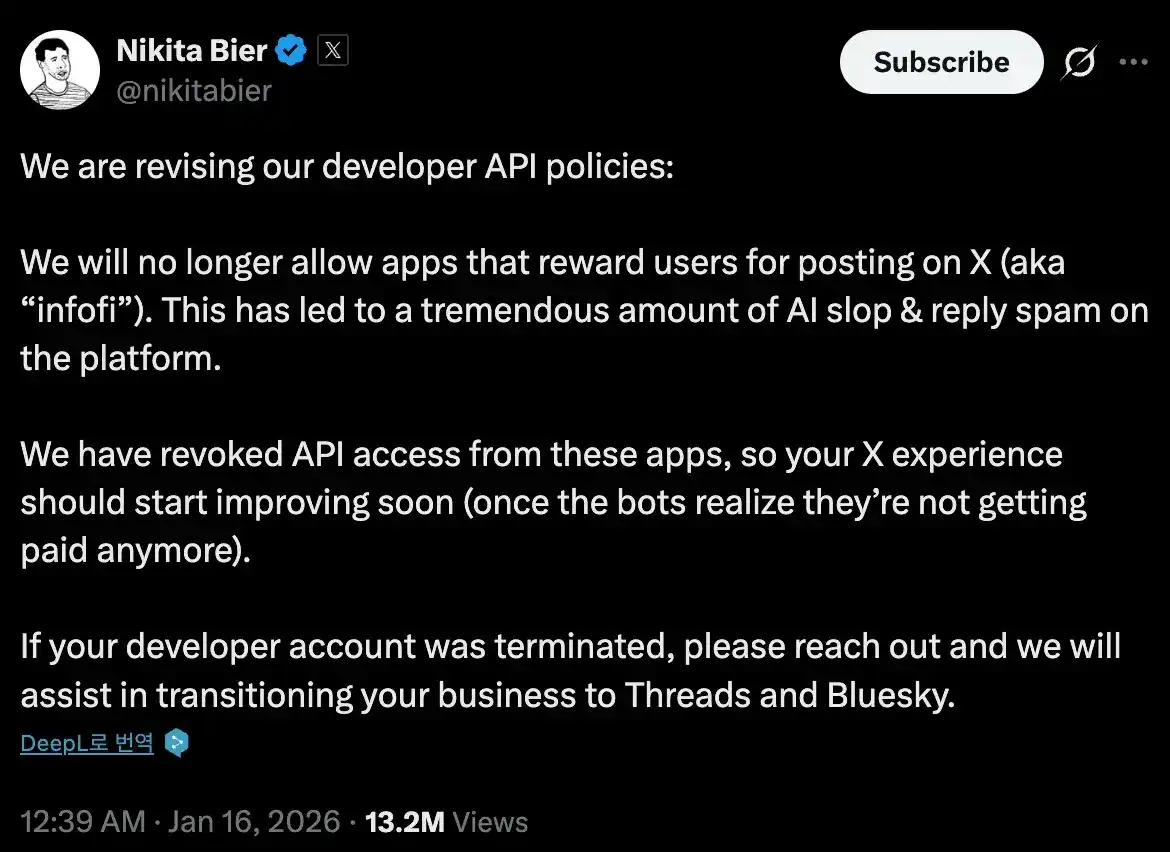
On January 15th, X platform's Product Lead, Nikita Bier, published a brief announcement stating that applications incentivizing user posts with rewards would no longer be permitted to operate on the platform. For the InfoFi sector, this was tantamount to a "death sentence."

According to the timeline disclosed by Kaito founder Yu Hu, the events unfolded as follows:

  • January 13th: Kaito received an email from X platform hinting at a potential review and requesting clarification.
  • January 14th: X platform sent a formal legal notice, to which Kaito submitted a legal response the same day.
  • January 15th: The official statement was publicly released, and Kaito, along with the entire industry, learned of the final decision simultaneously.

The market reaction was extremely severe, with the $KAITO price plummeting. The community accused the team of failing to provide an early warning, despite claiming to have contingency plans. Kaito subsequently issued an emergency statement explaining that they had previously resolved similar disputes through legal channels multiple times, leading to a misjudgment of the negotiation room in this incident.

Lesson: A single decision by a centralized company ended an emerging Web3 category in just three days. This reality, where the "power of life and death" lies in the hands of others, is suffocating the entire ecosystem.

2. If I Were an InfoFi Founder Now

Does this mean InfoFi has reached a dead end? Projects like Kaito are already preparing their next development plans. However, what is needed now is not a continuation of the old path but a completely different "InfoFi 2.0" version.

If I were the founder of an InfoFi project like Kaito, what practical choices are actually available now? By examining these potential forward paths, we can begin to outline the contours of InfoFi's next phase.

2.1 Complete Shutdown

This is the simplest and most direct option: cease operations before funds are completely exhausted. In reality, many small and medium-sized projects may enter a "zombie phase"—largely inactive, occasionally posting some social media updates, and gradually fading from public view.

Since the previously established "Product-Market Fit" (PMF) around the X platform has now vanished, choosing to shut down might be more realistic than continuously burning cash in search of an elusive new direction. If the project still holds usable data assets, these could be sold to other companies to recover some residual value. Therefore, most smaller InfoFi projects will likely choose this path.

2.2 Bounty-Based Funding Platform

If access to X's API is no longer possible, another option is to revert to an earlier business model: KOLs directly apply for relevant activities, submit content for manual review, and receive rewards upon approval.
Source: Scribble

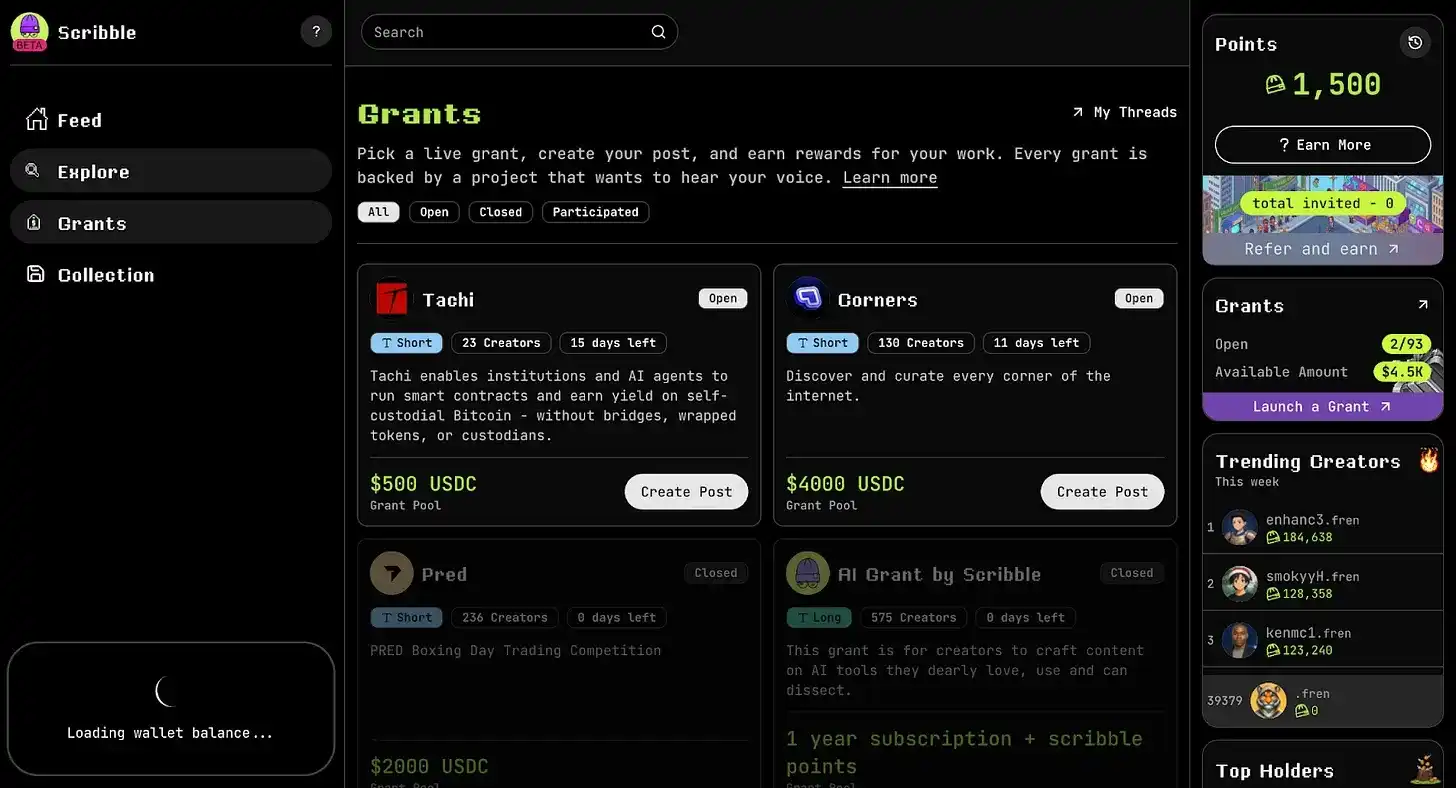
The model represented by Scribble is a typical example. Project parties post funding tasks in the form of bounties, KOLs create and submit content for platform review, and receive payment upon approval. This is a "submit first, review later" model, rather than relying on real-time API tracking.

This structure can be scaled as an open platform: the platform merely provides matching intermediation and infrastructure, while individual project parties manage their own campaigns. As more projects participate, the KOL pool expands accordingly; the growth of the KOL base, in turn, offers more choices for project parties. The drawback is the significant uncertainty for KOLs—if submitted content is rejected, the time and effort invested are wasted. After multiple failures, high-quality KOLs are likely to leave the platform.

2.3 Korean-Style Sponsored Blog Model
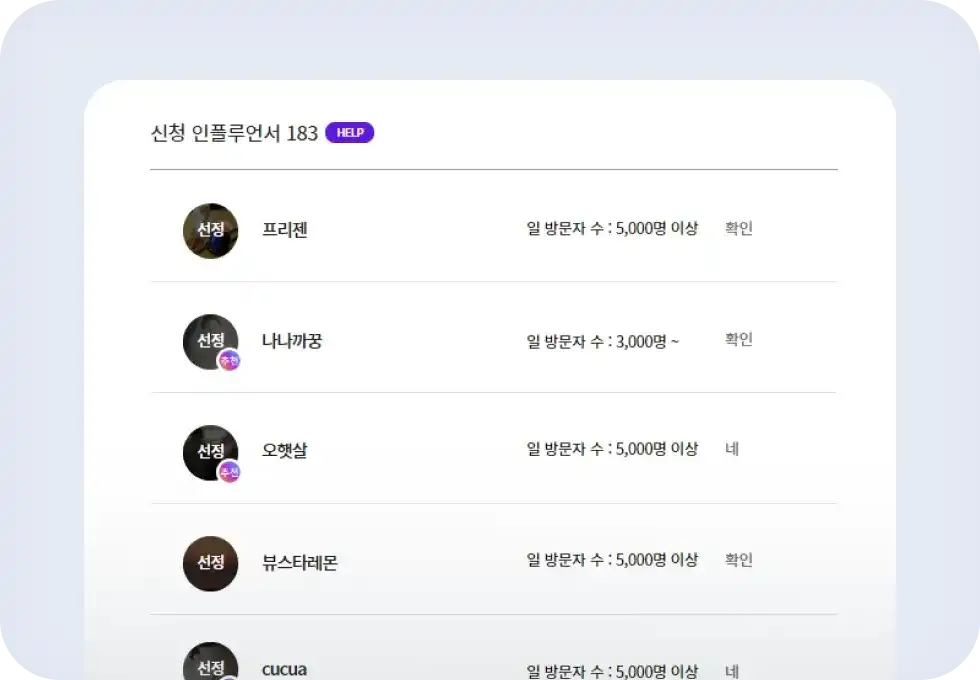
The Korean sponsored blog model follows a "select first, manage later" approach, rather than post-hoc review. Agencies like Revu have used this model for over a decade.

The process is very clear: the project party sets the target number of participants and launches a campaign, applicants submit their applications, and the project party selects suitable KOLs based on data like follower count and past performance. Selected KOLs receive clear creation guidelines, and after content is published, it is reviewed by operational staff. If it doesn't meet standards, revisions are requested; if deadlines are missed, corresponding penalties are applied.

In this model, KOLs can effectively avoid futile efforts. Once selected,报酬 is basically guaranteed as long as guidelines are followed. Unlike bounty-based systems, there is no risk of completing work only to be unreasonably rejected. From the project party's perspective, quality control becomes easier since only pre-vetted participants are chosen.

2.4 Multi-Platform Expansion

If X platform is no longer fertile ground, the next choice is inevitably to pivot to YouTube, TikTok, and Instagram. In the Web3 space, there is already a strong push to move beyond the X platform. The prevailing view is that real growth requires shifting from platforms dominated by crypto-native users to mainstream channels with a broader audience.

The main advantage of this path is a much larger potential user base than X platform, especially in emerging markets like Southeast Asia and Latin America, where TikTok and Instagram hold significant influence. Additionally, each platform runs on different algorithms, so even if one channel is restricted, overall operations can continue.

However, the trade-off is a dramatic increase in operational complexity. On X platform, reviewing text-based posts was usually sufficient; on YouTube, content length and production quality are paramount; on TikTok, the first three seconds of a video determine its performance; and on Instagram, the execution of Stories and format quality must be evaluated. This requires platform-specific expertise and may necessitate developing entirely new internal tools. Given the vastly different API policies and data collection methods across platforms, this is practically equivalent to rebuilding the entire project from scratch. Furthermore, policy risks still loom—any platform could change its rules abruptly, just like X did. However, dispersing activities across multiple platforms does significantly reduce reliance on any single one and is the only option that offers substantive scalability for larger projects.

2.5 MCN-Style KOL Management

In the Web2 MCN (Multi-Channel Network) model, the brand value of KOLs is crucial. In Web3, this influence is even more decisive: narratives drive capital, and a single comment from an opinion leader can directly impact token prices.

Successful InfoFi projects have typically cultivated an active and highly loyal group of KOLs, creators who have grown through months of deep engagement on the platform. The project party could retain this group and pivot them towards a data-driven management model, rather than starting from scratch to find creators. This differs from traditional Web2 MCNs that rely on continuously discovering new talent.

An MCN-style structure implies establishing formal contractual relationships, rather than loose, selective participation. With accumulated historical data and established relationships, the platform can wield stronger influence within the Web3 ecosystem and negotiate better business deals. For InfoFi projects, this requires a robust management system, with data becoming the core asset. If KOLs can be precisely guided through data, and project parties are provided with professional, data-driven GTM (Go-To-Market) strategies, this model will offer a lasting competitive advantage.

3. InfoFi 2.0

This collapse of the InfoFi ecosystem has left two profound lessons for the Web3 world:

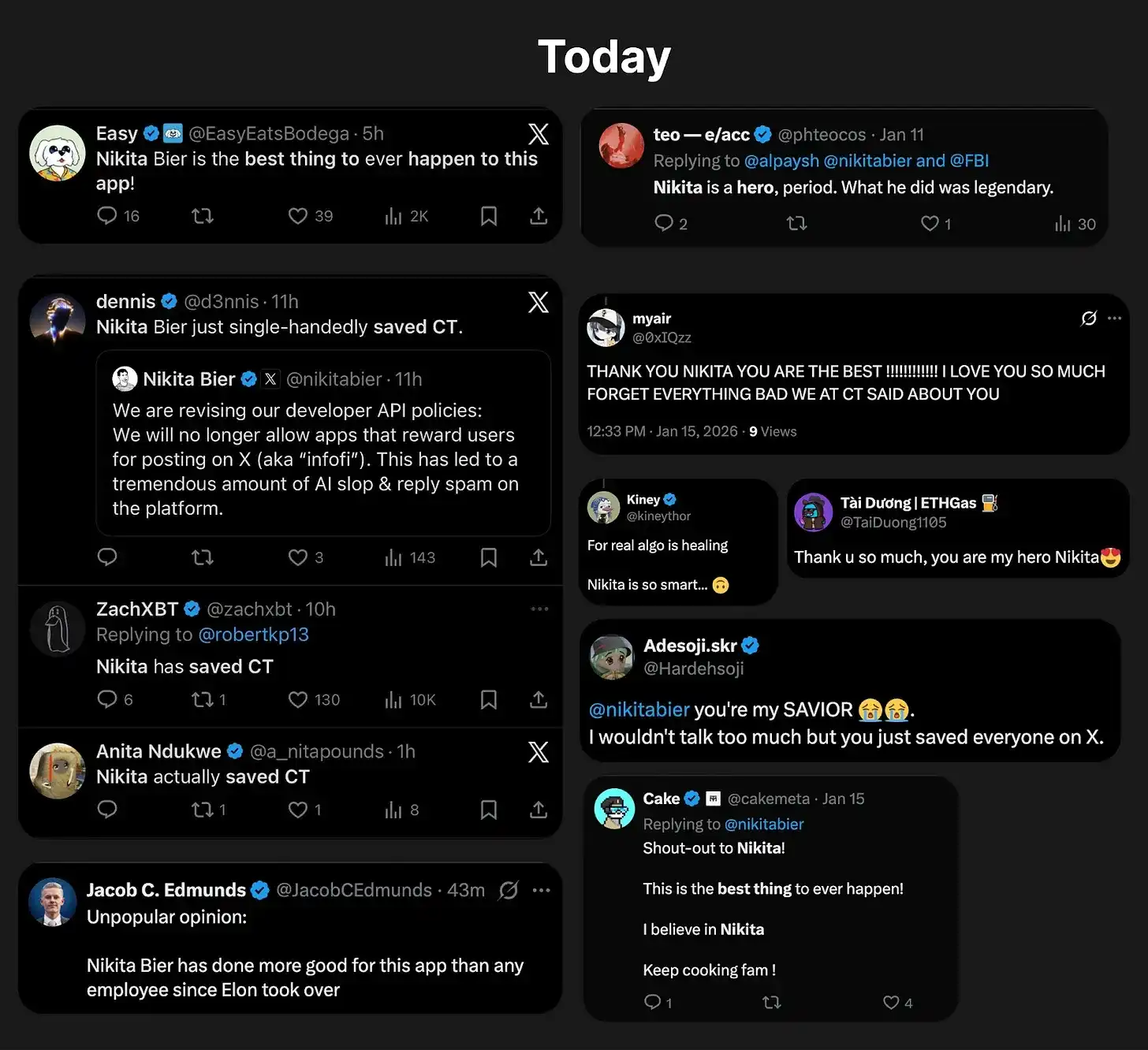
  1. The Irony of Decentralization: Many Web3 projects were deeply dependent on the centralized X platform, and a single decision by X was enough to destroy the entire system.
  2. The Limitations of Incentive Design: Reward mechanisms successfully attracted a large number of participants but lacked effective methods to control content quality. The flood of spam content gave X platform a clear reason to intervene.
Source: X(@nikitabier)

Does this mean the road for InfoFi has come to an end?

Not entirely. A minority of projects that found "Product-Market Fit" might survive by altering their business form. They could pivot to multi-platform expansion, curate premium campaigns, or transform into MCN-style management.

InfoFi 2.0 will likely become smaller in scale, more controllable, and more focused on content quality. It will shift from an open, permissionless platform to a rigorously vetted professional network, its form more closely resembling an integrated marketing platform that combines native GTM efforts and components like offline advertising.

However, fundamental questions remain on the table. Joel Mun from Tiger Research House points out: once incentive mechanisms are introduced, participants inevitably find ways to exploit system loopholes, making fair incentive structures extremely difficult to design. This speculative behavior leads to low-quality content and creates a negative feedback loop that can破坏 the platform.

Furthermore, researcher David raises a more essential question: he believes that the value maintenance of InfoFi tokens in the past relied more on staking airdrop expectations and belief in a certain narrative, rather than the platform's actual performance. Now, both have lost relevance. This leads to a direct question: why should investors buy InfoFi tokens in the future?

For InfoFi 2.0 to truly survive, these questions must be answered clearly and convincingly. If a project cannot align its interests with those of its token holders, it cannot achieve genuine sustainable development.

Original article link

Related Questions

QWhat was the immediate impact of X platform's API policy change on the InfoFi ecosystem, according to the article?

AThe policy change led to the instantaneous collapse of the InfoFi ecosystem within three days, completely exposing the structural vulnerability of Web3 projects that are overly reliant on a centralized platform.

QWhat are the five potential survival paths outlined for an InfoFi project like Kaito after the policy change?

AThe five paths are: 1. Complete shutdown, 2. Transitioning to a bounty-based funding platform, 3. Adopting a Korean-style sponsored blog model, 4. Expanding to other platforms (multi-platform expansion), and 5. Evolving into an MCN-style KOL management system.

QHow does the article describe the fundamental shift in the future model of InfoFi, referred to as 'InfoFi 2.0'?

AInfoFi 2.0 is described as becoming more refined and controllable, shifting from 'permissionless scaling' to 'curated, high-quality collaborations'. It will be smaller, more manageable, and more focused on content quality.

QWhat core challenge does the article identify regarding incentive systems in the InfoFi model?

AThe core challenge is the extreme difficulty in designing a fair incentive and compensation system. Once rewards are introduced, participants inevitably find ways to exploit the system, leading to low-quality content and negative feedback loops that can destroy the platform.

QWhat fundamental question about the value of InfoFi tokens is raised by researcher David in the article?

ADavid questions why investors would buy InfoFi tokens in the future, arguing that their value was previously maintained more by staking for airdrop expectations and belief in a narrative rather than the platform's actual performance, both of which have now lost relevance.

Related Reads

Three Months, 35 Billion Yuan: Investors Rush to Grab the OpenAI of the Physical World

Investors flock to a physical AI startup as the race for the "OpenAI of the physical world" heats up. Ji Jia Shi Jie (GigaWorld), a company dedicated to developing Artificial General Intelligence (AGI) for the physical world, has raised 3.5 billion RMB (approximately $490 million) in just three months, according to a report from investment media outlet Touzijie. The latest B2 funding round of 1 billion RMB attracted a wide range of top-tier investors, including sovereign wealth funds, industrial capital, and financial institutions. This brings the total funding for the young company, now valued over 10 billion RMB, to 3.5 billion RMB across three recent rounds. The company is led by Huang Guan, a post-90s Tsinghua University PhD with extensive experience in AI, autonomous driving, and entrepreneurship. Its core innovation is a "dual-pyramid" system comprising a five-layer data pyramid (from internet videos to real-world robot data) and a three-layer algorithm pyramid focused on world simulation, action alignment, and reinforcement learning. This system underpins its key models: the "World Action Model" (e.g., GigaBrain series for robot control) and the "World Generation Model" (e.g., GigaWorld series for simulating and understanding the physical world). Its models have reportedly achieved top rankings in global robotics benchmarks. Ji Jia Shi Jie argues that while current digital AGI excels in information processing, the next frontier is physical AGI—systems that can understand and interact with the real world. The company believes the field is approaching its "GPT-3 moment," a key inflection point in capability scaling. To achieve this, the company is pursuing a dual-market strategy. For the consumer (C) market, it launched the "SeeLight" brand and its S1 general-purpose humanoid robot, which has secured initial orders for deployment in real homes. For the business (B) market, it focuses on industrial automation with its Maker series robots, having signed agreements for large-scale deployment in factories, and its DriveDreamer world model for autonomous driving, which is already in use with over 30 automakers and tech companies. The report concludes that by bridging the gap between digital intelligence and physical action, Ji Jia Shi Jie aims to unlock a new wave of productivity, ultimately bringing physical AGI into everyday life.

marsbit13m ago

Three Months, 35 Billion Yuan: Investors Rush to Grab the OpenAI of the Physical World

marsbit13m ago

What's the Connection Between Pinduoduo's Huang Zheng and Blockchain?

This text explores the unexpected connection between Pinduoduo founder Colin Huang and blockchain, as suggested in his article *Turning Capitalism Upside Down*. Huang argues Pinduoduo's core business is about managing "uncertainty." He posits that wealth flows to the rich because they absorb life's uncertainties (e.g., illness, job loss) that devastate the poor, who pay a premium for certainty through insurance or stable prices. Pinduoduo's model attempts a "reverse insurance": by aggregating consumer demand via group-buying and flash sales, it creates a large, predictable order for manufacturers. This certainty allows factories to remove risk premiums, passing savings back as lower prices, thus partially reversing the wealth flow. The key obstacle, Huang notes, is that an individual's buying intent is an unreliable promise. He then asks if blockchain is the natural solution for this "reverse insurance." The text elaborates that blockchain, through smart contracts with binding deposits, could transform casual intent into a costly-to-break, enforceable commitment. This replaces interpersonal trust with coded rules, making promises credible, pricable, and resistant to fraud. Finally, the author draws a parallel to Bitcoin, framing two paths to creating certainty: the "Pinduoduo path" of aggregating decentralized will into scale, and the "Bitcoin path" of locking rules into immutable code. Both sacrifice something—personal freedom or system flexibility—to manufacture trust and predictability.

链捕手1h ago

What's the Connection Between Pinduoduo's Huang Zheng and Blockchain?

链捕手1h ago

The Storage Magnate Who Conquered a Trillion-Dollar Kingdom, Yet Ultimately Could Not Become the Richest

**Summary:** "The Memory Magnate Who Built a Trillion-Dollar Empire, Yet Never Became the Richest" explores the journey of Zhu Yiming, founder of GigaDevice (603986) and co-founder of the soon-to-IPO ChangXin Memory Technologies (CXMT). The article positions GigaDevice, a fabless chip designer now valued at ~¥340 billion, as a prequel to the massive IDM (Integrated Device Manufacturer) venture, CXMT. Starting in 2005 with minimal capital, Zhu strategically "picked up the pieces" by focusing on niche markets like NOR Flash and microcontrollers (MCUs), areas major players were exiting. This allowed GigaDevice to grow into a diversified semiconductor company, maintaining robust profitability even during industry downturns by controlling costs. However, the piece argues that in the highly cyclical and capital-intensive memory chip industry, the fabless model has limits. True resilience and scale require the ability for "counter-cyclical expansion" – investing heavily during downturns – a tactic only possible for IDMs like Samsung or SK Hynix. This insight led Zhu to partner with the Hefei city government in 2016 to establish CXMT, an IDM focused on DRAM. Zhu's symbolic moves, like forfeiting salary and diluting his equity, were crucial in securing the massive state and bank funding needed. CXMT's equipment base is now valued even higher than that of BYD's vast auto manufacturing empire. Despite the potential for CXMT to reach a market cap of ¥1-2 trillion upon its IPO, Zhu's indirect stake in both companies is estimated below 3%, placing his personal wealth far below that of China's top billionaires. The article concludes that his strategic vision built a trillion-yuan memory landscape, but the capital structure necessary to achieve it precluded a personal fortune of similar scale.

marsbit1h ago

The Storage Magnate Who Conquered a Trillion-Dollar Kingdom, Yet Ultimately Could Not Become the Richest

marsbit1h ago

XRP Ledger Daily Fees Drop Below $400 As Network Activity Question Returns

The XRP Ledger is drawing attention as daily network fees have fallen below $400. While low fees align with XRPL's design for affordable transactions and are often seen as a strength, the metric can also serve as an indicator of network demand and paid transaction volume. This data point of around $3,100 in weekly fee burn highlights the stark contrast with higher-fee chains like Ethereum and Bitcoin. The development fuels an ongoing debate. Proponents view low fees as a sign of efficiency and accessibility, while critics may question if the network is generating sufficient high-value activity relative to its market cap and payments-focused narrative. The article cautions against overstating the finding, noting a single low-fee day does not signify network failure. It instead adds context to discussions about XRPL's usage, especially alongside Ripple's broader initiatives in stablecoins (RLUSD), AI payments, and enterprise infrastructure. The report recommends monitoring for a fee rebound, checking transaction counts for a fuller picture, and confirming the trend via native explorers like Bithomp. It frames the story within a larger market shift where on-chain data, protocol updates, and infrastructure developments are becoming crucial alongside price action. The editorial stance is to present the verified data, explain its significance for assessing network activity, and avoid hype, positioning it as part of the daily crypto conversation.

bitcoinist6h ago

XRP Ledger Daily Fees Drop Below $400 As Network Activity Question Returns

bitcoinist6h ago

Trading

Spot
Futures

Hot Articles

Discussions

Welcome to the HTX Community. Here, you can stay informed about the latest platform developments and gain access to professional market insights. Users' opinions on the price of S (S) are presented below.

活动图片















