The Stablecoin Wars Just Got A New Contender — And This One Has 500,000 Retail Locations

bitcoinistPublished on 2026-06-02Last updated on 2026-06-02

Abstract

MoneyGram, one of the world's largest cross-border payments networks, launched its own branded US dollar stablecoin, MGUSD, on June 2. This marks a strategic shift from relying on third-party stablecoins like USDC to direct control over issuance and reserves. MoneyGram is an 85-year-old mainstream financial institution with 500,000 retail locations and over 50 million annual customers, primarily serving remittance-dependent families globally. Its launch of a native stablecoin, timed with the new US regulatory framework established by the 2026 GENIUS Act, significantly normalizes digital dollar instruments for a broad, non-crypto-native demographic. This move signals the stablecoin economy's convergence with the mainstream global payments industry.

MoneyGram, one of the world’s largest cross-border payments networks, announced on June 2 the launch of MGUSD — a native US dollar stablecoin bearing the company’s own brand and designed to serve as the foundational layer for a growing suite of financial services across its global remittance network, per the company’s official press release.

The move marks a decisive shift in MoneyGram’s stablecoin strategy. Until now the Dallas-based company had built its digital dollar services on third-party infrastructure — primarily Circle’s USDC, deployed through its Stellar Development Foundation partnership to power stablecoin balance features in its consumer app across Colombia and El Salvador. MGUSD changes that equation entirely.

A branded native stablecoin hands MoneyGram direct control over issuance, reserve management, and the yield economics that previously flowed to external issuers.
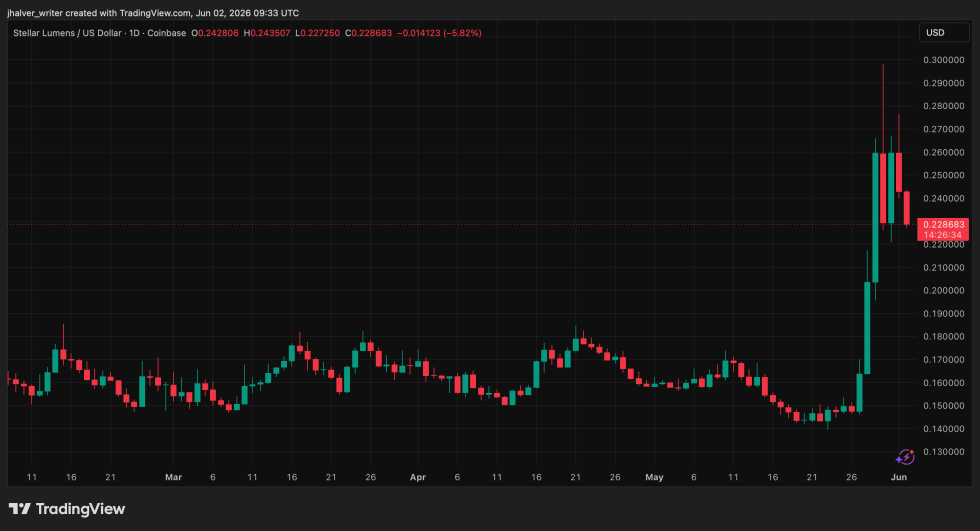
XLM's price trends to the upside on the daily chart. Source: XLMUSD Tradingview

Why This Stablecoin Matters For The Remittance Industry

MoneyGram is not a crypto-native company building a stablecoin for crypto-native users. It is a 85-year-old payments institution operating across more than 200 countries with approximately 500,000 retail locations and over 50 million customers annually — and it just issued its own digital dollar. The distinction is significant. When a company of this scale and regulatory standing launches a native stablecoin, it normalizes the instrument for the exact demographic — remittance-dependent families in Latin America, Africa, and Southeast Asia — that has historically been furthest from crypto adoption.

The timing is deliberate. The GENIUS Act, signed into law earlier in 2026, established the first formal US regulatory framework for stablecoin issuers — a development MoneyGram CEO Anthony Soohoo had publicly described as the guardrails the company needed to scale its digital dollar services confidently. MGUSD is the first major consumer-facing stablecoin launch to arrive squarely within that new regulatory window.

MoneyGram’s infrastructure buildout has been deliberate and sequential — Stellar partnership in 2021, Fireblocks treasury integration in December 2025, Tempo blockchain validator status in May 2026, and now a proprietary stablecoin. Each step has reduced its dependence on external partners and deepened its control over the digital payment stack.

This development marks a pivotal moment for the nascent sector’s convergence with mainstream global finance. A remittance giant issuing its own stablecoin — backed by decades of compliance infrastructure and half a million cash locations worldwide — is the clearest signal yet that the stablecoin economy is no longer a crypto industry story. It is a global payments industry story.

Cover image from Grok, XLM chart from Tradingview

Related Questions

QWhat is MGUSD and which company launched it?

AMGUSD is a native US dollar stablecoin launched by MoneyGram, one of the world's largest cross-border payments networks.

QHow does launching its own stablecoin (MGUSD) change MoneyGram's strategy compared to before?

APreviously, MoneyGram built its digital dollar services on third-party infrastructure like Circle's USDC. Launching its own branded stablecoin, MGUSD, gives MoneyGram direct control over issuance, reserve management, and yield economics, reducing dependence on external partners.

QWhy is MoneyGram's launch of a stablecoin significant for the remittance industry and crypto adoption?

AMoneyGram is an 85-year-old mainstream payments institution with a vast global network. Its launch of a native stablecoin normalizes the instrument for demographics like remittance-dependent families in Latin America, Africa, and Southeast Asia, who have been historically distant from crypto adoption.

QWhat recent US regulatory development is mentioned as enabling MoneyGram's stablecoin launch?

AThe GENIUS Act, signed into law earlier in 2026, established the first formal US regulatory framework for stablecoin issuers. MoneyGram's CEO stated this provided the necessary guardrails to scale its digital dollar services confidently.

QWhat key steps has MoneyGram taken in its infrastructure buildout leading to the MGUSD launch?

AMoneyGram's deliberate steps include: a Stellar partnership in 2021, Fireblocks treasury integration in December 2025, achieving Tempo blockchain validator status in May 2026, and finally launching its proprietary stablecoin, MGUSD.

Related Reads

Can DeepSeek Save China One Trillion Dollars?

"DeepSeek and the $1 Trillion Infrastructure Question" The article examines whether DeepSeek's AI optimization breakthroughs could potentially save China $1 trillion in future AI infrastructure costs. The analysis begins with Nvidia's upcoming Vera Rubin AI platform, costing ~$7.8 million, where memory (HBM4/LPDDR5X) constitutes $2 million—a 435% cost increase in one year, highlighting how AI hardware spending is shifting toward expensive memory components. DeepSeek's approach works in the opposite direction. Through three key technical innovations showcased in DeepSeek V4, the company dramatically improves hardware efficiency: 1. **Memory Compression (MLA)**: Re-engineers the attention mechanism to compress long-context memory (KV Cache) by over 90%, drastically reducing expensive HBM usage. 2. **Selective Activation (MoE)**: Employs Mixture-of-Experts architecture where only a small fraction of parameters (e.g., 49B out of 1.6T in V4-Pro) are activated per token, allowing most parameters to reside in cheaper memory/SSD. 3. **Computation Caching**: Reuses previously computed results via cache hits, replacing expensive GPU computations with cheap memory reads. Combined, these optimizations allow the same hardware to produce approximately 4x more tokens, effectively reducing required hardware investment by 75%. DeepSeek's pricing reflects this: a 10-billion token workload costs ~$522 monthly versus ~$9,000-$10,000 for competitors. The $1 trillion savings projection stems from McKinsey's estimate that global AI infrastructure will require ~$5.2 trillion investment by 2030. As China's daily token consumption grows toward quadrillions, even marginal efficiency gains scale massively. With a conservative 4x throughput improvement, China could avoid building tens of thousands of AI data centers equivalent to ~7 trillion RMB ($1 trillion) in saved investment. Critically, this strategy shifts dependency from scarce, expensive GPU/HBM—where China lags—toward more accessible storage, caching, and systems engineering where domestic suppliers like CXMT are gaining strength. Rather than "replacing Nvidia," DeepSeek rebalances AI's value chain away from monolithic hardware dependency. Ultimately, DeepSeek's technical breakthroughs could lower the barrier to AI adoption across Chinese industries by making advanced capabilities affordable at scale—transforming who can access next-generation AI.

marsbit42m ago

Can DeepSeek Save China One Trillion Dollars?

marsbit42m ago

Overturning the Mainstream Approach to Hallucinations: Metacognition is the New Solution for Large Models to Break the Hallucination Barrier

This paper, "Hallucinations Undermine Trust; Metacognition is a Way Forward," proposes a paradigm shift in combating AI hallucination. It argues that the current mainstream approaches—striving for omniscience by scaling data/models or having AI abstain from uncertain answers—are fundamentally flawed. The former has inevitable knowledge gaps, while the latter imposes a crippling "utility tax," requiring the rejection of many correct answers to achieve high accuracy, due to models' poor "discrimination" (the ability to distinguish correct from incorrect answers internally). The core contribution is redefining hallucination not as "being wrong," but as "expressing false information with unwarranted certainty." The proposed solution is **Faithful Uncertainty** or **Metacognition**: enabling AI to accurately perceive its internal uncertainty and honestly express it in its language (e.g., using hedging phrases when unsure). This creates a more reliable assistant that provides useful information while signaling its confidence, minimizing harm from errors. The paper emphasizes that metacognition is critical for the era of AI Agents. Without it, Agents cannot intelligently decide when to use tools like search engines, leading to inefficiency and misuse. Key implementation challenges are highlighted: the "bootstrapping paradox" of training with static uncertainty data, the "alignment distortion signal" where human preference training suppresses internal uncertainty cues, and the difficulty of causally evaluating true metacognition vs. its superficial imitation. The paper concludes that the goal should not be an infallible AI, but one that is honest about the limits of its knowledge, thereby building user trust through transparent communication of its certainty.

marsbit46m ago

Overturning the Mainstream Approach to Hallucinations: Metacognition is the New Solution for Large Models to Break the Hallucination Barrier

marsbit46m ago

Hedge by Buying Gold and Oil, Chase Soaring Returns with AI. ‘Dated’ Bitcoin Enters a Bear Market

Bitcoin has recently declined, hitting a two-month low near $66,123, while Ethereum fell to a three-month low around $1,837. Analysts suggest the drop is not merely due to factors like ETF outflows or MicroStrategy's selling but reflects a deeper issue: Bitcoin is losing a broader asset competition. In a near-zero interest rate environment, Bitcoin previously thrived as an outlet for investor dissatisfaction with inflation and limited options. However, the market landscape has shifted. Bitcoin now occupies an "awkward middle ground," facing competition on three fronts. For inflation hedging, investors prefer gold, energy stocks, and commodity producers—assets with tangible backing and clearer pricing power. For growth exposure, AI-related companies with actual revenues and profits are more attractive. Even within crypto, investors can choose stablecoins, exchanges, or infrastructure firms tied directly to adoption, offering clearer business models and leverage. Thus, Bitcoin is no longer the top choice for hedging, growth, or crypto exposure. This shift is evident in market reactions: despite recent warnings about persistent inflation from a Fed official, Bitcoin did not rally as it might have in the past. Instead, capital flowed to assets with direct commodity or energy exposure. The recent ETF outflows and MicroStrategy sales are symptoms, not causes, of this new reality. Investors are becoming more selective, demanding clearer value propositions beyond mere scarcity. The emerging bear case for Bitcoin is not about it being a bubble or failed technology, but that scarcity alone is no longer sufficient.

华尔街日报49m ago

Hedge by Buying Gold and Oil, Chase Soaring Returns with AI. ‘Dated’ Bitcoin Enters a Bear Market

华尔街日报49m ago

Trading

Spot
Futures

Hot Articles

How to Buy ONE

Welcome to HTX.com! We've made purchasing Harmony (ONE) simple and convenient. Follow our step-by-step guide to embark on your crypto journey.Step 1: Create Your HTX AccountUse your email or phone number to sign up for a free account on HTX. Experience a hassle-free registration journey and unlock all features.Get My AccountStep 2: Go to Buy Crypto and Choose Your Payment MethodCredit/Debit Card: Use your Visa or Mastercard to buy Harmony (ONE) instantly.Balance: Use funds from your HTX account balance to trade seamlessly.Third Parties: We've added popular payment methods such as Google Pay and Apple Pay to enhance convenience.P2P: Trade directly with other users on HTX.Over-the-Counter (OTC): We offer tailor-made services and competitive exchange rates for traders.Step 3: Store Your Harmony (ONE)After purchasing your Harmony (ONE), store it in your HTX account. Alternatively, you can send it elsewhere via blockchain transfer or use it to trade other cryptocurrencies.Step 4: Trade Harmony (ONE)Easily trade Harmony (ONE) on HTX's spot market. Simply access your account, select your trading pair, execute your trades, and monitor in real-time. We offer a user-friendly experience for both beginners and seasoned traders.

3.7k Total ViewsPublished 2024.03.29Updated 2026.06.02

How to Buy ONE

Discussions

Welcome to the HTX Community. Here, you can stay informed about the latest platform developments and gain access to professional market insights. Users' opinions on the price of ONE (ONE) are presented below.

活动图片