Author: Zen, PANews
"I want to do something bigger." On February 9th, Beast Industries announced the acquisition of Step, a financial app for teens and Gen Z focused on "credit building, savings tools, and a debit card."
If you only interpret this as "another side hustle for an influencer," you're underestimating the scale of this move. Because before this news, the market had already seen clearer groundwork.
In January 2026, the publicly listed company Bitmine announced a $200 million investment in Beast Industries. Its chairman, Tom Lee, explicitly tied MrBeast's future to the "digital financial platform" narrative in his public statements. As early as October 2025, the Beast side had filed a trademark application for "MRBEAST FINANCIAL," staking out a vast territory in one go.
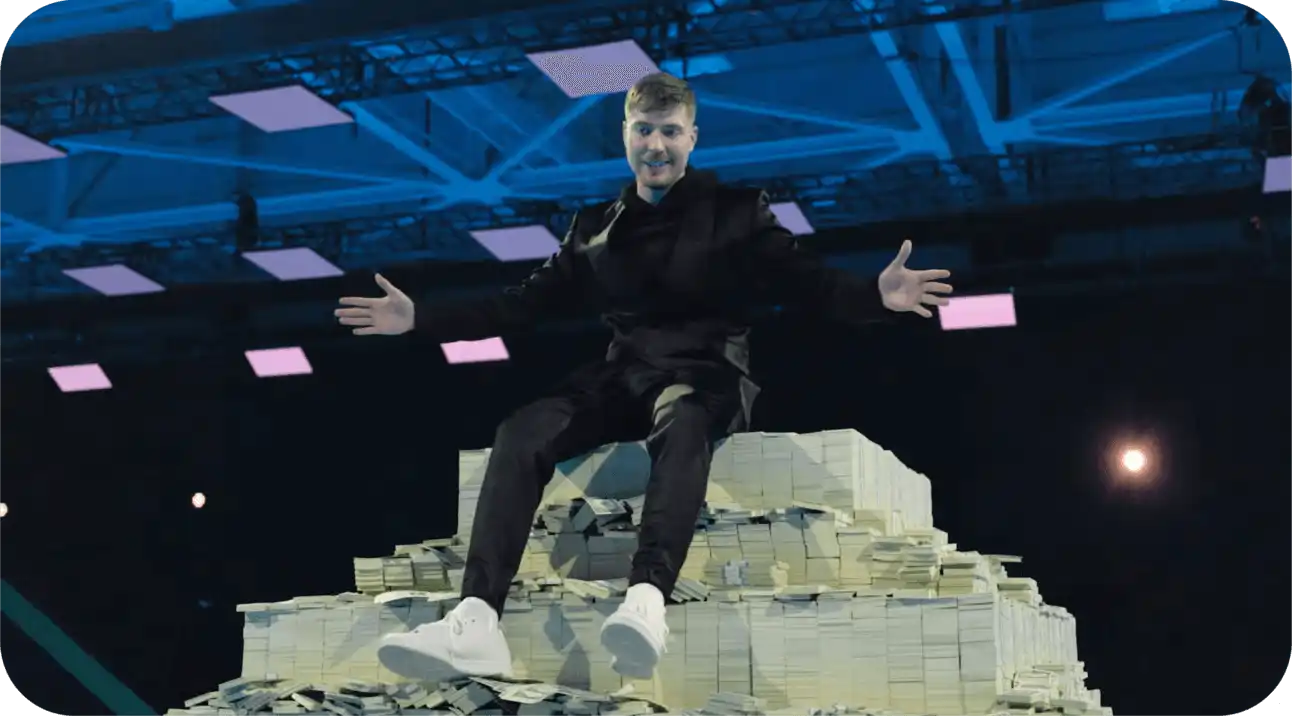
All of this happens against a more contrasting backdrop. As of February 2026, MrBeast's main channel subscriptions had reached approximately 467 million, making him the most dominant content machine globally; however, simultaneously, Beast Industries' media business was reported to be stuck in a structural dilemma of "high revenue, but even higher costs."
The World's Top YouTuber Loses Money the More He Makes
MrBeast, real name Jimmy Donaldson, is one of, if not the most successful and creative video creators on YouTube. Now 27 years old with 467 million fans, MrBeast has been creating content for 14 years.
In early 2012, the 13-year-old MrBeast opened the YouTube channel "MrBeast6000," thus beginning his video creation career. Initially, MrBeast tried all sorts of algorithm-recommended popular content, from gameplay of games like Minecraft to estimating the wealth of other YouTube creators. However, these videos didn't attract much attention, with view counts barely reaching a thousand. But this didn't stop him from continuing to create; MrBeast believed that with more effort, he would eventually stand out.
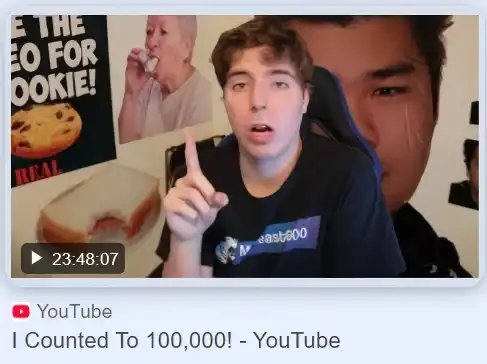
MrBeast's first successful "channel growth" happened in January 2017 when he uploaded a video of himself counting to 100,000, which quickly went viral, garnering tens of thousands of clicks in just a few days. Seeing this pattern work, MrBeast found his initial version of the traffic formula—extreme challenges, emotional stimulation, and shareable gimmicks. He subsequently counted to 200,000, spun a fidget spinner for 24 hours straight, and watched a music video for 10 hours continuously. He dropped out of college to devote himself fully to operating his YouTube channel.
As a full-time creator, MrBeast's ideas became more extravagant and eye-catching: he donated $10,000 to a livestreamer with zero viewers, poured 100 million water beads into a swimming pool, spent a night in a mental institution, soaked in slime for a day, etc. His fan base continued to skyrocket. To fund these video ideas, besides relying on ad revenue and merchandise sales, MrBeast also tirelessly signed brand partnership deals worth tens of thousands of dollars with many companies. These companies, based on his massive fan base and high view counts, were happy to pay high fees for this.
In March 2019, MrBeast gathered over thirty top YouTube influencers with a combined total of 200 million subscribers to host a real-life battle royale. Electronic Arts, the developer of the battle royale game Apex Legends, provided $200,000 in prize money for the event. This video quickly became a hit after its release, amassing over 15 million views in a short period. MrBeast自此开始贯彻综艺化制作的创作理念,也由此踏上了登顶YouTuber王座之路。(MrBeast自此 began adhering to a variety-show style production concept, setting him on the path to the top of the YouTube throne.)
The real-life $456,000 Squid Game was a super-hit video that officially established MrBeast as a phenomenal creator and one of the most important milestones in his career. The video became one of the most-watched videos on YouTube in 2021, garnering over 130 million views in one week. That same year, MrBeast also held the third Influencer Championship with 15 contestants and a prize pool of $1 million. In January 2022, Forbes magazine named MrBeast the highest-earning YouTube creator, estimating his 2021 income at $54 million.
However, due to the high-budget, variety-show production model, MrBeast's continuous investment in more outrageous challenges, sets, filming, and post-production caused the cost curve to rise rapidly with scale. Even though a single video could generate several million dollars in ad revenue and brand partnerships, he reinvested almost all of that income into the next round of filming, creating a cycle of higher budgets, larger scale, and stronger dissemination. MrBeast said he "reinvests everything to an almost stupid degree."
According to Business Insider, in 2024, his media business revenue was approximately $224 million, but costs were about $344 million, showing a clear loss-making structure for the content segment.
Therefore, for MrBeast, who started with video creation, the content business is closer to a customer acquisition and brand advertising positioning; it gathers attention and trust onto the MrBeast IP. What's truly easier to generate profits from are the replicable, scalable consumer goods and retail lines.
Chocolate Bar Becomes Pillar of Commercial Empire
MrBeast's first large-scale experiment in monetizing content traffic and personal IP was the launch of "MrBeast Burger" in 2020. Different from traditional fast-food chains, MrBeast Burger adopted the "ghost kitchen" model that rose during the pandemic: the brand does not build its own stores but partners with third-party operators, outsourcing the menu, marketing, and delivery channels to existing fast-food outlets like convenience stores and mom-and-pop shops.
The advantage of this model is extremely fast expansion. It doesn't require the slow climb of opening stores, selecting locations, and renovating like traditional restaurants. Instead, it can use MrBeast's expertise in content distribution to reach consumers in a very short time. In the first three months after launch, MrBeast Burger sold over 1 million burgers. In the following two years, the brand continued to expand rapidly, signing about 1700 "franchisees" by 2022. In September 2022, MrBeast also opened his first physical store in New Jersey, attracting about 10,000 fans on opening day.
However, the ghost kitchen model also has fatal flaws. Because fulfillment is handled by partner kitchens, MrBeast Burger found it difficult to maintain uniform quality control and service standards. Consequently, processing issues like undercooked burgers and soggy fries were hard to solve, and many consumers rated their products as inedible. Additionally, problems like incorrect orders and messy packaging persisted, causing irreversible damage to the MrBeast brand.
With problems too entrenched to solve, MrBeast decided to abandon the burger business and sued the partner Virtual Dining Concepts, who subsequently counter-sued, pushing the dispute into a long-drawn-out legal battle.
Unlike MrBeast Burger, MrBeast's second main line, the chocolate brand "Feastables," adopted a traditional consumer goods approach. That is, creating standardized products, entering retail channels, and solidifying brand power into a repeatable shelf business. Feastables was officially launched in January 2022, with its first product being the MrBeast Bar chocolate bar. It used gamified interactions and reward mechanisms to transplant the interactive advantages of his online content to offline consumer goods.
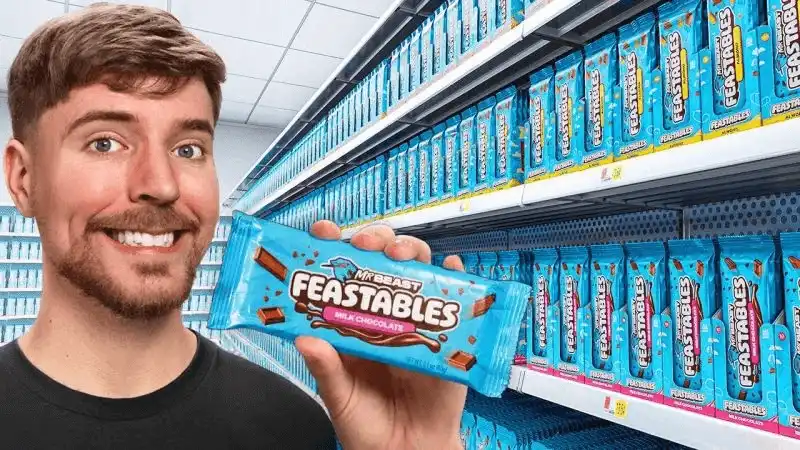
On October 2, 2023, Feastables partnered with the Charlotte Hornets, becoming the official jersey sponsor for the 2023-24 NBA season, further expanding the brand's influence. Currently, the Feastables brand is the cash flow pillar and growth engine in MrBeast's commercial layout. Its sales in 2024 were approximately $250 million, with profits around $20 million; in 2025, Feastables sales are projected to be about $520 million.
Additionally, MrBeast co-founded the snack kit brand Lunchly with several other influencers, positioning it against the well-known lunchbox brand Lunchables. However, the products launched by Lunchly were similar to existing Lunchables products, had relatively lower nutritional content, and received complaints about mold in the packaging. All Lunchly products contained a Feastables chocolate bar, leading some media to point out that the product was essentially meant to boost Feastables' sales.
Lunchly attracted significant criticism. Prominent YouTube gaming creator DanTDM called Lunchly "peddling crap to kids who don't know any better, from people they'd never believe would be peddling them crap." The UK youth movement Bite Back stated that it was particularly concerning for a social media star to promote high-sugar, high-fat foods. The head of food and nutrition at the Children's Alliance charity described the product launch as "junk food marketing."
Key Assistant Jeff Housenbold Joins
In early 2024, during a fundraising round, the venture capitalist Chamath Palihapitiya, who led MrBeast's first round of funding, introduced him to Jeff Housenbold, who subsequently joined and pushed for the company's professionalization.
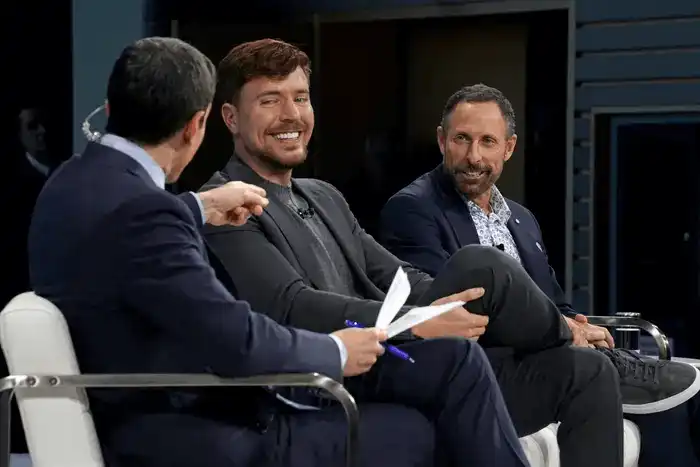
Housenbold was indeed the most suitable assistant to help MrBeast manage his commercial empire. Housenbold was formerly the CEO of the e-commerce company Shutterfly, leading the company to a successful IPO in 2006 during his tenure and building it into the fifth-largest independent e-commerce company in the US. Additionally, Housenbold served as a managing partner at SoftBank Investment Advisers, assisting in managing and leading the company's $100 billion Vision Fund. Some of the companies he invested in include DoorDash, Rappi, Compass, and Katerra.
Addressing the situation where Beast Industries' media business showed "high revenue but even higher costs," Housenbold introduced stricter budget processes upon taking office and set up a dedicated team to assess budget feasibility before filming, aiming to improve spending discipline while maintaining program quality.
Whereas MrBeast often bought expensive giveaways like Teslas at retail price, under Housenbold's leadership, the company shifted more towards obtaining products for free or at a discount through brand partnerships and established a dedicated brand partnership team for this purpose. Housenbold's goal is to "make everything the company does profitable," accompanied by efforts to renegotiate advertising contracts, raise prices, and reduce costs using tools/AI.
Acquiring Step, A Major Leap into Finance
"We believe MrBeast and Beast Industries are the most outstanding content creators of our generation, with influence and user engagement among Gen Z, Alpha, and Millennials that is unmatched," he said. "Beast Industries is the largest and most innovative creator platform globally, and our corporate and personal values are highly aligned."
In January of this year, Bitmine, the largest ETH treasury company, announced a $200 million investment in MrBeast's holding company. Bitmine Chairman Tom Lee stated that he believes MrBeast's future platform will play a key role in the digital finance领域 (digital finance领域 - field).
The first time MrBeast's financial布局 (layout/plans) gained widespread external attention was when his company filed a US trademark application for "MRBEAST FINANCIAL" in October 2025, encompassing everything from basic accounts to credit, investment, and even crypto and DeFi under the same brand narrative in one go.
Public records show that this trademark covers an extremely wide range of financial services. This includes mobile banking service software, short-term small loans, credit card and debit card issuance and transaction processing, investment management, investment banking services, insurance, financial consulting and "financial health education," as well as crypto payment processing and descriptions related to cryptography such as "crypto asset exchange through decentralized exchanges (DEX)."
On February 9, 2026, Beast Industries officially announced the acquisition of Step, formally entering the financial industry. As a fintech platform for the next generation, Step claims to have 7 million+ users and emphasizes that the platform has a "full-stack fintech team" with the goal of providing financial literacy and financial management-related products. The platform's financial products are underpinned by its partner bank Evolve Bank & Trust (Member FDIC).
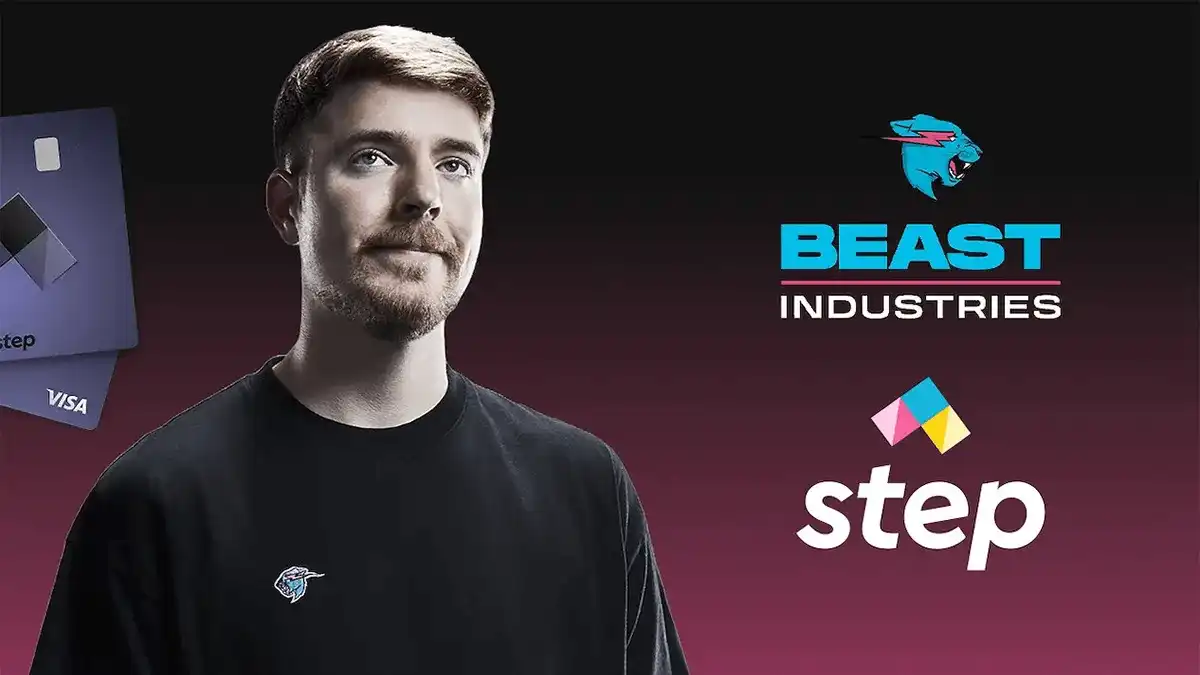
Step's core demographic is teenagers and Gen Z, highly overlapping with MrBeast's audience structure. This means this acquisition allows MrBeast to acquire a ready-made banking-as-a-service infrastructure, card issuance capabilities, and team, and then use his greatest strength—traffic and distribution—for customer acquisition and education.
Traditional Fintech customer acquisition is extremely expensive, while MrBeast possesses a globally top-tier attention gateway. This theoretically makes his conversion and retention chain more efficient than a typical financial app: first build trust through content, then use financial education and basic account products as the landing, gradually expanding to clearer compliant scenarios like credit building, debit cards/prepaid cards. The positioning of products like Step, aimed at young people, is also naturally suited for a "financial启蒙" (enlightenment) narrative. In an ideal state of high account activity, the long-term contribution per customer (LTV) for financial products will also be significantly higher than that of food retail.
However, potential problems exist here. Even if Step's positioning is financial education and basic accounts, anything involving teenagers will inherently face higher moral scrutiny from the outside world. For example, on communities like Reddit, some users' reactions to MrBeast's acquisition of Step were "why does he keep targeting teenagers," questioning if it's "inducing minors to borrow," intentionally treating fans as a traffic pool to harvest.
Trusting a creator to provide entertainment content is completely different from trusting them to handle the financial foundation of one's child; they are two different psychological thresholds. It's also questionable whether parents are willing to hand over their children's financial entry point to a网红品牌 (influencer brand) known for "high stimulation and strong entertainment."
Furthermore, judging by the methodology MrBeast used to rise to fame—"achieving viral widespread dissemination through high-intensity stimulation and using generous rewards as a gimmick"—financial regulation is extremely sensitive to "gamification, lottery-style, strong inducement."
MrBeast's highly dramatic style might conflict with the restraint required by financial compliance. Financial companies have much lower error tolerance than snack brands; once technical failures, complaints, or information disclosure disputes occur, the public will place all the blame on MrBeast and his brand.
In fact, such backlash has already happened in the cryptocurrency space. Over the past few years, MrBeast's investment behavior in cryptocurrency has sparked controversy. PANews previously published an on-chain investigation suggesting he might be using his influence for "pump and dump" operations. Under immense舆论压力 (public opinion pressure), MrBeast and his team began a series of PR operations aimed at distancing themselves.
MrBeast now holds a rare traffic card, but whether this card will be played as a more inclusive, transparent, and strictly self-disciplined "path to financial enlightenment," or cashed out as a growth shortcut targeting the most sensitive demographic of teenagers, is an answer only he himself knows.