The On-Chain Evolution of Private Credit: From Ledgers to Investable Products

深潮Xuất bản vào 2025-12-18Cập nhật gần nhất vào 2025-12-18

Tóm tắt

Private credit is undergoing a significant on-chain evolution, transitioning from a ledger-based operational upgrade to a distributable, investable product. While the total value of tokenized private credit has surged to around $24 billion, only 12% of the $19.3 billion in active loans tracked on RWA.xyz are held in transferable tokenized form. The market is split between "representative" tokenization—where blockchain serves as a transparent record-keeping system for off-chain loans—and "distributable" tokenization, where loans are natively issued and held as transferable tokens on-chain. The latter is growing rapidly, offering benefits like enhanced liquidity, faster settlement, and improved transparency. Figure dominates the market with a 73% share but uses blockchain only for record-keeping. In contrast, platforms like Maple are driving the shift toward fully distributable tokenized credit. This shift could standardize and scale private credit distribution by reducing intermediation, enabling programmable compliance, and improving portability—key advancements for an asset class that represents less than 2% of the $1.6 trillion global private credit market.

Author: Prathik Desai

Compiled by: Block Unicorn
Preface

On tokenized real-world asset (RWA) platforms, private credit is at a pivotal moment. Over the past year, tokenized private credit has been the fastest-growing category, surging from less than $50,000 to approximately $2.4 billion.

If stablecoins (whose payment channels cover all on-chain activities) are excluded, tokenized private credit ranks second only to on-chain commodities. Top tokenized commodities include Tether and Paxos's gold-backed currencies, as well as Justoken's tokens backed by cotton, soybean oil, and corn. This appears to be a serious category, with real borrowers, cash flows, underwriting mechanisms, and yields—and it is less dependent on market cycles compared to commodities.

But the story only becomes complex when you dig deeper.

This $2.4 billion in outstanding tokenized private credit represents only a small fraction of the total outstanding loans. This suggests that only a portion of these assets can truly be held and transferred on-chain in tokenized form.

In today's article, I will examine the reality behind the numbers of tokenized private credit and what these numbers mean for the future of this category.

Let's dive right in.

The Dual Nature of Tokenized Private Credit

The total active loans on the RWA.xyz platform are slightly over $19.3 billion. However, only about 12% of these assets can be held and transferred in tokenized form. This highlights the dual nature of tokenized private credit.

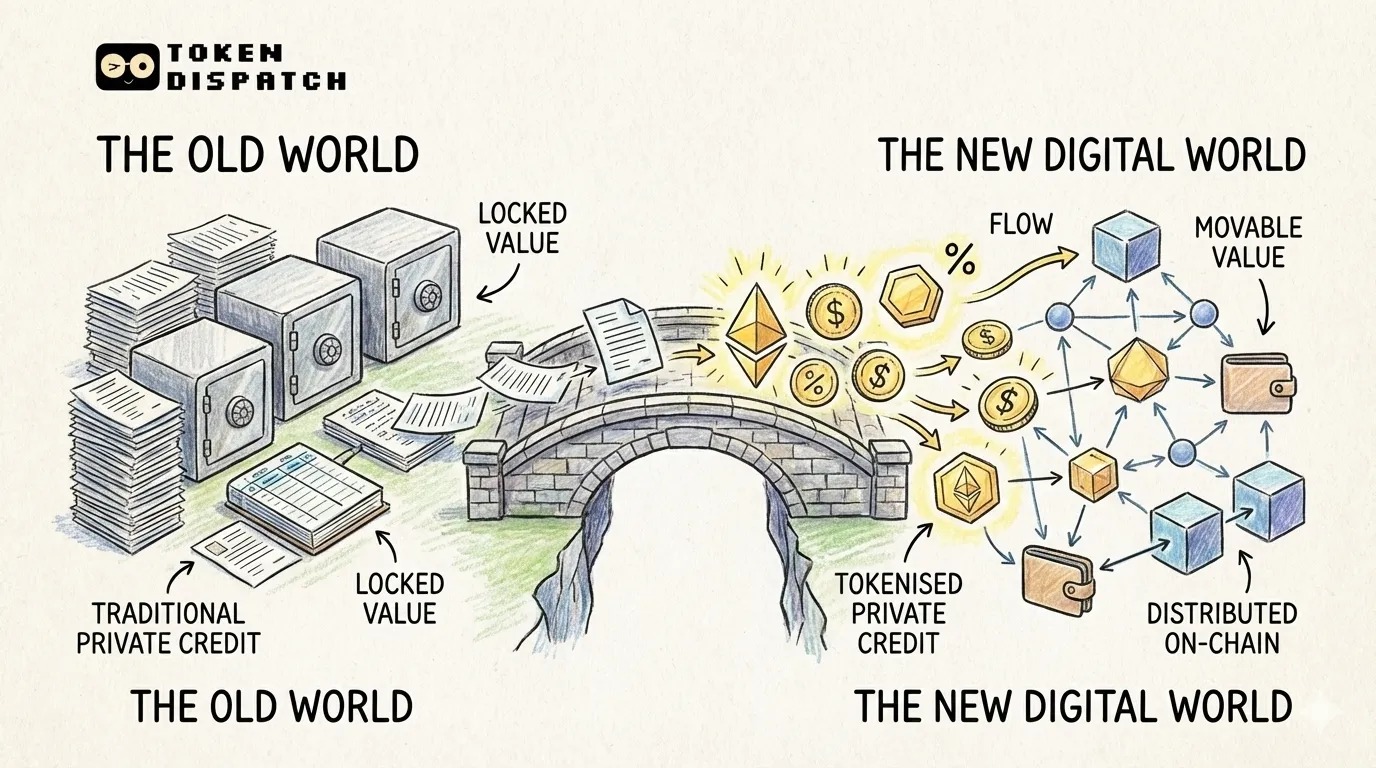
One aspect is "representative" tokenized private credit, where the blockchain merely provides operational upgrades by establishing an on-chain ledger of outstanding loans recorded from the traditional private credit market. The other aspect is the distribution upgrade, where blockchain-driven markets coexist with traditional (or off-chain) private credit markets.

The former is used solely for recording and reconciliation, documented on a public ledger. The latter, however, can be transferred to wallets for transactions.

Once you understand this classification system, you won't ask whether private credit is on-chain. Instead, you'll pose a sharper question: How much private credit originates from the blockchain? The answer to this question might offer some insights.
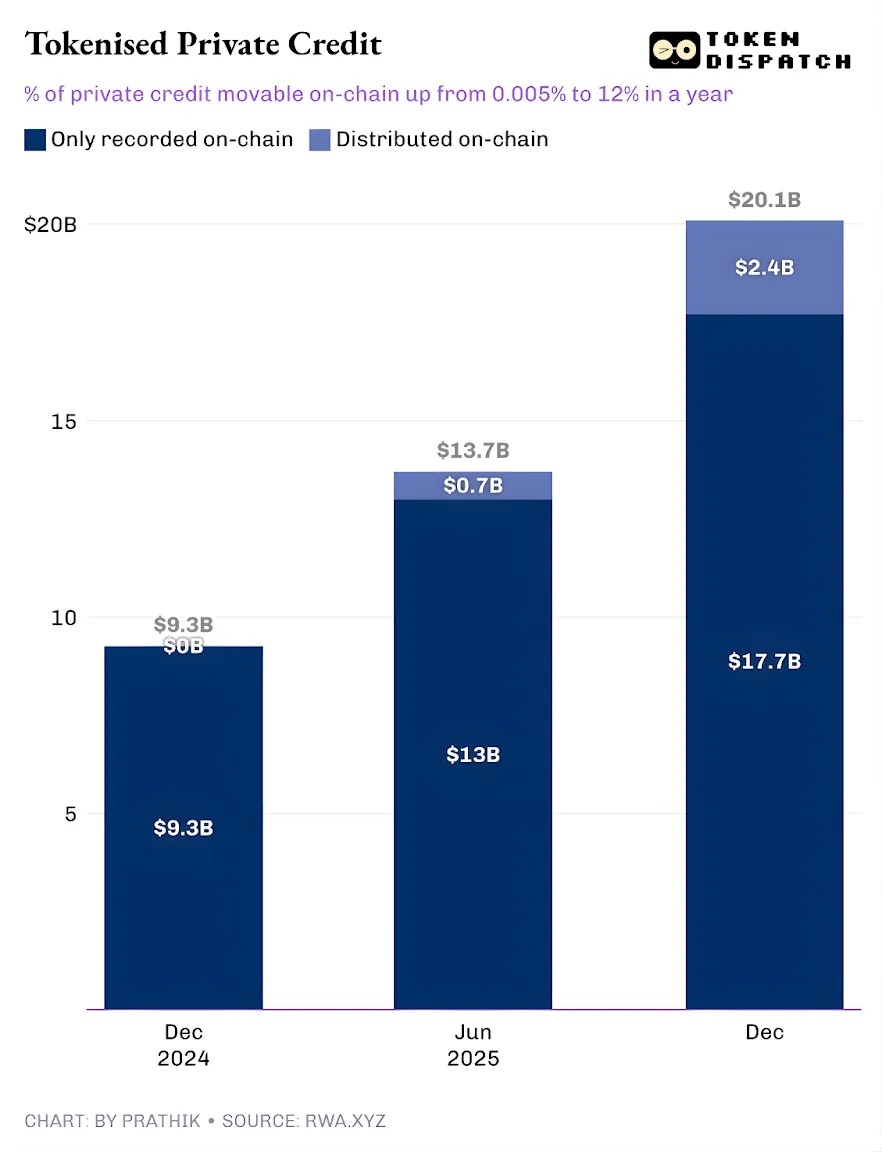
The trajectory of tokenized private credit is encouraging.

Until last year, almost all tokenized private credit was merely an operational upgrade. The loans already existed, borrowers made timely payments, platforms operated normally, and the blockchain simply recorded these activities. All tokenized private credit was only recorded on-chain and could not be transferred as tokens. Within a year, this share of on-chain transferable assets has climbed to 12% of the total trackable private credit.

It showcases the growth of tokenized private credit as a distributable on-chain product. This enables investors to hold fund shares, pool tokens, notes, or structured investment exposures in tokenized form.

If this distributed model continues to expand, private credit will no longer resemble a loan ledger but rather an investable on-chain asset class. This shift will change the benefits lenders derive from transactions. Beyond yields, lenders will gain a tool with greater operational transparency, faster settlement, and more flexible custody. Borrowers will access funding that isn't dependent on a single distribution channel, which could be highly beneficial in risk-averse environments.

But who will drive the growth of the distributable private credit market?

The Figure Effect

Currently, the majority of outstanding credit comes from a single platform, while the rest of the ecosystem forms a long tail.

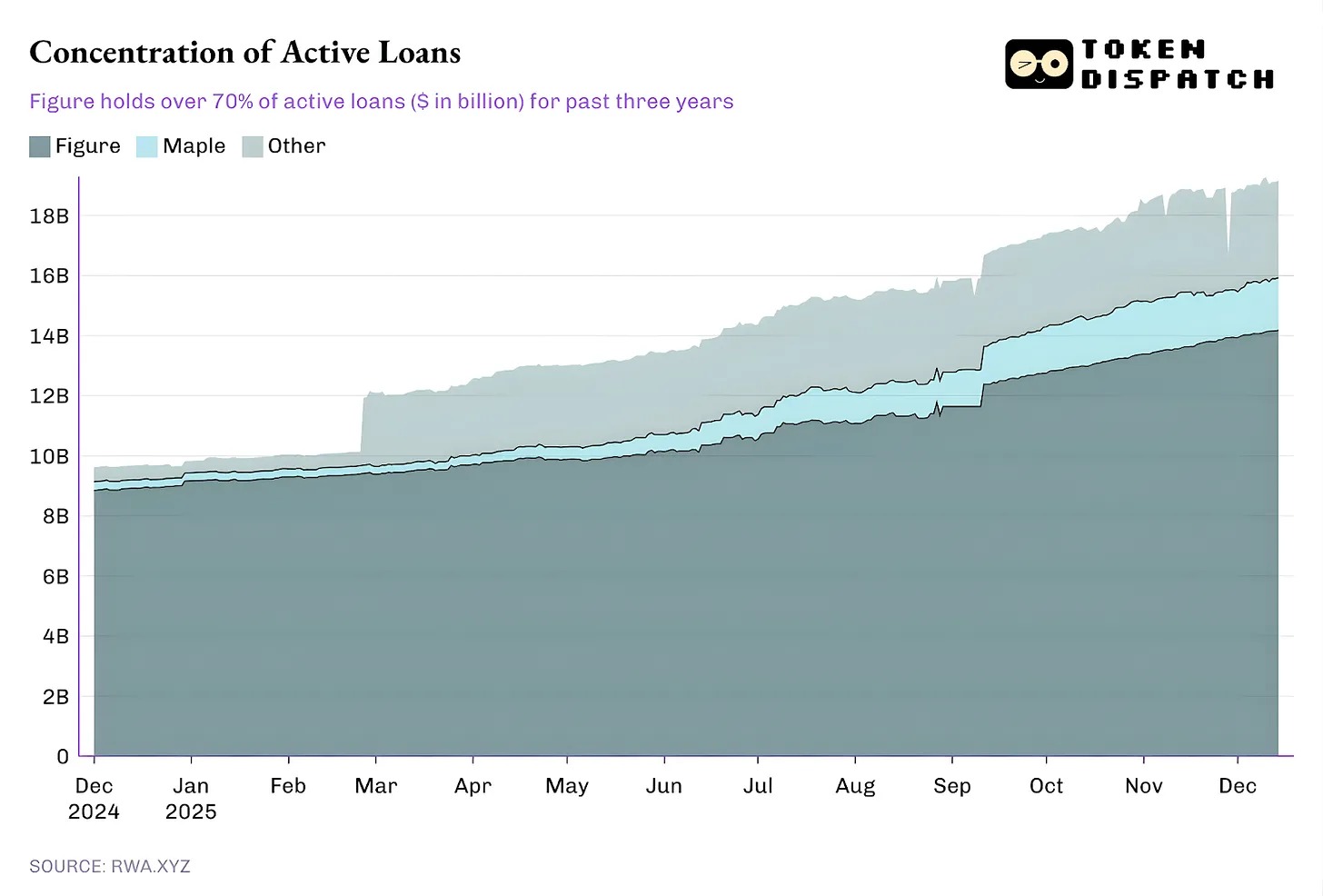
Since October 2022, Figure has dominated the tokenized private credit market, but its market share has dropped from over 90% in February to 73% today.
But what's more interesting is Figure's private credit model.

Although tokenized private credit now exceeds $14 billion, all the value of this industry leader is reflected in "representative" asset value, while the distributed value remains zero. This indicates that Figure's model is an operational pipeline that records loan issuance and ownership on the Provenance blockchain.

Meanwhile, some smaller players are driving the distribution of tokenized private credit.
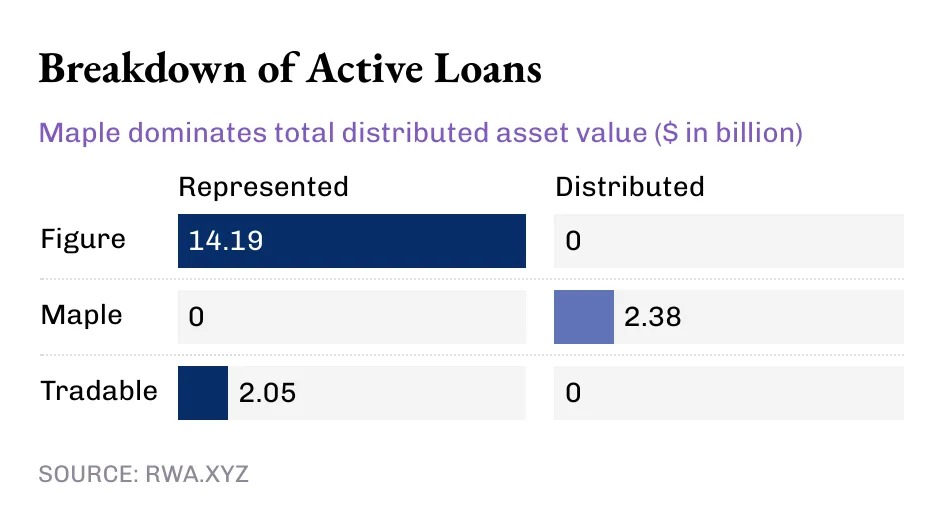
Figure and Tradable hold all their tokenized private credit as representative value, while Maple's value is entirely distributed via the blockchain.

From a macro perspective, the vast majority of the $19 billion in active on-chain loans are recorded on the blockchain. But the trend over the past few months is undeniable: more and more private credit is being distributed via blockchain. Given the immense growth potential of tokenized private credit, this trend will only intensify.

Even at $19 billion, RWAs currently account for less than 2% of the total $1.6 trillion private credit market.

But why is "movable, not just recorded" private credit important?

Movable private credit offers more than just liquidity. Gaining exposure to private credit off-platform through tokens provides portability, standardization, and faster distribution speed.

Assets acquired through traditional private credit channels trap holders within a specific platform's ecosystem. Such ecosystems have limited transfer windows and cumbersome secondary market trading processes. Additionally, secondary market negotiations are slow and primarily led by professionals. This gives existing market infrastructure far more power than asset holders.

Distributable tokens can reduce these frictions by enabling faster settlement, clearer ownership changes, and simpler custody.

More importantly, "movability" is a prerequisite for the large-scale standardized distribution of private credit, which has historically been lacking. In the traditional model, private credit appears in the form of funds, business development companies (BDCs), and collateralized loan obligations (CLOs), each adding multiple layers of intermediaries and opaque fees.

On-chain distribution offers a different path: programmable wrappers enforce compliance (whitelisting), cash flow rules, and information disclosure at the tool level, rather than through manual processes.


Câu hỏi Liên quan

QWhat is the current size of the tokenized private credit market, and how does it compare to the total outstanding private credit market?

AThe tokenized private credit market has grown to approximately $24 billion. However, this represents only a small fraction, about 1.2%, of the total $1.6 trillion private credit market.

QWhat is the key difference between 'representative' and 'distributable' tokenized private credit?

A'Representative' tokenized private credit uses the blockchain solely as an operational upgrade to record and reconcile loans from the traditional market on a public ledger. 'Distributable' tokenized private credit allows the assets to be held and transferred as tokens, enabling them to be portable and traded in a blockchain-driven market.

QWhich company is the current market leader in tokenized private credit, and what is unique about its model?

AFigure is the current market leader, holding 73% of the tokenized private credit market. Its model is unique because its entire $14+ billion in value is classified as 'representative' value, meaning the loans are recorded on the Provenance blockchain for operational purposes but are not distributable as transferable tokens.

QWhat are the potential benefits of 'distributable' tokenized private credit over traditional private credit instruments?

ADistributable tokenized private credit offers benefits such as portability, faster settlement, clearer ownership changes, simpler custody, and the potential for standardized, large-scale distribution. It reduces reliance on a single platform's ecosystem and the complex, slow processes of traditional secondary markets dominated by intermediaries.

QWhat does the growth of the distributable segment indicate for the future of private credit?

AThe growth of the distributable segment indicates a shift where private credit is evolving from being a simple on-chain ledger of loans into a true, tradable asset class. This transformation promises greater operational transparency, faster settlement, and more flexible custody options for lenders, while providing borrowers with access to capital that is not reliant on a single distribution channel.

Nội dung Liên quan

Ai sẽ định nghĩa các quy tắc trong thời đại AI? Anthropic nói về cục diện AI Mỹ-Trung năm 2028

AI cạnh tranh giữa Mỹ và Trung Quốc đang bước vào giai đoạn then chốt định hình cục diện trước năm 2028. Anthropic nhận định Mỹ và đồng minh hiện nắm lợi thế về chip tiên tiến, năng lực mô hình và vốn đầu tư. Tuy nhiên, các phòng lab AI Trung Quốc đang thu hẹp khoảng cách nhờ nhân tài, dữ liệu, hiệu suất kỹ thuật và khả năng sao chép công nghệ thông qua tấn công "chưng cất mô hình" (model distillation) cũng như lách các hạn chế xuất khẩu chip để tiếp cận năng lực tính toán. Báo cáo đưa ra hai viễn cảnh cho năm 2028: 1) Mỹ duy trì ưu thế áp đảo nếu siết chặt kiểm soát xuất khẩu chip và hạn chế rò rỉ công nghệ; 2) Trung Quốc cạnh tranh sát nút nếu Mỹ không hành động quyết liệt, cho phép Bắc Kinh đuổi kịp về năng lực AI và mở rộng ảnh hưởng toàn cầu thông qua việc triển khai cơ sở hạ tầng chi phí thấp. Anthropic nhấn mạnh, AI tiên tiến là công nghệ lưỡng dụng, có thể tác động sâu sắc đến an ninh mạng, cán cân quân sự và mô hình quản trị. Duy trì dẫn đầu về AI sẽ giúp Mỹ và đồng minh định hình các quy tắc, tiêu chuẩn toàn cầu và tạo đòn bẩy cho đối thoại an toàn AI với Trung Quốc. Cửa sổ cơ hội để khóa chắc lợi thế dẫn đầu 12-24 tháng hiện đang mở ra, nhưng sẽ không tồn tại mãi.

marsbit1 giờ trước

Ai sẽ định nghĩa các quy tắc trong thời đại AI? Anthropic nói về cục diện AI Mỹ-Trung năm 2028

marsbit1 giờ trước

“Tại sao bạn không mua ETF đòn bẩy 2x long SK Hynix?”

Tháng 10/2025, Quỹ ETF có đòn bẩy 2x (2 lần) theo cổ phiếu SK Hynix (07709.HK) niêm yết tại Hồng Kông, ngay lập tức bắt kịp đà tăng mạnh của ngành bán dẫn nhờ làn sóng AI. Chỉ sau 7 tháng, giá trị tài sản ròng (NAV) của quỹ tăng hơn 1011%, quy mô vượt 600 tỷ HKD, vươn lên dẫn đầu thế giới về sản phẩm đòn bẩy đơn cổ phiếu. Sức hút của quỹ này đến từ việc SK Hynix, nhà cung cấp chính HBM cho NVIDIA, hưởng lợi tối đa từ cơn khát chip nhớ AI, đạt lợi nhuận kỷ lục. Tuy nhiên, ETF đòn bẩy hàng ngày bộc lộ rủi ro lớn trong thị trường biến động. Giai đoạn tháng 3-4/2026, khi địa chính trị tại eo biển Hormuz gây bất ổn và cổ phiếu Hynix dao động mạnh, cơ chế tái cân bằng đòn bẩy hàng ngày đã tạo ra "tổn hao do biến động", khiến mức sụt giảm thực tế của quỹ vượt xa gấp đôi mức sụt giảm của cổ phiếu cơ sở. Bài viết cảnh báo rằng, dù được AI tiếp sức, ngành chip nhớ vẫn mang đặc tính chu kỳ sâu sắc. Lợi nhuận siêu ngạch hiện tại từ HBM có thể thúc đẩy các đối thủ như Samsung hay Micron đẩy mạnh R&D, phá vỡ thế độc quyền và làm giảm khan hiếm. Đồng thời, nhu cầu cuối cùng phụ thuộc vào chi tiêu vốn (Capex) khổng lồ cho AI của các đại gia công nghệ, một yếu tố dễ biến động. Tóm lại, câu chuyện của quỹ ETF 2x SK Hynix là một minh họa cho sự giao thoa giữa một cuộc cách mạng công nghiệp tốc độ chưa từng có (AI) và những ràng buộc vĩ mô, địa chính trị truyền thống. Nó cho thấy niềm tin vào tiến trình AI có thể quyết định lợi nhuận cuối cùng, nhưng con đường đi đến đó sẽ chịu ảnh hưởng nặng nề bởi biến động và bất ổn toàn cầu.

marsbit1 giờ trước

“Tại sao bạn không mua ETF đòn bẩy 2x long SK Hynix?”

marsbit1 giờ trước

Cardano (ADA) Có Thể Khởi Động Giai Đoạn Tăng Giá Mới Khi Niềm Tin Của Nhà Đầu Tư Đang Tăng

Sau đợt phục hồi chung của thị trường tiền điện tử vào thứ Năm, Cardano (ADA) đã quay đầu tăng trở lại, vượt qua ngưỡng 0,25 USD. Cấu trúc hiện tại và các tín hiệu on-chain của altcoin này đang bắt đầu hội tụ, làm tăng tiềm năng cho một đợt tăng giá mạnh. Nhà phân tích thị trường kỳ cựu Ali Martinez đã đưa ra dự báo lạc quan, cho rằng ADA có thể sắp bắt đầu một đợt bùng nổ tăng giá mới. Dự đoán này chủ yếu dựa vào Chỉ báo SuperTrend, vừa chuyển sang tín hiệu mua trên biểu đồ hàng ngày sau một đợt điều chỉnh giảm kéo dài. Martinez tin rằng điều này báo hiệu sự kết thúc của giai đoạn kiệt sức cục bộ và sự đảo chiều xu hướng. Ông kỳ vọng ADA có thể tăng lên vùng kháng cự 0,33 USD, và nếu giữ được đà, mục tiêu tiếp theo là 0,42 USD, với điều kiện hỗ trợ 0,25 USD được giữ vững. Song song đó, hoạt động on-chain cho thấy sự tự tin đang dần quay trở lại. Báo cáo từ Santiment tiết lộ rằng các bên liên quan chính (các "cá mập" và "cá voi") đã tích lũy ADA một cách ổn định kể từ tháng 12/2023. Hiện các ví nắm giữ ít nhất 1 triệu ADA đang sở hữu tới 67,47% tổng nguồn cung lưu hành. Xu hướng tích lũy này, bất chấp việc vốn hóa thị trường của ADA đã giảm, có khả năng định hình đà tăng và kích hoạt một đợt tăng giá ổn định trong tương lai.

bitcoinist2 giờ trước

Cardano (ADA) Có Thể Khởi Động Giai Đoạn Tăng Giá Mới Khi Niềm Tin Của Nhà Đầu Tư Đang Tăng

bitcoinist2 giờ trước

a16z Crypto: Giải thích về Đạo luật CLARITY dành cho các doanh nhân tiền mã hóa

Ủy ban Ngân hàng Thượng viện Hoa Kỳ vừa thông qua dự luật "cấu trúc thị trường" tiền mã hóa mang tên CLARITY (Đạo luật Minh bạch Thị trường Tài sản Kỹ thuật số), đánh dấu bước tiến lịch sử cho ngành công nghiệp này. Dự luật nhằm thiết lập các quy tắc rõ ràng cho mạng lưới blockchain và tài sản kỹ thuật số, chấm dứt một thập kỷ thiếu khung pháp lý cụ thể dẫn đến bóp nghẹt đổi mới và gây rủi ro cho người tiêu dùng. CLARITY được so sánh với vai trò nền tảng của Đạo luật Chứng khoán 1933, hứa hẹn tạo ra cơ hội to lớn bằng cách mang lại sự rõ ràng cho các nhà sáng lập startup, người dùng và tổ chức tài chính truyền thống. Lộ trình tiếp theo là hợp nhất với dự luật từ ủy ban khác, trình Thượng viện và Hạ viện biểu quyết trước khi Tổng thống ký ban hành. Bài viết nhấn mạnh sự cần thiết của CLARITY khi các quy định chắp vá trong thập kỷ qua đã gây nhầm lẫn, đẩy hoạt động đổi mới ra nước ngoài và tạo môi trường cho các đối tượng xấu. Các khu vực như EU với MiCA đã đi trước Mỹ. Thành công của Đạo luật GENIUS về stablecoin năm 2025 là minh chứng cho thấy khung pháp lý rõ ràng có thể thúc đẩy tăng trưởng mạnh mẽ. CLARITY kế thừa và phát triển từ các dự luật trước đó như FIT21 (2024) và bản CLARITY tại Hạ viện (2025), với mục tiêu: cung cấp lộ trình khởi chạy an toàn cho mạng blockchain, làm rõ vai trò giám sát giữa SEC và CFTC, tăng cường bảo vệ người tiêu dùng. Điểm cốt lõi là CLARITY công nhận bản chất khác biệt giữa mạng lưới và công ty. Khung pháp lý truyền thống dành cho các thực thể tập trung, có kiểm soát, trong khi mạng blockchain phi tập trung vận hành dựa trên quy tắc chung và phân phối giá trị cho người tham gia. Áp dụng luật công ty lên mạng lưới sẽ làm biến dạng chúng, dẫn đến tập trung quyền lực và giá trị vào tay trung gian - một vấn đề phổ biến trong nền kinh tế kỹ thuật số hiện nay. Blockchain cho phép xây dựng các mạng thực sự phi tập trung, trao quyền kiểm soát và quyền sở hữu lại cho người dùng. Trong bối cảnh chuyển đổi nền tảng số và sự trỗi dậy của AI, việc ai kiểm soát các hệ thống số là vấn đề sống còn. Các mạng blockchain phi tập trung cung cấp một lựa chọn thay thế: một cơ sở hạ tầng trung lập, giảm thiểu rủi ro điểm đơn lẻ và sự phụ thuộc. CLARITY được thiết kế để con đường này khả thi tại Mỹ. Nếu được thông qua, nó sẽ cho phép các nhà xây dựng vận hành minh bạch, gọi vốn trong nước và tập trung vào đổi mới lâu dài, đồng thời cung cấp công cụ tốt hơn cho các cơ quan quản lý để xử lý gian lận. Giống như GENIUS đã mở ra làn sóng stablecoin, CLARITY kỳ vọng sẽ giải phóng tiềm năng đổi mới tiếp theo của ngành công nghiệp tiền mã hóa.

marsbit2 giờ trước

a16z Crypto: Giải thích về Đạo luật CLARITY dành cho các doanh nhân tiền mã hóa

marsbit2 giờ trước

Giao dịch

Giao ngay
Hợp đồng Tương lai
活动图片