Author: TVBee
Original Title: Gold May Have Only 0.5 Reasons Left to Rise
Two months ago, Brother Feng warned of the risks in gold. Beyond technical indicators, the historical similarities are no coincidence.
The day after Brother Feng's article was published, gold reached a historical high, then experienced a decline, a rebound, and another decline, hitting a low of around $4100 yesterday.
Subsequently, influenced by Trump's remarks, gold rose alongside U.S. stocks and BTC.
However, setting aside short-term fluctuations, does the logic for gold's rise still hold?
┈➤ Gold's Rising Logic One: Safe-Haven
The core logic of gold's rise is its safe-haven status.
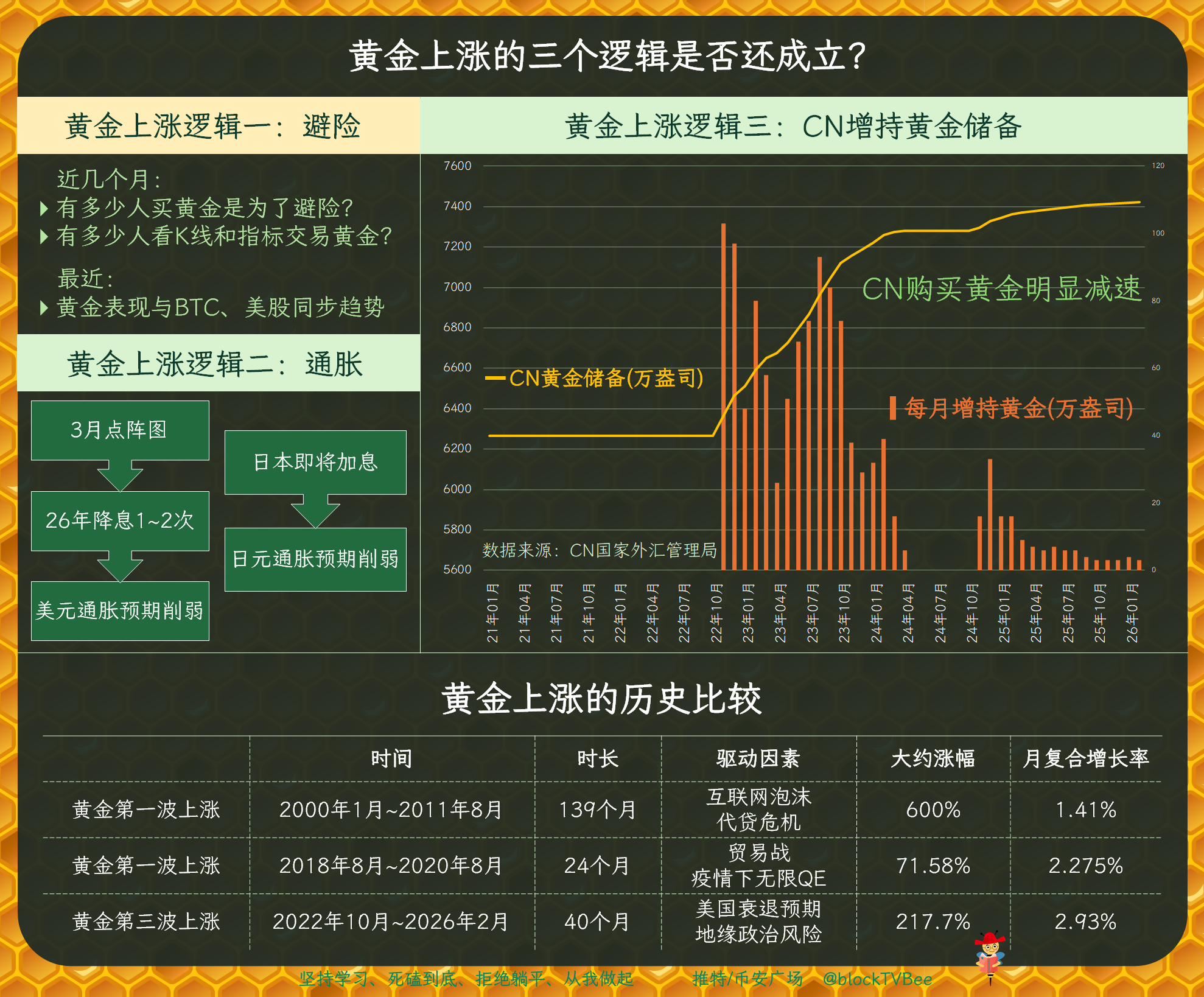
From January 2000 to August 2011, gold surged by 600%, with a monthly compound growth rate of approximately 1.41%.
This period covered the 2000 dot-com bubble and the 2008 subprime mortgage crisis.
╰✦ Changes in Market Motivation and Behavior
However, in recent months, how many people have purchased gold for safe-haven purposes?
How many are trading based on K-lines and indicators, even going long or short on gold?
With such market motivations and behaviors dominating, the risks remain, but gold's safe-haven logic has likely been significantly diluted.
╰✦ Gold Begins to Move in Sync with BTC and U.S. Stocks
In recent days, gold has been observed fluctuating in sync with BTC and U.S. stocks.
Yesterday, after Trump's remarks, gold rebounded simultaneously with BTC and U.S. stocks.
Gold's safe-haven attributes may have been overshadowed by speculative attributes in the short term.
┈➤ Gold's Rising Logic Two: Inflation
From August 2018 to August 2020, gold rose by approximately 71.58%, with a monthly compound growth rate of about 2.275%.
This period coincided with the trade war and the impact of the pandemic, during which the Fed initiated low interest rates and unlimited QE.
The second logic for gold's rise is inflation. In an environment of significant fiat currency inflation, gold's value-preserving ability may come into play.
╰✦ Expectations for U.S. Dollar Inflation Are Weakening
However, the Fed's interest rate forecast dot plot released in March shows 0-1 rate cuts in 2026. In such an environment, U.S. CPI may rise due to crude oil influences, but this would affect global prices. Relative to other fiat currencies, the expectation for the U.S. dollar's depreciation in 2026 has decreased.
╰✦ Expectations for Yen Inflation Are Weakening
As a safe-haven currency, the yen is simultaneously affected by loose fiscal policies and tight monetary policies. However, Japan's interest rate hike plan continues to be implemented, and the expectation for yen depreciation may also be weakening.
┈➤ Gold's Rising Logic Three: China's Purchases
It cannot be denied that China's efforts to increase gold reserves are significant, which impacts domestic investors.
Regardless of China's motivation for buying gold, the purchasing behavior itself shows a clear slowdown.
The People's Bank of China began increasing gold reserves in November 2022. By March 2024, gold reserves rose from 62.64 million ounces to 72.74 million ounces, an increase of 10.1 million ounces. The average monthly increase was 594,100 ounces.
From March to September 2024, the pace of gold purchases slowed, with an increase of about 20,000 ounces per month on average.
Subsequently, the pace shifted to an average monthly increase of 160,000 ounces for four months before slowing again.
In the last five months, the PBOC has been increasing gold reserves by about 30,000 ounces per month.
The bad news is that China's gold buying pace has slowed significantly.
The good news is that China is still continuously buying gold.
This is the remaining 0.5 reason for gold's rise.
┈➤ Final Thoughts: Can This 0.5 Reason Be Relied On?
╰✦ China's Purchase Volume Has a Weak Impact on the Global Market
On one hand, approximately 7 billion ounces of gold have been mined globally, with jewelry accounting for about 45%-48%, private investment for 20%-22%, and official reserves for about 17%. Considering private investment alone, there are about 1.47 billion ounces.
According to the latest clearing data from the London Bullion Market Association (LBMA) for January 2026, the daily clearing volume in the London market alone reached 18.2 million ounces.
The PBOC's monthly purchase of 30,000 ounces of gold has a very weak positive impact on prices.
╰✦ Divergence Between China's Purchase Volume and Gold Price Technically
On the other hand, assuming China's gold purchases are a key driver of gold's rise. However, since late 2024, China has clearly slowed its gold purchases. In contrast, the gold price has accelerated its rise since late 2024. From a technical perspective, this is a divergence.
Therefore, while the PBOC's continued gold purchases may still provide some positive signal, it can at most be considered 0.5 of a reason for gold's continued rise.
╰✦ Gold's Growth Rate Has Surpassed Previous Periods
Finally, from October 2022 to February 2026, the gold price rose by 217.7%, with a monthly compound growth rate of 2.93%.
Comparing these three waves of gold's rise, the first wave was relatively slower because the QE tool did not exist before 2008.
The second wave of gold's rise was due to simultaneous safe-haven demand and U.S. dollar inflation.
The third wave of gold's rise was primarily driven by safe-haven motives. Although CPI was not low, both the looseness of monetary policy and CPI were significantly lower than during the second wave.
However, the speed of the third wave of gold's rise has already exceeded that of the second wave, which included "massive money printing." Thus, gold's rise may have already透支 (overdrawn) future safe-haven space.
Therefore, with safe-haven attributes透支 and inflation expectations weakening, unless there is a more extreme and unexpected black swan event (e.g., nuclear weapons deployment in war), it is not advisable to place too much hope on this 0.5 reason for gold's rise.
Twitter:https://twitter.com/BitpushNewsCN
Bitpush TG Discussion Group:https://t.me/BitPushCommunity
Bitpush TG Subscription: https://t.me/bitpush





















