Bitcoin is attempting to hold the $70,000 level as geopolitical tensions in the Middle East intensify, injecting fresh uncertainty into global financial markets. The asset began the week trading above $74,000 but experienced a sharp repricing as investors reacted to escalating developments around the Strait of Hormuz, a critical chokepoint for global energy supply. As the conflict appeared likely to persist, markets quickly adjusted expectations, triggering volatility across risk assets, including cryptocurrencies.
According to a recent CryptoQuant report, energy-related geopolitical shocks can act as a transmission channel for broader macroeconomic disruptions. Escalations that threaten global oil supply often reinforce inflationary pressures and increase capital costs across the financial system. These dynamics force investors to reassess monetary policy expectations, particularly regarding the trajectory of interest rates and liquidity conditions.
On Thursday, March 5, the Hormuz-related escalation triggered a sudden repricing across markets. Bitcoin, which had been trading comfortably above the $74,000 level earlier in the week, dropped sharply as the market digested the implications of a potentially prolonged conflict and its impact on the global macro environment.
Despite the volatility, Bitcoin’s internal market structure appears to be showing a degree of resilience. While macro risks are being priced across global markets and influencing Federal Reserve expectations, on-chain flows suggest that underlying demand remains active, indicating that market participants are approaching the current environment with increasingly selective capital allocation strategies.
Energy Shock Triggers ETF Outflows While On-Chain Data Shows Resilience
The report further explains that the geopolitical escalation surrounding global energy supply has triggered immediate reactions across both traditional and crypto markets. Several macro indicators illustrate the scale of the shock. Bitcoin ETFs recorded a net outflow of approximately $139.2 million on March 5, reflecting a rapid shift toward risk aversion among institutional investors. At the same time, energy markets reacted strongly: Brent crude climbed to $85.41 while WTI reached $81.01, signaling that traders are pricing in potential logistical disruptions.
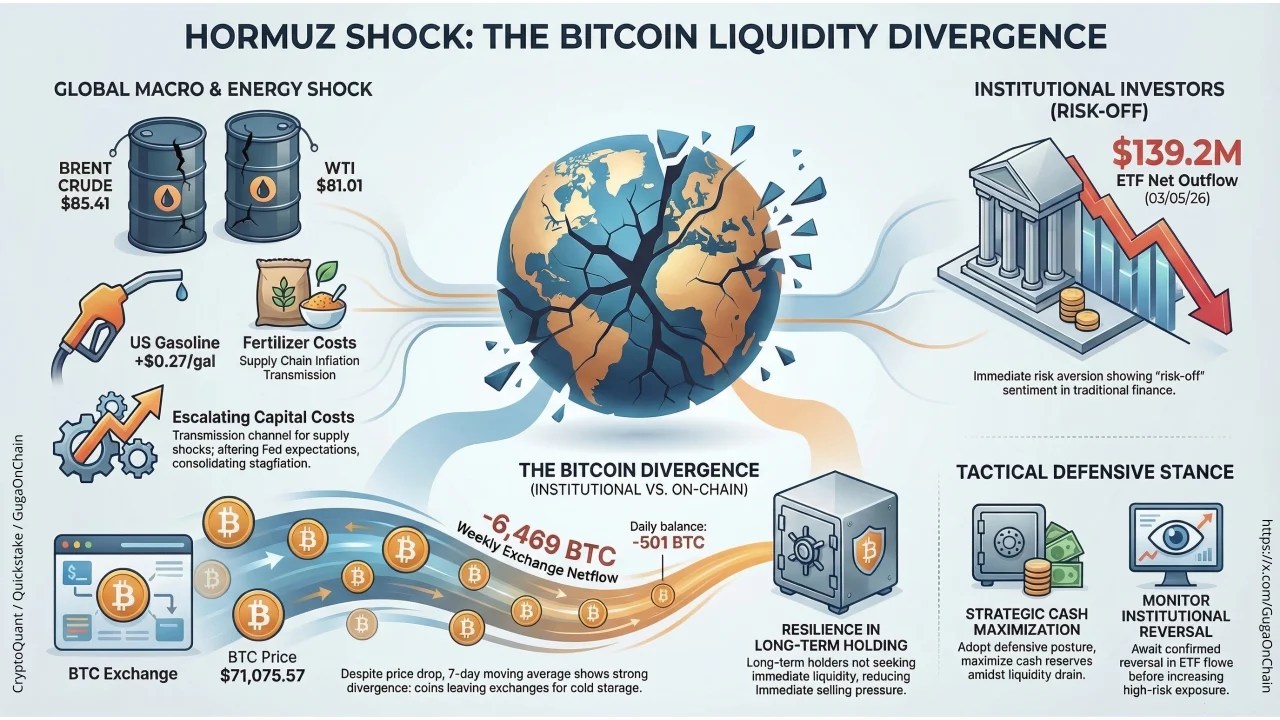
The ripple effects extend beyond energy markets. US gasoline prices rose by roughly $0.27 per gallon during the week, demonstrating how quickly supply shocks pass through to consumers. Meanwhile, fertilizer prices have also begun to climb, creating a dual cost shock that threatens to pressure global food supply chains.
Despite this macro-driven liquidity drain, Bitcoin’s on-chain structure shows signs of resilience. The report highlights the Bitcoin Exchange Netflow (Total) metric as a key indicator of market liquidity. When adjusted using a 7-day moving average to filter daily noise, exchange flows remain clearly negative even amid global risk-off sentiment.
Recent daily data shows a net balance of approximately -501 BTC leaving exchanges, while weekly cumulative withdrawals reached around -6,469 BTC. This suggests that long-term holders are not seeking immediate liquidity. Instead, coins continue moving into cold storage, reducing available supply and limiting near-term selling pressure as the market navigates the broader macro shock.