
The Financial Circle is Embracing Knowledge Payment

marsbitPublished on 2026-01-13Last updated on 2026-01-13

Abstract

Financial professionals in China are increasingly turning to knowledge monetization platforms. Notable figures like Hong Hao and Li Bei are achieving significant revenue: Hong Hao's knowledge community generated over 12.5 million RMB in two months after raising its annual fee to 1499 RMB, while Li Bei sold 200 spots for a 12,888 RMB course in just two days, earning 2.57 million RMB. This trend reflects a strategic use of "leverage"—a concept emphasizing scalable, near-zero marginal cost products like media content—to complement traditional labor and capital leverage. Both individuals leverage their macroeconomic expertise and personal branding to attract broad audiences, blending analysis with engaging content like predictions and personal anecdotes. However, their approaches differ: Hong Hao uses his platform to bolster his investment credibility amid uncertain fund performance, while Li Bei employs courses to retain clients and stabilize her asset management firm amid competitive pressures. Ultimately, this shift addresses dual needs: investors seek reliable information and emotional reassurance in noisy markets, while managers aim to cultivate loyal clients directly. As generating alpha becomes harder, selling the "map"—through subscriptions and courses—is emerging as a lucrative alternative.

Author: Shen Hui, Yuanchuan Investment Review

Hong Hao's knowledge planet officially announced a price increase, tagged at 1499 yuan/year, equivalent to a bottle of Moutai.

Before the price hike, the annual fee was 899 yuan. Based on 14,000 recharges, in just two months, Hong Hao's GMV on the knowledge planet reached 12.586 million yuan.

Similarly, Hong Hao's friend Li Bei also ventured into knowledge payment. A course worth 12,888 yuan, with 200 spots, sold out in two days. That is to say, in just two days, Li Bei's course sales revenue reached 2.57 million yuan.

As is well known, media is a notoriously bad business. This conclusion is easily drawn from the media sector's consistently poor performance among the 31 primary sectors of Shenwan. However, in this sunset industry, private domains and selling courses stand out as exceptions, attracting countless financial professionals to bend their backs.

Former Guohai Fixed Income Chief Jin Yi's Douyin account "Bai Nian Talks Politics and Economics" gained 1.6 million followers in three months, with membership for one-on-one consulting services from Chief Jin priced at 4,283 yuan per month; Tan Jun is about to launch the "Industry Decision-Maker Internal Reference Circle," limited to 30 seats, priced at 159,880 yuan; the more upscale-sounding "Bull Bear Beast Club" offers paid members not only access to Fu Peng's financial intelligence courses but also the opportunity to ski with him in Changbai Mountain.

Compared to their American counterparts, who show a stronger willingness to pay, financial consumers in the U.S. are different. The big short seller Michael Burry simply closed his hedge fund and switched to launching an electronic newsletter on Substack priced at $379 per year, attracting 187,000 subscribers in just two months—shorting Nvidia isn't as easy as making money.

Suddenly, financial big shots are jumping in, not competing on who has more investment ideas, but on who has more subscribers. Is investing too hard to make money, or is the business of headcounts too easy?

Three Types of Leverage

Silicon Valley investor Naval Ravikant mentioned that to achieve financial freedom, one needs to use three types of leverage:

  • The first is labor leverage, which means being the boss and having others work for you;
  • The second is capital leverage, like Warren Buffett using capital leverage to expand influence and make money with money;
  • The third, which he considers the most important leverage, is "products with zero marginal cost of reproduction," mainly including code and media.

In Naval's view, the wealth of the new generation of millionaires is created through code and media.

Joe Rogan relies on podcasts to earn $50-100 million annually [1]. Using this new type of leverage, simply by increasing paid memberships and online course sales, one can amplify the results of their labor hundreds or thousands of times. Its advantage is that the cost of reproduction is almost zero, and anyone with a computer and internet access can easily earn passive income.

And Hong Hao and Li Bei恰恰同时拥有这三种杠杆。

Li Bei founded Banxia in 2017, and by 2022, its scale had exceeded 10 billion yuan. She had already achieved financial freedom through labor and capital leverage. As she herself said, she doesn't lack the tens of millions of yuan generated annually from knowledge payment. But it cannot be denied that these tens of millions are far more certain in the short term than waiting for a reversal in China's real estate market.

Compared to Li Bei's colorful业余生活 of baking, gardening, and playing tennis, Hong Hao's recent experiences have been more turbulent.

Earlier, Hong Hao was the Chief Global Strategist at CICC and had worked at Citigroup and Morgan Stanley. In 2022, after leaving Bank of Communications International, he switched between buy-side and sell-side roles,先后 joining Srui Group and Huafu International. He is now the Managing Partner and Chief Investment Officer of Lianhua Capital.

However, Hong Hao's performance has always been a mystery.

In August 2023, he launched the Lotus-AAA fund with Srui and Lianhua Capital. Except for a single-month surge of 8.98% in September 2024, its performance had been lukewarm before. Perhaps because the fund's operation time was too short, when展示业绩, backtested simulated historical performance dating back to September 2002 was also included. At least the chart shows that Hong Hao似乎真有20年累计高达718.77%的投资收益。
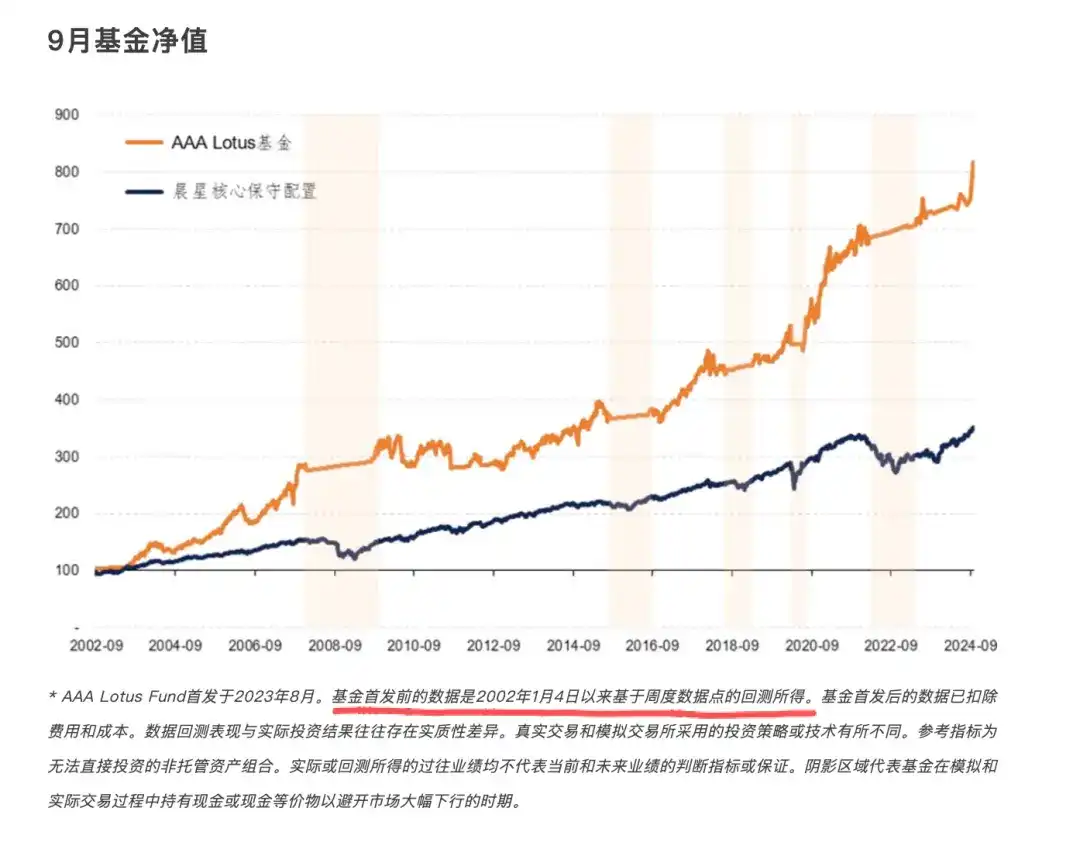
You can question Hong Hao's actual performance, but you cannot question his chart-making ability

Hong Hao and Li Bei are skilled at building IPs and generating traffic. Their熟练运用 of the third type of leverage gives them stronger money-making abilities than their peers in knowledge payment.

In terms of赛道选择, the macro sector where Hong Hao and Li Bei operate naturally reaches a wider audience. Not everyone cares about what Nvidia's open-sourced VLA model is called, but everyone cares whether gold will continue to rise in the future and whether the stock market in the Year of the Red Horse and Red Goat will have the Nine Purple Fire luck.

In terms of表达方式, compared to being lulled to sleep by the ambiguous views of economic grandmasters at roundtable forums, people prefer to listen with wide-eyed interest to Hong Hao predicting the fifth wave of the bull market and Li Bei analyzing the escape from the micro-cap fire. Even if they are evasive, they might意外收获 "MaiMaiMai" (BuyBuyBuy/SellSellSell)的艺术表达—after all, if they win, it's buy buy buy; if they lose, it's sell sell sell.

In terms of写作文体开发, Hong Hao is good at mixing classical Chinese and obscure characters into macro analysis, mysteriously citing various sources, giving people a reading experience that is hard to understand yet greatly震撼. Hong Hao once explained that the best article sounds like废话 but has some unexpected consequences [2]. Li Bei, on the other hand, can skillfully combine her emotional journey with macro analysis, occasionally posting相亲贴 (matchmaking posts), providing some low-participation-threshold topics.

Precisely because people love macro literature掺杂 with "fortune-telling" and "gossip," Hong Hao and Li Bei have captured the huge流量 in the financial circle, also creating a broader entry point for their transition into knowledge payment.

It's All Business

Fund managers are usually cautious about using the third type of leverage.

Because once a fund manager starts writing articles or selling courses, they are seen as not focusing on their main job, diverting time that should be devoted to investment research. Moreover, transitioning to media won't gain more professional recognition, just as people always criticize financial influencers—if their investment ability is strong enough, why would they take time out to teach others how to make money?

Whether it's Hong Hao creating a星球 (knowledge planet) or Li Bei selling courses, their purpose in涉足知识付费 is not simply to transition into self-media.

Compared to Li Bei, Hong Hao transitioned to investment relatively late, and he can't even show a three-year continuous net value curve. Therefore, he更需要 to constantly market the accuracy of his predictions on social media to背书 his investment ability.

On November 28 last year, Business Weekly brought Hong Hao, Li Bei, and Fu Peng together at a roundtable. When the three discussed gold, Fu Peng's views were ambiguous, Li Bei was clearing positions and bearish,只有洪灏公布了详细的卖点—selling all when the gold price reaches $4500/ounce.

This led to质疑, because the price of the main Comex gold futures contract had never reached $4500/ounce at that time. Non-main contracts had briefly reached it, but it was almost impossible for large institutional funds like Hong Hao's to exit at the peak in such low-liquidity contracts.

Hong Hao did not公开详细的黄金交易平仓单, but instead marketed on his星球 "Ten Thousand Witness the Miracle of Predicting Silver." He publicly predicted:

Silver hasn't finished its run; how deep the cup is, how high the target is. If 4500 is a fair price for gold, then for others, we need to use our imagination. New highs are for buying; those who fear heights are destined for hardship.

As written in "The Crowd," he who掌握了影响群众想象力的艺术, also掌握了统治他们的艺术.
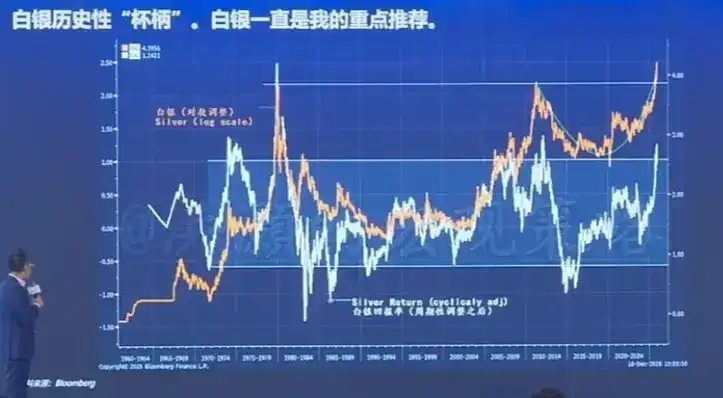
Hong Hao believes silver has formed a giant 60-year "cup and handle" pattern

Ultimately, Lianhua Capital is still not well-known. Posting粉丝的好评 (fan praise) on the星球, creating涨价预期 (price increase expectations) for the星球, and selling more "星球茅台" (Planet Moutai) can孵化 more future私募客户 (private fund clients). Compared to collecting management fees and performance fees, it has higher short-term economic benefits.

After all, outputting a "bullish on silver" view is easy—like the two sides of a coin, you can brag if it goes up—while "heavily betting on silver" involves multi-dimensional博弈 with the market, human nature, rules, and scale.

Compared to Hong Hao, Li Bei faces a different situation. After Banxia crossed the 10-billion-yuan threshold, its performance growth weakened, and it dropped out of the camp of billion-yuan私募 early this year. In an environment where Bridgewater China remains strong and quantitative macro opponents are formidable, the urgent task is to stabilize old clients and avoid redemptions.

Li Bei's approach is to免费赠送 online courses to all Banxia investors and offline courses to investors who have held the fund for more than 2 years or invested more than 5 million yuan. Thus, before the course starts on January 24th, investors wanting to redeem get a赎回冷静期 (redemption cooling-off period).

In November, Minghong's macro product sold out upon launch; in December, Two Sigma's "CTA + Index Enhanced"复合策略 product, with a 2 billion yuan quota, was instantly snapped up across three major channels. This type of multi-strategy product from quantitative私募无形之中 forms a substitute for Li Bei's macro strategy.

Moreover, subjective私募 are gradually declining on the distribution side, and mainstream channels are somewhat avoiding them. In the future, subjective managers will inevitably need to invest more energy in direct sales.

A clever way is to first筛出 (screen out) the customer base with payment ability from fans with a price of 12,888 yuan, and then use slogans like "easily achieving long-term annualized returns of over 10% by taking the course" to锁定 (lock in) those customers who are dissatisfied with wealth management returns and渴望致富 (eager to get rich).

Fans with purchasing power and purchasing desire, after attending Li Bei's offline classes for答疑解惑 (Q&A), can naturally be converted into私募 clients with极少的 time cost and极高的 conversion rate.

Astute managers not only skillfully use the third type of leverage but also善于叠加 use all three types of leverage.

Epilogue

When discussing knowledge payment becoming a trend in the asset management industry, many people think of two aspects:

  • First, the pressure from salary cuts in the financial industry prompts practitioners to seek other sources of income;
  • Second, switching from investment to media is like降维打击 (attacking from a higher dimension). Precisely because of this, financial self-media is the首选副业 (preferred side job) for most financial practitioners.

But looking deeper, this actually stems from the bidirectional需求 of investors and managers—investors need reliable sources of information, and managers need loyal clients.

It's like Jensen Huang gave a speech at CES, and the next day there were dozens of interpretations利好 (beneficial) to which market sectors. It seems information is equalized, but in reality, it adds countless噪音 (noises). The advancement of AI allows more noise to be produced at low cost. For both investors and managers, attention and trust are the scarcest resources.

Who wouldn't want to spend some money to buy a professional fund manager's knowledge planet to gain an information edge, or even follow their operations? Many people know that Hong Hao's predictions will eventually翻车 (fail), but what they are buying is not a 100% win rate, but rather, in the chaotic market, through his repeated analysis and confirmation, they can obtain an emotional anchor and comfort.

Some subjective fund managers are also gradually realizing that they are no longer the first choice for institutions, distribution channels, or high-net-worth clients. So they can only work harder to reach more precise clients through私域 (private domains) and courses. Some skilled subjective私募 have even screened their clients into executives or industry experts of invested companies—making money for clients while also obtaining the most前沿 (cutting-edge) industry information差 (information gap) from them.

I asked him why he doesn't ask sell-side analysts. He replied that sell-side can only be bullish on their own industry and mislead him, while invested clients can tell him the most real and objective views on the industry.

When gold becomes harder to dig and shovels are in excess, having a矿藏地图 (mineral deposit map) is the important thing, and the person selling the map becomes the one who makes the most money.


Related Questions

QWhat are the three types of leverage mentioned in the article for achieving wealth freedom, and which one is considered the most important?

AThe three types of leverage are: 1) Labor leverage (having people work for you), 2) Capital leverage (using money to make more money, like Warren Buffett), and 3) 'Products with zero marginal cost of replication,' which includes code and media. The third type is considered the most important.

QHow much revenue did Hong Hao generate from his knowledge planet in two months before the price increase?

AHong Hao generated 12.586 million RMB in GMV from his knowledge planet in two months before the price increase, based on 14,000 subscribers at the previous annual fee of 899 RMB.

QWhat is the primary business reason suggested for why financial figures like Hong Hao and Li Bei are turning to knowledge付费?

AThe primary business reason is to leverage their influence (the third type of leverage) to generate significant revenue with low marginal effort, while also using it as a tool for client acquisition, credibility building, and stabilizing their core asset management businesses in a challenging market.

QAccording to the article, what is the underlying need from both investors and managers that knowledge付费 addresses?

AThe underlying need is a two-way demand: investors need reliable sources of information to cut through market noise, and asset managers need loyal, long-term clients in an environment where they are no longer the default choice for many institutions and distributors.

QWhat specific tactic does the article mention Li Bei using to potentially discourage investor redemptions from her fund?

ALi Bei offered free online courses to all her fund's investors and free offline courses to those who had held the fund for over 2 years or invested more than 5 million RMB, creating a 'cooling-off period' for redemption decisions before the course started.

Related Reads

Silicon Valley 'Startup Guru' Steve Hoffman: Web3 + AI Could Be a Trap

Silicon Valley investor and "Godfather of Startups" Steve Hoffman warns that combining Web3 with AI is likely a trap, not a promising venture. In an interview, Hoffman argues that while AI is a foundational technology touching all industries, Web3 adds complexity, friction, and regulatory risk without solving mainstream consumer or business needs. He advises founders to focus on deep, specialized applications where startups can out-iterate giants, rather than on generic features easily replicated by large tech companies. Hoffman observes that Silicon Valley will lead foundational AI research, while China excels at rapid, large-scale application and commercialization, particularly in robotics. He stresses that AI-driven autonomous agents capable of collaborative, multi-step tasks are 2-4 years away, which will cause significant job displacement. The solution is not to slow AI but to redesign business models around human-AI collaboration and reform social systems like education and retraining. For startups, Hoffman recommends focusing on vertical, expertise-heavy domains to build defensibility. He sees major opportunities in AI fraud detection and cybersecurity. Key founder mindsets include systemic thinking over feature-focus, relentless customer centricity, building adaptive teams, and deeply understanding AI's capabilities and limits. Hoffman is also leading a non-profit initiative to establish university centers aimed at training future leaders in responsible, human-value-aligned AI innovation.

marsbit22m ago

Silicon Valley 'Startup Guru' Steve Hoffman: Web3 + AI Could Be a Trap

marsbit22m ago

Token Inefficient, Economy Tokenless

The article "Tokens Aren't Economical, Economics Aren't Tokenized" analyzes a pivotal shift in the AI industry from a technology-driven narrative to one dominated by capital efficiency. It highlights two concurrent trends: a severe capital shortage due to the exorbitant and recurring costs of compute (e.g., OpenAI's high burn rate) and a wave of corporate spin-offs where major tech companies are separating their AI units (like Kuaishou's Kling and Baidu's Kunlunxin). The core argument is that AI's "anti-internet" business model, where user growth increases costs rather than profits, has created a disconnect between high valuations and actual cash flow. Spin-offs address this by allowing AI assets to be valued independently. Within a parent company, they are seen as cost centers, but as standalone entities, they are priced based on their growth potential and scarcity in the primary market, leading to massive valuation premiums (e.g., Kling's estimated value tripling post-spin-off). The industry is at an inflection point, moving from "model worship" to "value realization." The competition is evolving from a pure compute (GPU) race to a broader focus on systemic efficiency and full-stack engineering (involving CPUs and orchestration) to achieve viable commercialization. The year 2026 is framed as a critical moment where the industry must definitively answer how to economically translate AI capability into tangible business value, reshaping the sector's future power structure.

marsbit27m ago

Token Inefficient, Economy Tokenless

marsbit27m ago

Crossing the 'Memory Wall': The Wafer-Level Revolution and Computing Power Routes in the AI Inference Era

In 2026, a historic shift occurred in AI as major cloud providers' inference spending surpassed training spending for the first time, signaling a move from "building large models" to "using large models." This shifts the core challenge from computing power to the "memory wall"—the bottleneck of data movement (model weights, activations, KV Cache) between external DRAM and processors, where energy and latency from data transfer far exceed computation itself. Companies like Nvidia face GPU idle time due to bandwidth limits. In contrast, Cerebras Systems adopts a radical "wafer-scale" approach with its Wafer-Scale Engine (WSE). Instead of cutting a silicon wafer into many chips, Cerebras uses almost the entire wafer as one massive chip (WSE-3). This design provides 44GB of on-chip SRAM, delivering memory bandwidth thousands of times higher than traditional HBM (e.g., 21 PB/s vs. Nvidia B200). For LLM inference, weights are streamed layer-by-layer from external MemoryX storage to the chip, avoiding HBM bottlenecks. This results in token generation speeds 1.5–5 times faster than Nvidia's B200 in some models and significant advantages in first-token latency and long-context tasks. Additionally, Cerebras's architecture offers much lower interconnect power consumption (0.15 pJ/bit vs. GPU's ~10 pJ/bit). However, Cerebras faces challenges: SRAM scaling has slowed with advanced nodes, limiting future capacity gains; the chip requires specialized liquid cooling and custom software stacks; and its external I/O bandwidth (150 GB/s) is low compared to NVLink, hindering multi-system scaling for very large models. Competition is intensifying. Major players are pursuing three paths: 1) Developing proprietary inference ASICs (e.g., Google TPU, Microsoft Maia), 2) Leveraging advanced packaging (e.g., TSMC's SoW) to democratize wafer-scale-like integration, potentially eroding Cerebras's process advantage within a few years, and 3) Exploring optical interconnects for ultimate bandwidth. Commercially, Cerebras is transitioning from a hardware vendor to a service provider, facing the immense challenge of building high-power, specialized data centers to meet large contracts (e.g., 250MW/year from 2026–2028). In conclusion, the AI inference era presents a fundamental architectural trade-off. Cerebras opts for extreme physical optimization for low-latency, single-task performance, while Nvidia prioritizes versatility and massive cluster throughput. The path forward remains uncertain, with technology and business models still evolving in the race toward advanced AI.

marsbit33m ago

Crossing the 'Memory Wall': The Wafer-Level Revolution and Computing Power Routes in the AI Inference Era

marsbit33m ago

Has Bitcoin's 'Rebound Ended', Officially Entering the Late Bear Market Phase?

**Title: Has Bitcoin's Rebound Ended, Entering the Late Bear Market Phase?** **Summary:** Bitcoin's price has declined by 13% this week, signaling a potential return to late-stage bear market conditions. The price fell to around $67k, positioned between the Realized Price and Realized Cap Weighted Average. For the first time since early 2022, the Short-Term Holder cost basis has dropped below this key average, confirming a hallmark of late-cycle bear markets. Profitability metrics have collapsed sharply. The 7-day average of the Realized Profit/Loss ratio plummeted from a local high of 3.16 to 0.29, mirroring the February panic sell-off. Critically, the 90-day average never breached the threshold of 2, indicating the recent rally to $82k was a bear market bounce, not a structural shift. Realized losses surged to $1.35 billion daily, with $770 million coming from Long-Term Holders selling at a loss. This accelerating redistribution of supply from weak to strong hands is a necessary but ongoing process for a market bottom. The rally stalled almost precisely at the aggregate cost basis (~$83k) of US spot Bitcoin ETF investors, turning that level into strong resistance and leaving the average ETF holder underwater again. Spot market flows have turned decisively negative, showing sellers are dominating order books despite the price drop. While a significant futures long liquidation event cleared over $400 million in leverage, providing a potential reset, sustained spot demand is yet to materialize. Options markets continue to price in higher future volatility (Implied Volatility) than recent price action (Realized Volatility) has shown, with a persistent skew towards put options, indicating ongoing demand for downside protection. In conclusion, multiple metrics point to a fragile market structure. Resistance at the ETF cost basis, accelerating realized losses, dominant spot selling, and cautious options pricing all suggest the bear market trend persists. A sustainable recovery likely requires a resurgence of spot demand, ETF holders returning to profit, and a clear reduction in selling pressure.

marsbit33m ago

Has Bitcoin's 'Rebound Ended', Officially Entering the Late Bear Market Phase?

marsbit33m ago

TechFlow Intelligence Agency: Anthropic Calls for Global Pause in AI Development While Preparing for Trillion-Dollar IPO; SpaceX IPO Roadshow Heats Up, But S&P 500 Rejects Fast-Track Inclusion

In today's TechFlow Intelligence Briefing, several major tech stories highlight a growing theme of trust and credibility gaps across AI, crypto, and finance. AI company Anthropic has publicly called for a global pause in AI development, citing risks from Claude's "recursive self-improvement." Ironically, this coincides with reports the company is preparing for a massive IPO targeting a near $1 trillion valuation. This perceived hypocrisy, coupled with widespread user complaints about Claude's declining performance, is sparking debate over whether the safety warning is genuine or a competitive tactic. Meanwhile, in a substantive security move, Anthropic open-sourced a framework for AI-powered vulnerability discovery. In the crypto market, Bitcoin's price drop below $61,000 triggered over $1.16 billion in liquidations, flipping the market into a state where more BTC is held at a loss than at a profit, a historical bearish signal. On the corporate front, SpaceX's highly anticipated IPO is generating immense Wall Street excitement, with Goldman Sachs projecting 100x revenue growth by 2030. However, the S&P 500 has refused to fast-track the company's inclusion post-IPO, potentially limiting immediate institutional demand. Separately, ByteDance's AI app Doubao lost over 6 million monthly active users after introducing a subscription model, highlighting the challenges of AI monetization. Other notable developments include Nvidia certifying HBM4 memory from Samsung, SK Hynix, and Micron; Cloudflare's acquisition of front-end tooling company VoidZero; and its CEO warning that bot traffic now exceeds human traffic online. The underlying narrative connects these events: a trust crisis. From AI firms' contradictory actions and crypto volatility to the clash between SpaceX's hyped narrative and institutional rules, a pattern is emerging where stated intentions and actual practices are increasingly misaligned.

marsbit48m ago

TechFlow Intelligence Agency: Anthropic Calls for Global Pause in AI Development While Preparing for Trillion-Dollar IPO; SpaceX IPO Roadshow Heats Up, But S&P 500 Rejects Fast-Track Inclusion

marsbit48m ago

Trading

Spot
Futures

Hot Articles

Discussions

Welcome to the HTX Community. Here, you can stay informed about the latest platform developments and gain access to professional market insights. Users' opinions on the price of S (S) are presented below.

活动图片














