The Fed's $40 Billion Treasury Purchases Are Not the Same as Quantitative Easing

深潮Published on 2025-12-13Last updated on 2025-12-13

Abstract

The Federal Reserve's announcement of $40 billion monthly Treasury purchases has sparked market speculation about quantitative easing (QE). However, this program, termed Reserve Management Purchases (RMP), is functionally distinct from QE. While it meets the mechanical criteria of QE—large-scale asset purchases with newly created reserves—its purpose is stability, not stimulus. RMP aims to counteract liquidity drainage caused by tax season withdrawals into the Treasury General Account (TGA), preventing repo market stress like the 2019 crisis. It is liquidity-neutral, merely replacing lost reserves rather than expanding net liquidity. True QE would require either longer-duration asset purchases (e.g., bonds or MBS) or excess liquidity injection beyond system needs. The RMP signals Fed readiness to backstop liquidity, reducing tail risks and providing mild support for risk assets, but it is not a systematic easing tool.

Author: Alex Krüger

Compiled by: Deep Tide TechFlow

The Federal Reserve has just committed to purchasing $40 billion in U.S. Treasuries per month, and the market has already started shouting "Quantitative Easing (QE)!"

While on the surface this figure appears to be a signal of economic stimulus, the underlying mechanism tells a different story. Powell's move is not aimed at stimulating the economy but at preventing operational issues within the financial system.

Below is an analysis of how the Fed's Reserve Management Purchases (RMP) program structurally differs from Quantitative Easing (QE) and its potential implications.

What is Quantitative Easing (QE)?

To strictly define Quantitative Easing and distinguish it from standard open market operations, the following conditions must be met:

Three Mechanical Conditions

  1. Mechanism (Asset Purchases): The central bank purchases assets, typically government bonds, by creating new reserve funds.

  2. Scale (Large-Scale): The purchase volume is significant relative to the total market size, aimed at injecting substantial liquidity into the system rather than making fine adjustments.

  3. Objective (Quantity Over Price): Standard policy adjusts supply to achieve a specific interest rate (price) target, while QE commits to purchasing a specific quantity of assets regardless of the resulting interest rate changes.

Functional Condition

  • Positive Net Liquidity (QE): The pace of asset purchases must exceed the growth of non-reserve liabilities (such as currency and the Treasury General Account). The goal is to forcibly inject excess liquidity into the system, not merely provide the required liquidity.

What are Reserve Management Purchases (RMP)?

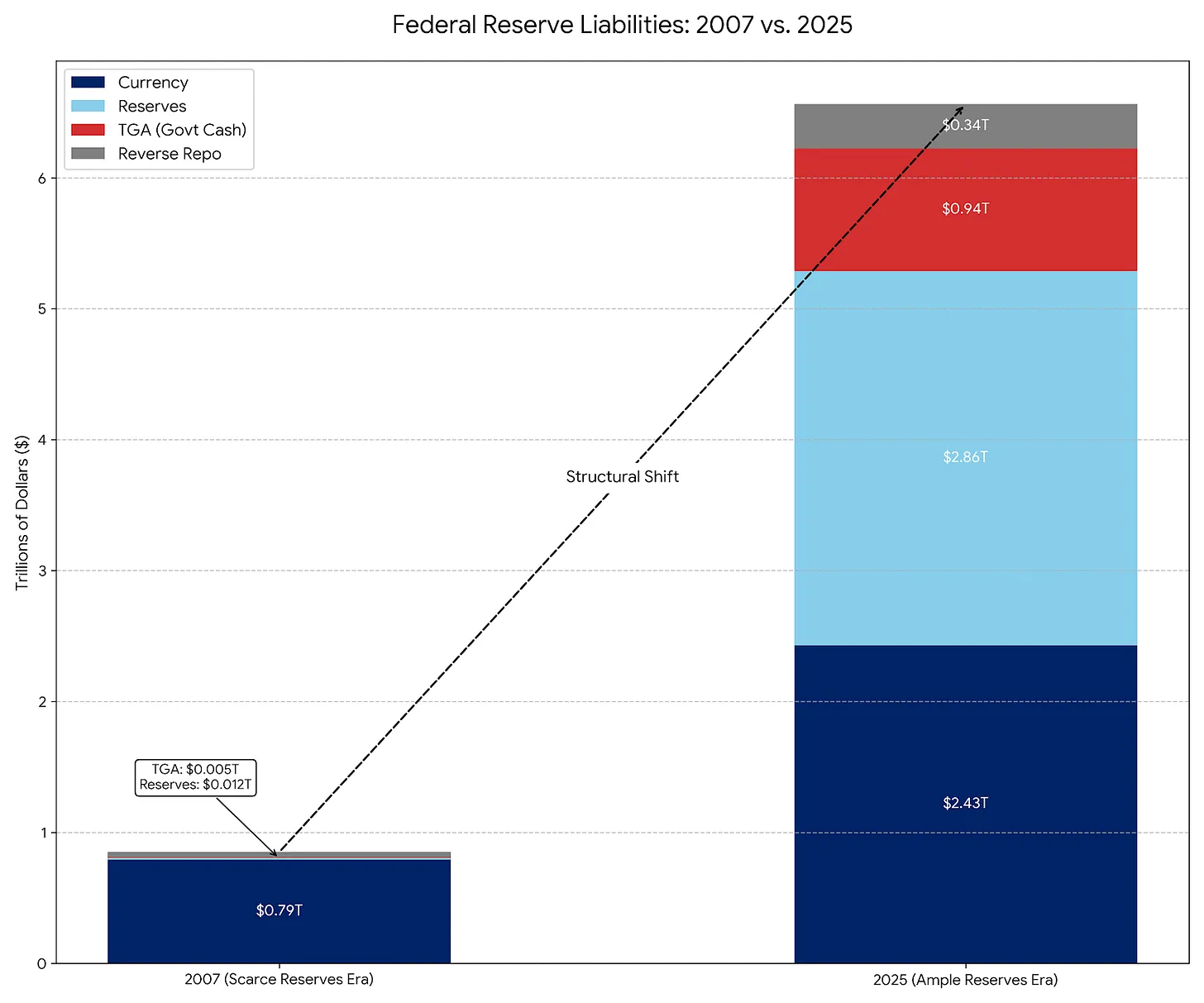
RMP is essentially the modern successor to Permanent Open Market Operations (POMO), which was the standard operating procedure from the 1920s until 2007. However, the composition of the Fed's liabilities has changed dramatically since 2007, requiring an adjustment in operational scope.

POMO (Scarce Reserves Era)

Before 2008, the Fed's primary liability was physical currency in circulation; other liabilities were minor and predictable. Under POMO, the Fed purchased securities merely to meet the public's gradual demand for physical cash. These operations were calibrated to be liquidity-neutral and were small in scale, not distorting market prices or depressing yields.

RMP (Ample Reserves Era)

Today, physical currency constitutes only a small portion of the Fed's liabilities, which are dominated by large and volatile accounts like the Treasury General Account (TGA) and bank reserves. Under RMP, the Fed purchases short-term Treasury bills (T-Bills) to buffer these fluctuations and "maintain ample reserve supplies on an ongoing basis." Similar to POMO, RMP is designed to be liquidity-neutral.
Why Launch RMP Now: TGA and the Impact of Tax Season

Powell is rolling out the Reserve Management Purchase program (RMP) to address a specific financial system problem—the TGA (Treasury General Account) liquidity drain.

How it Works: When individuals and businesses pay taxes (particularly around the December and April major tax deadlines), cash (reserves) is transferred from their bank accounts to the government's checking account at the Fed (TGA), which is outside the commercial banking system.

Impact: This transfer of funds drains liquidity from the banking system. If reserves fall too low, banks will stop lending to each other, potentially triggering a repo market crisis (similar to September 2019).

Solution: The Fed is now launching RMP to offset this liquidity drain. They are creating $40 billion in new reserves to replace the liquidity that is about to be locked in the TGA.

Without RMP: Tax payments tighten financial conditions (bearish). With RMP: The impact of tax payments is neutralized (neutral).

Is RMP Actually QE?

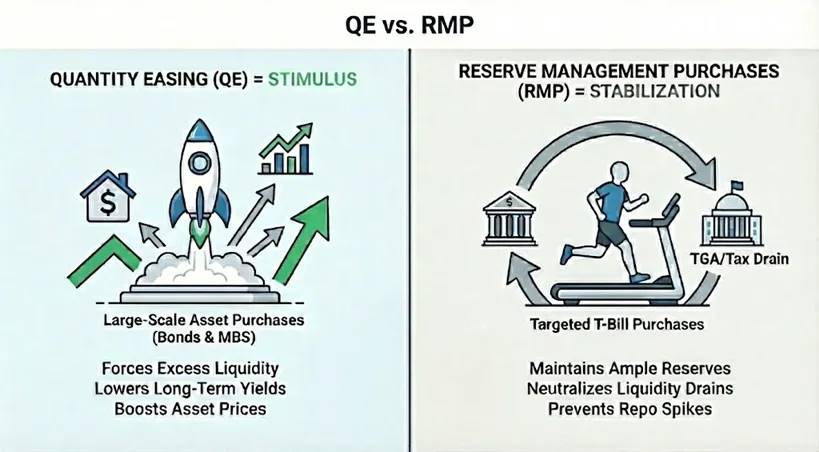
Technically: Yes. If you are a strict monetarist, RMP fits the definition of QE. It meets the three mechanical conditions: large-scale asset purchases ($40 billion per month) via new reserves, with a quantity-based rather than price-based target.

Functionally: No. RMP serves to stabilize, while QE serves to stimulate. RMP does not significantly loosen financial conditions but prevents them from tightening further during events like TGA replenishment. Since the economy naturally drains liquidity, RMP must run continuously just to maintain the status quo.
When Would RMP Turn into True QE?

For RMP to transform into full-fledged QE, one of the following two variables must change:

A. Change in Duration: If RMP begins purchasing long-term Treasuries or mortgage-backed securities (MBS), it becomes QE. By doing so, the Fed removes interest rate (duration) risk from the market,压低 yields, forcing investors into higher-risk assets and thereby pushing up asset prices.

B. Change in Quantity: If the natural demand for reserves slows (e.g., TGA stops growing), but the Fed still purchases $40 billion per month, RMP becomes QE. At this point, the Fed is injecting more liquidity into the financial system than is needed, and this excess inevitably flows into financial asset markets.

Conclusion: Market Impact

RMP is designed to prevent the liquidity drain from tax season from impacting asset prices. Although technically neutral, its reintroduction sends a psychological signal to the market: the "Fed Put" is activated. This announcement is a net positive for risk assets, providing a "mild tailwind." By committing to $40 billion in monthly purchases, the Fed effectively provides a floor for banking system liquidity. This eliminates the tail risk of a repo crisis and boosts confidence in market leverage.

It is important to note that RMP is a stabilizer, not a stimulator. Since RMP only replaces the liquidity drained by the TGA rather than expanding the net monetary base, it should not be mistaken for the systemic easing of true QE.


Trending Cryptos

Related Questions

QWhat is the key difference between the Federal Reserve's $40 billion Treasury purchase program and Quantitative Easing (QE)?

AThe key difference is functional: the Reserve Management Purchases (RMP) program is designed to stabilize the financial system by offsetting liquidity drains (like tax season withdrawals to the TGA), maintaining neutrality, while QE aims to stimulate the economy by injecting excess liquidity into the system to lower yields and encourage risk-taking.

QUnder what conditions could the RMP transition into full Quantitative Easing?

ARMP could transition into QE if either: A) The duration of purchased assets changes (e.g., shifting from short-term Treasuries to long-term bonds or MBS), or B) The quantity of purchases exceeds natural liquidity demand (e.g., if TGA growth slows but the Fed continues $40B monthly purchases, injecting excess liquidity).

QWhy did the Federal Reserve initiate the RMP program at this specific time?

AThe Fed initiated RMP to address liquidity drainage during tax season, when tax payments move reserves from banks to the Treasury General Account (TGA), risking a repo market crisis similar to September 2019. RMP offsets this by creating new reserves to maintain system stability.

QHow does the RMP program align with the mechanical criteria of Quantitative Easing, and why is it still not considered QE?

ARMP mechanically meets QE criteria: asset purchases via new reserves, large scale ($40B/month), and quantity-focused targets. However, functionally it is not QE because it replaces drained liquidity (neutral effect) rather than injecting net new liquidity to stimulate the economy or lower yields.

QWhat is the 'Fed Put' signal mentioned in the article, and how does RMP contribute to it?

AThe 'Fed Put' refers to the perceived safety net where the Fed intervenes to protect markets from severe downturns. RMP reinforces this signal by providing a liquidity backstop, eliminating tail risks like repo crises, and boosting market confidence in leverage, though it is a stabilizer, not a stimulator.

Related Reads

Stablecoins Are the 'Royalists' of the Crypto World: Open USD Brings the Old Monetary System into the Fray

Title: Stablecoins Are the "Royalists" of the Crypto World: Open USD Brings the Old Monetary System into the Fray The article analyzes the launch of Open USD, a new dollar-pegged stablecoin backed by a coalition of over 140 traditional financial, payment, and tech giants like Visa, BlackRock, and Google. Author Hu Yilin argues that stablecoins like Open USD represent not a "moderate" wing of the crypto revolution, but a "royalist reform" within the old monetary system. He posits that while stablecoins adopt blockchain's efficiency, programmability, and borderless nature, they fundamentally reinforce the US dollar's centrality and the Federal Reserve's authority. They aim to replace inefficient "bureaucrats" (like traditional payment networks) rather than challenge the "monarch" (the dollar-based system). Thus, Open USD symbolizes the old system co-opting blockchain technology to upgrade dollar hegemony, potentially marginalizing native crypto projects like Circle's USDC. Hu contrasts this with more revolutionary paths, like a "Bitcoin standard," which seeks to change the monetary base itself. He warns that if the crypto ecosystem's unit of account, collateral, and value anchor remain dollar-denominated stablecoins,链上繁荣 may enrich the traditional financial system ("off-chain") rather than granting monetary premium to native crypto assets like ETH. Projects with civilizational ambitions, he argues, cannot reduce their narrative to mere "fuel" or transaction fees but must grapple with the core revolutionary idea: that a decentralized market does not require a central bank as the anchor of monetary order.

marsbit1h ago

Stablecoins Are the 'Royalists' of the Crypto World: Open USD Brings the Old Monetary System into the Fray

marsbit1h ago

Standard Chartered Takes Over USDC Onboarding; Circle Cedes Control for Scale

Standard Chartered and Circle have announced a partnership where institutional clients can now mint and redeem USDC directly through Standard Chartered's existing banking infrastructure, eliminating the need for separate accounts with Circle. Initially launching in the Dubai International Financial Centre (DIFC), this service represents the first time a Global Systemically Important Bank (G-SIB) is offering such direct, integrated access. This move effectively "translates" USDC into a standard banking option, opening the door for major institutional capital like pension funds and sovereign wealth funds that require the trust, compliance, and risk frameworks of a major bank. For Circle, this is a strategic trade: ceding some direct client relationships to leverage Standard Chartered's vast distribution network, thereby potentially massively scaling USDC's circulation and its core interest revenue model. For Standard Chartered, it's a chance to offer a new digital asset service without building the underlying stablecoin infrastructure. The partnership signals a significant shift in the stablecoin narrative. Rather than bypassing traditional finance, stablecoins are becoming integrated into it, with major banks like Standard Chartered positioning themselves at the crucial entry point. The focus is moving from legitimizing stablecoins to determining how value and pricing power will be distributed among issuers, banking channels, and regulatory frameworks in this new, converging landscape.

marsbit4h ago

Standard Chartered Takes Over USDC Onboarding; Circle Cedes Control for Scale

marsbit4h ago

Trading

Spot

Hot Articles

Discussions

Welcome to the HTX Community. Here, you can stay informed about the latest platform developments and gain access to professional market insights. Users' opinions on the price of S (S) are presented below.

活动图片