The Encrypted Super App Revolution: When Coinbase Breaks Financial Boundaries

marsbitPublished on 2025-12-22Last updated on 2025-12-22

Abstract

Coinbase and Robinhood are leading a shift towards integrated financial "super apps," moving beyond fragmented services to combine stock trading, cryptocurrencies, derivatives, and predictive markets in a single platform. This consolidation addresses inefficiencies like multi-day settlement delays and fragmented liquidity, allowing instant asset reallocation within one account. Key enablers include tokenization for 24/7 trading, clearer regulations, and advanced mobile wallet infrastructure. Social trading is emerging as a differentiator, enabling users to mimic trusted traders. However, this recentralization raises concerns about counterparty risk, gamified trading incentives, and whether this truly democratizes finance or merely replaces traditional gatekeepers. The era of financial fragmentation is ending, but the outcome—genuine innovation or repackaged control—remains uncertain.

Original Author: Nishil Jain

Original Compilation: Luffy, Foresight News

Last week, Coinbase launched a new product touted as the "Future of Finance." One app now integrates five major functions: 24/5 stock trading, centralized exchange and on-chain cryptocurrency trading, futures and perpetual contract trading, prediction markets, and even features an AI financial analyst. All functions are accessible via mobile, with a single account balance allowing users to instantly switch between different asset classes.

Not long ago, Robinhood had already taken the lead: launching tokenized stock trading in Europe, 24/5 futures trading, cryptocurrency interest-earning services, and planning to launch the social trading feature Robinhood Social in 2026.

The mainstream discourse on platform X interprets this trend as the evolution of "super apps," but a key point is being missed: this is not merely a simple addition of functions; it is breaking down the boundaries of financial asset categories that were artificially divided due to regulatory and technological limitations.
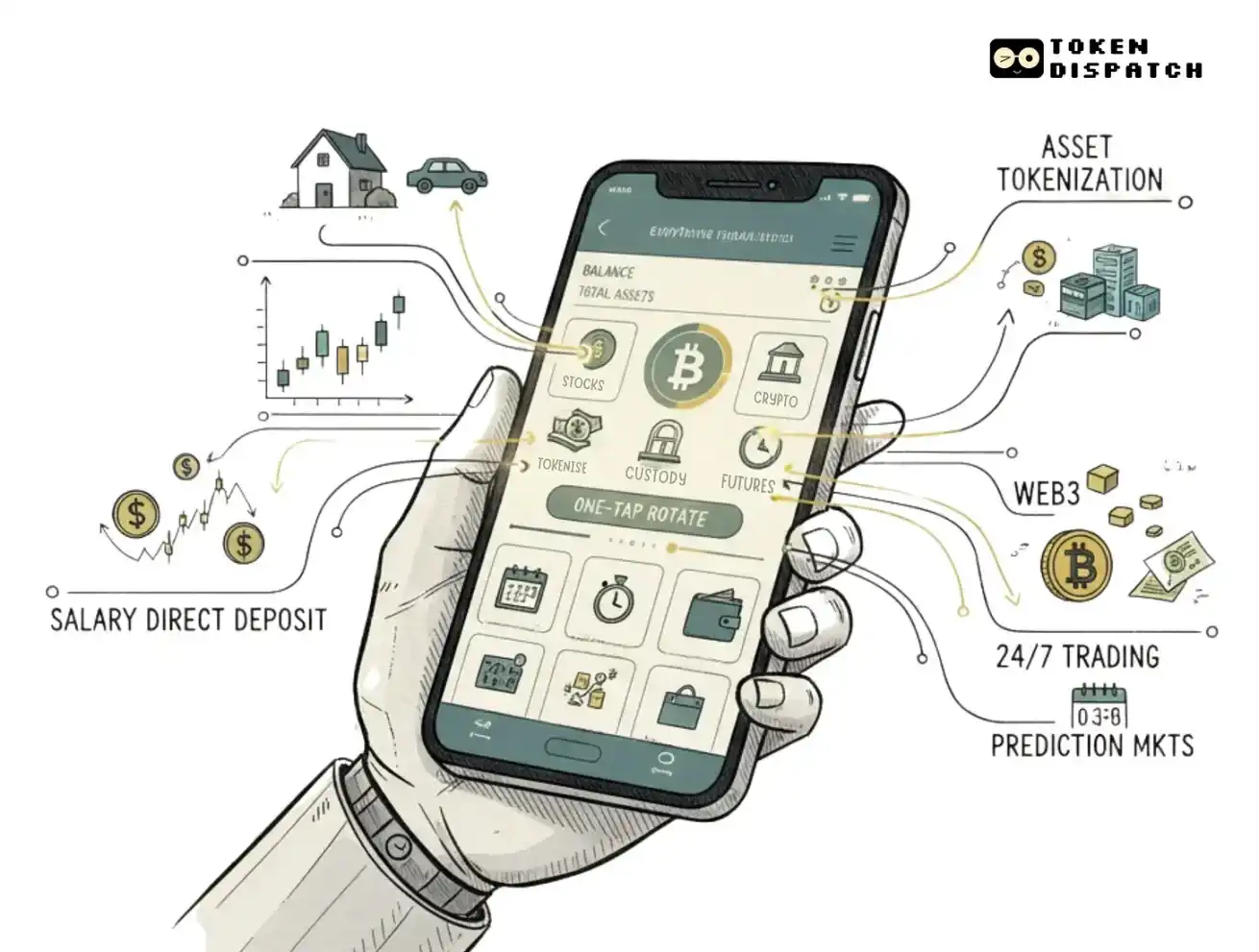
Why, after a decade of fragmented development, are financial applications now experiencing a wave of integration? What does this mean for the users and platforms involved? Let's delve into the topic.

The Pain Points of Fragmentation

Over the past decade, numerous fintech applications have emerged, but most only cover a single aspect of financial services, with functions like stock trading, cryptocurrencies, payments, and savings scattered across different apps.

While this model provided users with more choices and allowed companies to focus on refining single solutions, it posed significant problems in practical use.

Want to sell stocks and buy cryptocurrencies? Stock trades executed on Monday only settle on Tuesday due to T+1 settlement; then initiating a withdrawal takes 2-3 days for the funds to reach your bank account; transferring funds to Coinbase takes another 1-2 days. From "deciding to reallocate funds" to "funds actually being available," the entire process takes about 5 days. In those 5 days, the investment opportunity you initially spotted might have already vanished, while your funds remain idle in cumbersome processes.

For example, you might want to buy Bitcoin at $86,000 on December 18th, but due to process delays, end up buying it 5 days later at $90,000. For more volatile investment opportunities like meme coins, Initial Coin Offerings (ICOs), or Initial Public Offerings (IPOs), the losses from such delays can be even more severe.

The problem of fragmentation isn't limited to a single region. An Indian investor wanting to buy NVIDIA stock must complete multiple KYC verifications, open an account with a broker that supports Indian users investing in US stocks, and deposit additional funds, all just to buy that one stock.

We've all felt this operational friction, but only recently has the infrastructure capable of solving this problem begun to take shape.

The Cornerstones of Change: Infrastructure Maturation

Three structural changes have made the birth of integrated financial platforms possible.

Tokenization Breaks Time Barriers

Traditional stocks can only be traded during NYSE trading hours (9:30 AM to 4:00 PM ET, 5 days a week), while cryptocurrencies enable 24/7 trading. By achieving stock tokenization on Layer 2 networks, it has been proven that, with the right technical mechanisms, stocks can theoretically be traded around the clock.

Now, Robinhood's tokenized stocks launched in Europe support 24/5 trading, and Coinbase is set to follow this model.

Regulatory Frameworks Become Clearer

In recent years, Bitcoin spot ETFs have been listed successfully, stablecoin legalization processes have advanced, tokenization regulatory frameworks have entered deliberation stages, and prediction markets have gained approval from the U.S. Commodity Futures Trading Commission (CFTC). Although the regulatory environment is not perfect, it is clear enough for platforms to confidently develop multi-asset products without fear of being completely shut down.

Mobile Wallet Infrastructure Matures

Embedded wallets can now seamlessly handle complex cross-chain operations. Platforms like Privy, acquired by Stripe, allow users to create wallets using existing email addresses without dealing with seed phrases; the recently launched crypto trading app Fomo enables non-crypto users to trade tokens on Ethereum, Solana, Base, Arbitrum, and other chains without manually selecting networks, and supports Apple Pay deposits. The backend automatically handles all complex processes—users simply click "Buy Token" to complete the transaction.

The Core Logic of Liquidity Integration

The core driver behind this change is: funds scattered across different applications are essentially idle capital.

In an integrated model, users only need to maintain a single account balance: after selling stocks, funds can be instantly used to buy cryptocurrencies, eliminating the wait for settlement windows, withdrawal review periods, and intermediaries like banks. The 5-day opportunity cost vanishes entirely.

Platforms that integrate liquidity are more efficient. With deeper liquidity pools, they can offer better execution speeds; since all trading pairs share the same underlying liquidity, they can support more pairs; they can provide yield on idle capital, like banks; furthermore, reduced friction leads to increased user trading volume, generating more fee income for them.

Coinbase's Integration Blueprint

Coinbase is the most typical case in this wave of financial integration. Founded in 2012, the company started as a simple cryptocurrency exchange, only supporting the buying and selling of Bitcoin and Ethereum. In the following years, Coinbase gradually added institutional custody, staking services, and cryptocurrency lending interest-earning products, evolving into a full-service crypto platform by 2021.

Its expansion didn't stop: it launched the Coinbase Card for cryptocurrency spending, the Coinbase Commerce payment solution for merchants, and built its own Layer 2 blockchain, Base.

The new product launch on December 17th marks the full realization of Coinbase's "super app" vision. Now, Coinbase supports 24-hour stock trading, plans to launch Coinbase Tokenize for institutional real-world asset tokenization early next year, has integrated prediction markets through a partnership with Kalshi, launched futures and perpetual contract trading, and integrated Solana ecosystem DEX trading functionality within the app. Additionally, the Base app has expanded to 140 countries and enhanced the social trading experience.

Coinbase is gradually becoming the operating system for on-chain finance. Through a single interface and a single account balance, it covers trading needs for all asset classes, aiming to allow users to complete all financial operations without leaving the platform.

Robinhood is following a similar development path: starting with commission-free stock trading, gradually adding cryptocurrency trading, a Gold subscription service offering 3% cashback and 3.5% deposit interest, futures trading, and subsequently launching tokenized stocks in Europe.

Both platforms are betting on the same core logic: users don't want to download different apps for stocks, cryptocurrencies, and derivatives; they need a single account balance, a unified interface, and the ability to instantly reallocate funds.

Social Trading: An Emerging Differentiated Competency

Asset integration solves the liquidity problem but does not solve the user's asset discovery challenge.

When there are millions of assets available in the market, how should users filter trading targets? How should they build their investment portfolios?

This is where social features add value. Coinbase's Base app includes a dynamic feed where users can see others' buy actions; Robinhood plans to launch Robinhood Social in 2026; eToro has offered social trading since 2007, paying copy traders 1.5% of the assets held as commission.

A batch of apps exploring social trading features has also emerged in the on-chain space, such as Fomo, 0xPPL, and Farcaster. These apps allow users to see what their friends are investing in, follow them, and copy their trades.
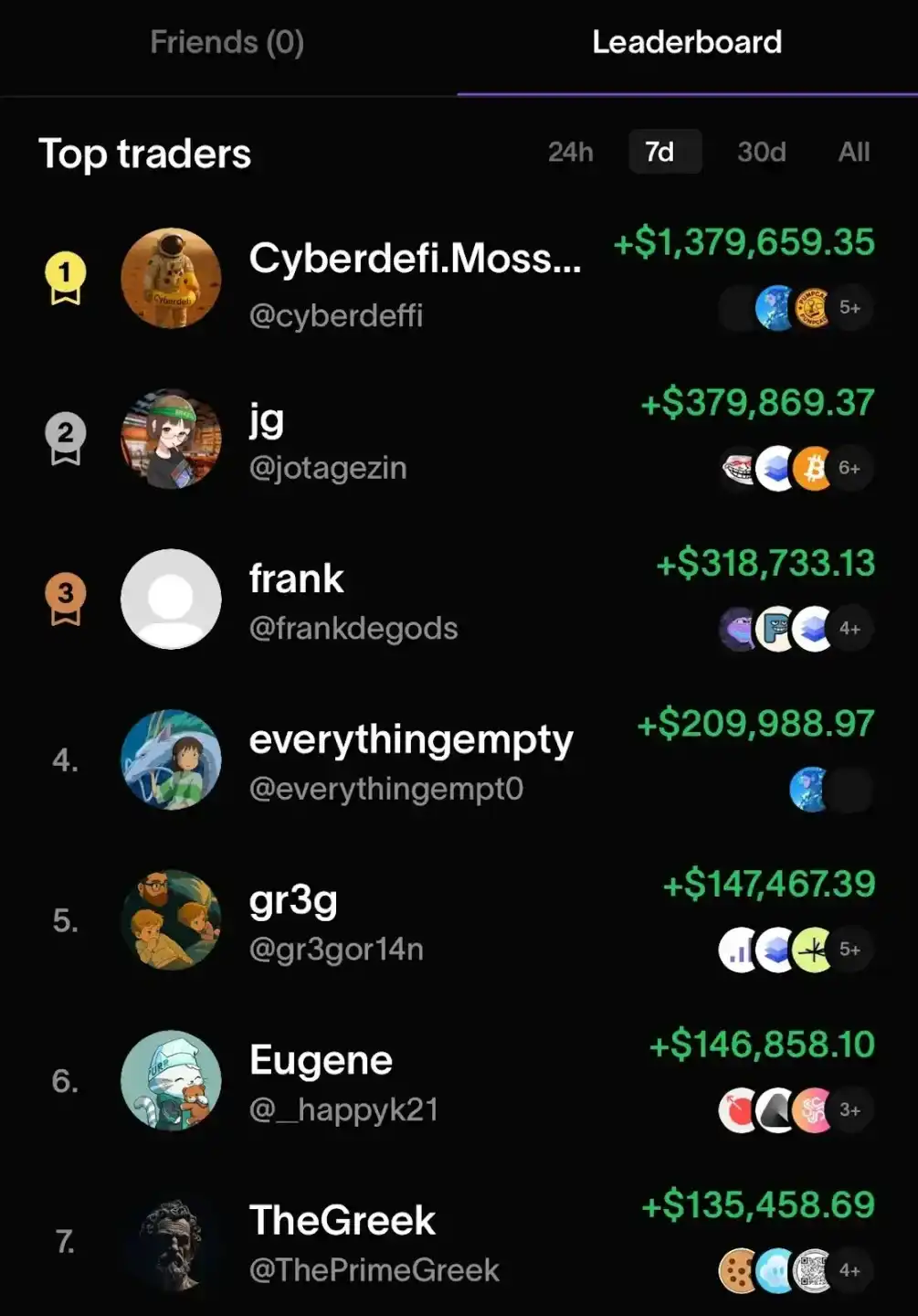
Fomo's leaderboard page

Social trading allows users to see others' trading behavior in real-time and copy it with one click. This significantly reduces decision-making friction: no independent research, just follow trusted trading strategies. Once a platform forms a stable community ecosystem—where users follow trading experts and build personal reputations—users become less likely to migrate to other platforms, creating a powerful competitive barrier and user stickiness for trading apps.

Centralized exchanges have offered copy trading since 2022, but usage rates have remained below 2%. Mobile app platforms are betting that optimizing the user experience will increase the adoption of this feature. Whether their judgment is correct will determine if social trading becomes a true differentiated competency or just another ordinary feature.

The Pessimistic View: Potential Risks and Controversies

Let's be frank about the current situation: the original intention of cryptocurrency was to achieve financial decentralization, remove intermediaries, and let users control their assets.

And now, we are rebuilding centralized platforms: Coinbase controls asset custody, trade execution, and social graphs; Robinhood holds the private keys for embedded wallets; users need to trust the platform's solvency, security, and ongoing operational capability. All this implies counterparty risk.

Robinhood's tokenized stocks are essentially derivatives tracking stock prices, not actual stocks. If the platform collapses, what users hold is merely an IOU.

Problems caused by gamification are also worsening: 24/7 trading means you might make impulsive trades at 3 AM; social feeds can induce FOMO when you see others profiting; push notifications alert you to every market fluctuation. This is essentially scaled casino psychology, meticulously optimized by designers who understand how to trigger dopamine responses.

Is this progress in financial democratization, or just a repackaged exploitative system? This is a philosophical question worth pondering.

The Essence Behind the Phenomenon

We spent a decade deconstructing financial services, operating under the assumption that fragmentation would foster competition and bring more choices.

But it turns out that fragmentation also caused inefficiencies: idle funds, dispersed liquidity, and users forced to hold more idle capital due to cumbersome fund transfer processes. The new era is changing this.

Coinbase and Robinhood are gradually becoming new types of banks: they hold your salary, savings, investments, and spending patterns; they control trade execution, asset custody, and access; they介入 (intervene in) every transaction. The only difference from traditional banks is: a more beautiful interface, 24/7 trading markets, and deposit rates 50 basis points higher.

Whether we are achieving financial democratization by lowering barriers and improving efficiency, or merely changing the gatekeepers while keeping the barriers themselves, the era of fragmentation is over. In the coming years, we will witness whether financial integration based on open underlying technology can yield better results than the traditional banks we once fled, or if it merely changes the logo that locks users in.


Trending Cryptos

Related Questions

QWhat are the three major structural changes that have enabled the emergence of integrated financial platforms?

AThe three major structural changes are: 1) Tokenization breaking down time barriers, allowing for 24/7 trading of assets like stocks. 2) A clearer regulatory framework, with approvals for Bitcoin ETFs, stablecoins, and prediction markets. 3) The maturation of mobile wallet infrastructure, enabling seamless cross-chain operations and simplified user experiences.

QAccording to the article, what was the core problem with the fragmented fintech landscape of the past decade?

AThe core problem was inefficiency and opportunity cost. Moving money between different apps for different asset classes (e.g., selling stocks to buy crypto) could take up to 5 days due to settlement times, bank transfers, and platform delays, causing users to miss out on time-sensitive investment opportunities.

QHow does the article describe the core competitive advantage of platforms like Coinbase and Robinhood in their new integrated model?

ATheir core competitive advantage is the consolidation of liquidity into a single account balance. This eliminates the friction of moving funds between apps, allows for instant reallocation of capital across asset classes, provides better execution speeds from deeper liquidity pools, and enables them to generate yield on idle capital like a bank.

QWhat role does 'social trading' play in the evolution of these financial super apps, as outlined in the text?

ASocial trading addresses the 'asset discovery' problem by allowing users to see what others are buying and to copy their trades. It reduces decision-making effort, builds community and user loyalty, and creates a powerful competitive moat for platforms that successfully implement it.

QWhat is the main philosophical concern or 'pessimistic perspective' raised about these new integrated platforms?

AThe concern is that these platforms are rebuilding centralized systems, contradicting crypto's original ethos of decentralization. Users must trust the platform's solvency, security, and ongoing operation, introducing counterparty risk. Furthermore, features like 24/7 trading, social feeds, and notifications are seen as gamification that exploits behavioral psychology, potentially creating a more efficient system for exploitation rather than true democratization.

Related Reads

The "Impossible Triad" Is Fundamentally a Pseudo-Problem

The article argues that blockchain's fundamental limitation is not the scalability trilemma (decentralization, scalability, security), which has been largely solved, but the lack of **privacy** and, until recently, clear **legitimacy**. Blockchain is described as a slow, expensive, globally shared computer whose core value is censorship resistance and verifiability. While ideal for native digital assets like money (e.g., stablecoins), its default transparency acts as a **tax**, exposing all transactions and enabling MEV extraction, which deters serious institutional capital. Simultaneously, its permissionless nature created regulatory ambiguity. The piece contends that **privacy** is the missing critical feature. It rejects the false choice between total transparency and complete anonymity. Modern cryptography (like zero-knowledge proofs) enables **compliant privacy**: users can prove facts (solvency, KYC status, compliance) without revealing the underlying sensitive data (specific holdings, identities). This preserves auditability for regulators and eliminates the leak of financial information. With recent regulatory progress (e.g., the GENIUS Act) addressing legitimacy, adding default, provably compliant privacy becomes a pure upgrade. It transforms blockchain from a costly, public ledger into a confidential settlement layer, finally bridging the gap to mainstream institutional and individual adoption of on-chain finance.

链捕手10h ago

The "Impossible Triad" Is Fundamentally a Pseudo-Problem

链捕手10h ago

Optical Chips: Collective Capacity Expansion

The global optical chip industry is experiencing a massive wave of expansion driven by surging AI data center demand. Major players across the US, Japan, Europe, and China are aggressively investing to ramp up production capacity. In the US, Coherent is expanding its 6-inch Indium Phosphide (InP) semiconductor fab in Texas, supported by CHIPS Act funding and a $2 billion strategic investment from NVIDIA. Lumentum is building a new factory for InP optical devices, and Nokia is scaling its advanced photonic chip packaging and testing capabilities. NVIDIA's investments aim to secure future supply of critical lasers and optical interconnect products for AI infrastructure. Japan's JX Advanced Metals, a leading InP substrate supplier, plans a multi-billion yen investment to increase its capacity 7-10 times, strengthening its grip on the crucial upstream materials market. In Europe, IQE and Tower Semiconductor settled a patent dispute and signed a multi-year InP epitaxial wafer supply agreement, highlighting that next-generation silicon photonics platforms will integrate high-performance InP components. STMicroelectronics and Sivers Semiconductors are also expanding silicon photonics production and partnerships. China is rapidly building out its domestic supply chain. Dongshan Precision's subsidiary, Source Photonics, announced a $12 billion project to expand optical chip and module production. Companies like Sanan Optoelectronics and Yunnan Germanium are scaling up InP chip manufacturing and substrate production, moving towards vertical integration from materials to modules. While debate continues around the exact future architecture—whether CPO (Co-Packaged Optics), NPO, or pluggables will dominate—analysts like Morgan Stanley argue the underlying driver is unchangeable: the explosive growth in bandwidth demand. This will inevitably increase the volume of optical engines, lasers, and related content per GPU, regardless of the final technical path. The competition for "more light" in the AI era has intensified into a global, full-chain capacity race.

marsbit12h ago

Optical Chips: Collective Capacity Expansion

marsbit12h ago

Stablecoins Finally Find Real Yield: An In-Depth Look at On-Chain Reinsurance Re | A Conversation with Re Founder Karan Saroya

Stablecoin Real Yield Found: A Deep Dive into On-Chain Reinsurance with Re's Karan Saroya As stablecoin supply exceeds $170 billion, the search for sustainable, non-speculative yield intensifies. Re, an on-chain reinsurance platform, provides an answer: connecting stablecoin capital to the trillion-dollar traditional reinsurance market. Re operates as a regulated reinsurer, accepting stablecoin deposits as collateral to back US insurance companies. These insurers pay premiums, generating yield that flows back to on-chain depositors. Currently supporting 35 insurers and underwriting $500 million, Re projects scaling to over $1 billion soon. Key insights from a Bankless podcast with founder Karan Saroya and investor Avichal of Electric Capital: 1. **Uncorrelated, Real-World Yield:** Re offers stablecoin holders access to reinsurance returns (targeting 12-14%+), an asset class entirely separate from crypto or equity markets. 2. **Operational Efficiency via Smart Contracts:** Re replaces traditional, labor-intensive capital fundraising with smart contracts, allowing a ~12-person team to compete with industry giants. 3. **Regulatory Leverage:** For every $1 of collateral, regulations allow backing $5-7 in written premiums. This leverage amplifies returns from the underlying risk-free rate. 4. **DeFi Integration:** Depositors receive receipt tokens, which can be used in protocols like Morpho for "looping," potentially pushing yields to 18-20%+. 5. **The "DeFi Mullet" Model:** A compliant front-end (regulated reinsurer) paired with a decentralized back-end (smart contracts, DeFi capital markets). 6. **RE Governance Token:** Modeled on Lloyd's of London, the token governs the central capital pool's allocation, counterparty acceptance, and parameters. 7. **Real Economic Impact:** Capital funds real-world productivity (factories, clinics, businesses) via insurance, moving beyond crypto's internal loops. The discussion highlights a pivotal moment: DeFi's supply-side infrastructure is now met by real demand for productive yield, potentially kickstarting a flywheel where vast on-chain stablecoin capital seeks these real-world returns.

链捕手13h ago

Stablecoins Finally Find Real Yield: An In-Depth Look at On-Chain Reinsurance Re | A Conversation with Re Founder Karan Saroya

链捕手13h ago

1996 or 1999? Walsh's First Test is 'How to View AI'

"1996 or 1999? Wall's First Big Test Is 'How to View AI'" Federal Reserve Chairman Wall's initial challenge is not whether to raise or cut rates, but a more fundamental judgment: what kind of boom is the current AI boom? This will determine the Fed's policy path and define his legacy. Economics is split between two opposing views, according to reporter Nick Timiraos. One sees imminent productivity gains that will increase supply and cool inflation, allowing the Fed to hold steady. The other argues that while productivity benefits are distant, demand shocks are here now, and waiting for data confirmation risks missing the intervention window, forcing sharper rate hikes later. Wall has signaled a leaning toward the first view, echoing 1996-era Alan Greenspan, who embraced strong, productivity-driven growth without fear of inflation. However, Wall faces a different macro environment than Greenspan did, with tariff pressures, expanding fiscal deficits, and diminishing globalization benefits, which could force more significant inflation pressures even if AI benefits materialize. Wall's logic, expressed before taking office, is that AI-driven productivity gains won't show in official data for years. If the Fed waits for confirmation, it might mistakenly tighten policy and choke off the very growth that could suppress inflation. This argues for using forward-looking narratives over lagging data. Chicago Fed President Austan Goolsbee presents a key counter-argument. He distinguishes between expected and unexpected productivity booms. A widely anticipated boom, like the current AI wave, can cause people to spend future wealth gains in advance, overheating the economy before productivity actually rises, thus requiring preemptive rate hikes. He cites rising costs for AI data centers as evidence of such overheating. Fed Governor Christopher Waller offers a rebuttal to Goolsbee, noting the "expected spending" mechanism only works if people can borrow against future income, which many households cannot do due to borrowing constraints. Wall also faces a paradox related to his desire to reduce the Fed's use of "forward guidance" (pre-announcing policy moves). This practice was established in 1999 when Greenspan began signaling hikes to avoid market shocks. If the economy follows a less optimistic path, Wall may be forced to choose between using the guidance he wants to abolish or risking market volatility by staying silent. The ultimate question defining Wall's first major test remains: Is this 1996 or 1999?

marsbit14h ago

1996 or 1999? Walsh's First Test is 'How to View AI'

marsbit14h ago

Trading

Spot
Futures

Hot Articles

How to Buy SUPER

Welcome to HTX.com! We've made purchasing SuperFarm (SUPER) simple and convenient. Follow our step-by-step guide to embark on your crypto journey.Step 1: Create Your HTX AccountUse your email or phone number to sign up for a free account on HTX. Experience a hassle-free registration journey and unlock all features.Get My AccountStep 2: Go to Buy Crypto and Choose Your Payment MethodCredit/Debit Card: Use your Visa or Mastercard to buy SuperFarm (SUPER) instantly.Balance: Use funds from your HTX account balance to trade seamlessly.Third Parties: We've added popular payment methods such as Google Pay and Apple Pay to enhance convenience.P2P: Trade directly with other users on HTX.Over-the-Counter (OTC): We offer tailor-made services and competitive exchange rates for traders.Step 3: Store Your SuperFarm (SUPER)After purchasing your SuperFarm (SUPER), store it in your HTX account. Alternatively, you can send it elsewhere via blockchain transfer or use it to trade other cryptocurrencies.Step 4: Trade SuperFarm (SUPER)Easily trade SuperFarm (SUPER) on HTX's spot market. Simply access your account, select your trading pair, execute your trades, and monitor in real-time. We offer a user-friendly experience for both beginners and seasoned traders.

5.3k Total ViewsPublished 2024.03.29Updated 2026.06.02

How to Buy SUPER

Discussions

Welcome to the HTX Community. Here, you can stay informed about the latest platform developments and gain access to professional market insights. Users' opinions on the price of SUPER (SUPER) are presented below.

活动图片