Tether may tokenize equity to ensure liquidity for investors: Report

cointelegraphPublished on 2025-12-12Last updated on 2025-12-12

Abstract

Tether, the issuer of USDT, is reportedly considering tokenizing equity and share buybacks to provide liquidity for investors as it aims for a $500 billion valuation. The company halted a shareholder’s attempt to sell a $1 billion stake, which would have valued Tether at $280 billion. Instead, Tether plans to offer liquidity solutions through tokenization or buybacks after closing a funding round aimed at raising $20 billion for a 3% stake. Tokenized equity enhances liquidity by enabling easier transfers, fractional ownership, and use as collateral in DeFi. The move aligns with growing regulatory support for onchain finance, including the SEC’s recent approval for DTCC to tokenize traditional assets like stocks and bonds.

Tether, the stablecoin company that issues the USDt (USDT) dollar-pegged token, is considering tokenizing investor equity and share buybacks to offer liquidity for investors as it seeks a $500 billion valuation.

Bloomberg reported on Friday, citing a source familiar with the matter, that Tether recently stopped an existing shareholder from selling their stake as the company is in talks to raise $20 billion for a 3% stake in the stablecoin's issuer business.

The investor sought to sell a $1 billion stake that valued Tether at $280 billion, Bloomberg reported. In response, Tether plans to offer investor liquidity through tokenization or share buybacks after the funding round closes.

Cointelegraph reached out to Tether but had not received a response by the time of publication.

Tokenizing a company’s equity can increase liquidity by making shares easier to transfer, fractionalize and borrow against. Onchain equity allows holders to maintain their positions while using a tokenized representation of their equity as collateral in decentralized finance (DeFi) applications.
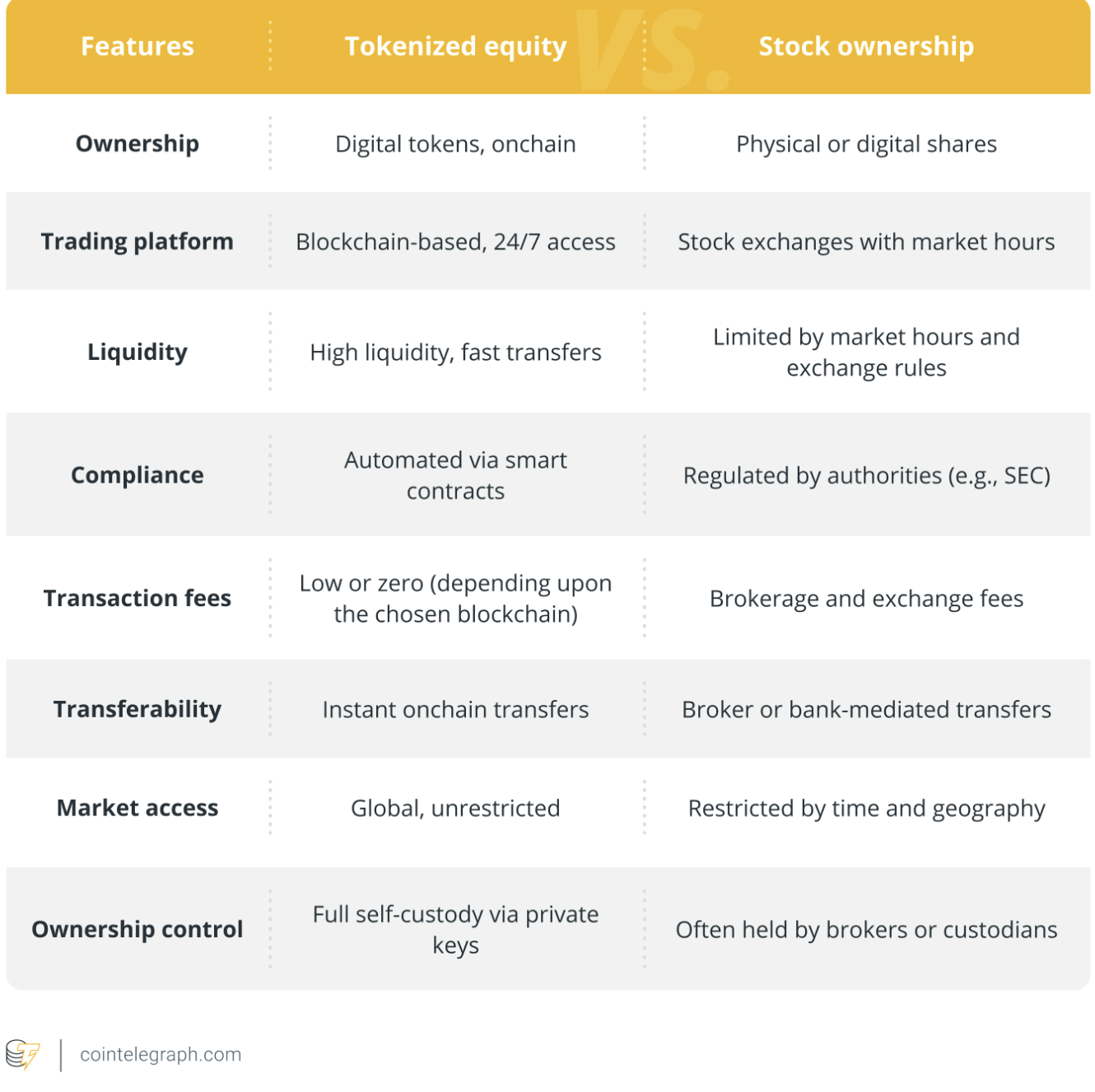
The differences between tokenized equity and shares issued through the traditional financial system. Source: Cointelegraph

Related: Tether solvency fears are ‘misplaced’ as company sits on large surplus: CoinShares

Tokenized finance is gaining steam as US regulators move to overhaul legacy financial tech

On Thursday, the US Securities and Exchange Commission (SEC) gave the green light to the Depository Trust and Clearing Corporation (DTCC), a clearinghouse and settlement company, to tokenize stocks, exchange-traded funds and bonds.

“US financial markets are poised to move onchain,” SEC Chair Paul Atkins said on Thursday, adding, “Onchain markets will bring greater predictability, transparency, and efficiency for investors.”

Source: Paul Atkins

Financial services company J.P. Morgan facilitated a $50 million tokenized bond issue for crypto investment company Galaxy Digital Holdings on the same day as Atkins’ announcement.

Crypto exchanges are also looking to expand trading of tokenized products, following the SEC’s nod to the DTCC and Atkins’ comments.

Coinbase, a US-based cryptocurrency exchange, is expected to announce its expansion into tokenized stocks and prediction markets as early as Wednesday.

The company told Cointelegraph that it will host a livestream to showcase new products, but did not specify which products would be unveiled.

Tokenized public stocks are still in the early stages of adoption, with nearly $700 million in public equities tokenized at the time of this writing, according to RWA.xyz data.

Magazine: Bitcoin whale Metaplanet ‘underwater’ but eyeing more BTC: Asia Express
Related Reads

Moutai Moment: When Liquidity Dries Up, Everyone Huddles Around HYPE and ZEC

In May 2026, a notable sentiment shift is occurring in the crypto market, symbolized by prominent Ethereum advocate David Hoffman selling his remaining ETH. While major assets like ETH and SOL struggle—ETH is down over 50% from its 2025 high—two assets, HYPE and ZEC, are rallying strongly. This divergence mirrors the "core asset crowding" phenomenon seen in traditional markets during liquidity crunches, where capital concentrates in few perceived safe havens. The market faces liquidity pressure, partly due to Bitcoin ETF outflows and stalled narratives for major Layer 1s. In contrast, Hyperliquid (HYPE) attracts capital due to its strong fundamentals as a leading decentralized perp exchange with substantial protocol revenue and a share of USDC reserve yields. Its tokenomics, heavily favoring users, add to its appeal. Meanwhile, Zcash (ZEC) surges as a "privacy beta" play, driven by growing fears over AI-driven deanonymization and quantum computing threats. Endorsements from figures like Arthur Hayes and Multicoin Capital's Tushar Jain, alongside regulatory clarity and ETF expectations, fuel its rise. This crowding poses risks. Similar to the A股白酒 rally that ended when liquidity returned, the current crypto crowding could unravel if macro conditions improve or if positions become too concentrated, leading to a sharp correction. The article concludes by questioning whether investors hold assets out of conviction or inertia and prompts consideration of what the next crowded trade might be.

marsbit10m ago

Moutai Moment: When Liquidity Dries Up, Everyone Huddles Around HYPE and ZEC

marsbit10m ago

Trading

Spot
Futures

Hot Articles

Discussions

Welcome to the HTX Community. Here, you can stay informed about the latest platform developments and gain access to professional market insights. Users' opinions on the price of MAY (MAY) are presented below.

活动图片