Teen Accused Of $13M Crypto Scam That Funded Miami Luxury

bitcoinistPublished on 2026-06-12Last updated on 2026-06-12

Abstract

A Canadian teenager, Trenton Richard David Johnston, is accused of running a cryptocurrency fraud scheme from the Miami area, allegedly causing over $13 million in losses. The 19-year-old and unnamed co-conspirators are charged with posing as support representatives from a major search engine and crypto companies to gain access to victims' digital accounts and crypto wallets. He was indicted on charges of conspiracy to commit wire fraud and money laundering. Prosecutors allege that Johnston, along with co-defendant Brandon Michael Tardibone, laundered more than $1 million of the illicit funds to finance luxury vehicles, high-end jewelry, and an extravagant nightlife. Tardibone is additionally charged with harboring Johnston, who had overstayed his visa. Both defendants face up to 20 years in prison if convicted. The case is being prosecuted by the U.S. Attorney's Office for the Southern District of Florida.

A Canadian teenager accused of running a multimillion-dollar crypto fraud operation from the Miami area has become the latest young defendant tied to a high-value social-engineering theft case in the US Prosecutors say the scheme caused more than $13 million in losses and helped finance luxury vehicles, jewelry and nightlife spending.

The case centers on Trenton Richard David Johnston, a Canadian national who was 19 when federal prosecutors in the Southern District of Florida announced the indictment on May 11. According to the US Attorney’s Office, Johnston had overstayed his visa and remained in the US unlawfully while allegedly operating a fraud scheme that targeted victims’ digital accounts and crypto wallets.

Federal prosecutors said Johnston and unnamed co-conspirators posed as support representatives from a major search engine and crypto-related companies. The alleged objective was familiar but effective: convince victims that their accounts were at risk or already compromised, obtain access to the accounts, and move the assets before the victims could respond.

The DOJ framed the core allegation bluntly, saying Johnston and others “allegedly impersonated support representatives from a popular search engine and cryptocurrency-related companies.” The agency also cautioned: “An indictment/complaint is merely an allegation. All defendants are presumed innocent until proven guilty beyond a reasonable doubt in a court of law.”

Johnston was charged with conspiracy to commit wire fraud and conspiracy to commit money laundering. A later docket entry listed a plea agreement as to Johnston filed on June 9, indicating the case has already moved beyond the initial indictment stage for at least one defendant.

Crypto Scam: Luxury Spending Becomes Part Of The Case

The alleged theft was not described as a simple wallet-drain operation. Prosecutors also accused Johnston and Brandon Michael Tardibone, 28, of Miami, of laundering proceeds through financial transactions designed to conceal the nature and source of the funds.

According to the DOJ, Johnston and Tardibone allegedly used more than $1 million in illicit proceeds to lease luxury vehicles, buy high-end jewelry and finance what prosecutors called an “extravagant nightlife and entertainment lifestyle.” That spending trail is central to the government’s theory: the alleged crypto theft did not just move across wallets, but into visible luxury assets and services.

Tardibone was separately accused of knowingly harboring Johnston while Johnston was unlawfully present in the US Prosecutors said Tardibone provided lodging at a luxury Miami-area residence in an effort to help Johnston evade immigration authorities. He was charged with conspiracy to commit money laundering and harboring an alien in the United States.

The case is being investigated by HSI Miami, with assistance from the Federal Deposit Insurance Corporation Office of Inspector General, IRS Criminal Investigation, US Customs and Border Protection, and the Golden Beach Police Department. Assistant US Attorneys Jackson K. Dering V and Robert F. Moore are prosecuting the matter.

If convicted on the original charges, Johnston faced up to 20 years in prison on the wire fraud conspiracy and money laundering conspiracy counts. Tardibone also faces up to 20 years on the money laundering conspiracy charge and up to 10 years on the harboring charge.

At press time, the total crypto market cap stood at $2.14 trillion.
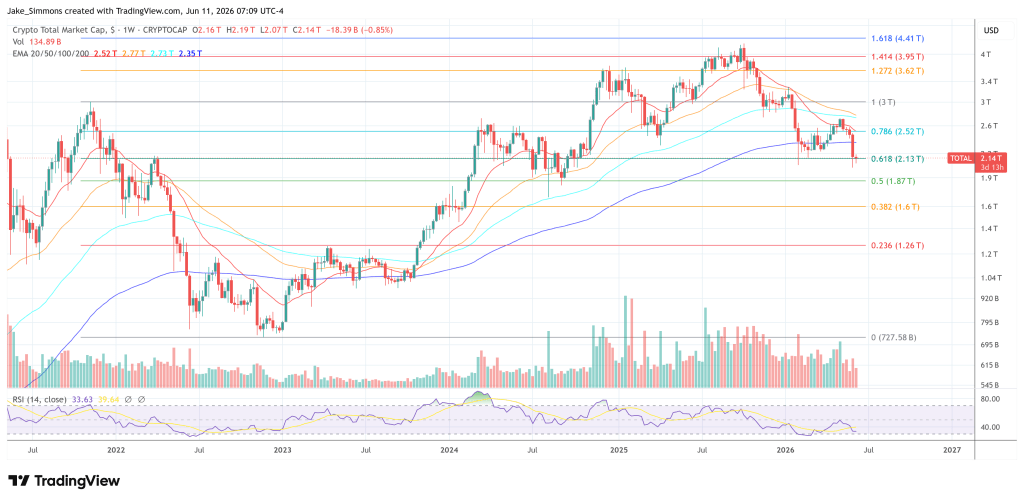
Total crypto market cap must stay above the 0.618 Fib, 1-month chart | Source: TOTAL on TradingView.com

Related Questions

QWhat is the core allegation against Trenton Richard David Johnston according to the US Department of Justice?

AAccording to the DOJ, Johnston and others allegedly impersonated support representatives from a popular search engine and cryptocurrency-related companies to convince victims their accounts were compromised, gain access, and steal assets.

QHow did the defendants allegedly use the proceeds from the crypto scam?

AThey allegedly used over $1 million in illicit proceeds to lease luxury vehicles, buy high-end jewelry, and finance an extravagant nightlife and entertainment lifestyle.

QWhat charges was Brandon Michael Tardibone facing in connection to this case?

ABrandon Michael Tardibone was charged with conspiracy to commit money laundering and harboring an alien (Johnston) in the United States.

QWhat was the status of Johnston's legal case as indicated by a docket entry mentioned in the article?

AA docket entry listed a plea agreement for Johnston filed on June 9, indicating the case had moved beyond the initial indictment stage for at least one defendant.

QWhat agencies were involved in investigating this crypto fraud case?

AThe case was investigated by HSI Miami, with assistance from the Federal Deposit Insurance Corporation Office of Inspector General, IRS Criminal Investigation, U.S. Customs and Border Protection, and the Golden Beach Police Department.

Related Reads

In Jinjiang, Fujian, a Storage Super Unicorn Lies Quiet

In Fujian's Jinjiang, a city known for sportswear, lies a quiet semiconductor giant: Fujian Jinhua Integrated Circuit Co. (JHICC). Once a promising domestic DRAM manufacturer alongside Yangtze Memory and ChangXin Memory Technologies (CXMT), its journey was derailed in 2018 when the U.S. placed it on an Entity List and filed criminal charges for alleged trade secret theft. This halted production for years. A turning point came in February 2024 when a U.S. federal court found JHICC not guilty. However, it had lost crucial time. While CXMT soared to become a top-valued A-share company in 2024, JHICC, with an estimated valuation of 80 billion RMB, was just restarting. Its current output is primarily customized DDR4 chips, not the advanced DDR5/HBM demanded for AI, but it still benefits from the broader memory chip upcycle. JHICC's story is tied to Chen Zhengkun, a veteran engineer who left Micron to lead the venture. Founded in 2016 with state-backed funding, JHICC partnered with Taiwan's UMC to develop DRAM technology. Rapid progress was cut short by the U.S. actions, which Micron initiated, partly due to its heavy reliance on the Chinese market. Post-sanctions, Chen's team worked to rebuild the production line with reduced reliance on U.S. technology. According to its records, JHICC achieved small-scale production and revenue growth under immense pressure. It now focuses on the stable "niche" DRAM market (e.g., TVs, routers) with a monthly capacity of ~40,000 wafers, aiming for 60,000 by 2026. It holds over 1,000 patents but remains on the Entity List. For Jinjiang, investing in JHICC was a bold industrial leap. The local government provided unwavering financial and logistical support during the crisis, helping the company survive. JHICC has become the anchor for a growing local semiconductor cluster. Though its scale lags behind domestic peers, JHICC's persistence symbolizes a hard-won foothold in a global market long dominated by Samsung, SK Hynix, and Micron. Having missed one boom, it seeks a place in the new AI-driven memory supercycle.

marsbit3m ago

In Jinjiang, Fujian, a Storage Super Unicorn Lies Quiet

marsbit3m ago

Must-Watch Events Next Week|CLARITY Act Could Face Senate Vote; SpaceX, Circle to Report Earnings (8.3-8.9)

**Summary: Key Events and Developments to Watch (August 3-9)** The upcoming week is marked by significant financial disclosures, key legislative deadlines, and notable product updates. **Major Financial Events:** Several companies are scheduled to release their Q2 2026 earnings. American Bitcoin (ABTC) will report on August 3, followed by SpaceX and Hut 8 Mining Corp. on August 4, and Circle on August 5. Notably, a significant portion of SpaceX shares (up to 12% of total shares) will be unlocked on August 6 following their earnings release. **Key Legislative Deadline:** The U.S. Senate faces an August 7 deadline to secure 60 votes for the CLARITY Act, a bipartisan bill aiming to establish a federal regulatory framework for cryptocurrencies. The Senate may hold a full vote on the bill during the week. **Economic Data:** The U.S. July Non-Farm Payrolls report will be released on August 7, providing crucial labor market data. **Technology & Product Updates:** * **Shutdowns:** DeFi portfolio tracker Zapper and wallet app Ctrl Wallet will cease operations on August 3. * **Upgrades:** LayerZero will deprecate its v1 relayers on August 3. XRP Ledger's new version 3.3.0, featuring five new functions, is expected next week. * **AI:** Elon Musk announced that the advanced Grok 4.6 AI model is set for release around August 7. * **Bitcoin:** The BIP-110 forced signaling for a potential Bitcoin network change is scheduled to begin around August 8. **Other Notable Events:** Chinese robotics firm Unitree Tech has set its preliminary price inquiry for its IPO for August 5. South Korean exchange Upbit will delist AQT and AERGO tokens on August 3.

marsbit2h ago

Must-Watch Events Next Week|CLARITY Act Could Face Senate Vote; SpaceX, Circle to Report Earnings (8.3-8.9)

marsbit2h ago

Trading

Spot
活动图片