# Venture Capital Related Articles

HTX News Center provides the latest articles and in-depth analysis on "Venture Capital", covering market trends, project updates, tech developments, and regulatory policies in the crypto industry.

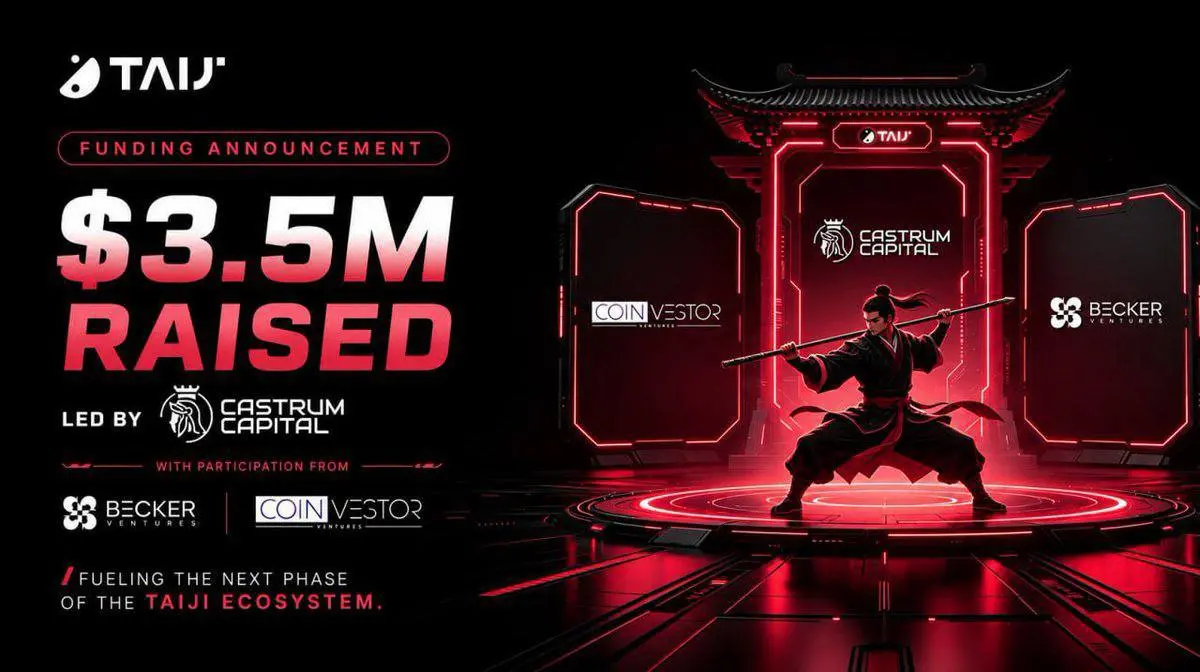
TaiJi Secures $3.5 Million Strategic Funding with Participation from Castrum Capital, Becker Ventures, and Coinvestor Ventures

TaiJi Secures $3.5 Million Strategic Funding TaiJi has announced the completion of a $3.5 million strategic funding round, with participation from Castrum Capital, Becker Ventures, and Coinvestor Ventures. The investment will support product development, upgrades to its AI inference engine, the construction of a multi-agent analysis system, improvements to market data infrastructure, global community expansion, and the advancement of ecosystem partnerships. Operating within the BSC ecosystem, TaiJi is building an AI-driven on-chain market intelligence network. The platform integrates market data, on-chain fund flows, liquidity changes, social media sentiment, news events, and project developments into a unified AI inference system. This approach aims to transform fragmented information into structured event inferences, impact pathways, risk assessments, and follow-up indicators, helping users navigate the increasingly complex and event-driven Web3 market. Unlike traditional market tools, TaiJi is constructing an intelligent analysis framework. It continuously aggregates real-time data to form a native market data network and builds a dataset of post-event market reactions for review. A core component is its multi-agent inference framework, where specialized agents—for markets, on-chain activity, sentiment, risk, and events—collaborate to analyze signals and generate insights. The first phase of TaiJi's product will focus on several key modules: Market Intelligence for real-time data aggregation; a Scenario Engine for AI-driven event inference; an Impact Map visualizing effects on assets and narratives; Risk Signals for identifying potential threats; and My TaiJi for personalized tracking and historical analysis. With this new funding, TaiJi plans to accelerate product development and testing, gradually rolling out its core features while expanding its presence within the BSC ecosystem and the broader global Web3 market.

链捕手06/02 09:26

TaiJi Secures $3.5 Million Strategic Funding with Participation from Castrum Capital, Becker Ventures, and Coinvestor Ventures

链捕手06/02 09:26

The Wind of 'Proactive' AI Blows into Silicon Valley: Hark Secures $700 Million in Funding

Hark, an AI startup founded in late 2025, has raised $700 million in Series A funding at a $6 billion valuation. Led by Parkway Venture Capital with participation from NVIDIA, AMD Ventures, Intel Capital, Qualcomm Ventures, and Salesforce Ventures, the company aims to develop next-generation human-computer interfaces using a combination of proprietary foundational models and custom-built AI-native hardware. Founded by serial entrepreneur Brett Adcock, Hark envisions a system of multimodal devices equipped with agentic capabilities, end-to-end voice models, and personalized memory. This "active" AI approach seeks to move beyond passive chatbots, creating collaborative companions that anticipate needs and interact naturally within the real world. Adcock's experience with Figure, a humanoid robotics company, informs this hardware-focused venture. The article argues that while current AI is powerful, it remains confined to screens and traditional interfaces like chat. The next paradigm shift requires dedicated hardware that is always-on, possesses persistent memory, and enables intuitive interaction, potentially rivaling the impact of the iPhone. Hark is assembling a team with talent from Apple, Meta, Google, and Tesla to tackle this complex engineering challenge across models, hardware, and interaction design. Finally, the piece suggests Chinese startups may have an advantage in this "active" AI hardware space due to strong manufacturing ecosystems, a vast domestic market, and supportive government policies, framing the competition as one that requires integrated progress in models, operating systems, and devices.

marsbit05/28 10:22

The Wind of 'Proactive' AI Blows into Silicon Valley: Hark Secures $700 Million in Funding

marsbit05/28 10:22

Morning Brief | Deloitte Acquires Crypto Infrastructure Firm Blocknative; Stablecoin Firm Checker Raises $8M; a16z Likely Becomes Largest External Holder of HYPE

ChainCatcher Daily Update - May 21st Major headlines include Deloitte's acquisition of crypto infrastructure firm Blocknative, signaling further traditional finance adoption. In funding news, stablecoin infrastructure company Checker secured $8 million, while decentralized derivatives platform Variational raised $50 million in a Series A round led by Dragonfly Capital. Significant corporate moves saw Tether acquire SoftBank's entire stake in Twenty One Capital (XXI), and Mastercard pivot its strategy by investing in BVNK for stablecoin payments after abandoning Zerohash. VC giant Andreessen Horowitz (a16z) is reported to be a major external holder of HYPE, with positions exceeding $356 million. On the institutional front, MicroStrategy's CEO noted that 13 of its top 15 institutional shareholders increased their $MSTR holdings in Q1 2026, with aggregate positions growing 27%. Meanwhile, the parent company of the NYSE, ICE, announced plans to launch a futures market for AI computing power ("hashrate"). The report also features a "Meme Hot List" ranking trending tokens on Ethereum, Solana, and Base networks, and highlights several key articles. These include an analysis of renowned investor Duan Yongping's first crypto investment in Circle, concerns over talent drain and institutional selling pressure at the Ethereum Foundation, the growing business of crypto asset recovery, and an examination of the trillion-dollar potential and remaining hurdles for the tokenized asset market.

链捕手05/21 01:32

Morning Brief | Deloitte Acquires Crypto Infrastructure Firm Blocknative; Stablecoin Firm Checker Raises $8M; a16z Likely Becomes Largest External Holder of HYPE

链捕手05/21 01:32

Review of Over 30 Humanoid Robot Companies: Who Will Prevail in 2026?

This article provides an overview of the rapidly expanding humanoid robot industry, highlighting over 30 key companies and predicting which might succeed by 2026. Key companies discussed include Tesla (Optimus), which leverages its AI and manufacturing scale; Figure AI, the fastest-growing and highest-valued startup at $39B; Boston Dynamics, with 30+ years of expertise; Agility Robotics, the first to achieve commercial deployment (Digit in logistics); and Unitree Robotics, offering the most affordable humanoid (G1 at $16,000). Other notable firms mentioned are Apptronik (Apollo, focused on ROI), 1X Technologies (home-use NEO), Sanctuary AI (Phoenix with advanced hydraulic hands), and UBTech Robotics (a major commercial player). Companies from China, like Xiaomi, AgiBot, and Fourier Intelligence, are also prominent. The industry is driven by trends including price disruption (robots under $20K), AI breakthroughs in vision-language-action models, massive production scaling (Tesla targeting 1M units/year), and Robot-as-a-Service (RaaS) models. Investment is substantial, with billions from backers like NVIDIA, Jeff Bezos, Microsoft, and Amazon. The market, valued at $2.9B in 2025, is projected to reach $4-18B by 2030. The conclusion states that no single company yet dominates, with the next 2-3 years being critical for transitioning from prototypes to viable commercial products.

marsbit05/20 01:31

Review of Over 30 Humanoid Robot Companies: Who Will Prevail in 2026?

marsbit05/20 01:31

Agents Capital Markets: How Will Autonomous Agents Get Funded?

"Agents Capital Markets: How Autonomous Agents Will Raise Capital" Within a decade, specialized capital markets will emerge for AI Agents—software entities with legal personhood that perform work, earn revenue, and need capital. Unlike today's AI companies (like Sierra or Harvey) backed by traditional VC, these future *Agent companies* will be autonomous, legally-recognized entities (e.g., Wyoming memberless LLCs) that directly own assets, sign contracts, and incur liabilities. The driving forces are fourfold: 1) **Overwhelming economics** (Agent companies can deliver services at 85-90% lower cost than human firms); 2) **Proven demand** (current Agent operators already generate billions in revenue); 3) **Existing legal frameworks** enabling algorithmically-managed companies; and 4) **Massive, yield-seeking capital pools** (e.g., private credit) looking for new, uncorrelated assets. Agent capital markets won't rely on one model but a multi-layered "stack" matching different growth stages: 1) VC equity for early human-led builders; 2) Programmatic working capital advances (like Stripe Capital); 3) Revenue-based financing (RBF); 4) Slate financing (pooled funds for many Agents, similar to Hollywood); and 5) Tokenization as a secondary settlement layer, not a primary funding source. The ultimate shift is from funding constrained by human decision-makers to capital flowing algorithmically based on an Agent's auditable performance, contract book, and cash flows. This transition will be enabled by standardized infrastructure—rating methodologies, contracts, indices—turning Agents from software experiments into a foundational, financeable sector of the economy. The constraints are loosening; the opportunity is here.

链捕手05/19 05:15

Agents Capital Markets: How Will Autonomous Agents Get Funded?

链捕手05/19 05:15

A Decade's Bet on Cerebras: How the 'Wafer-Scale AI Chip' Reached NASDAQ

"Cerebras, a pioneering AI chip company, successfully debuted on NASDAQ (CBRS) on May 14, 2026, with its stock price surging approximately 68% on the first day. This marks a significant milestone following a decade-long journey, as recounted by early investor Steve Vassallo. The story begins not in 2016, but with the deep, 19-year relationship between Vassallo and founder Andrew Feldman, which started with Feldman’s previous company, SeaMicro (acquired by AMD in 2012). In 2016, Feldman and a core team of chip and system experts sought to challenge the emerging consensus. At a time when AI’s practical utility was still debated and GPUs were becoming the default hardware, they envisioned a fundamentally new computer architecture purpose-built for AI workloads. They identified memory bandwidth, not raw compute power, as the critical bottleneck for neural networks. Defying industry inertia, Cerebras pursued a radical, wafer-scale chip design—58 times larger than the biggest existing chips. This meant confronting and solving a cascade of unprecedented engineering challenges: power delivery, thermal management, and maintaining electrical continuity across tens of thousands of connections. It required reinventing nearly every aspect of modern computing—semiconductors, systems, data structures, software, and algorithms. The path was fraught with setbacks, including a prototype that caught fire on its first power-up. Progress was marked by intense, iterative problem-solving, with the board meeting every 6-8 weeks to tackle the latest technical frontier. Through disciplined perseverance and deep trust within the team, they achieved a breakthrough in August 2019 when their first wafer-scale computer successfully operated. Feldman’s drive for a 1000x leap, his formative upbringing among intellectual giants who modeled both brilliance and kindness, and his belief in building a loyal, mission-driven team were central to Cerebras’s culture. His competitive strategy was that of David vs. Goliath—finding innovative, human-centric approaches that larger incumbents would overlook. From the symbolic delivery of the first term sheet over a backyard fence in 2016 to the NASDAQ bell ringing in 2026, Cerebras’s journey is a testament to long-term vision, technical audacity, and the power of foundational founder-investor relationships. It stands as a reminder that the computing revolution can come not just from more GPUs, but from a complete reimagining of the architecture itself."

marsbit05/15 03:55

A Decade's Bet on Cerebras: How the 'Wafer-Scale AI Chip' Reached NASDAQ

marsbit05/15 03:55

a16z, The Biggest Donor Behind the US Midterm Elections

Theodore Schleifer reports for The York Times that the venture capital firm Andreessen Horowitz (a16z), along with its founders Marc Andreessen and Ben Horowitz, has become the single largest donor in the current U.S. midterm election cycle, contributing over $115 million in political funds. This massive expenditure, far exceeding the $63 million from the 2024 cycle, marks a significant shift in political funding from individual billionaires to corporate entities. A16z’s strategy involves long-term political engagement. Immediately after the 2024 election, it injected over $23 million into key crypto-focused Super PACs. Its funding is now channeled through a bipartisan network supporting its core business interests: $47.5 million to the crypto Super PAC Fairshake and $50 million to Leading the Future, a new Super PAC promoting pro-artificial intelligence candidates. The firm and its founders have also donated $12 million to a pro-Trump Super PAC. This political push is closely tied to a16z's commercial stakes in crypto and AI and reflects founders’ evolving political views, particularly Andreessen’s shift toward conservative circles. His access has grown, including an advisory role during Trump’s transition and a seat on a White House tech council. The firm’s activism has sparked internal dissent and external backlash. Critics, including progressive Democrats and some Republicans, argue it represents an attempt to buy political influence. In response, a rival "Public First" Super PAC, dubbed "z16a," has formed to counter a16z’s spending on AI policy. Despite the controversy, a16z frames its involvement as essential for fostering a pro-innovation policy environment.

marsbit05/14 03:30

a16z, The Biggest Donor Behind the US Midterm Elections

marsbit05/14 03:30

Tian Yuandong Announces Startup Venture After Leaving Meta

After leaving Meta, Tian Yuan Dong has announced his new venture. The startup Recursive_SI has officially launched with a list of founders including Tian Yuan Dong. The founding team also comprises Richard Socher (CEO), Tim Rocktäschel, Jeff Clune, Tim Shi, Caiming Xiong, and Alexey Dosovitskiy, among others. These members have experience building AI research labs at companies like Salesforce and Uber, and have held leadership roles at OpenAI, DeepMind, Google Brain, and Meta. Recursive_SI aims to develop artificial intelligence capable of conducting experiments autonomously and safely improving itself through an open-ended, automated scientific discovery process. This is seen as a promising path toward superintelligence. The company has raised $650 million at a valuation of $4.65 billion, led by GV (Google Ventures) and Greycroft, with significant investments from AMD Ventures and NVIDIA. The team has grown to over 25 members, including new additions like Zhuge Mingchen. Zhuge, a Founding Member, holds a Ph.D. in Computer Science from KAUST under Professor Jürgen Schmidhuber. His research focuses on Coding Agents, Recursive Self-Improvement (RSI), and next-generation machine paradigms, with contributions including early RSI systems like GPTSwarm and work on agentic AI frameworks. The founders shared their vision on X: building AI that can automatically discover knowledge and recursively self-improve, fundamentally changing the way science and technology advance. The team is recognized as a leader in core areas of recursive self-improving AI, with past breakthroughs in open-ended algorithms, AI-generated algorithms, automated testing, world models, Vision Transformers, RAG, and AI scientists. There is high anticipation for Recursive_SI's future research.

marsbit05/14 00:26

Tian Yuandong Announces Startup Venture After Leaving Meta

marsbit05/14 00:26

活动图片