# Oracle Related Articles

HTX News Center provides the latest articles and in-depth analysis on "Oracle", covering market trends, project updates, tech developments, and regulatory policies in the crypto industry.

Who Defines the "Facts"? The Truth About Power and the Potential for Malice in Polymarket's Resolution Mechanism

Polymarket, a prediction market platform, faces renewed criticism over fairness following its intervention in a market regarding a potential U.S. invasion of Venezuela. On January 4, Polymarket issued a clarification stating that the U.S. operation to capture Venezuelan President Maduro did not qualify as an "invasion," causing a sharp drop in the value of "YES" shares for the event occurring by January 31 and impacting user profits. This is not the first such incident. The article explains Polymarket’s resolution mechanism, which relies on the oracle protocol UMA. Each prediction market has predefined rules, but Polymarket can issue additional clarifications for unforeseen events, as in this case. The resolution process requires a whitelisted address to propose an outcome with a security deposit. If unchallenged, it is accepted. If disputed, a debate and UMA token holder vote occur, with unbalanced incentives favoring the challenger to ensure proposal quality. The core issues are ambiguity in rule interpretation and the centralization of power. Rules are inherently interpretable, and platform neutrality is complicated by its U.S. base and geopolitical biases. Furthermore, the UMA voting mechanism, though economically incentivized, remains vulnerable to manipulation by large token holders, as seen in a past incident where a $7 million market was inaccurately resolved. Ultimately, users are not betting on real-world outcomes but on how rules will be interpreted and enforced.

Odaily星球日报01/08 03:55

Who Defines the "Facts"? The Truth About Power and the Potential for Malice in Polymarket's Resolution Mechanism

Odaily星球日报01/08 03:55

TRON ECO Ecosystem's 2025 Breakthroughs: Deepening DeFi Application Value, Meme Ecosystem Successive Explosions, and Forward-Looking AI Track Layout

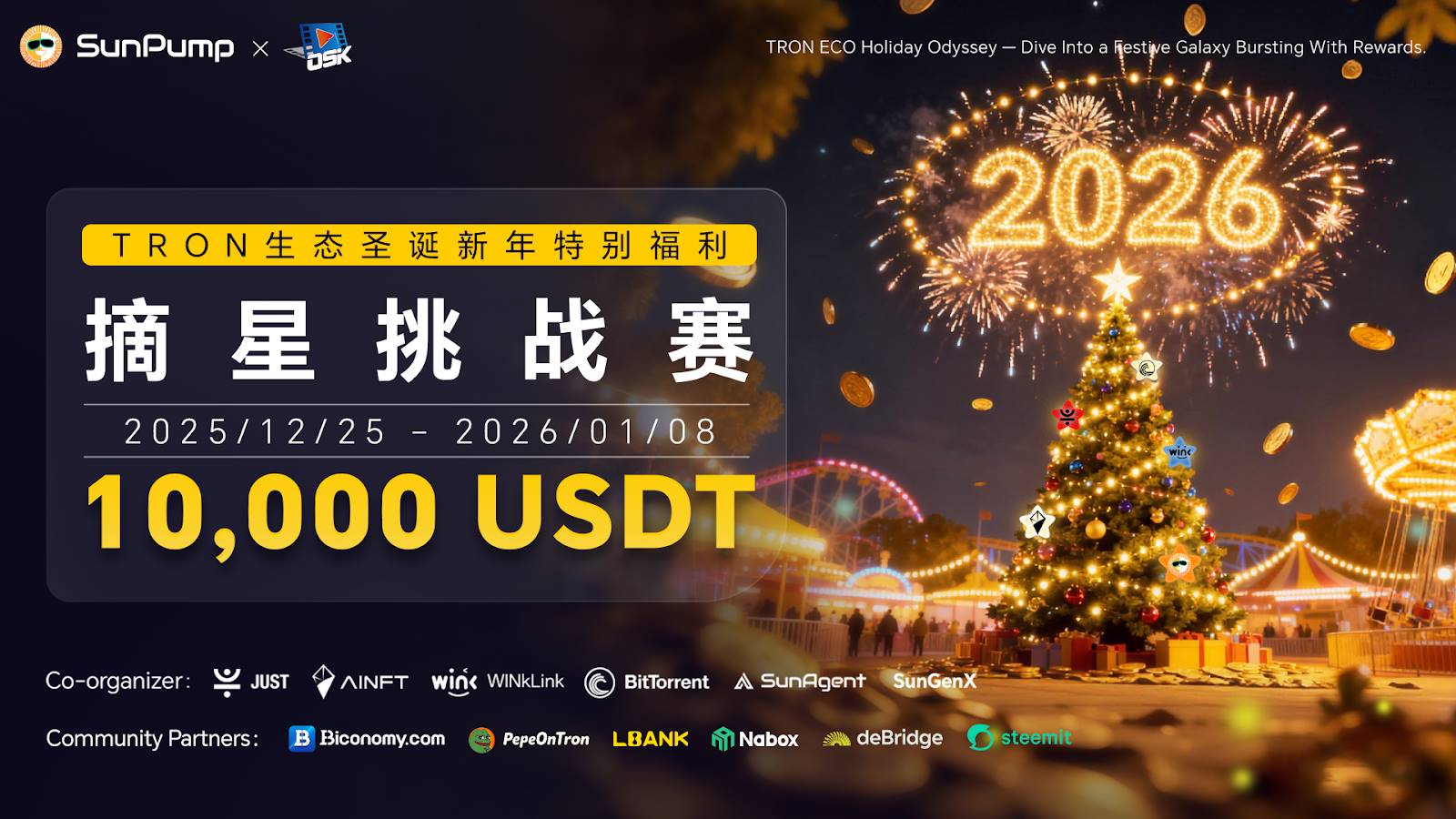
In 2025, TRON achieved significant breakthroughs, solidifying its role as a global financial infrastructure. Its on-chain USDT circulation surpassed $80 billion, and it gained recognition as an official U.S. GDP release blockchain. The DeFi ecosystem, with a TVL exceeding $4.4 billion, saw major upgrades: JustLend DAO evolved into a comprehensive financial hub, introduced GasFree transactions, and executed a $59 million JST buyback; SUN.io expanded its product suite, including the derivatives platform SunX; BTTC enhanced cross-chain efficiency with its 2.0 upgrade; and WINkLink provided reliable oracle services. The Meme ecosystem, driven by SunPump, experienced explosive growth, with over 100,000 tokens created. It facilitated low-barrier token launches, partnered with exchanges like Binance, and integrated deeply with DeFi protocols to enhance liquidity and user engagement. TRON also advanced in AI integration: AINFT transitioned from an NFT platform to an AI infrastructure, focusing on AI Agent deployment and model training, while SunAgent enabled users to perform on-chain operations via natural language commands. Together, DeFi, Meme, and AI form a synergistic ecosystem—DeFi provides value stability, Meme drives user adoption, and AI fosters innovation—positioning TRON for continued leadership in the evolving Web3 landscape.

Odaily星球日报01/01 08:58

TRON ECO Ecosystem's 2025 Breakthroughs: Deepening DeFi Application Value, Meme Ecosystem Successive Explosions, and Forward-Looking AI Track Layout

Odaily星球日报01/01 08:58

Gambling or Cognitive Monetization? Deconstructing the Smart Money Path and Eleven Arbitrage Strategies in Prediction Markets

The article "Gambling or Cognitive Monetization? Deconstructing the Smart Money Path and Eleven Arbitrage Strategies in Prediction Markets" explores the rise of prediction markets as a high-potential sector in crypto, expected to surge around the 2026 FIFA World Cup. Unlike traditional crypto trading, prediction markets focus on probability-based outcomes rather than price speculation, attracting "smart money" through sophisticated strategies. Key data shows platforms like Polymarket and Kalshi have seen trading volumes spike 3-7x during recent market downturns, though the total market size remains early-stage at ~$385 billion—far below major exchanges but with trillion-dollar potential by 2030. Eleven arbitrage strategies are detailed: 1. **Math Arbitrage**: Exploiting pricing imbalances (e.g., YES + NO < 1). 2. **Cross-Platform Hedging**: Capitalizing on odds discrepancies across markets. 3. **High-Probability "Bonds"**: Betting on near-certain outcomes for small, steady returns. 4. **Initial Liquidity Sniping**: Scripts grab low-priced shares at market creation. 5. **AI Probability Modeling**: Using AI to identify mispriced events. 6. **AI Information Gaps**: Leveraging speed advantages in news digestion. 7. **Correlated Markets**: Profiting from delayed reactions in related events. 8. **Automated Market Making**: Earning fees via liquidity provision. 9. **Whale Tracking**: Copying high-success addresses. 10. **Exclusive Research**: Monetizing private or grassroots data (e.g., election insights). 11. **Oracle Manipulation**: Exploiting UMA’s optimistic oracle flaws—though upgrades aim to fix this. Prediction markets thrive by offering a "truth machine" for the information age: they aggregate collective wisdom via monetary stakes, convert expertise into profit, and lower entry barriers with simple binary options. However, risks include short market cycles, low liquidity in niche events, manipulation, and regulatory uncertainty. The core remains a math-driven battlefield where cognitive edge—not just capital—wins.

marsbit12/29 08:16

Gambling or Cognitive Monetization? Deconstructing the Smart Money Path and Eleven Arbitrage Strategies in Prediction Markets

marsbit12/29 08:16

Prediction Markets = Market Manipulation? The Failure of Collective Wisdom and the Battle for Settlement Rights

This article examines the controversial nature of prediction markets, particularly Polymarket, through three case studies, arguing that they are vulnerable to manipulation, groupthink, and battles over settlement authority, rather than being pure expressions of collective wisdom. Case 1: "Who will HBO identify as Satoshi?" Despite leaked evidence and media reports confirming the documentary would identify Peter Todd, the price for "Len Sassaman" remained high due to the community's emotional preference for a more narratively satisfying outcome. This demonstrates how narrative and emotion can cause market prices to deviate from factual evidence. Case 2: "How many gifts will Santa deliver?" Traders discovered a hardcoded number in the NORAD website's source code and drove the price of that outcome above 90%. However, this turned the market into a bet on whether the developers would change the number before the deadline, highlighting how centralized control of information sources creates exploitable opportunities. Case 3: "Israel strikes Gaza" contract. In the final hours, a coordinated effort using unverified screenshots and sell orders crashed the price of "No" to 1-2%, creating a false narrative of an attack. The contract was controversially settled as "Yes," showcasing how narrative, capital, and control over the settlement process can be weaponized to manipulate outcomes. The analysis concludes that prediction markets are not neutral but are instead arenas where media narratives, platform rule design, social media influence, and technical exploitation (e.g., finding hardcoded values) can be leveraged to manipulate prices and settlements, often benefiting organized, resource-rich players at the expense of the crowd.

marsbit12/23 05:06

Prediction Markets = Market Manipulation? The Failure of Collective Wisdom and the Battle for Settlement Rights

marsbit12/23 05:06

活动图片