# OpenClaw Related Articles

HTX News Center provides the latest articles and in-depth analysis on "OpenClaw", covering market trends, project updates, tech developments, and regulatory policies in the crypto industry.

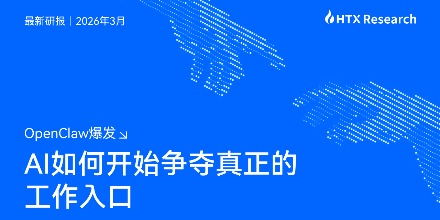
HTX Research Latest Report Deciphers OpenClaw: The Battle for Execution Entry and Huobi HTX's AI Strategic Path

HTX Research, the analytical arm of Huobi HTX, has released a report titled "From the Rise of OpenClaw: How AI Begins to Compete for the True Work Interface." The report analyzes the emerging trend of AI evolving from a conversational tool into an execution layer, using the rapid growth of the open-source project OpenClaw as a key example. OpenClaw is a personal AI assistant that operates on a user's local device. It receives tasks through messaging platforms like WhatsApp, Telegram, Slack, and others, and can execute actions by integrating with files, browsers, calendars, email, and terminals. This signifies a major shift: AI is moving beyond answering questions to actively performing tasks, competing for the "execution interface" of the digital age. The report identifies five converging trends enabling this shift: sufficient model capability for multi-step tasks, the high frequency of messaging apps as a natural interface, open-source distribution, self-hosted models addressing data privacy, and a strong market need for small teams to achieve more with fewer resources. It highlights a particular fit in the Chinese market, where many small and medium teams operate on message-driven platforms like WeCom and Feishu. Some Chinese cities have already begun offering support policies to foster an OpenClaw ecosystem. However, the report also outlines three major hurdles for such tools to become reliable infrastructure: security risks (noting recent malware incidents), the need for robust governance and auditing, and the necessity for industry-specific templates to move beyond early adopters. Complementing this analysis, the report details Huobi HTX's own AI strategy. Rather than building an execution layer, HTX is focusing on becoming a "platform service entrance and ecosystem connector." Its proprietary AINFT product aggregates major AI models (OpenAI, Anthropic, Google) into a single access point for users, with crypto-native features like TronLink wallet sign-ins and a pay-as-you-go model instead of subscriptions. HTX's competitive strategy is differentiated by its focus on integrating AI directly into its trading platform. Its "HTX AI Skills" currently cover spot and futures trading execution, with plans to expand into market analysis, intelligence, and a built-in assistant, aiming to create a closed loop for user experience. In conclusion, while the move of AI into the execution layer is still in its early stages with significant challenges ahead, the direction is clear. The next phase of AI competition will extend beyond model performance to encompass control of interfaces, permission governance, and skill ecosystems. Huobi HTX's early布局 in this area presents a notable case study for how crypto platforms can integrate AI as a core, operational asset.

marsbit03/24 06:21
HTX Research Latest Report Deciphers OpenClaw: The Battle for Execution Entry and Huobi HTX's AI Strategic Path

marsbit03/24 06:21

WEEX Labs: The Lobster Craze, What Can Agentic Economy Bring to Web3?

WEEX Labs: The Rise of OpenClaw and What Agentic Economy Brings to Web3 NVIDIA CEO Jensen Huang recently praised OpenClaw as the "largest, most popular, and most successful open-source project in human history." This AI agent, developed by a former Apple engineer, gained 320,000 GitHub stars in just three months, surpassing Linux and React. Its logo resembles a lobster claw, hence the nickname "Lobster" in Chinese communities. Unlike traditional AI chatbots like ChatGPT or Claude, which primarily respond to queries, OpenClaw represents a shift towards autonomous execution. It can take over operating systems, autonomously use browsers, code executors, APIs, and iMessage, planning and performing tasks until completion. Its official skill marketplace, ClawHub, already offers over 27,000 skills, expanding its capabilities. This development signals the beginning of the Agentic Economy, where AI evolves from conversational tools to proactive doers. Web3 is identified as the ideal ecosystem for this growth due to its native compatibility with autonomous, code-driven interactions. Key integrations include: - The x402 protocol enabling autonomous payments and model switching. - ERC-8004 providing portable reputation and identity. - ClawPay, ClawCredit, and ClawRouter facilitating private payments, native credit, and routing. - Stablecoins like USDT and USDC serving as 24/7 banking for agents. Notable projects leveraging this synergy include KITE (a PoAI L1 blockchain for agents), Pieverse (enabling gasless on-chain transactions via messaging apps), and GoPlus Security’s SafuSkill (a security-focused skills marketplace). Meme tokens like "Lobster" have also emerged, capitalizing on the trend. The article concludes that OpenClaw’s rise marks a new phase—Agentic Era—where AI agents can perform 24/7 transactions, collaboration, and entrepreneurship, driving new DeFi narratives and on-chain activity.

marsbit03/18 10:34

WEEX Labs: The Lobster Craze, What Can Agentic Economy Bring to Web3?

marsbit03/18 10:34

Is Your "OpenClaw" Running Naked? CertiK Test: How Vulnerable OpenClaw Skill Bypasses Audits, Takes Over Computers Without Authorization

OpenClaw, a popular open-source, self-hosted AI agent platform, has experienced rapid growth due to its flexibility and extensibility. Its ecosystem relies heavily on third-party “Skills” from the Clawhub marketplace, which can perform high-risk operations like system automation and crypto wallet transactions. However, security firm CertiK has identified critical vulnerabilities in the platform’s security model. CertiK’s research reveals that OpenClaw’s current security—primarily dependent on pre-publishing scans like VirusTotal, static code analysis, and AI logic checks—is fundamentally flawed. These measures can be easily bypassed through simple code obfuscation, and malicious Skills can be published even before scanning is complete. In a proof-of-concept, CertiK developed a seemingly benign Skill that contained a hidden remote code execution vulnerability. It passed all checks without warnings and, once installed, allowed full system control via a remote command. The core issue is not a specific bug but a industry-wide misconception: over-reliance on scanning instead of runtime isolation. Unlike systems like iOS, which enforce strict sandboxing, OpenClaw’s sandbox is optional and often disabled for functionality, leaving systems exposed. CertiK recommends that OpenClaw enforce mandatory sandboxing and granular permission controls for Skills. Users are advised to deploy OpenClaw on isolated devices and avoid exposing sensitive data or assets until stronger isolation is implemented. The report stresses that security must evolve from detection-based approaches to default containment of risks at runtime.

marsbit03/17 14:39

Is Your "OpenClaw" Running Naked? CertiK Test: How Vulnerable OpenClaw Skill Bypasses Audits, Takes Over Computers Without Authorization

marsbit03/17 14:39

Earning $100,000 in 10 Days: An Interview with OpenClaw's Practical Experience in Prediction Markets

In an interview with Odaily Planet Daily, Kevin, a former ERP architect and Web3 investor, shares how he used OpenClaw to generate a profit of approximately $100,000 in just 10 days, turning a $30,000 investment into over $130,000 at its peak (currently around $112,000). Kevin began his crypto journey during the "inscription summer" of 2023, earning his first significant returns from ORDI. He later transitioned to prediction markets, specifically Polymarket, in mid-2025, attracted by its improved liquidity and user experience. Initially, he used self-developed algorithmic strategies for arbitrage, primarily in sports betting markets, doubling a $100,000 investment over several months. Since integrating OpenClaw in late February, Kevin adopted a hybrid approach: 60% of his strategy remains automated arbitrage, while 40% uses OpenClaw for predictive betting. OpenClaw helps gather and analyze factors like smart money movements, public sentiment, team lineups, and player conditions—even identifying new influencing variables. It also automates backtesting, strategy discovery, and execution, making it effective in Polymarket due to its AI-friendly API. While currently focused on sports markets with limited automated capital ($1,000 per test account), Kevin plans to expand into other domains and may later offer paid OpenClaw "Skills" based on his methodology.

Odaily星球日报03/16 06:25

Earning $100,000 in 10 Days: An Interview with OpenClaw's Practical Experience in Prediction Markets

Odaily星球日报03/16 06:25

活动图片