# Microsoft Related Articles

HTX News Center provides the latest articles and in-depth analysis on "Microsoft", covering market trends, project updates, tech developments, and regulatory policies in the crypto industry.

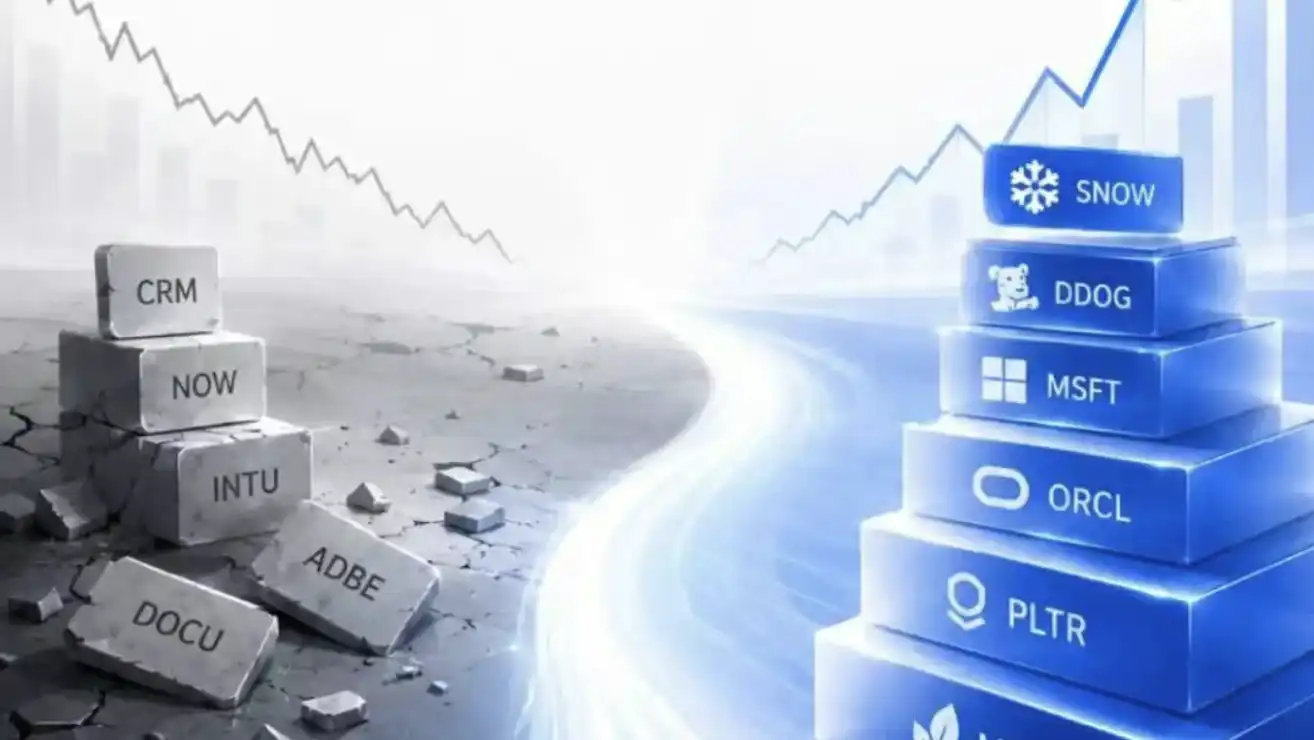
SaaS Battle Royale: The Survivors Who Win All Share One Common Trait

**Summary** The AI revolution has triggered a "SaaS apocalypse," forcing a brutal market shakeout. The key dividing line is the pricing model. Companies like Snowflake and Datadog, which charge based on consumption (e.g., data processed or compute used), are thriving. AI workloads actively *generate* more demand for their services, fueling growth. Datadog's accelerating revenue is a prime example. Microsoft and Palantir, as platform/ecosystem players, also benefit by acting as essential channels for AI deployment. In contrast, traditional SaaS firms built on per-seat or per-task licensing (e.g., Intuit, Adobe) face direct pressure, as AI threatens to automate the very human tasks their software supports. Companies like Salesforce, a per-seat giant, are caught in the middle. While showing strong AI monetization (e.g., its Agentforce platform) and experimenting with consumption-based "Flex Credits," its stock remains under pressure, illustrating that the market rewards *completed* transitions, not just the intent. The recent Microsoft Build conference underscored key trends: AI is evolving from an assistant to an autonomous "agent," and platform providers like Microsoft are consolidating their control. The market's recovery is highly selective, focused on identifying which companies are "fed by AI" versus "eaten by AI." Future focus will be on the diffusion of this recovery to transforming companies and the real-world adoption data of AI agents like Microsoft Copilot.

marsbit06/03 02:02

SaaS Battle Royale: The Survivors Who Win All Share One Common Trait

marsbit06/03 02:02

Microsoft Halts Vibe Coding: "Burning Tokens" Is Now More Expensive Than Employees

Microsoft has halted the widespread internal use of Claude Code, withdrawing licenses from most employees by the end of its fiscal year, June 30, 2026. This reversal comes just six months after actively promoting the AI coding tool to boost productivity via "vibe coding"—where developers describe intent in natural language and let the LLM generate code. The core issue isn't the tool's effectiveness; internal reports suggest employees preferred Claude Code over Microsoft's own Copilot CLI. The problem is financial: the "copilot mode" adds a variable, consumption-based token cost on top of existing employee salaries without a proportional revenue increase. As usage grew, the token bills became unsustainable, leading to what sources describe as a cost-structure failure. Similar overruns have been reported at other firms like Uber. The article contrasts this with the approach of AI-native startups, exemplified by Y Combinator's philosophy. Here, high token consumption is strategic—it replaces, rather than supplements, human labor. Startups operate with tiny teams where AI agents handle work previously done by many, making the high token bill financially viable as it offsets much larger personnel costs. The conclusion is that "vibe coding" isn't dead, but its economics fail within traditional corporate structures that treat AI as a productivity add-on for existing staff. Success requires a foundational shift to an AI-native organization, where processes are built to be "legible to AI," and the company's core knowledge and assets reside in documented, AI-accessible systems rather than solely in employees' minds. The future divide will be between companies that merely add AI tools and those that redesign their organizations around them.

marsbit05/26 08:51

Microsoft Halts Vibe Coding: "Burning Tokens" Is Now More Expensive Than Employees

marsbit05/26 08:51

Has Microsoft Lost Its Way in the AI Race, and Can Copilot Bring It Back on Track?

Microsoft, once seen as an early AI frontrunner due to its investment in OpenAI, is navigating a strategic shift amid increased competition. Its initial reliance on OpenAI’s GPT models has been complicated by OpenAI’s growing ambitions as a direct competitor, rapid advancements from rivals like Claude and Gemini, and the disruptive rise of AI agents, which challenge its traditional SaaS business model. These factors contributed to stock declines and slower-than-expected adoption of its flagship Copilot products. In response, CEO Satya Nadella has taken a hands-on role in product development, signaling the urgency of change. Microsoft is pivoting from a model-centric strategy to a "model-agnostic" enterprise platform approach. It aims to become the foundational layer connecting various AI models—from OpenAI, Anthropic, or its own new "Superintelligence" team—with enterprise workflows, data, security, and cloud services. Recent organizational changes merged consumer and enterprise Copilot teams to accelerate innovation, exemplified by new products like Copilot Tasks and Copilot Cowork. However, this transformation comes at a high cost. Microsoft faces massive capital expenditures, potentially reaching ~$190 billion by 2026, to support AI infrastructure. While its platform strategy shows early signs of traction with growing Azure AI revenue, it must balance startup-like agility with the reliability expected by enterprise clients. The core challenge is no longer being the sole AI winner but defending its position as the essential enterprise software entry point amidst rapid technological commoditization and the shift towards always-on AI agents.

marsbit05/23 04:37

Has Microsoft Lost Its Way in the AI Race, and Can Copilot Bring It Back on Track?

marsbit05/23 04:37

GitHub Empire on the Brink of Collapse: Source Code Leak, 18-Year Veteran Leaves, Microsoft Loses 1.5 Billion Developers

GitHub is facing an unprecedented crisis, marked by a massive exodus of developers and severe operational failures. The tipping point came when Mitchell Hashimoto, creator of Ghostty and an 18-year GitHub user, publicly severed ties, citing persistent platform outages that made serious work impossible. This departure highlights a broader pattern of user frustration. The platform's instability has drawn complaints from major corporate clients like Citibank and Intel, forcing Microsoft to issue substantial service credits. A critical incident last month saw an accidentally triggered, unreleased feature cause widespread repository rollbacks, erasing recent code changes and pushing enterprises to migrate. Security has catastrophically breached. In May 2026, hackers infiltrated over 3,800 of GitHub's internal repositories via a poisoned VS Code extension installed by a developer, leading to the attempted sale of core source code for $50,000. This follows the discovery of a critical zero-day vulnerability in March that threatened access to millions of repositories. Internally, GitHub's autonomy has collapsed. After the resignation of CEO Thomas Dohmke in mid-2025, Microsoft eliminated the CEO role, folding GitHub into its CoreAI division under the unpopular leadership of Jay Parikh. This triggered a talent drain, with key executives and engineers leaving. A disruptive migration of GitHub's infrastructure to Azure servers, pushed by CTO Vladimir Fedorov, is blamed for the recurring outages. Competitively, GitHub Copilot is under "existential threat" from superior AI coding tools like Cursor (now owned by SpaceX) and Claude Code, which offer more advanced contextual coding and automation. Ironically, Microsoft's own engineers reportedly preferred Claude Code, forcing management to revoke licenses. Financially, GitHub is a loss leader. Despite Copilot surpassing 4.7 million paid users and $3 billion in annual revenue, the AI inference costs for free services massively outstrip subscription income, hurting Microsoft's cloud margins. The recent shift from a flat fee to a pay-as-you-go model for Copilot has further alienated developers. The core question for Microsoft is whether a centralized code repository remains essential in the AI agent era. The erosion of trust, developer culture, and platform reliability threatens the very ecosystem Microsoft spent decades building.

marsbit05/22 10:52

GitHub Empire on the Brink of Collapse: Source Code Leak, 18-Year Veteran Leaves, Microsoft Loses 1.5 Billion Developers

marsbit05/22 10:52

Cloud PC Gets a Second Chance, Google/Alibaba/Microsoft Battle for Cloud AI Dominance

Google unexpectedly announced "Android Computer," a new high-end productivity-focused PC series, positioning cloud AI as its core rather than an add-on. This move signals a potential revival for the "cloud computer" concept in the AI era. The article argues that current "AI PCs" are essentially traditional Windows machines with AI features grafted on, heavily reliant on cloud AI for complex tasks due to limited local consumer-grade hardware capabilities. This reliance raises questions about the value of premium local AI hardware. Cloud computers, which struggled with latency-sensitive applications like cloud gaming, are seen as a natural fit for AI PCs due to AI's higher tolerance for response time. Google's Android Computer deeply integrates AI (powered by its Gemini model) into the OS interface, making it contextually available. Its hardware-agnostic approach (supporting both x86 and ARM chips) further underscores the shift towards cloud-centric AI. Other players are adapting: Cloud service providers like Alibaba are enhancing their AI cloud computer offerings; chipmakers (Intel, AMD) are focusing on data center AI chips; traditional PC brands are adding AI software layers; and Apple is leveraging its ecosystem and affordable hardware. Microsoft is defining AI PC standards, embedding Copilot (powered by GPT and Bing) into Windows, and also relying on cloud AI. In conclusion, Android Computer challenges the traditional PC form factor by proposing a "light local, heavy cloud" model. This approach appears promising amid rising hardware costs and local compute bottlenecks. The future PC market will involve a multifaceted competition around cloud integration, OS-level AI, and cross-device ecosystems, potentially redefining the PC as a screen and network conduit to cloud-based AI productivity.

marsbit05/18 02:05

Cloud PC Gets a Second Chance, Google/Alibaba/Microsoft Battle for Cloud AI Dominance

marsbit05/18 02:05

Is Elon Musk Actually the Victim?

"Victim or Vindicator? Inside the OpenAI Trial That Shattered the Myth." In May 2026, the federal court in Oakland became the stage for deconstructing the carefully curated narrative of OpenAI. The trial revealed a complex reality far removed from its founding ideals. The core dispute centered on whether OpenAI, founded in 2015 as a non-profit dedicated to benefiting "all of humanity," had betrayed its mission by shifting towards a lucrative commercial structure, particularly after its 2019 capped-profit affiliate (OpenAI LP) was established and Microsoft invested $13 billion. Elon Musk, a co-founder and early funder, sued, claiming the organization was "stolen" and turned into a de facto Microsoft subsidiary for private gain. OpenAI countered that Musk's funds were unconditional donations and his lawsuit was driven by a desire for control and regret after leaving to found his own AI venture, xAI. The trial exposed early fractures. Evidence from 2017, years before ChatGPT's success, showed the founders were already grappling with the immense financial demands of pursuing Artificial General Intelligence (AGI). Musk himself had proposed having Tesla fund OpenAI. The court scrutinized whether the founders knowingly crossed a moral line. Greg Brockman's personal diary, entered as evidence, contained entries about wealth goals and anxieties over the company's revenue path, alongside self-reminders about the moral bankruptcy of "stealing" the non-profit. Brockman later testified his OpenAI stake was worth nearly $30 billion. The character of CEO Sam Altman was a key battleground. Musk's legal team cited five individuals, including co-founder Ilya Sutskever and former board members, who had described Altman as dishonest. This highlighted a recurring "trust debt" within OpenAI's leadership, exemplified by the chaotic 2023 boardroom coup and subsequent reinstatement. Altman defended his position, arguing Musk sought to absorb OpenAI into Tesla and that commercial success amplified OpenAI's charitable impact. Testimony from Microsoft CEO Satya Nadella underscored how commercial realities now dominated. While framing Microsoft's massive investment as a way to enlarge the non-profit's funding "pie," texts revealed Nadella pressuring Altman to launch ChatGPT's paid version quickly. Nadella also revealed that during the 2023 crisis, Microsoft was prepared to hire Altman and his team, showcasing the board's diminished power against the gravity of capital, talent, and infrastructure. Ultimately, the trial depicted OpenAI not as a singular act of betrayal but as a gradual, systemic transformation. Its grand AGI mission required a "heavier machine" to sustain it—a machine of computing power (largely from Microsoft), capital, and commercial obligations that inevitably reshaped its priorities. The non-profit board, tasked with guarding the mission, found itself unable to control the commercial juggernaut it had enabled. For the public, the proceedings served as a sobering window into the making of a foundational technology. The AI tools increasingly integrated into daily life—from writing and coding to customer service—are not born from a transparent, purely altruistic process. They emerge from a tangled web of personal ambitions, private negotiations, control struggles, and cloud computing bills. The trial's legacy is the stark realization that as AI becomes societal infrastructure, its steering wheel remains in very few, and very human, hands.

marsbit05/15 09:06
Is Elon Musk Actually the Victim?

marsbit05/15 09:06

Google and Microsoft Battle in the AI PC Arena: Is Local Computing Power an IQ Tax? Is the Cloud PC the Ultimate Form?

Google and Microsoft are competing in the AI PC arena, with the article questioning whether powerful local AI hardware is necessary. It argues that current "AI PCs" often rely heavily on cloud AI for complex tasks, making premium local AI silicon potentially less critical. Google recently unveiled "Android PCs," a new high-end productivity-focused product line. Unlike traditional AI PCs that add AI features to existing Windows systems, Android PCs position cloud-based AI, specifically Google's Gemini, as their core. The system deeply integrates AI, allowing context-aware assistance directly where the user is working, regardless of the underlying device hardware (x86 or ARM). The piece suggests that cloud computing might be the future for AI PCs. Unlike cloud gaming, which demands ultra-low latency, AI tasks are more tolerant of network delays, as users already expect some processing time. This makes the cloud-computing model well-suited for AI. Examples like Alibaba's "Wuying AI Cloud Computer" show how cloud services can offer robust AI capabilities without requiring powerful local hardware. This shift challenges the traditional PC model. With rising memory costs and limitations in consumer-grade local AI performance, the "light local, heavy cloud" approach offers an alternative. It could lead to devices that primarily need a good display and network connection, with heavy AI lifting done remotely. However, the transition is just beginning. Traditional players like Microsoft are pushing both local AI standards (e.g., 40+ TOPS NPU requirements) and deeply integrating cloud AI (Copilot with GPT) into Windows. Apple leverages its tight ecosystem and has found success with more affordable MacBooks, potentially positioning it well for AI integration later. Chipmakers like Intel and AMD, while promoting local AI, also benefit massively from supplying data centers for the cloud AI infrastructure. The conclusion is that AI is redefining the PC. The future battle will involve cloud integration, OS-level AI, and cross-device ecosystems. While questions about network reliability, data privacy, and user adaptation remain, the era of the AI cloud computer seems to be on the horizon.

marsbit05/15 06:35

Google and Microsoft Battle in the AI PC Arena: Is Local Computing Power an IQ Tax? Is the Cloud PC the Ultimate Form?

marsbit05/15 06:35

活动图片