# Decentralization Related Articles

HTX News Center provides the latest articles and in-depth analysis on "Decentralization", covering market trends, project updates, tech developments, and regulatory policies in the crypto industry.

From 'Global Computer/Settlement Layer' to 'Bulletin Board': What Are Ethereum and Vitalik Trying to Achieve?

In a significant shift of perspective, Vitalik Buterin recently proposed that Ethereum's core value may not lie in its function as a "world computer" or "global settlement layer," but rather as a simple yet powerful primitive: a cryptographically secure, globally shared "public bulletin board." This concept emphasizes data availability—a neutral, uncensorable, and permanent data layer where anyone can read and write information, but no single entity (including governments or developers) can alter or erase it. This "global shared memory" supports applications like secure voting systems, certificate revocation lists, and decentralized coordination—scenarios that require verifiable and tamper-proof data publishing rather than complex on-chain execution. The emergence of AI further validates this direction. As AI agents and services grow, so does the need for privacy-preserving and trustless interactions. Proposals like ZK API Usage Credits illustrate how Ethereum can enable anonymous AI model access and agent-to-agent economic coordination, relying precisely on the blockchain’s transparent and immutable data layer. Rather than a step back, this reframing represents a maturation of Ethereum’s vision—from defining what it can do to serving as essential infrastructure for what the world truly needs: a foundational layer of truth in an increasingly automated and opaque digital era.

marsbit03/22 07:06

From 'Global Computer/Settlement Layer' to 'Bulletin Board': What Are Ethereum and Vitalik Trying to Achieve?

marsbit03/22 07:06

VIP Believers in the Crypto Winter: Billions Evaporated, Why Do They Still Hold On?

Amid a brutal crypto winter that wiped out trillions in market value, a core group of believers remains steadfast. This Vanity Fair article explores the "VIP faithful" who continue to buy and hold despite catastrophic crashes, regulatory crackdowns, and industry scandals. Key figures like Galaxy Digital's Michael Novogratz, ARK Invest's Cathie Wood, and early investors like Meltem Demirors are portrayed not as mere speculators, but as participants in what they describe as a "religious movement." The piece traces crypto's evolution from its ideological origins in the 2008 Bitcoin whitetimepaper—a response to centralized financial system failures—to its mainstream adoption and subsequent commodification. The article highlights the deep internal rift between two groups: the original "believers" who champion decentralization and individual sovereignty, and the "grifters" and "tourists" who joined during boom cycles, turning crypto into a casino. It details the rise of NFTs through platforms like OpenSea, the catastrophic collapses of Terra/Luna and FTX, and the intense regulatory witch hunt led by the SEC under Gary Gensler. Ultimately, the narrative questions whether crypto's inevitable march into the mainstream—evidenced by political lobbying, institutional adoption, and even a Trump meme coin—represents a betrayal of its founding ideals or the ultimate validation of its success. Through booms, busts, and regulatory battles, the true believers stand firm,坚守信仰 (holding faith) in the face of the enduring crypto winter.

Odaily星球日报03/18 09:16

VIP Believers in the Crypto Winter: Billions Evaporated, Why Do They Still Hold On?

Odaily星球日报03/18 09:16

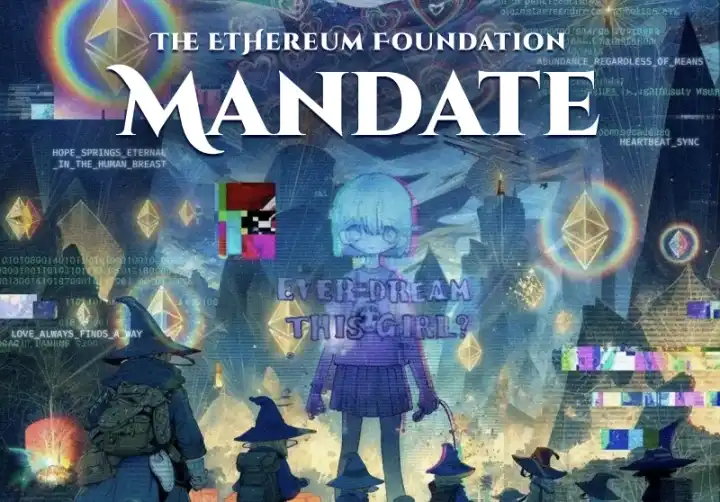
Setting a 'Suicidal' Rule for Themselves: What Is the Ethereum Foundation Aiming For?

The Ethereum Foundation (EF) has released a new mission statement, "EF Mandate," outlining its core philosophy and operational principles. Its ultimate goal is to pass the "walkaway test"—ensuring the Ethereum network would continue to function perfectly even if the EF were to dissolve. The foundation defines its role as a guardian, not a ruler, and commits to a "subtraction philosophy," focusing only on essential tasks like core protocol development and long-term research that others in the ecosystem cannot or will not do. It explicitly states what it will not do: act as a kingmaker, rating agency, marketing firm, or encourage Ethereum's use as a "casino." A key framework is CROPS, an indivisible set of non-negotiable principles for all development: Censorship Resistance, Open Source, Privacy, and Security. The vision is to create a "digital sanctuary" for the next 1,000 years, protecting users from coercion by governments, corporations, or AI, and enabling self-sovereignty over data, identity, and assets. The document serves as a decision-making algorithm, prioritizing long-term, decentralized solutions over short-term convenience and user autonomy over paternalistic protection. However, it faces real-world challenges, including budget dependency on ETH's price and potential trade-offs between its idealistic CROPS principles and user demands for speed and low cost. Community reaction is mixed, with critics calling it ideologically rigid and out of touch with practical applications like stablecoins and RWA, while supporters see it as a necessary commitment to Ethereum's foundational values. Vitalik Buterin clarified that the mandate represents a direction the EF has been moving toward for months.

marsbit03/16 04:43

Setting a 'Suicidal' Rule for Themselves: What Is the Ethereum Foundation Aiming For?

marsbit03/16 04:43

Daniil and David Liberman: AI is Not Just a Battle of Models, But a Battle of Computing Infrastructure

In the article "Daniil and David Liberman: AI Is Not Just a Battle of Models, but a Battle of Compute Infrastructure," the authors argue that the core of AI development is not just about algorithmic advances but control over computational resources. They emphasize that AI is not a neutral technology—who owns and governs the compute infrastructure ultimately determines who benefits from AI. Currently, advanced AI compute is highly concentrated among a few cloud providers and specific nations, creating a growing "compute divide." This centralization leads to high costs, limited access, and geographic imbalance. Decentralized alternatives, meanwhile, often waste resources on consensus mechanisms rather than meaningful computation. The authors propose a practical alternative: an infrastructure where most compute is used for actual AI work, governance is based on verified computational effort (not capital), and global GPU access is permissionless. They stress that infrastructure choices made today will have long-term economic and geopolitical consequences. For businesses, early reliance on centralized AI infrastructure creates lock-in effects that reduce strategic flexibility over time. The authors warn that waiting too long to explore decentralized options may make transition prohibitively difficult. They conclude that future generations must recognize that AI architecture is a deliberate design choice—not an inevitability—and that open, decentralized infrastructure is essential to preserving fairness, innovation, and freedom in the AI era.

marsbit03/16 03:19

Daniil and David Liberman: AI is Not Just a Battle of Models, But a Battle of Computing Infrastructure

marsbit03/16 03:19

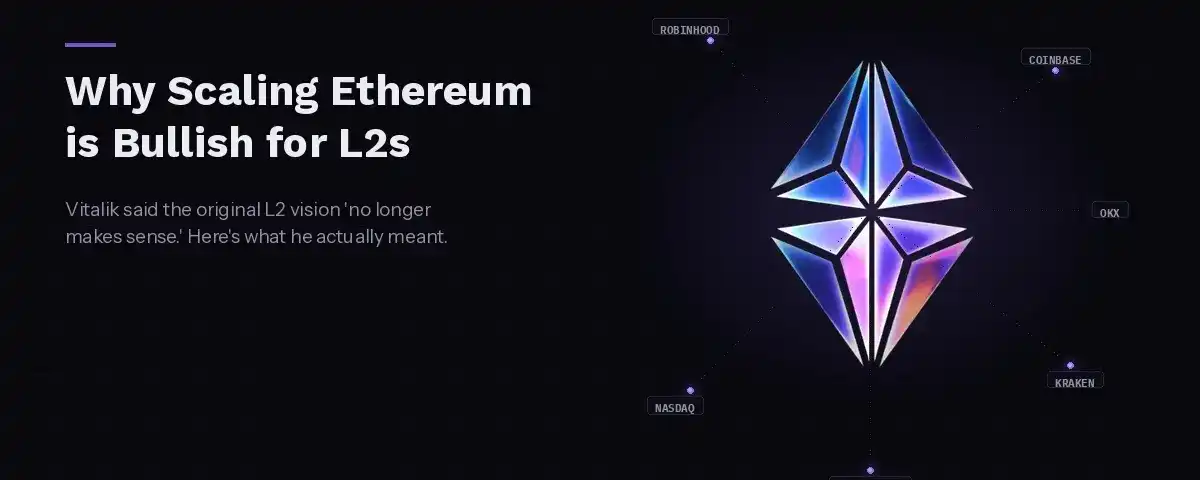
Actually, ETH Scaling is a Major Boon for L2s

Vitalik Buterin's recent comments on Ethereum scaling have been misinterpreted. He did not declare Layer 2s (L2s) a failure but rather signaled a strategic shift: Ethereum is moving from a "rollup-centric" scaling model, where L2s were seen as simple replicas of the base layer, to one where the L1 itself undergoes aggressive scaling. L2s remain crucial, but their primary value proposition has evolved to be customization, not just cheap transactions. Two key developments drove this change. First, Ethereum's base layer is scaling faster than anticipated. After years of cautious progress to preserve decentralization, an ambitious new roadmap aims to drastically increase L1 throughput through a series of upgrades, including a higher gas limit, faster block times, parallel transaction processing, and a fundamental transition to a native zero-knowledge (zkEVM) architecture. This allows Ethereum to scale while maintaining its superior decentralization. Second, L2s have found product-market fit with institutions. Companies like Robinhood, Coinbase, and Kraken are building their own L2s because they need Ethereum's security and access to its liquidity, but also require control for regulatory compliance, custom fee structures, and operational flexibility. This creates a spectrum of L2s, from highly decentralized ones to more controlled, institutionally-focused chains—a reality Vitalik acknowledges is valid as long as marketing is honest. Crucially, scaling the L1 does not compete with L2s; it makes them better. A more powerful L1 means cheaper data availability and settlement costs for L2s, faster withdrawals, and quicker finality. The main unresolved challenge is liquidity fragmentation between L2s, which the Ethereum Foundation is prioritizing with new interoperability solutions for 2026. The narrative that Ethereum is abandoning L2s is incorrect. The ecosystem is maturing into a system with a radically scaling L1 at its core, surrounded by a flourishing ecosystem of specialized L2s.

marsbit03/15 03:20

Actually, ETH Scaling is a Major Boon for L2s

marsbit03/15 03:20

活动图片