# Acquisition Related Articles

HTX News Center provides the latest articles and in-depth analysis on "Acquisition", covering market trends, project updates, tech developments, and regulatory policies in the crypto industry.

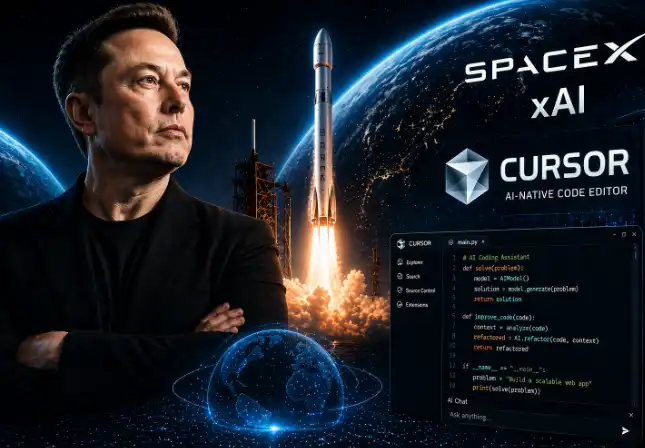
SpaceX Ties Up with Cursor: A High-Stakes AI Gambit of 'Lock First, Acquire Later'

SpaceX has secured an option to acquire AI programming company Cursor for $60 billion, with an alternative clause requiring a $10 billion collaboration fee if the acquisition does not proceed. This structure is not merely a potential acquisition but a strategic move to control core access points in the AI era. The deal is designed as a flexible, dual-path arrangement, allowing SpaceX to either fully acquire Cursor or maintain a binding partnership through high-cost collaboration. This "option-style" approach minimizes immediate regulatory and integration risks while ensuring long-term alignment between the two companies. At its core, the transaction exchanges critical AI-era resources: SpaceX provides its Colossus supercomputing cluster—one of the world’s most powerful AI training infrastructures—while Cursor contributes its AI-native developer environment and strong product adoption. This synergy connects compute power, models, and application layers, forming a closed-loop AI capability stack. Cursor, founded in 2022, has achieved rapid growth with over $1 billion in annual revenue and widespread enterprise adoption. Its value lies in transforming software development through AI agents capable of coding, debugging, and system design—positioning it as a gateway to future software production. For SpaceX, this move is part of a broader strategy to evolve from a aerospace company into an AI infrastructure empire, integrating xAI, supercomputing, and chip manufacturing. Controlling Cursor fills a gap in its developer tooling layer, strengthening its AI narrative ahead of a potential IPO. The deal reflects a shift in AI competition from model superiority to ecosystem and entry-point control. With programming tools as a key battleground, securing developer loyalty becomes crucial for dominating the software production landscape. Risks include questions around Cursor’s valuation, technical integration challenges, and potential regulatory scrutiny. Nevertheless, the deal underscores a strategic bet: controlling both compute and software development access may redefine power dynamics in the AI-driven future.

marsbit04/23 00:41

SpaceX Ties Up with Cursor: A High-Stakes AI Gambit of 'Lock First, Acquire Later'

marsbit04/23 00:41

When Top Crypto VCs Are Shrinking Across the Board, Why Has This Firm Grown by 150%?

In a declining crypto market where top venture capital firms like Paradigm, Pantera, a16z crypto, and Multicoin saw significant reductions in assets under management (AUM), Haun Ventures stood out with a 150% growth, increasing its AUM from $1 billion to $2.5 billion by 2025. Founded by Katie Haun, a former federal prosecutor and a16z crypto veteran, the firm combines regulatory insight with investment discipline. Initially investing heavily in NFTs during the 2022 hype, Haun Ventures quickly pivoted as the bubble burst, adopting a cautious approach with only six investments over the following 18 months. The firm balanced its portfolio between digital tokens and traditional equity, allocating about 30% to liquid tokens like Bitcoin and Ethereum, which contributed significantly to returns as Bitcoin’s price surged. By 2024, Haun Ventures shifted focus to B2B solutions in payments and developer infrastructure, leading over 56% of its investment rounds—the highest rate among top VCs. This strategy paid off with several high-multiple exits via acquisitions, such as Bridge (acquired at $1.1 billion from a $200 million valuation) and BVNK (acquired at $1.8 billion from a $750 million valuation). The firm’s success is attributed to its regulatory foresight, adaptive strategy, high-conviction lead investments, and emphasis on real-world utility and exit efficiency—making it a standout performer during the crypto downturn.

marsbit04/20 10:32

When Top Crypto VCs Are Shrinking Across the Board, Why Has This Firm Grown by 150%?

marsbit04/20 10:32

175-Year-Old Western Union: Not Just Playing with Stablecoins, but Also Acquired a Digital Wallet

At 175 years old, Western Union, the global money transfer giant, is undergoing a significant digital shift. After a failed 2018 experiment with Ripple's XRP due to high costs, the company is now aggressively embracing blockchain and digital assets. In April 2026, Western Union acquired Singapore-based digital wallet Dash from Singtel, marking its first digital wallet asset in the Asia-Pacific region. Dash, with 1.4 million users, offers a full suite of services including payments, remittances, savings, insurance, and investments, deeply integrated into Singapore's local life. This move is part of a broader strategy to modernize its legacy business. While Western Union's vast network of over 500,000 physical agent locations remains its backbone, it is also its biggest cost burden. The company faces intense competition from digital-native rivals like Wise and Remitly, which offer significantly lower fees. To compete, Western Union is building a "Digital Asset Network." A key component is its own USD-pegged stablecoin, USDPT, issued on the Solana blockchain in partnership with Anchorage Digital. It is also piloting a stablecoin-linked Visa card with Rain for users in high-inflation countries like Argentina, allowing them to spend or cash out dollars at its agent locations. The acquisition of Dash represents a fundamental change: moving from being a transient "pipe" for money transfers to building a destination where users stay. Dash provides a trusted, established platform to test and deploy these new digital products, serving as a launchpad for Western Union's expansion across the Asia-Pacific region.

marsbit04/07 09:46
175-Year-Old Western Union: Not Just Playing with Stablecoins, but Also Acquired a Digital Wallet

marsbit04/07 09:46

活动图片