Survey finds 6 in 10 of Asia’s rich plan to ramp up crypto buying in 2026

cointelegraphPublished on 2025-12-11Last updated on 2025-12-11

Abstract

A new survey by Sygnum reveals that over 60% of high-net-worth individuals (HNWIs) in Asia plan to increase their cryptocurrency investments in 2026, reflecting a strong bullish outlook for digital assets over the next two to five years. The study, which surveyed 270 HNWIs and professional investors across ten APAC countries, found that 87% already hold crypto, with an average portfolio allocation of around 17%. Notably, 90% view digital assets as important for long-term wealth preservation rather than pure speculation. The shift underscores growing institutional acceptance, with most investors expecting traditional wealth managers to offer regulated crypto services. Key motivations include portfolio diversification and intergenerational wealth planning.

High-net-worth individuals in the Asia Pacific region are becoming increasingly bullish on crypto assets, with more than half planning to increase their portfolio exposure, according to a new survey.

It found that 6 in 10 of the surveyed Asian high-net-worth individuals (HNWIs) are prepared to increase their crypto allocations based on a strong two- to five-year outlook, according to Sygnum’s APAC HNWI Report 2025.

The results of the survey, released on Thursday, revealed that Asian private wealth has “moved decisively into digital assets,” and is now expecting traditional wealth managers to catch up.

The findings also revealed that an overwhelming 90% of surveyed HNWIs view digital assets as “important for long-term wealth preservation and legacy planning, not purely speculation.”

“Digital assets are now firmly embedded within APAC’s private wealth ecosystem,” said Gerald Goh, Sygnum co-founder and APAC CEO.

“Despite near-term macro uncertainty, we continue to see accelerating adoption driven by strategic portfolio diversification, intergenerational wealth planning, and demand for institutional-grade products.”

This represents a fundamental shift from crypto as a speculative asset to an institutional wealth management product.

More than half of portfolios hold over 10% crypto

The survey revealed that 87% of Asian HNWIs already hold crypto, and around half have an allocation of more than 10%. The average portfolio allocation is around 17%.

87% of investors also said they would ask their private bank or adviser to add crypto services if offered through regulated partners.

Meanwhile, 80% of those actively investing reported holdings in blockchain protocol tokens, such as Bitcoin (BTC), Ether (ETH) and Solana (SOL). The most common reason for investing, according to 56% of respondents, was portfolio diversification.
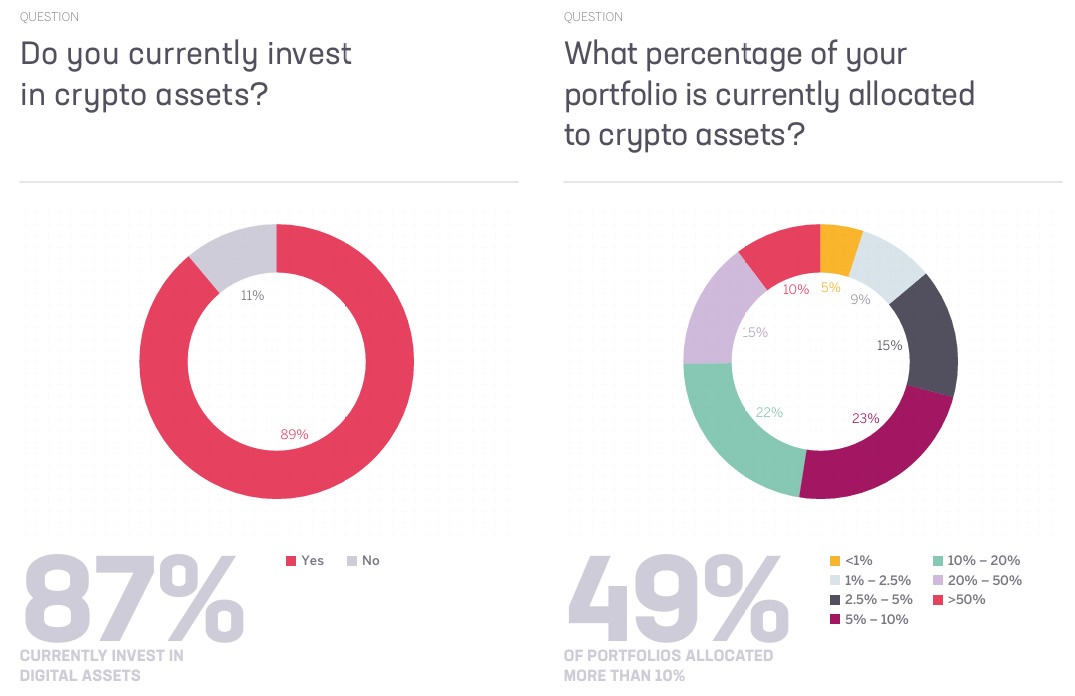
Nearly half of the portfolios hold more than 10% in crypto. Source: Sygnum


“APAC is rapidly becoming one of the world’s fastest-growing and most important digital asset gateways, and we expect this momentum to strengthen further into 2026,” Goh said.

Related: Ripple’s big Singapore win: What the expanded license allows now

The survey polled 270 HNWIs with more than $1 million in investable assets and professional investors with over ten years of experience across ten APAC countries, mostly in Singapore, but including Hong Kong, Indonesia, South Korea and Thailand.

Magazine: XRP’s ‘now or never’ moment, Kalshi taps Solana: Hodler’s Digest

Related Reads

The Value Distribution of Stablecoins

**Summary: The Value Distribution of Stablecoins** The article argues that stablecoins are evolving from mere trading tools into broader channels for dollar access. It divides the stablecoin ecosystem into four layers to analyze how value is distributed: 1. **Issuance Layer:** Mints stablecoins, holds reserve assets, and captures the spread between reserve yield and user costs (e.g., Tether, Circle). This layer currently earns the largest profit margin. 2. **Infrastructure Layer:** Connects stablecoins to the traditional financial system, handling fiat on/off-ramps, banking integration, compliance (KYC/AML), and asset management (e.g., Bridge, BVNK). This is the "unglamorous" but critical work, building the essential bridges between crypto and real-world finance. 3. **Acquiring/Distribution Layer:** Integrates stablecoins into merchant systems, manages payment flows, and provides enterprise financial software (e.g., Stripe, Coinbase). They act as the access point for businesses. 4. **Application Layer:** The end-users and businesses that ultimately use stablecoins for payments, settlements, or as a store of value. They benefit from convenience but have little pricing power. The core thesis is that while the issuance layer currently dominates profits, the often-overlooked **infrastructure layer holds significant long-term potential**. The real challenge and barrier to mass adoption is not the on-chain transfer of stablecoins (which is simple), but the complex "last mile" integration into existing business workflows, banking systems, and regulatory frameworks across different countries. Companies in this layer are currently in a "land grab" phase, investing heavily to build networks, secure bank partnerships, and establish compliance pathways. While their position is currently pressured by the profitable issuers above and distribution platforms below, the article suggests that if stablecoins become a default financial rail for businesses, the infrastructure providers who have done the hard work of integration will ultimately gain strong pricing power and become entrenched, essential players.

marsbit6h ago

The Value Distribution of Stablecoins

marsbit6h ago

The Value Distribution of Stablecoins

The Value Distribution of Stablecoins The article argues that stablecoins are evolving from a mere trading tool into a broad "dollar channel." It analyzes the industry's value chain through four layers: 1. **Issuance Layer (e.g., Tether, Circle):** The top layer that mints stablecoins, holds reserve assets, and captures the thickest interest rate spread. 2. **Infrastructure Layer (e.g., Bridge, BVNK):** Connects stablecoins to the traditional financial system, handling critical but complex "dirty work" like fiat on/off-ramps, banking integration, compliance (KYC/AML), and cross-border settlement. 3. **Acquiring/Distribution Layer (e.g., Stripe, Coinbase):** Embeds stablecoins into merchant systems, manages payment flows, and integrates with enterprise software. 4. **Application Layer:** End-users and businesses that ultimately use stablecoins for payments, settlement, or storing value. The author posits that while the issuance layer currently captures the most profit, the most overlooked and potentially critical layer is infrastructure. The core challenge for stablecoin adoption isn't the on-chain transfer (which is simple), but bridging the gap between blockchain and the real-world financial system. This involves solving practical problems for businesses: fiat conversion, reconciliation, tax handling, and user onboarding. Infrastructure companies are currently in a difficult "land-grab" phase—building networks, securing banking relationships, and achieving compliance country-by-country. They face pressure from both the profitable issuance layer above and distribution platforms below. However, the author suggests this layer is building a crucial moat. Once stablecoins become a default business rail, the infrastructure players who have done the hard work of integration may gain significant, durable value and pricing power.

链捕手6h ago

The Value Distribution of Stablecoins

链捕手6h ago

Trading

Spot
Futures

Hot Articles

Discussions

Welcome to the HTX Community. Here, you can stay informed about the latest platform developments and gain access to professional market insights. Users' opinions on the price of S (S) are presented below.

活动图片