Strongest quarter in three years – Yet, Canaan’s CAN stays below $1!

ambcryptoPublished on 2026-02-11Last updated on 2026-02-11

Abstract

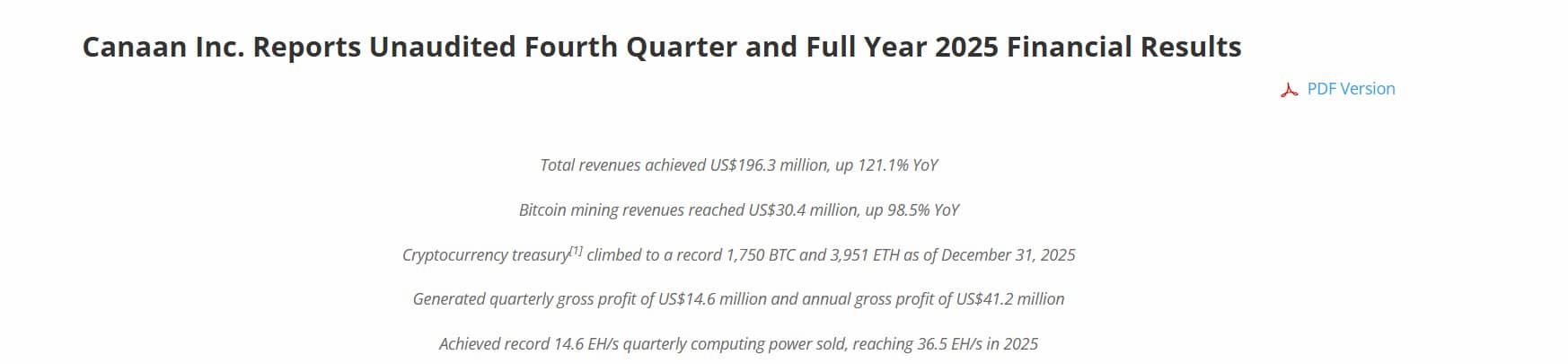
Crypto miner Canaan reported its strongest quarterly revenue in three years, with Q4 revenue surging 121.1% year-on-year to $196.3 million. This growth was driven by increased mining output and high demand for its machines, including a record 14.6 EH/s in computing power shipments. Mining revenue alone rose 98.5% to $30.4 million, and the company expanded its digital asset holdings to 1,750 BTC and 3,950 ETH. Despite these strong operational and financial results, Canaan’s stock (CAN) continues to trade below $1, currently at $0.57, down nearly 7% in a day. The company faces potential delisting from Nasdaq after receiving a warning for non-compliance with the exchange’s minimum bid price requirement. Canaan has until July 13 to bring its share price above $1 for at least 10 consecutive trading days. The stock has fallen about 18% year-to-date and over 70% in the past 12 months, reflecting persistent investor concerns despite record performance.

Crypto miner Canaan just delivered its strongest quarterly revenue in three years. However, instead of celebrating, the market focused on its sub-$1 stock price and potential Nasdaq delisting.

Here’s what you need to know.

Record revenue can’t get the market to smile

Canaan’s latest earnings report delivered numbers the company hasn’t seen in years, with a 121.1% jump in fourth-quarter revenue to $196.3 million.

Source: X

The numbers were powered by mining output and high demand for its machines. Mining revenue alone climbed 98.5% year-on-year to $30.4 million.

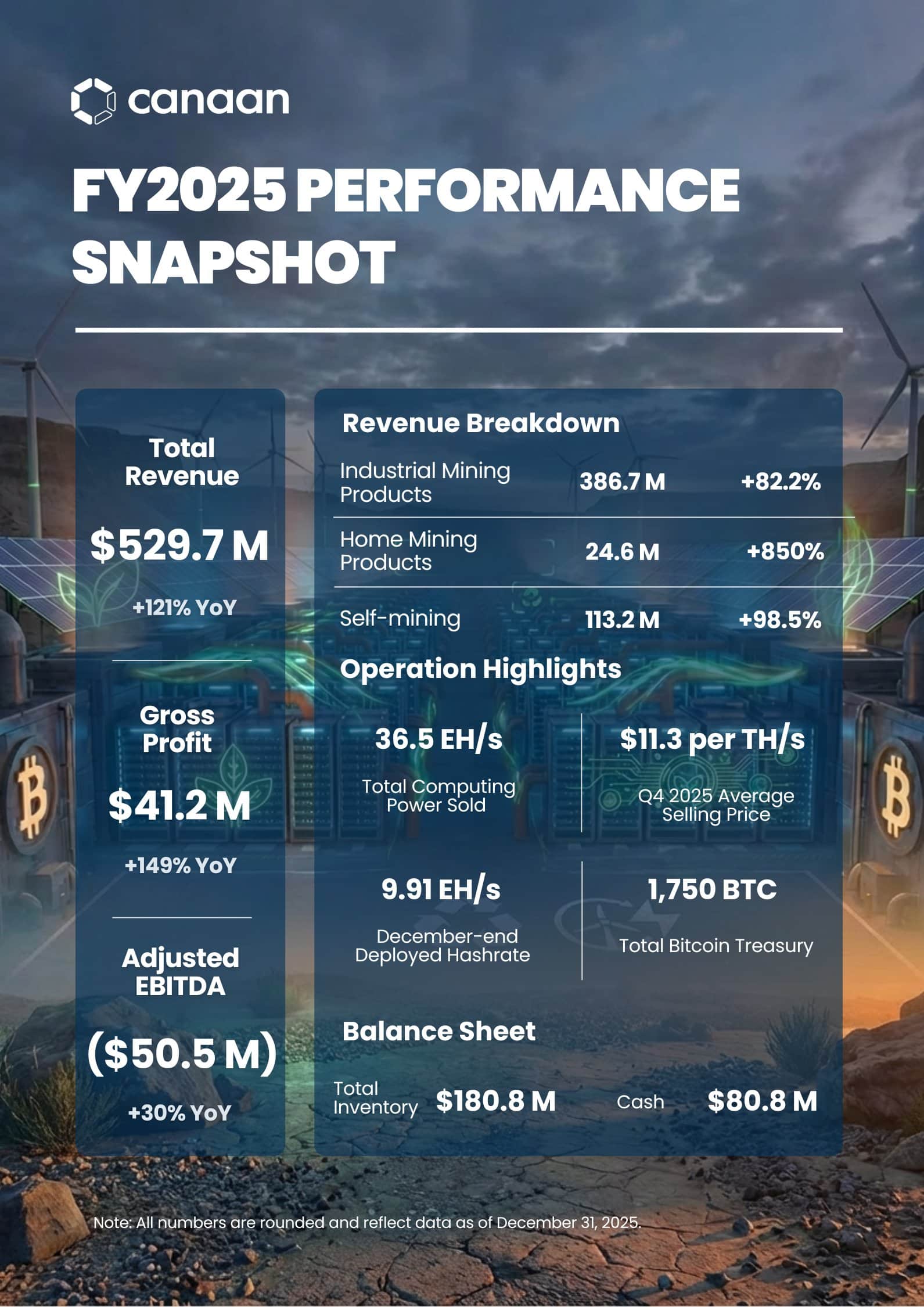
At the same time, Canaan expanded its digital asset reserves, ending the quarter with a record 1,750 BTC  (valued at nearly $120 million) and 3,950 ETH worth about $7.9 million.

Source: Canaan

Machine shipments also hit a milestone, with a record 14.6 exahashes per second (EH/s) delivered during the quarter. Computing power sales rose by 60% too, compared to a year ago.

Success overshadowed by falling stock

Canaan continued to scale its mining footprint in Q4, expanding installed capacity to 9.91 EH/s, with 7.65 EH/s actively running. Meanwhile, Bitcoin network’s hashrate went from a peak of 1,150 EH/s in mid-October to around 980 EH/s.

And yet, the operational gains did little to reassure investors. At the time of writing, CAN was trading at $0.57, down 6.87% over the day.

More trouble ahead?

The share price is now creating a bigger problem. Stock is down about 18% since the start of the year; a 70.2% fall over the past 12 months.

Source: Canaan

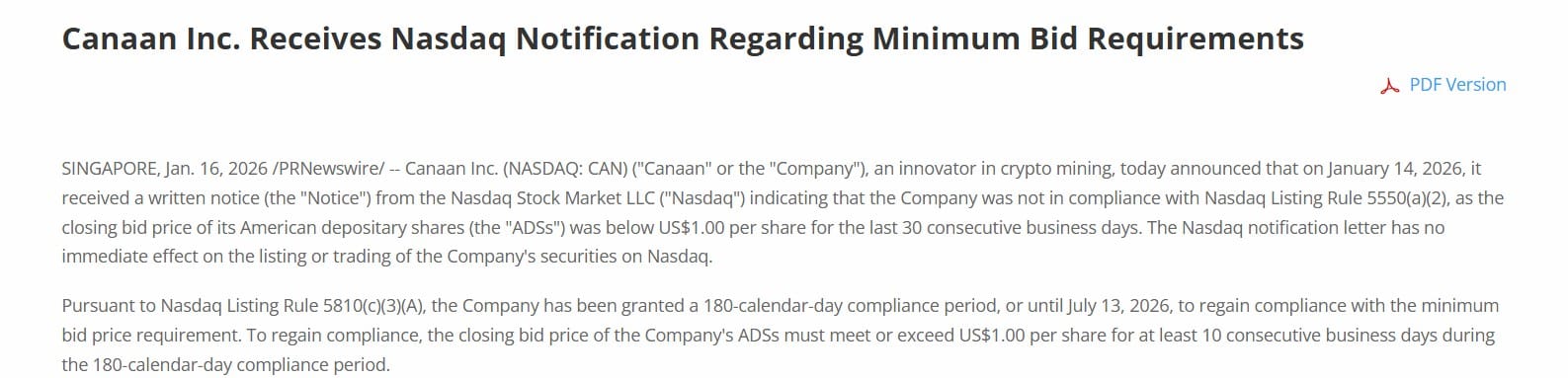
On 16 January, the Singapore-based miner disclosed a Nasdaq warning, stating that it was no longer in compliance with the exchange’s minimum bid requirement. To avoid delisting, Canaan must push its closing share price back above $1 for at least 10 consecutive trading days.

The company has 180 days until 13 July to meet the rule.


Final Thoughts

  • Canaan posted a 121% revenue surge, but its sub-$1 stock price keeps Nasdaq delisting risk in focus.
  • With a deadline to regain compliance, CAN’s next moves could make or break.
Next: Top 8 crypto presales making headlines in February 2026
Share
  • Share
  • Tweet

Trending Cryptos

Related Questions

QWhat was the percentage increase in Canaan's Q4 revenue and what was the total amount?

ACanaan's Q4 revenue increased by 121.1% to a total of $196.3 million.

QWhy is Canaan's stock (CAN) at risk of being delisted from Nasdaq?

ACanaan received a Nasdaq warning because its stock price fell below the exchange's minimum bid requirement of $1, and it must maintain a closing price above $1 for 10 consecutive trading days to avoid delisting.

QHow much did Canaan's mining revenue grow year-on-year in Q4?

ACanaan's mining revenue grew by 98.5% year-on-year to $30.4 million in the fourth quarter.

QWhat was the value of Canaan's digital asset reserves at the end of the quarter?

ACanaan ended the quarter with digital asset reserves valued at nearly $120 million for its 1,750 BTC and approximately $7.9 million for its 3,950 ETH.

QBy what date must Canaan regain compliance with Nasdaq's minimum bid price requirement?

ACanaan has until July 13 to regain compliance with Nasdaq's minimum bid price requirement, giving it 180 days from the January 16 warning.

Related Reads

Podcast Notes | Conversation with GSR Asset Management Head: To Determine if This Crypto Rally is Real, Just Watch the Lending Rates on Aave

Podcast Summary: Dialogue with GSR's Head of Asset Management: To Determine if This Crypto Rally is Real, Just Check Lending Rates on Aave Andy Baehr, Managing Director of Asset Management at GSR, discusses the current crypto market, characterizing it as stuck in a state of "ambivalence" with short-lived, unsustainable rallies. He outlines a simple framework: the market moves between "ambivalence" and "conviction" (sustained upward momentum). Currently, every rally resembles a single-stage rocket booster that quickly fizzles out. Baehr identifies three key signals to watch: 1) DeFi lending rates, 2) the potential passage of the CLARITY Act, and 3) the market forming a consensus on the "Fed hawkish peak." He emphasizes that the most immediate indicator for the sustainability of the recent CPI-triggered rally is the USDC borrowing rate on Aave, currently around 3.75%—close to U.S. Treasury yields. The absence of a credit spread indicates low leverage demand and a lack of market energy. He explains that a healthy, sustained rally requires layered buying pressure. Last year's rally progressed from an ETH short squeeze to crypto-native trader influx and finally to ETF inflows. Currently, this structure is missing. Other potential structural buyers like Digital Asset Treasury (DAT) companies are absent, and ETF flows have proven transient. Baehr notes that while small-cap crypto tokens outperformed large caps in Q2—a potential sign of capitation in major assets—capital is also flowing to more exciting opportunities like AI stocks and tech IPOs, leaving crypto sidelined. Regarding DeFi, he highlights that platforms like Aave provide a clear, real-time signal of leverage demand through their supply/demand-driven interest rates. A significant, sustained rate increase would signal genuine market conviction. He also observes the quiet emergence of fixed-income-like products and vaults in DeFi. On regulation, the probability of the CLARITY Act passing before the August 7th deadline has dropped linearly from 75% to below 40% on Polymarket. Baehr suggests its passage would be treated as a bullish surprise, a potent driver for price movement. However, political hurdles, including ethical clause debates and disclosures about the First Family's crypto profits, remain significant obstacles. Ultimately, the market awaits clarity on the Fed's terminal rate under Chair Warsh. Until the "Fed Solstice"—the point where the market collectively understands the peak of hawkish policy—sustained conviction will be difficult to achieve.

marsbit18m ago
Podcast Notes | Conversation with GSR Asset Management Head: To Determine if This Crypto Rally is Real, Just Watch the Lending Rates on Aave

marsbit18m ago

7 Months After the Collapse of Huiwang, Southeast Asia's Escrow Platforms Undergo a Major Reshuffle

Following the collapse of Huione Pay—dubbed the "Alipay of Southeast Asia"—seven months ago, the region's underground financial guarantee platform sector is undergoing a significant reshuffle. This power vacuum has been swiftly filled by emerging platforms such as XinBi, Tiger/Navigator, JinBei (renamed JinBo), Dali/Tiancheng, and FullyLight. These platforms, operating largely via Telegram and offering services like escrow for illicit transactions, have absorbed the vast user base and markets left behind by Huione. While positioning themselves as "trust intermediaries," their primary clientele consists of networks involved in online scams, money laundering, illegal gambling, and even human trafficking. For instance, the Tiger/Navigator platform explicitly provides "escrow" services for kidnapping-for-ransom operations ("强押车交易"). Data underscores the immense scale: Huione alone processed over $103 billion in cryptocurrency payments and facilitated over $31 billion through its escrow market before its downfall, linking it to Cambodia's notorious Prince Group. Since its collapse, competitors have seen explosive growth. For example, the XinBi platform has accumulated over $1.6 billion in total USDT revenue, while platforms like NewPay, OkPay (under Dali), and FullyLight Wallet collectively processed over $4.8 billion in USDT in a single year. This ecosystem thrives in regions like Cambodia and Myanmar, where regulatory gaps allow these platforms to act as critical financial infrastructure for sprawling cybercrime industries, from scam compounds to online casinos. The article concludes that the moniker "Southeast Asian Alipay" is a misnomer, obscuring the platforms' fundamental role in enabling serious criminal enterprises rather than representing legitimate financial innovation.

Odaily星球日报1h ago

7 Months After the Collapse of Huiwang, Southeast Asia's Escrow Platforms Undergo a Major Reshuffle

Odaily星球日报1h ago

Trading

Spot

Hot Articles

Discussions

Welcome to the HTX Community. Here, you can stay informed about the latest platform developments and gain access to professional market insights. Users' opinions on the price of S (S) are presented below.

活动图片