Strategy survives first Nasdaq 100 shakeup since entering the index

cointelegraphPublished on 2025-12-13Last updated on 2025-12-13

Abstract

Strategy, formerly MicroStrategy, retained its position in the Nasdaq 100 index during the latest annual rebalancing, despite a 3.74% drop in its stock on the day. The company, the largest corporate holder of Bitcoin, recently purchased an additional 10,624 BTC, bringing its total holdings to 660,624 BTC worth nearly $60 billion. However, its stock has declined over 15% in the past month. MSCI is reviewing whether to classify companies with substantial crypto holdings as investment vehicles rather than operating firms. If MSCI enforces a rule excluding firms with over 50% of assets in crypto, Strategy could be affected as early as January, potentially forcing passive funds to sell up to $2.8 billion in shares. Strategy's leadership argues it is an operating company, not a passive Bitcoin holder. To address market concerns, Strategy raised $1.44 billion to meet dividend and debt obligations. CEO Michael Saylor continues promoting Bitcoin as "digital gold" and is engaging institutional investors to bring more capital into the space.

Strategy held on to its place in the Nasdaq 100 during this year’s rebalancing, securing its first successful test in the benchmark since joining the index in December last year.

The company, previously known as MicroStrategy, has become the largest corporate holder of Bitcoin (BTC). With its latest purchase of 10,624 Bitcoin for around $962.7 million last week, Strategy’s total holdings stand at 660,624 BTC, worth nearly $60 billion.

The latest Nasdaq 100 adjustment saw Biogen, CDW, GlobalFoundries, Lululemon, On Semiconductor and Trade Desk removed from the tech-heavy gauge, while Alnylam Pharmaceuticals, Ferrovial, Insmed, Monolithic Power Systems, Seagate and Western Digital entered the lineup, according to Reuters.

Despite remaining in the index, Strategy shares ended the day down by 3.74%. The company’s shares has been in a downtrend as of late, losing over 15% in the past month alone.
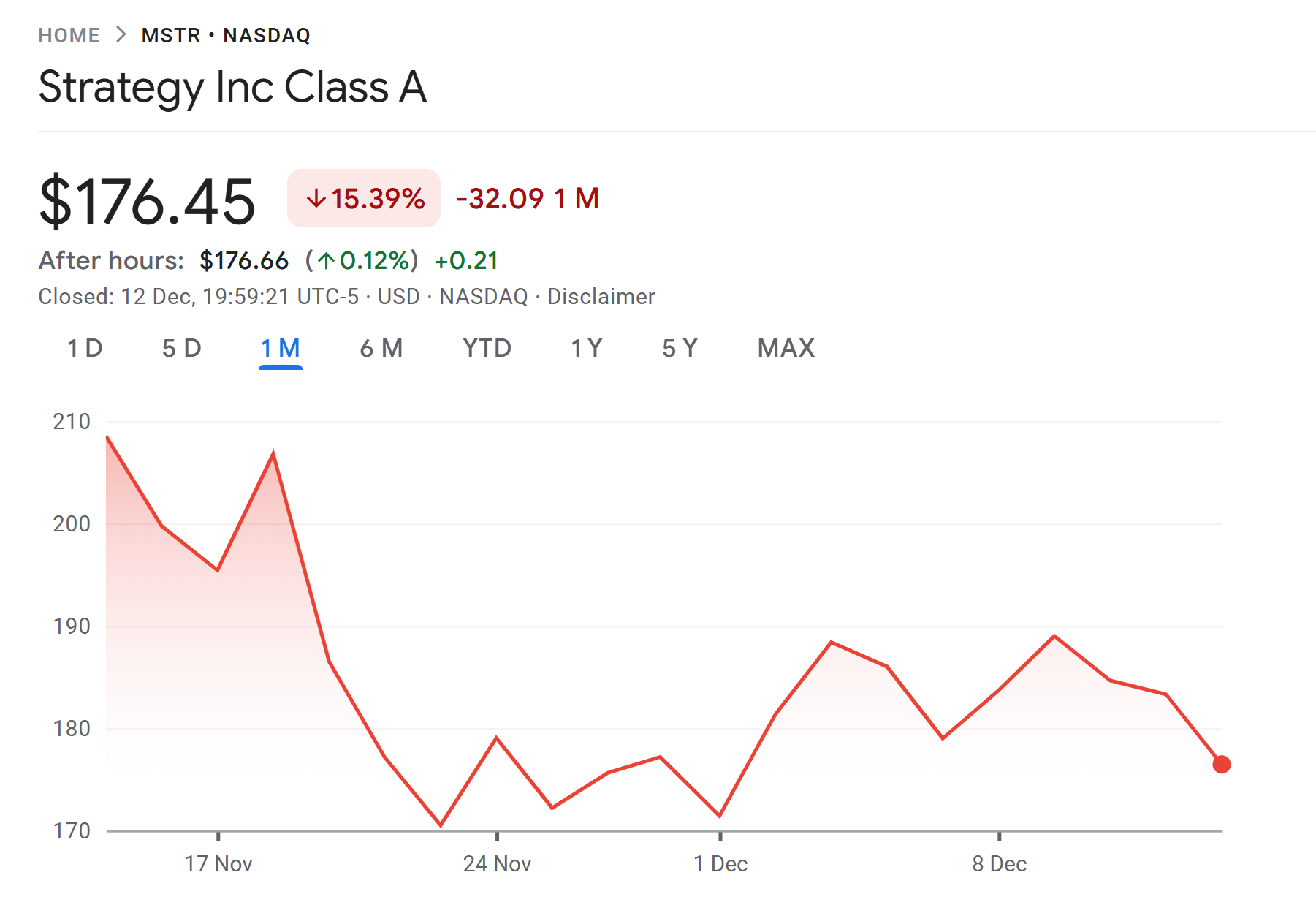
Strategy shares down 15% over the past month. Source: Google Finance

Related: MSCI’s Bitcoin snub is like penalizing Chevron for oil: Strategy CEO

MSCI review puts Strategy at risk

Strategy’s inclusion in the Nasdaq 100 stands out not only because its business model is unusual, but because of the mounting debate over whether such companies resemble operating firms or de facto investment vehicles.

Those questions intensified this year as MSCI began reviewing how to classify companies that raise capital primarily to acquire digital assets. The index provider has considered excluding firms whose crypto holdings exceed 50% of total assets, a move that could hit Strategy as early as January. JPMorgan warned that as much as $2.8 billion worth of Strategy shares held by passive funds could be forced to sell if MSCI follows through.

Strategy’s leadership has pushed back. In a letter to MSCI dated Dec. 10, Executive Chairman Michael Saylor and CEO Phong Le argued that the company is not a passive Bitcoin accumulator but an operating enterprise that issues preferred stock and other instruments to finance new purchases.

Related: Bitcoin treasuries stall in Q4, but largest holders keep stacking sats

Strategy raises $1.4 billion to quell FUD

Strategy recently raised $1.44 billion to counter market concerns over its ability to meet dividend and debt obligations if the share price fell further. “There was FUD that was put out there that we wouldn’t be able to meet our dividend obligations, which causes people to pile into a short Bitcoin bet,” Le said.

At the Bitcoin MENA event in Abu Dhabi, Saylor also said he has been meeting with sovereign wealth funds, bankers and family offices to position Bitcoin as “digital capital” and “digital gold.” He argued that a new category of “digital credit” built on top of Bitcoin can deliver yield without the volatility typically associated with the asset, underscoring his push to bring institutional capital into the space.

Magazine: 2026 is the year of pragmatic privacy in crypto — Canton, Zcash and more

Trending Cryptos

Related Reads

Blood Loss of $55 Million Selling 3,588 BTC, Strategy Becomes a Literal Scumbag

On July 6th, Strategy (formerly MicroStrategy) disclosed in an SEC filing that it sold 3,588 Bitcoin (BTC) between June 29th and July 5th for approximately $216 million, at an average price of ~$60,200. This marked the company's largest net sale since initiating its Bitcoin strategy in 2020 and its first institutionalized reduction of its core holding. The sale resulted in a realized loss of about $54.8 million, as the selling price was below its average cost basis of ~$75,476 per BTC. The proceeds were used to pay preferred stock dividends and replenish USD reserves. This move follows a new "Digital Credit Capital Framework" approved on June 29th, authorizing the sale of up to $1.25 billion in Bitcoin. The sale consumes roughly 17% of this authorized amount in its first week. Strategy's foundational narrative, built by founder Michael Saylor, was a commitment to "never sell" Bitcoin. The recent institutionalized selling framework and these substantial sales represent a significant shift from that original promise. While the amount sold is only 0.4% of Strategy's total holdings of 843,775 BTC, the action challenges the premium at which its stock (MSTR) trades relative to its Bitcoin holdings. Investors had priced in the "never sell" narrative. The company now faces a contradiction: it sells Bitcoin at a loss to pay dividends on the preferred stock it issued to fund Bitcoin purchases. Saylor has framed selling as a tool for future strategic purchases, but each sale erodes the credibility of the original commitment, potentially threatening the premium valuation of MSTR shares.

Foresight News37m ago

Blood Loss of $55 Million Selling 3,588 BTC, Strategy Becomes a Literal Scumbag

Foresight News37m ago

Dialogue with Yihui Capital, SoundAI Technology, Ling Universe, and Zhongbo Jili: Opportunities and Challenges in the AI Smart Hardware Track

On June 28, 2026, an event titled "New Opportunities in AI Hardware: The Battle for Interactive Entry Points Begins" was held in Beijing. It featured a report from ITJuzi and discussions with experts from SoundAI, Ling Universe, One Reed Capital, and Zhongbo Juli on the opportunities and challenges in China's AI hardware sector. Key report findings highlight the sector's intense activity: 327 out of 431 startups founded post-2023 have secured funding, with 179 investments in H1 2026 alone. The landscape is dominated by embodied intelligent robots, while wearable tech like smart rings and AI glasses shows rapid growth. Geographically, Shenzhen leads, leveraging its superior hardware supply chain, followed by Beijing and Shanghai. The overarching trend is for companies to focus on micro-innovations within specific scenarios rather than reinventing foundational technology. Industry leaders shared several critical insights: 1. **Balancing Innovation & Market Readiness**: Entrepreneurs face the "hammer looking for a nail" dilemma. Success requires balancing technical capability with user acceptance, cost control, and incremental design improvements rather than chasing disruptive innovation. 2. **Competitive Landscape**: The future interactive entry point may not be a single super-device but a mix of universal terminals and specialized, scenario-specific hardware. While large companies have ecosystem advantages, startups can win by deeply targeting vertical markets and specific user groups. 3. **Core Challenges & Business Models**: Key hurdles include deep understanding of AI models and navigating non-transparent hardware supply chains. Viable business models may involve selling hardware at cost and generating revenue through software subscriptions, but this requires tight control over both hardware BOM and model inference costs. 4. **The Road to Commercialization**: The ultimate test is market validation—achieving sales growth and sustainable cash flow. Companies must find the right application scenario, use edge computing effectively, and close the loop from technology to commercial success. 5. **The Future of Interaction**: Proactive, context-aware interaction is the next frontier, though it's currently limited by issues like model hallucinations and environmental perception. The near-term focus should be on identifying target users and creating a coherent experience in specific domains, such as health wearables. In summary, to succeed in the competitive AI hardware arena, companies must strategically choose their niche, build a team with the right geographical advantages (e.g., leveraging Shenzhen's supply chain), and most importantly, execute a flawless commercialization strategy that translates technology into market-accepted products and sustainable business growth.

marsbit1h ago

Dialogue with Yihui Capital, SoundAI Technology, Ling Universe, and Zhongbo Jili: Opportunities and Challenges in the AI Smart Hardware Track

marsbit1h ago

Trading

Spot

Hot Articles

Discussions

Welcome to the HTX Community. Here, you can stay informed about the latest platform developments and gain access to professional market insights. Users' opinions on the price of S (S) are presented below.

活动图片