Strategy Repays Its Costs and Starts Hoarding US Dollar Cash Again

marsbitPublished on 2026-08-25Last updated on 2026-08-25

Abstract

The article details a strategic shift by MicroStrategy, the world's largest corporate Bitcoin holder, as it pivots from aggressive Bitcoin accumulation to building substantial cash reserves. Following a 13% weekly Bitcoin rally above $78,000—which brought its massive 840,447 BTC holding back above its average cost basis of $75,385 per coin—MicroStrategy took no new Bitcoin purchases. Instead, the company raised approximately $2 billion by selling shares. It allocated these funds into two new US dollar pools: a restricted "USD Reserve" for debt/股息 payments (now holding $5.1B) and a flexible "USD Cash" pool ($1.59B) for potential market opportunities. This move marks a departure from CEO Michael Saylor's long-held narrative that cash is "melting ice." The primary driver is the need to meet fixed financial obligations, like the 12% dividend on its STRATeGY Preferred Shares (STRC), which have traded below their $100 face value. To support STRC's price, MicroStrategy has sold Bitcoin and used equity proceeds to repurchase these shares under a $1 billion buyback program. Analysts note this shift addresses immediate liquidity needs but highlights challenges in MicroStrategy's famed "flywheel" model. The model, which relied on issuing premium-priced stock to buy more Bitcoin, is impaired as the company's stock premium has evaporated. While the new cash reserves provide flexibility and time, they do not eliminate the underlying financial obligations. The article frames this囤积 of th...

Last week, Bitcoin rose 13%, reclaiming the $70,000 level over five trading days for the first time since June. By Monday this week, the price was already above $78,000.

Strategy, the world's largest corporate buyer of Bitcoin, did not buy a single coin during this week.

Instead, it did another thing: it sold 18.26 million shares of its own common stock, raising approximately $2 billion, and turned this money into US dollars. As of August 23, the company's USD liquidity on its books totaled $6.69 billion.

Where did this $2 billion go?

$300 million went into the "USD Reserve"—a dedicated pool the company established in June, which can only be used to pay preferred stock dividends and debt interest. Using it for other purposes requires board approval. This pool now holds $5.1 billion.

$136.4 million was used to repurchase 1.43 million shares of STRC preferred stock.

The remaining money went into a newly established pool with a straightforward name: "USD Cash," currently holding $1.59 billion. Unlike the previous one, this pool's use is entirely open—it can be used to buy Bitcoin, repurchase common or preferred stock, repay convertible bonds, replenish the USD Reserve, or be used for other corporate purposes.

The company's stated reason is that the added flexibility allows management to respond faster to market changes, "including price dislocations in Bitcoin or the company's own securities."

The same filing also shows that for the week ending August 23, Strategy did not buy or sell any Bitcoin, with its holdings remaining at 840,447 coins for the second consecutive week. In fact, it hasn't bought a single coin since the week of June 22.

Why is a company that buys Bitcoin hoarding cash?

To understand how abnormal this is, one must first know how many times Michael Saylor has repeated that analogy over the past few years: Holding cash is like holding a melting ice cube. Strategy's entire narrative was built on this sentence—converting every cent on the balance sheet into Bitcoin, as quickly as possible.

Now it has two labeled US dollar pools, totaling $6.69 billion.

The reason lies in the cost basis line.

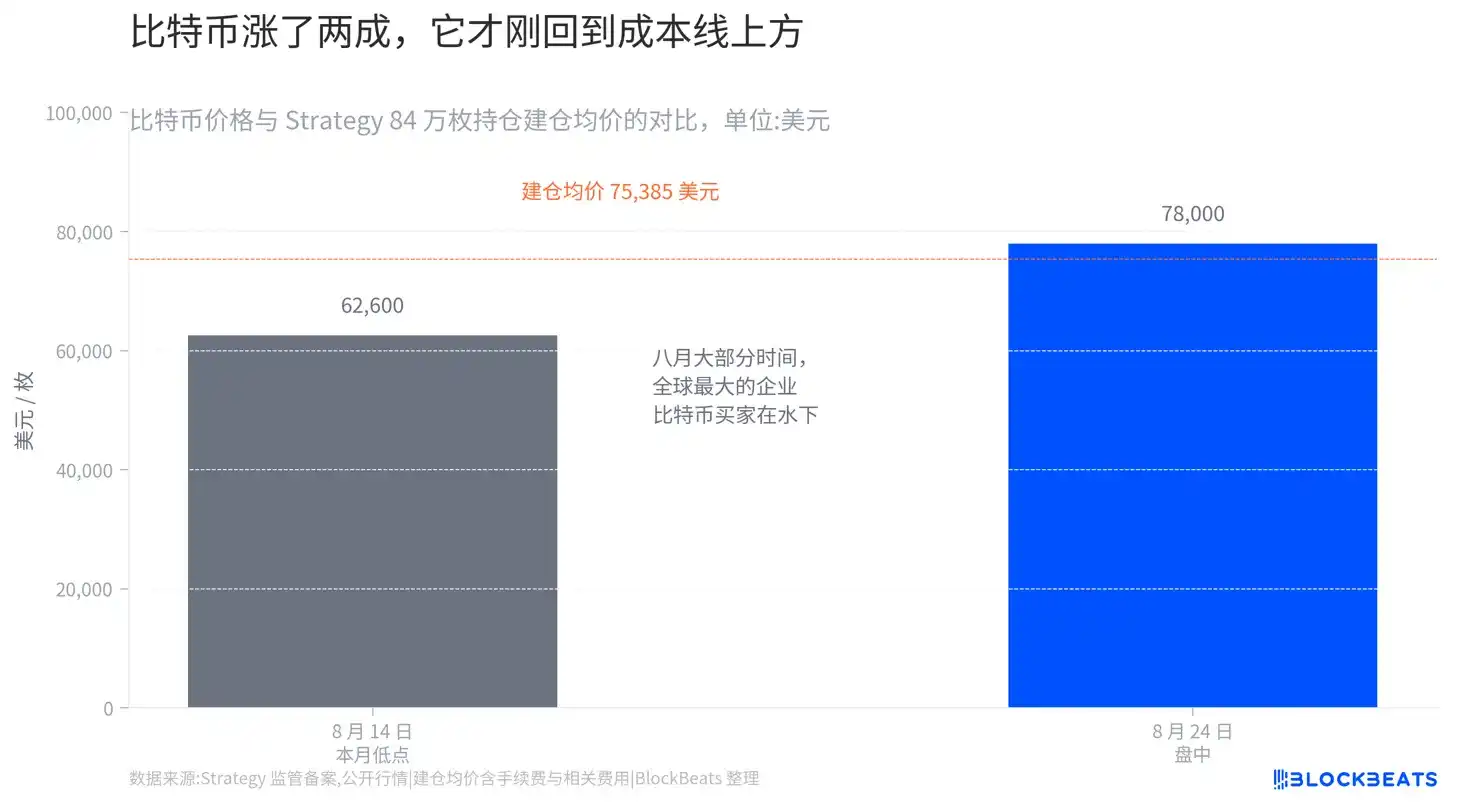
Strategy's 840,447 Bitcoins cost a total of $63.36 billion, averaging $75,385 per coin (including fees and related costs). This line is the key to the whole matter: on August 14, when Bitcoin fell to $62,600, the company reported unrealized losses on its Bitcoin holdings as high as $8.2 billion.

It wasn't until last week when the price recovered to $78,000 that the company finally moved back above its cost basis line, with a floating profit of $1.4 billion.
The problem is, paper losses don't need to be repaid, but dividends and interest must be paid on time.

The STRC preferred stock issued by Strategy promises a 12% annual dividend on a face value of $100. It can be understood as a high-interest IOU from the company—market confidence in this IOU is directly reflected in its price.

Throughout the summer, STRC traded below its face value; the company's CEO Phong Le publicly stated in early August that the 12% dividend would be maintained and that the goal was for STRC to stay in the $99 to $100 range long-term.

To prop up this price, they need to buy back. And when Bitcoin is in a deep correction and the stock price isn't rising either, where does the money come from?

The answer lies in the new capital management framework established in June—it for the first time allowed Strategy to sell Bitcoin to repurchase preferred stock that had fallen below face value.

On August 3, the company sold 1,638 Bitcoins, cashing out $104.73 million; by August 5, the 5,226 Bitcoins sold had raised $321 million, used to repurchase $106 million worth of STRC. On August 17, it raised another $334 million by issuing shares, also for repurchasing preferred stock.

This recent $2 billion share issuance is an amplified version of the same playbook. To date, the $1 billion preferred stock repurchase plan has used approximately $483.4 million, with $516.6 million remaining; another $1 billion common stock repurchase authorization hasn't been touched.

What went wrong with the flywheel?

The model Strategy has followed in recent years, the market calls it the "flywheel": issue new shares to raise capital → buy Bitcoin → Bitcoin price rises → stock price rises faster than Bitcoin → the higher the premium, the more money can be raised by issuing the same number of shares → buy more Bitcoin.

The fuel is the premium—how much more the market is willing to pay for each dollar's worth of Bitcoin Strategy holds.

Now that premium is gone. MSTR has fallen about 66% over the past year. Bloomberg's phrasing is that this financing flywheel "remains impaired, with a valuation premium well below levels seen in previous cycles." Once the premium disappears, issuing shares goes from "using other people's money for free leverage" to pure dilution.

Nansen senior research analyst Nicolai Sondergaard lays out this calculation clearly: "For MSTR shareholders, this trade-off is dilution for flexibility. The recent equity offering strengthens the balance sheet but does not immediately increase the Bitcoin exposure per share."

His assessment of the new pool is equally sober: "The new USD Cash pool gives Strategy more time and optionality, but it does not eliminate those underlying obligations."

In other words: dividends still need to be paid, interest still needs to be paid, and convertible bonds still need to be repaid when they mature. Cash buys time, not an escape.

So, how should we understand this week's moves?

In mid-August, index provider MSCI initiated a consultation proposing to exclude "non-operating companies" from its global investable market indices. The determination uses a two-step screening process, looking at the proportion of operating assets and five financial metrics. Under this proposal, Strategy, Japan's Metaplanet, and uranium-holding Yellow Cake could all be affected.

For a company with significant passive fund holdings, being removed from an index means a batch of sell orders regardless of price. On the day the news broke, MSTR fell 4.3%.

Strategy's rebuttal was fiery: the duty of index providers is to measure the market, not to decide what assets a company can hold.

This round of Bitcoin's rise has a clear driver: Trump urging Congress to pass legislation regulating digital assets, while the US Treasury doubled the size of its long-term Treasury buybacks, pushing yields lower—lower yields make risk assets more attractive.

The price has returned, unrealized losses have turned into unrealized gains. MSTR rose 3% in Monday's early trading to $122.79, and STRC traded at $96.49, still over three dollars away from the range Phong Le mentioned.

And what this company did this week was convert $2 billion into US dollars and place it in two pools.

The once-thought-to-be-melting ice cube is now the most flexible thing in its hands.

Related Questions

QWhat significant financial action did Strategy take last week despite Bitcoin's price rise?

AStrategy did not buy any Bitcoin. Instead, it sold 18.26 million shares of its common stock, raising approximately $2 billion, and converted all of that money into US dollars.

QWhat is the purpose of the two US dollar reserve pools created by Strategy, and what are their key differences?

AStrategy created two dollar pools: 'USD Reserve' and 'USD Cash'. The 'USD Reserve' (with $5.1 billion) is restricted for paying preferred stock dividends and debt interest, requiring board approval for other uses. The 'USD Cash' pool (with $1.59 billion) has fully open purposes, allowing flexibility to buy Bitcoin, repurchase shares, repay debt, or fund other corporate needs.

QWhy has Strategy shifted its focus to accumulating cash, which contradicts its previous narrative?

AThe shift is primarily due to Strategy's need to meet fixed financial obligations like dividends and interest payments on its preferred stock (STRC). With its 'flywheel' model impaired due to a vanished stock premium and Bitcoin's price volatility causing unrealized losses, accumulating cash provides the necessary liquidity and flexibility to manage these obligations without being forced to sell Bitcoin at inopportune times.

QHow did Strategy's 'flywheel' financing model work, and what is its current status?

AThe 'flywheel' model involved issuing new stock at a premium (due to high market valuation), using the proceeds to buy Bitcoin, which would drive the stock price higher, allowing the company to raise even more money in subsequent offerings. Currently, this model is impaired because Strategy's stock has lost its valuation premium, turning equity issuance into simple dilution for shareholders rather than a leverage tool.

QWhat potential external risk did Strategy recently face, and how did it respond?

AStrategy faced the risk of being excluded from the MSCI global investable market indexes, as MSCI proposed removing 'non-operating companies'. This could trigger forced selling by passive funds. Strategy argued against the proposal, stating that index providers should measure the market, not dictate what assets a company can hold.

Related Reads

NVIDIA Stuns with First Vera Rubin Test, DeepSeek Throughput Skyrockets 30x

NVIDIA has unveiled the first on-silicon test results for its next-generation flagship cabinet, the Vera Rubin NVL72, using DeepSeek-V4-Pro on real "agent coding" workloads. The results are staggering: compared to the current leading GB300 NVL72, Vera Rubin delivers up to a 30x increase in throughput per megawatt and reduces token generation cost by up to 35x. The benchmark used was the AgentX test from SemiAnalysis, which captures full AI agent workflows with growing context, tool calls, and sub-agent generation, moving beyond traditional LLM benchmarks. This highlights a shift from the LLM era to the Agent era. Key innovations behind Vera Rubin's performance include extreme co-design, separation of services, distributed KV cache, KV-aware routing, MegaMoE architecture, 4-bit NVFP4 quantization, and 6th-gen NVLink for efficient MoE model execution. Simultaneously, NVIDIA announced the full-scale production of two new chips: 1. **Groq 3 LPX:** A low-latency inference accelerator designed for the Vera Rubin platform. When paired with Rubin GPUs for context processing, it achieves record-breaking output speeds—e.g., running Gemma 4 31B at 3,400 tokens/sec—drastically reducing multi-step agent task times. 2. **Vera CPU:** A processor specifically built for agentic AI, featuring 88 custom Olympus cores and 1.2TB/s memory bandwidth to handle the complex orchestration of agent tasks. SpaceXAI is already deploying it, with plans for space-based Vera Rubin systems by 2028. NVIDIA's strategy has evolved from selling GPUs to providing a complete, optimized "AI factory" stack—encompassing GPU, CPU, and specialized accelerators—to power the emerging Agent AI economy.

marsbit41m ago

NVIDIA Stuns with First Vera Rubin Test, DeepSeek Throughput Skyrockets 30x

marsbit41m ago

Bessent Repurchases U.S. Treasury Bonds, So Why Is Bitcoin Rising?

On August 19, U.S. Treasury Secretary Scott Bessent significantly increased the limits for buying back long-term Treasury bonds (10, 20, and 30-year maturities), calling it a "Treasury Twist Operation." The goal was to lower soaring long-term yields, which had recently hit multi-decade highs, by boosting demand for these bonds. However, the effect on yields was brief and limited. The article explains that the Treasury's bond buybacks, funded by issuing more short-term debt or using its cash reserves, do not create new money but merely restructure government debt. Major factors pushing yields higher—such as large budget deficits, corporate borrowing for AI investments, inflation driven by rising oil prices, and Federal Reserve policy uncertainty—remained unaddressed, limiting the operation's impact. Instead of taming bond yields, the intervention was interpreted by markets as a sign of official concern over debt sustainability and potential future currency depreciation. This triggered a rally in assets perceived as hedges against such risks: Bitcoin surged toward $80,000, gold rose, and the U.S. dollar weakened. Further context includes Bessent's unusual suggestion for corporations to issue more medium-term ("belly") debt and the potential long-term role of dollar-pegged stablecoins (backed heavily by Treasuries) in influencing government borrowing costs. The move broke with the Treasury's traditional "regular and predictable" debt management approach. Analysts warn that such unexpected interventions could ultimately increase long-term borrowing costs if they erode investor confidence, creating a potential "Bessent put" similar to the "Greenspan put" for equities. Ultimately, the operation twisted markets for currencies and alternative assets more than the Treasury yield curve itself.

marsbit46m ago

Bessent Repurchases U.S. Treasury Bonds, So Why Is Bitcoin Rising?

marsbit46m ago

DeFi Sector Bounces Back Strongest: Which High-Revenue Projects Offer Entry Opportunities?

DeFi Sector Leads Recovery: Which High-Revenue Projects Are Worth Watching? DeFi has been one of the most active sectors during the recent market rebound. Beyond chasing price action, a key fundamental metric for evaluating DeFi protocols is sustainable revenue, which indicates real user demand. This analysis highlights high-revenue projects across key categories, using protocol fee data (net of supplier payouts). **DEX** * **Uniswap (UNI)**: Leads with $7.18M in 30-day revenue. Protocol fees from v2 and select v3 pools are used for UNI token burns. * **Solana DEXs**: Jupiter (JUP, $4.69M 30-day revenue) uses 50% of revenue for JUP buybacks. Meteora (MET, $1.67M) and Raydium (RAY, $1.13M) also allocate portions of fees to token buybacks. * **PancakeSwap (CAKE)**: Earned $5.16M in 30 days, with part of its fees used for CAKE burns, maintaining a net deflationary supply. * **Aerodrome (AERO)**: On Base, it generated $4.11M in 30 days. Revenue is directly distributed to veAERO holders rather than used for buybacks. **Lending** * **World Liberty Financial (WLFI)**: Top earner with $10.47M in 30-day revenue. A proposal passed to use 100% of fees from its Protocol-Owned Liquidity (POL) for WLFI buybacks, but holder net income remains zero. * **Aave (AAVE)**: Generated $4.12M in 30 days. Its buyback program was paused in April 2026 following the rsETH bridge attack. **ETH Staking** * **ether.fi (ETHFI)**: Earned $3.03M in 30 days. Revenue from eETH withdrawals is used for ETHFI buybacks, which are then distributed to sETHFI stakers. * **Lido (LDO)**: Generated $2.31M. Its new NEST mechanism automatically uses 50% of annual revenue exceeding $40M for LDO buybacks. In summary, several DeFi protocols are generating significant revenue, with many employing token buyback or direct distribution mechanisms. This revenue provides a fundamental basis for evaluation amid market volatility.

marsbit50m ago

DeFi Sector Bounces Back Strongest: Which High-Revenue Projects Offer Entry Opportunities?

marsbit50m ago

Trading

Spot
活动图片