Strategy CEO Highlights Scenarios Where Company Would Sell Bitcoin — Report

bitcoinistPublished on 2026-05-11Last updated on 2026-05-11

Abstract

Strategy CEO Phong Le outlined potential scenarios for the company to sell portions of its massive Bitcoin holdings, a departure from its "Never Sell" philosophy. In a CNBC interview, Le stated sales could occur to finance dividend payments for its Perpetual Preferred Stock if doing so increases shareholder value, defined as a rise in "Bitcoin per share." He emphasized a data-driven approach, prioritizing math over ideology. Other reasons include when the company's book value is below market value or to capture tax benefits. As the largest corporate holder with 818,334 BTC (~$65 billion), Strategy has significant annual dividend obligations (~$1.5 billion). Le believes the Bitcoin market's high liquidity (~$60B daily volume) can absorb such sales without major price impact. Bitcoin currently trades around $80,840.

Strategy CEO Phong Le has highlighted scenarios in which the company would offload some of its Bitcoin holdings. This explanation follows the treasury firm’s chairman, Michael Saylor, hinting at the possibility of strategically selling portions of its BTC over the past week.

Why Strategy Could Shed Some Of Its Bitcoin Holdings

In an interview with CNBC, Le analyzed the conditions under which Strategy could sell some of its Bitcoin holdings. While this move would be in stark contrast to the firm’s “Never Sell” strategy, the CEO believes a change in philosophy might be necessary given current market conditions.

The CEO mentioned that the company could sell some of its BTC to finance the payment of the 11.5% dividend yield on its Perpetual Preferred Stock (STRC). Le said that Strategy would sell a portion of its BTC to cover the dividend if it increases shareholder value (defined as a rise in the “Bitcoin per share”).
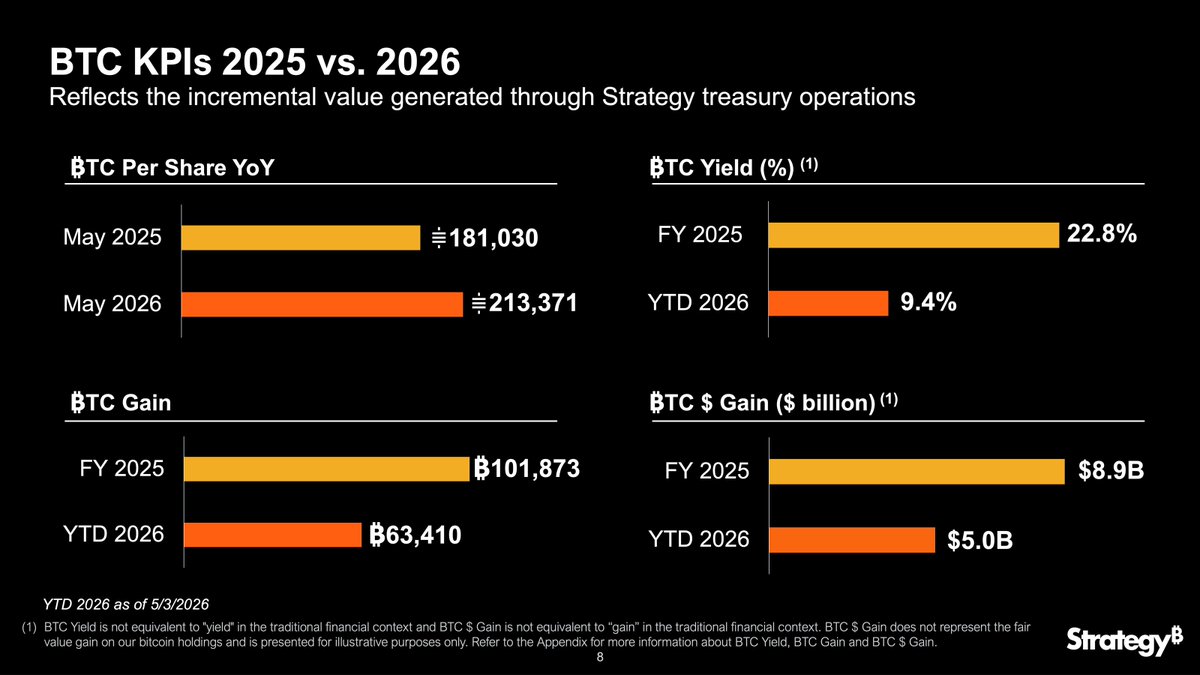
Source: @phongle on X

Le said in the interview:

I believe in math over ideology, and at the point where selling Bitcoin versus selling equity to pay a dividend is better for our Bitcoin per share, and for our common shareholders, we will do it.

Strategy’s CEO further explained that BTC sales are accretive to shareholder value when the company’s book value is below market value, or vice versa. Le also mentioned the option to sell Bitcoin to capture deferred tax gains (and losses, as in its current case).

As of press time, Strategy is the largest corporate holder of Bitcoin, with about 818,334 BTC (approximately 4% of the cryptocurrency’s supply) on its books. With more than $1.5 billion in annual dividend obligations, Le suggested that its $65 billion BTC holdings are more than enough to cover these payments.

How Could Strategy’s Sales Affect Bitcoin Price?

As expected, the idea that the largest corporate holder of Bitcoin would sell its holdings to meet obligations has not been well received. However, the Strategy CEO believes that the premier cryptocurrency is liquid enough to withstand any major sales by his firm.

In Le’s own words, selling in the open market to fund a $1.5 billion dividend payment is a drop in the ocean of Bitcoin’s daily trading volume of over $60 billion. While admitting that Strategy is a significant player in the market, Le does not believe his firm’s activity has any major influence on price (considering how liquid the market is).

As of this writing, BTC is valued at around $80,840, reflecting a 0.5% price increase in the past 24 hours.

The price of BTC on the daily timeframe | Source: BTCUSDT chart on TradingView


Related Questions

QAccording to the article, what is the primary scenario under which Strategy might sell some of its Bitcoin holdings?

AStrategy might sell some of its Bitcoin to finance the payment of the 11.5% dividend yield on its Perpetual Preferred Stock, but only if doing so increases shareholder value by raising the 'Bitcoin per share' metric.

QWhat are the two conditions mentioned by CEO Phong Le under which selling Bitcoin would be considered accretive to shareholder value?

ASelling Bitcoin would be accretive to shareholder value when the company's book value is below its market value, or conversely, when the market value is below the book value.

QHow does CEO Phong Le justify a potential shift from the company's 'Never Sell' strategy regarding Bitcoin?

APhong Le justifies the potential shift by stating 'I believe in math over ideology,' meaning that a change in philosophy might be necessary given current market conditions if selling Bitcoin benefits shareholders more than selling equity.

QWhat is the approximate size of Strategy's Bitcoin holdings, and how does it compare to the overall Bitcoin supply?

AStrategy holds about 818,334 BTC, which is approximately 4% of Bitcoin's total supply, with a value of approximately $65 billion as referenced in the article.

QHow does CEO Phong Le assess the potential market impact of Strategy selling Bitcoin to cover its dividend obligations?

ALe believes the impact would be minimal, stating that selling to fund a $1.5 billion dividend payment is a 'drop in the ocean' compared to Bitcoin's daily trading volume of over $60 billion, and he does not believe his firm's activity has a major influence on price given the market's liquidity.

Related Reads

Codex Goal Mode Usage Guide: How to Make AI Continuously Pursue a Specific Objective

"Codex Goal Mode: How to Make AI Work Continuously Toward a Specific Goal" OpenAI's Codex "goal mode" (/goal) transforms the AI from a reactive code assistant into a proactive execution agent capable of working autonomously for hours or even days to achieve a defined objective. To maximize its effectiveness, follow these key principles: 1. **Define Clear, Verifiable Exit Criteria:** The goal prompt should be a concise, measurable success condition, not a lengthy specification. Use quantifiable metrics like "reduce build time by 30%" or "achieve 100% test parity." 2. **Provide Initial Guidance and Tools:** Direct Codex toward likely problem areas and specify available tools (e.g., browsers, testing environments) to prevent it from exploring unproductive paths. 3. **Enable Progress Measurement:** Equip Codex with ways to track advancement, such as creating comparison tools for visual tasks or evaluation sets, ensuring it can gauge its own progress. 4. **Use a Realistic Execution Environment:** For tasks like performance optimization, provide access to environments that closely mimic production (e.g., similar configs, databases) to yield valid results. 5. **Be Cautious with Visual Goals:** Avoid vague "pixel-perfect" instructions. Instead, supplement visual references with functional checklists or design system specifications to prevent Codex from obsessing over minor details. 6. **Implement Progress Tracking:** For long-running tasks, have Codex commit code to draft PRs, update progress documents, or send Slack updates to maintain visibility into its work. 7. **Review and Consolidate Results:** Once the goal is met, instruct Codex to review its work, clean up ineffective experimental code, and reflect on what strategies succeeded or failed. Ultimately, using goal mode shifts the developer's role from writing prompts to managing a persistent engineering agent—defining objectives, establishing metrics, configuring environments, and conducting final reviews.

marsbit11m ago

Codex Goal Mode Usage Guide: How to Make AI Continuously Pursue a Specific Objective

marsbit11m ago

From Ethereum to AI's 'CROPS': What Exactly Is This 'Slow Variable' That Vitalik Has Repeatedly Emphasized?

Recently, Vitalik Buterin has frequently emphasized the concept of "CROPS," first outlined in the Ethereum Foundation's March mandate as core principles guiding its focus: Censorship Resistance, Capture Resistance, Open Source, Privacy, and Security. CROPS represents Ethereum's commitment to providing foundational capabilities for user sovereignty—enabling asset ownership, identity expression, and coordination without reliance on centralized platforms or surrendering ultimate control. This framework is gaining new urgency with the rise of AI, particularly AI agents managing digital assets and automating transactions. While AI offers convenience, it risks centralizing user data, intent, and control if dependent on opaque, centralized services. Vitalik argues for "CROPS AI"—AI that is open, privacy-preserving, secure, and capable of local execution to maintain user agency. He highlights convergence between "CROPS Ethereum access layers" and "CROPS AI," such as using zero-knowledge proofs for private remote LLM calls and Ethereum RPC reads, ensuring users can access services without exposing sensitive information. Ultimately, CROPS is not just an abstract ideal but a practical guide for Ethereum's development and AI integration. It addresses the critical long-term question: as digital systems grow more powerful, how can users retain control over their privacy, assets, and autonomy? In an AI-driven era, these principles may define Ethereum's enduring value—prioritizing verifiable, secure, and user-centric design over short-term optimizations like speed and cost alone.

marsbit16m ago

From Ethereum to AI's 'CROPS': What Exactly Is This 'Slow Variable' That Vitalik Has Repeatedly Emphasized?

marsbit16m ago

Trading

Spot
Futures
活动图片