Strait Of Hormuz Crisis Deepens After Trump Deadline – Crypto Markets Brace For Volatility

bitcoinistPublished on 2026-03-23Last updated on 2026-03-23

Abstract

The Strait of Hormuz crisis has escalated dramatically following a 48-hour ultimatum from former US President Donald Trump, threatening to destroy Iranian power plants if free passage is not restored. Iranian forces have blockaded the strait since March 4, attacking ships and reducing tanker transits by over 90%, which has sent Brent crude soaring past $100 per barrel. The disruption is causing severe global energy shock, with potential shortages in key commodities and rising prices. Despite the oil market volatility and shifting interest rate expectations, Bitcoin has shown relative stability, consolidating between $67,000 and $71,000 as speculative leverage cools.

One ship paid $2 million just to pass through the Strait of Hormuz. That single data point tells you everything about the state of the world’s most critical oil corridor right now.

Ships Sit Idle As Clock Runs Out

US President Donald Trump issued a 48-hour ultimatum Saturday, threatening to destroy Iranian power plants if free passage through the Strait of Hormuz is not restored by Monday night.

The warning — posted on Truth Social — came as maritime data showed tanker transits through the strait have collapsed by more than 90%. Hundreds of vessels sit idle on both sides of the waterway, pushing Brent crude above $100 per barrel for the first time since 2022.

Iran declared the Strait of Hormuz closed on March 4, three days after the US and Israel launched joint air strikes on Iranian military targets on February 28.

Since then, Iranian forces have attacked at least 10 ships attempting to transit the corridor, killing five crew members aboard two vessels.

Tehran has made clear it is not backing down. Iranian officials warn they will target regional energy facilities if their own oil infrastructure comes under direct attack.
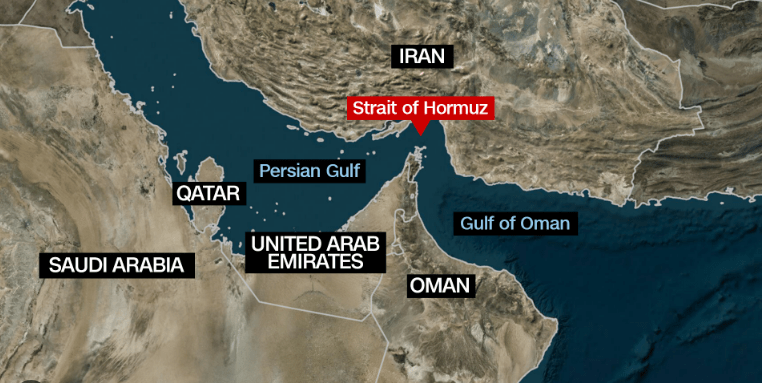
The Strait of Hormuz. Image: CNN

The US military has tried to punch holes in Iran’s ability to threaten shipping. Admiral Brad Cooper, head of US Central Command, said American fighter jets bombed an underground Iranian coastal facility storing anti-ship cruise missiles earlier this week, claiming it had “degraded” Iran’s attack capacity. Iran’s response to Trump’s latest ultimatum: threats of broader retaliation.

Energy Shock Ripples Across Global Markets

The scale of this disruption has no modern equivalent. The International Energy Agency called it “the greatest global energy and food security challenge in history.”

Brent crude hit $126 per barrel at its peak — the closure has been described as the largest energy supply disruption since the 1970s oil crisis.

BTCUSD now trading at $68,687. Chart: TradingView

The economic pain extends well beyond the pump. Moody’s supply chain lead Andrei Quinn-Barabanov warned that for many commodities moving through the strait, inventories typically cover only a few weeks, meaning shortages could surface quickly if disruptions drag on.

Roughly 85% of Middle East polyethylene exports move through the Strait of Hormuz, meaning packaging, auto parts, and consumer goods are all facing higher costs. Aluminum, fertilizer, and helium prices have also climbed.

Bitcoin Holds Ground As Crypto Watches Oil

Digital asset markets are not sitting this one out. US strikes on Iran and the blockade of the Strait of Hormuz have hit the global oil market, pushing volatility to its highest levels since 2020 and forcing markets to revise expectations on the timing of interest rate cuts — a shift that directly affects crypto valuations.

Yet Bitcoin has shown a degree of staying power that surprised some traders. Even as oil prices swung violently and Goldman Sachs warned of potential $150 per barrel prices, Bitcoin consolidated between $67,000 and $71,000, with falling open interest suggesting a cooling of speculative leverage.

Featured image from Navy Lookout, chart from TradingView

Trending Cryptos

Related Questions

QWhat was the specific ultimatum issued by former US President Donald Trump regarding the Strait of Hormuz?

AUS President Donald Trump issued a 48-hour ultimatum on Saturday, threatening to destroy Iranian power plants if free passage through the Strait of Hormuz was not restored by Monday night.

QHow has the closure of the Strait of Hormuz impacted global oil prices and tanker transits?

AThe closure caused tanker transits through the strait to collapse by more than 90%, pushing Brent crude above $100 per barrel for the first time since 2022, with a peak of $126 per barrel.

QBeyond oil, what other global commodities and industries are being affected by the Strait of Hormuz crisis?

ARoughly 85% of Middle East polyethylene exports move through the strait, impacting packaging, auto parts, and consumer goods. Prices for aluminum, fertilizer, and helium have also climbed due to the disruption.

QHow has the Bitcoin market reacted to the increased volatility and energy shock caused by the crisis?

ABitcoin showed a degree of stability, consolidating between $67,000 and $71,000 despite the oil price swings. Falling open interest suggested a cooling of speculative leverage in the market.

QWhat military action did the US take in response to Iran's threat to shipping, and what was Iran's stated retaliation?

AThe US military bombed an underground Iranian coastal facility storing anti-ship cruise missiles, claiming it degraded Iran's attack ability. Iran responded to Trump's ultimatum with threats of broader retaliation.

Related Reads

Wall Street Morning News: V-shaped Rebound at Month-end, but Nasdaq Suffers Worst July in 12 Years; Funds Accelerate Concentration Towards Cloud Giants

Despite a V-shaped rebound at the end of July, the Nasdaq posted its worst July since 2004, while the S&P 500 had its worst July since 2014. Markets were jolted by geopolitical shifts, as President Trump canceled a planned strike on Iran, leading WTI crude to plunge over 8%. This, alongside OPEC+ announcing a supply increase, reversed crude's sharp July gains. Treasury yields surged, with the 10-year yield rising over 30 basis points in July—its largest July increase since 2005. In a rare move, the US and Japan jointly intervened to weaken the USD/JPY, aiming to prevent potential Japanese sales of US Treasuries. While the tech sector faced deleveraging pressure throughout July, cloud giants staged a massive rally on strong earnings. Microsoft, Amazon, and Google collectively added nearly $1.5 trillion in market value last week. Amazon soared over 15% on accelerating AWS growth, Microsoft extended historic gains, Google fully recovered post-earnings losses, and Meta ended an 11-day losing streak. In contrast, Apple tumbled over 7% on supply chain and guidance concerns, ceding its "world's most valuable company" title to Nvidia. The memory and storage sector corrected sharply. Gold edged up 0.91% in July, with analysts viewing the ~30% pullback from January highs as a potential basing period, supported by long-term central bank demand. Key events to watch this week include earnings from Palantir, AMD, SpaceX (its first post-IPO report), and memory giants like Western Digital. The US July non-farm payrolls report on Friday will be critical for gauging the Fed's policy path. SpaceX also faces a significant lock-up expiration, testing market liquidity.

marsbit49m ago

Wall Street Morning News: V-shaped Rebound at Month-end, but Nasdaq Suffers Worst July in 12 Years; Funds Accelerate Concentration Towards Cloud Giants

marsbit49m ago

Rubin Ultra Makes Major Cuts, Even Nvidia Can't Handle Memory Price Hikes?

NVIDIA's Rubin Ultra, the top-tier variant of the newly announced Rubin AI accelerators, has reportedly seen significant specification downgrades, according to an industry report from SemiAnalysis. Initially designed with four compute dies (4-die), the Rubin Ultra is now said to be reduced to a 2-die design. Key changes highlighted in the report include: * **No increase in peak theoretical compute performance**, remaining at 35 PFLOPs like the standard Rubin. * **Severe reduction in memory capacity** to 192GB using 8-Hi HBM stacks, which is less than the standard Rubin's 288GB using 12-Hi stacks. * **Negligible memory bandwidth improvement** of only 1 TB/s. * **Slightly higher chip-level power consumption**. * The **primary upgrade is a massive increase in scale-up interconnect capacity**, supporting connections for up to 576 GPUs via NVLink, compared to 72 for the standard Rubin. The report suggests the redesign is primarily a cost-optimization move driven by the sharp rise in HBM (High-Bandwidth Memory) prices. By reducing the expensive HBM content and shifting investment towards enhanced system-scale networking, NVIDIA aims to maintain the platform's value for large-scale AI training clusters while managing soaring material costs. The news reportedly triggered a sell-off in South Korean memory stocks, with SK Hynix and Samsung shares falling around 8%, as markets grew concerned that NVIDIA—a major HBM buyer—might be reducing its reliance on high-capacity memory, potentially capping future pricing power for memory makers.

Odaily星球日报1h ago

Rubin Ultra Makes Major Cuts, Even Nvidia Can't Handle Memory Price Hikes?

Odaily星球日报1h ago

Trading

Spot

Hot Articles

How to Buy ONE

Welcome to HTX.com! We've made purchasing Harmony (ONE) simple and convenient. Follow our step-by-step guide to embark on your crypto journey.Step 1: Create Your HTX AccountUse your email or phone number to sign up for a free account on HTX. Experience a hassle-free registration journey and unlock all features.Get My AccountStep 2: Go to Buy Crypto and Choose Your Payment MethodCredit/Debit Card: Use your Visa or Mastercard to buy Harmony (ONE) instantly.Balance: Use funds from your HTX account balance to trade seamlessly.Third Parties: We've added popular payment methods such as Google Pay and Apple Pay to enhance convenience.P2P: Trade directly with other users on HTX.Over-the-Counter (OTC): We offer tailor-made services and competitive exchange rates for traders.Step 3: Store Your Harmony (ONE)After purchasing your Harmony (ONE), store it in your HTX account. Alternatively, you can send it elsewhere via blockchain transfer or use it to trade other cryptocurrencies.Step 4: Trade Harmony (ONE)Easily trade Harmony (ONE) on HTX's spot market. Simply access your account, select your trading pair, execute your trades, and monitor in real-time. We offer a user-friendly experience for both beginners and seasoned traders.

4.7k Total ViewsPublished 2024.03.29Updated 2026.06.02

How to Buy ONE

Discussions

Welcome to the HTX Community. Here, you can stay informed about the latest platform developments and gain access to professional market insights. Users' opinions on the price of ONE (ONE) are presented below.

活动图片