Stablecoin demand goes mainstream! Issuers rake in $5B on Ethereum

ambcryptoPublished on 2026-01-11Last updated on 2026-01-11

Abstract

Stablecoin demand is going mainstream as they become a preferred method for everyday spending, with payment card usage surging 400% year-over-year. Industry leaders highlight the efficiency of blockchain-powered payments, enabling users to transact in dollars anytime, anywhere. Despite stagnant crypto prices, ERC-20 stablecoin active addresses and total supply are near record highs, driven by adoption in underbanked and high-inflation regions for cross-border transfers and business payments. In 2025 alone, stablecoin issuers generated approximately $5 billion in revenue from Ethereum deployments, benefiting from increased user activity. However, upcoming U.S. regulatory decisions on stablecoin yield rules could impact future growth and reward structures.

Stablecoins are now a preferred way for people to actually spend money!

As payment cards powered by stablecoins catch steam, the idea of using crypto for everyday transactions is the realest it’s ever been. Will the pace turn into a faster sprint in the year ahead?

In real wallets

Industry leaders are increasingly pushing for stablecoin-powered cards as the next big thing this year.

Case in point, Dragonfly managing partner Haseeb Qureshi recently posted on X that this is because they bring blockchain efficiency to traditional payments.

He said,

“All they know is that all of a sudden, they can pay people and buy stuff in dollars, any time, anywhere, and it all “just works.”

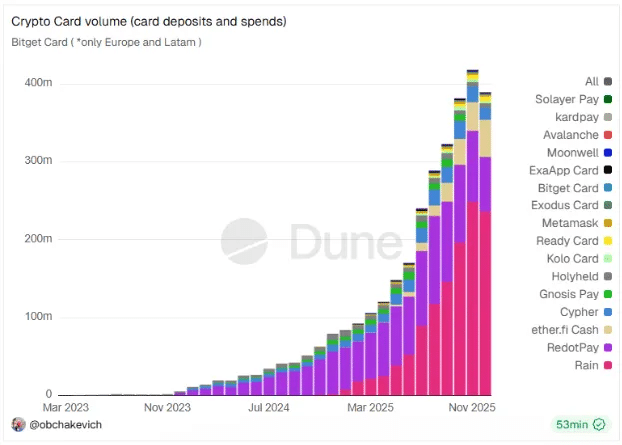
Startups like Rain are scaling at higher speeds, with card usage and payment volumes rising by 400% overall in the past year.

Source: X

By supporting dollar-pegged stablecoins across major blockchains, these platforms allow users to spend at their convenience. This supports industry growth as a whole.

Usage grows even if the market isn’t

Source: CryptoQuant

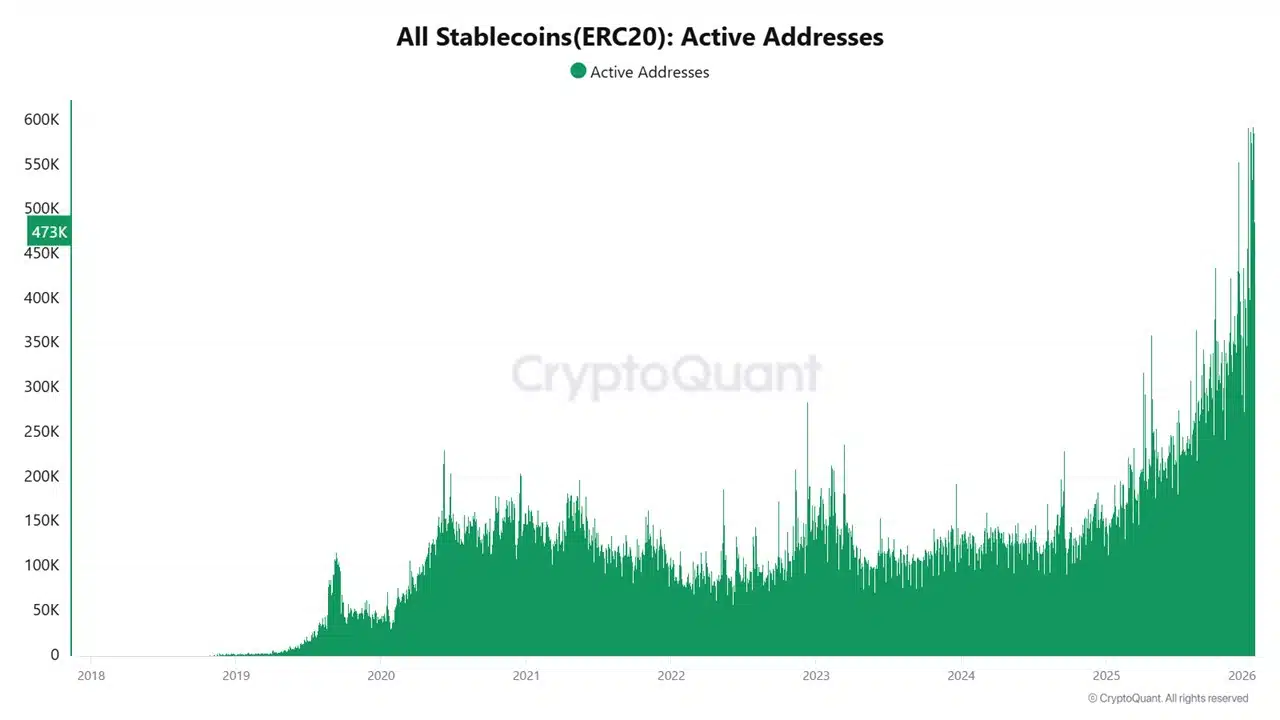
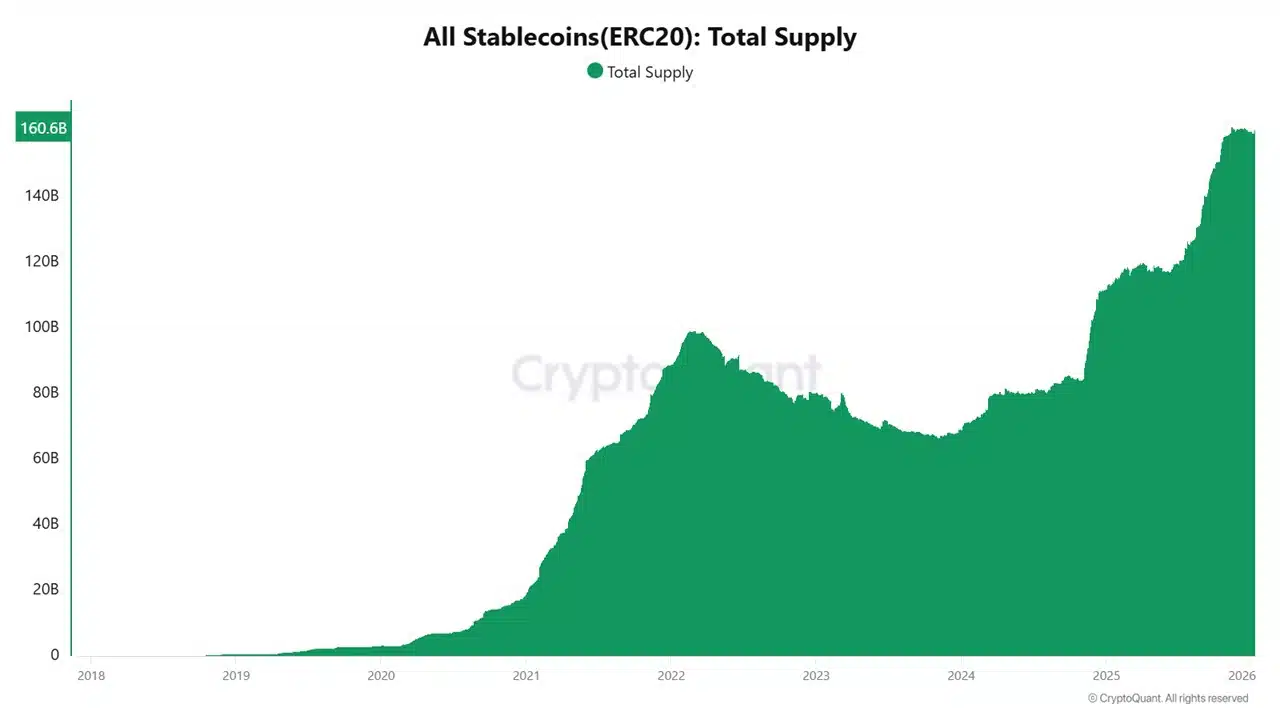
Even while crypto prices are stuck in a range,  ERC20 stablecoin active addresses are at near record highs! This comes along with a steadily rising total supply.

Source: CryptoQuant

The consistency is stunning—even during pullbacks, neither usage nor supply dropped in any way that matters.

Growth is reportedly strongest in underbanked and high-inflation regions; these are areas where stablecoins power cross-border transfers and business payments.

It’s paying off… literally

In the midst of all these ever-growing numbers, issuers are generating serious revenue by building on Ethereum [ETH].

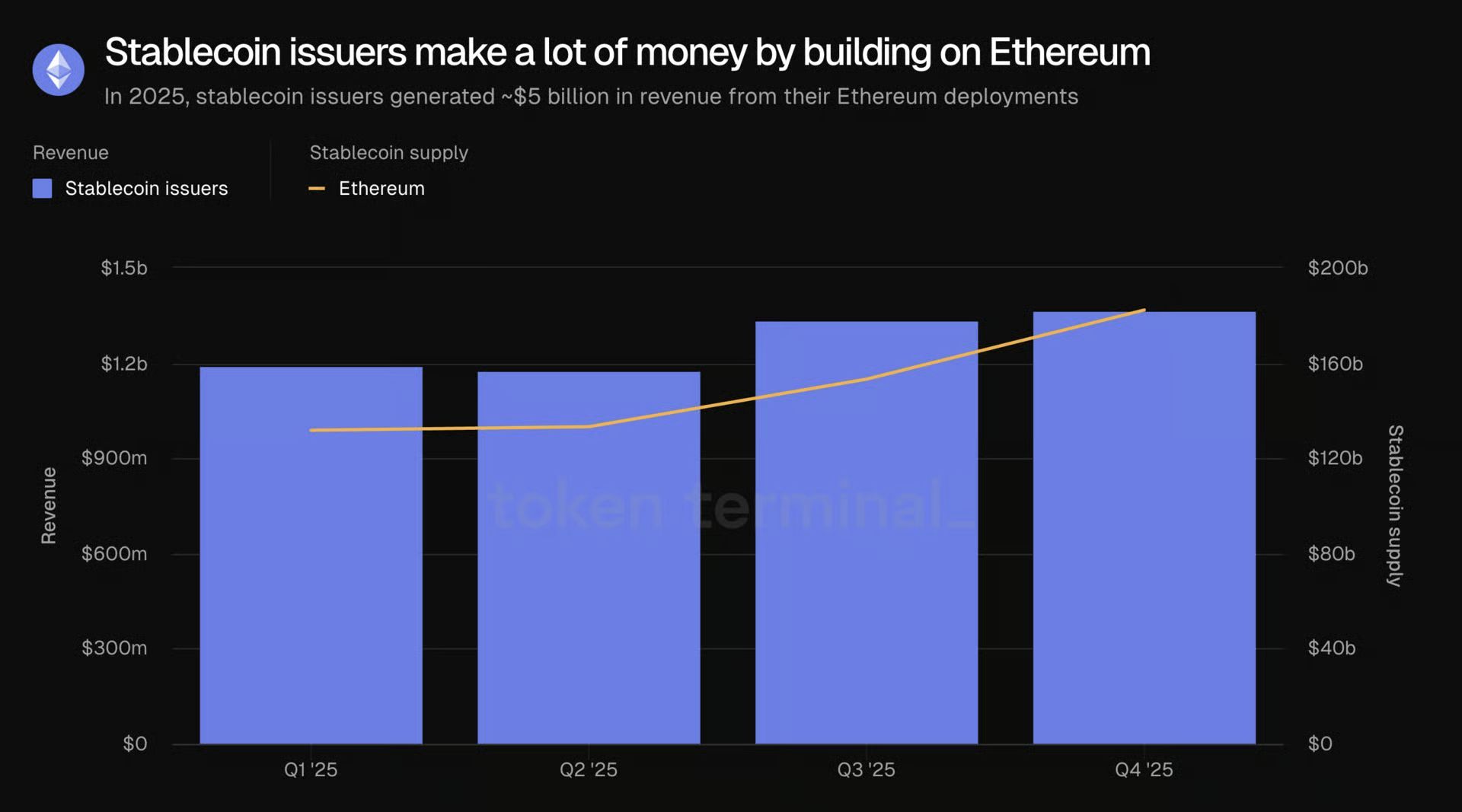
In 2025 alone, stablecoin issuers pulled in roughly $5 billion from their Ethereum deployments. Revenue went up along with stablecoin supply throughout the year!

Source: X

Users continue to transact on Ethereum, issuers go where the users are, and revenue follows activity. It’s a clean feedback loop, and it works for all those who are involved.

AMBCrypto previously reported that U.S. lawmakers are debating potential changes to stablecoin yield rules as part of bipartisan negotiations. This is on a crypto market structure bill scheduled for markup on the 15th of January.

While discussions are ongoing, the outcome could influence how stablecoin issuers structure rewards and payments going forward.


Final Thoughts

  • Stablecoin payments are going mainstream, with card usage jumping 400% YoY.
  • As issuers generate $5 billion on Ethereum, upcoming policy decisions could alter the current pace.
Next: Bitcoin compresses between $90K and $94K – A big move is brewing
Share
  • Share
  • Tweet

Related Questions

QWhat is the main reason stablecoin-powered cards are gaining popularity according to industry leaders?

AIndustry leaders like Dragonfly's Haseeb Qureshi believe stablecoin-powered cards are gaining popularity because they bring blockchain efficiency to traditional payments, allowing users to pay people and buy stuff in dollars anytime, anywhere, and it 'just works'.

QHow much did card usage and payment volumes grow for startups in the past year?

AStartups like Rain saw card usage and payment volumes rise by 400% overall in the past year.

QHow much revenue did stablecoin issuers generate from their Ethereum deployments in 2025?

AStablecoin issuers generated roughly $5 billion from their Ethereum deployments in 2025.

QWhat trend is observed in ERC20 stablecoin active addresses despite crypto price stagnation?

AERC20 stablecoin active addresses are at near record highs even while crypto prices are stuck in a range, with a steadily rising total supply.

QWhich regions are experiencing the strongest growth in stablecoin usage and why?

AGrowth is strongest in underbanked and high-inflation regions, where stablecoins power cross-border transfers and business payments.

Related Reads

Huang Renxun Dramatically 'Saves' South Korean Stock Market

In early June, South Korea's stock market experienced a sharp decline, with the KOSPI index dropping over 5% and triggering a trading halt. Amid this volatility, NVIDIA CEO Jensen Huang's visit to Seoul provided a dramatic boost to market sentiment. During his trip, Huang held a dinner meeting with SK Group Chairman Chey Tae-won and SK Hynix CEO Kwak Noh-Jung. He announced that NVIDIA's new Vera CPU would utilize SK Hynix DRAM and confirmed a multi-year technical collaboration between the two companies. This partnership aims to co-develop next-generation memory for NVIDIA's AI infrastructure roadmap, covering products from data center supercomputers to personal AI devices. Huang also publicly commented that AI company stocks were attractively priced. A key announcement was that NVIDIA's upcoming Vera Rubin AI supercomputer systems will use HBM4 memory, with supply qualifications granted to all three major suppliers: SK Hynix, Samsung Electronics, and Micron Technology. Despite this multi-sourcing strategy, Huang warned that the industry-wide chip shortage, affecting everything from wafers to packaging, is expected to persist for several years due to relentless demand from global AI factory construction. The collaboration extends beyond memory supply. SK Hynix will employ NVIDIA's AI platforms and Omniverse digital twin technology to enhance its own semiconductor design, simulation, and manufacturing processes, aiming for more autonomous factory operations. This visit builds upon a prior October 2025 agreement for SK Group to build a large-scale AI data center using over 50,000 NVIDIA GPUs. Huang's itinerary also included meetings with other Korean giants like Hyundai, LG, and Samsung, indicating NVIDIA's broader strategy to deepen ties with South Korea's tech industry.

链捕手4h ago

Huang Renxun Dramatically 'Saves' South Korean Stock Market

链捕手4h ago

When Inference Becomes a Scarce Resource, Who Captures the Value?

When Inference Becomes the Scarce Resource, Who Captures the Value? The core AI bottleneck has shifted from model training to inference (runtime execution). While concerns persisted about an "AI compute gap"—initially a $200B, now a $600B problem—the market is now recognizing that the solution and value lie in the inference layer. Nvidia's financial restructuring around "serving tokens" and Cerebras's successful IPO highlight this shift. Inference is a recurring, usage-based cost, estimated to be 10-50x larger than the one-time training market, especially with the rise of agentic AI. The inference stack spans six layers: silicon (e.g., Nvidia), bare metal (e.g., CoreWeave), GPU rental/aggregation, deployment/optimization, model APIs, and end applications. Most companies operate in one layer. However, Hyperbolic uniquely spans three layers (GPU rental, deployment, and model APIs) without owning any hardware. It aggregates fragmented GPU supply from multiple cloud providers into a standardized pool, offering developers the cheapest available compute through intelligent routing. Its multi-cloud aggregation creates a data moat and a flywheel: more supply leads to better pricing data and liquidity, attracting more developers and providers. In contrast, applications like Venice operate at the top of the stack, reselling privacy-wrapped inference but remaining dependent on and constrained by the underlying compute costs they purchase. As inference demand explodes, value accrues not just to consumer applications but increasingly to the aggregation and routing layer that captures their cost of revenue. The coming potential GPU oversupply reinforces this dynamic. While hardware owners may suffer from depreciation, asset-light aggregators like Hyperbolic benefit from price arbitrage, routing workloads to the cheapest available capacity. The ultimate winner in the inference economy may not be the entity with the most GPUs, but the one that can most efficiently discover, aggregate, and route the world's fragmented compute.

链捕手4h ago

When Inference Becomes a Scarce Resource, Who Captures the Value?

链捕手4h ago

Trading

Spot
Futures

Hot Articles

Discussions

Welcome to the HTX Community. Here, you can stay informed about the latest platform developments and gain access to professional market insights. Users' opinions on the price of ETH (ETH) are presented below.

活动图片















